Mohammad bin Salman bin Abdulaziz Al Saud (Arabic: محمد بن سلمان بن عبدالعزيز آل سعودMuhammad bin Salmān bin ‘Abd al-‘Azīz Āl Sa‘ūd; born 31 August 1985 [2][3][4]), known colloquially as MbS,[2][5][6] is the Crown Prince of Saudi Arabia. He is serving as the country'sDeputy Prime Minister[7] (the title of Prime Minister being held by the king) and is also President of the Council for Economic and Development Affairs and Minister of Defense – the world's youngest at the time of his appointment.[8] He has been described as thepower behind the throne of his father, King Salman, who suffers from Alzheimer's disease.[9] He was appointed Crown Prince[10]in June 2017 following King Salman’s decision to remove Muhammad bin Nayef from all positions, making Mohammad bin Salman heir apparent to the throne.[11][12][13]
He has led several successful reforms, which include regulations restricting the powers of the religious police, [14] and the removal of theban on female drivers.[15] Further cultural developments under his reign include the first Saudi public concerts by a female singer, the first Saudi sports stadium to admit women,[16]and an increased presence of women in the workforce.[17] His Vision 2030 program aims to diversify the Saudi economy through investment in non-oil sectors including technology and tourism. In 2016 he announced plans to list the shares of the state oil company Saudi Aramco.[18]
Despite international praise for his strides towards the social and economic liberalisation of Saudi Arabia, commentators and human rights groups have been vocally critical of Mohammad bin Salman's leadership and the shortfalls of his reform program, citing a rising number of detentions of human rights activists, his intervention in Yemen, the escalation of theQatar diplomatic crisis[19], the start of theLebanon–Saudi Arabia dispute, and the arrest of members of the Saudi royal family in November 2017.[20][21][22] NGOs includingAmnesty International and Human Rights Watch continue to criticize the Saudi government for its violations of human rights.[23][24][25]
Early life and education[edit]
Mohammed bin Salman Al Saud was born on 31 August 1985.[3][4][26] He is the son of King Salman from his third spouse,[27] Fahda bint Falah bin Sultan bin Hathleen.[1] She is the granddaughter of Rakan bin Hithalayn, who was the head of the Al Ajman tribe.[28]
Prince Mohammed bin Salman is the eldest among his mother's children;[27] his full siblings include Turki bin Salman, former chairman of the Saudi Research and Marketing Group, and Khalid bin Salman.[29]  rince Mohammed holds a bachelor's degree in law from King Saud University.[30]
After graduating from college, Mohammed bin Salman spent several years in the private sector before becoming personal aide to his father. He worked as a consultant for the Experts Commission, working for the Saudi Cabinet.[31]
On 15 December 2009, at the age of 24, Mohammed bin Salman entered politics as a special advisor to his father when the latter was the governor of Riyadh Province.[32] At this time, Mohammed bin Salman began to rise from one position to another such as secretary-general of the Riyadh Competitive Council, special advisor to the chairman of the board for the King Abdulaziz Foundation for Research and Archives, and a member of the board of trustees for Albir Society in the Riyadh region.[33]
In October 2011, Crown Prince Sultan bin Abdulaziz died, and the current King Salman began his ascent to power by becoming second deputy prime minister and defense minister in November 2011 and making Mohammed bin Salman his private advisor.[34]
Chief of the Court[edit]
In June 2012, Crown Prince Nayef bin Abdulaziz Al Saud died and Prince Muhammad bin Salman moved up into the number two position in the hierarchy, as his father became the new crown prince and first deputy prime minister. He soon began remaking the court in his own image. On 2 March 2013, the chief of the Crown Prince court Prince Saud bin Nayefwas appointed governor of the Eastern Province and Prince Mohammed bin Salman succeeded him in the post. He was also given the rank of minister.[35][36][37] On 25 April 2014 Prince Mohammed was appointed state minister.[33]
Defense Minister and Deputy Crown Prince[edit]

President
Donald Trumpspeaks with Prince bin Salman, Washington, D.C., 14 March 2017

U.S. Defense Secretary
James Mattis with Prince Mohammad, 22 March 2018
On 23 January 2015, King Abdullah died, Salman took the throne and Prince Mohammed bin Salman was appointed Minister of Defense.[38] He was also named as the Secretary General of the Royal Court on the same date.[39]In addition he retained his post as the Minister of the State.[40][41]
In Yemen, the political unrest (which began escalating in 2011) rapidly became a major issue for the newly appointed Minister of Defense, with rebel Houthis taking control of northern Yemen in late 2014, followed by President Abdrabbuh Mansur Hadi and his cabinet’s resignation. Mohammed bin Salman’s first move as minister was to mobilize a pan-GCC coalition to intervene following a series of suicide bombings in Sanaa via air strikes against Houthis, and impose a naval blockade.[42] In March 2015, Saudi Arabia began leading a coalition of countries allied against the Houthi rebels.[43] While there was agreement among those Saudi princes heading security services regarding the necessity of a response to the Houthis' seizure of Sana'a, which had forced the Yemeni government into exile, Prince Mohammad launched the intervention without full coordination across security services. Saudi National Guard Minister Prince Mutaib bin Abdullah, who was out of the country, was left out of the loop of operations.[14] While Prince Mohammed bin Salman sold the war as a quick win on Houthi rebels in Yemen and a way to put President Hadi back in power, however, it became a long war of attrition.[44][45]
In April 2015, Muhammad bin Nayef, who is King Salman's nephew,[46][47] and Prince Mohammed bin Salman became Crown Prince and Deputy Crown Prince, respectively, under King Salman’s royal decrees.[48]
In late 2015, Prince Mohammed attended a meeting between King Salman and U.S. President Barack Obama, where the prince broke protocol to deliver a monologue criticizingU.S. foreign policy.[14] When Prince bin Salman announced an anti-terrorist military alliance of Islamic countries in December 2015, some of the countries involved said they had not been consulted.[14]
Regarding his role in the military intervention, Prince Mohammed bin Salman gave his first on-the-record interview on 4 January 2016 to The Economist, which had called him the "architect of the war in Yemen". Denying the title, he explained the mechanism of the decision-making institutions actually holding stakes in the intervention, including the council of security and political affairs, Ministry of Foreign Affairs from the Saudi side. He added that the Houthis usurped power in the Yemeni capital Sana’a before he served as Minister of Defense.[44][49][50]
In response to the threat from ISIL, In December 2015 Prince Mohammad established the Islamic Military Counter Terrorism Coalition (IMCTC), a Saudi-led Islamic alliance against terrorism.[51] The IMCTC's first meeting took place in Riyadh in November 2017 and involved defense ministers and officials from 41 countries.[52]
Crown Prince[edit]
Mohammed bin Salman was appointed Crown Prince on 21 June 2017, following his father's decision to depose Muhammad bin Nayef, making him heir apparent to the throne.[53] The change of succession had been predicted in December 2015 by an unusually blunt and public memo published by the German Federal Intelligence Service,[54][55] which was subsequently rebuked by the German government.[56]
On the day he became Crown Prince, U.S. President Donald Trump called Mohammed bin Salman to "congratulate him on his recent elevation". Trump and the new crown prince pledged "close cooperation" on security and economic issues, according to the White House, and the two leaders also discussed the need to cut off support for terrorism, the recent diplomatic dispute with Qatar, and the push to secure peace between Israel and the Palestinians.[57] Mohammed bin Salman told the Washington Post in April 2017 that without America's cultural influence on Saudi Arabia, "we would have ended up like North Korea."[58]
Political, economic, and social changes[edit]
Prince Mohammed's ideology has been described as nationalist[59][60] and populist,[61][62]with a conservative attitude towards politics, and a liberal stance on economic and social issues.[63][64] It has been heavily influenced by the views of Abu Dhabi Crown PrinceMohammed bin Zayed.[65][66]
On 29 January 2015, Prince Mohammed was named the chair of the newly establishedCouncil for Economic and Development Affairs,[67] replacing the disbanded Supreme Economic Commission.[67] In April 2015, Prince Mohammed bin Salman was given control over Saudi Aramco by royal decree following his appointment as deputy crown prince.[68]
In 2018 he voiced his support for a Jewish homeland. Saudi Arabia does not recognizeIsrael.[69] This is the first time that a senior Saudi royal has expressed such sentiments publicly.[70][71][72]
Vision 2030[edit]
Prince Mohammed bin Salman took the leadership in the restructuring of Saudi Arabia's economy, which he officially announced in April 2016 when he introduced Vision 2030, the country's strategic orientation for the next 15 years. Vision 2030 plans to reform Saudi's economy towards a more diversified and privatized structure. It details goals and measures in various fields, from developing non-oil revenues and privatization of the economy to e-government and sustainable development.[73]
At the inaugural Future Investment Initiative conference in Riyadh in October 2017, bin Salman announced plans for the creation of Neom, a $500 billion economic zone to cover an area of 26,000 square kilometres on Saudi Arabia’s Red Sea coast, extending intoJordan and Egypt.[74] Neom aims to attract investment in sectors including renewable energy, biotechnology, robotics and advanced manufacturing.[75][76] The announcement followed plans to develop a 34,000 square kilometre area across a lagoon of 50 islands on Saudi Arabia’s Red Sea coastline into a luxury tourism destination with laws on a par with international standards.[77][78] In a further effort to boost the tourism industry, in November 2017 it was announced that Saudi Arabia would start issuing tourist visas for foreigners, beginning in 2018.[79]
Prince Mohammed bin Salman's biggest bet was his plan to restore the Saudi kingdom'sdominance in global oil markets by driving the new competition into bankruptcy, by keeping the oil price low enough for a long enough period. Saudi Arabia persuaded OPEC to do the same. A few small players went bankrupt, but American frackers only shut down their less-profitable operations temporarily, and waited for oil prices to go up again. Saudi Arabia, which had been spending $100 billion a year to keep services and subsidies going, had to admit defeat in November 2016. It then cut production significantly and asked its OPEC partners to do the same.[44]
In the last week of September 2018, Mohammed bin Salman inaugurated the much-awaited $6.7bn high-speed railway line connecting Mecca and Medina, two holiest cities of Islam. The Haramain Express is 450km line travelling up to 300km/h that can transport around 60 million passengers annually. The commercial operations of the railway will begin from 1 October 2018.[80]
Domestic reforms[edit]
Mohammed bin Salman significantly restricted the powers of the religious police.[14] He established an entertainment authority that started hosting comedy shows, professional wrestling events, and monster truck rallies.[14] In an interview with al Arabiya he shared his idea for "Green cards" for non-Saudi foreigners.[81]
In February 2017, Saudi Arabia appointed its first woman to head the Saudi Stock Exchange.[82][83]
In April 2017, bin Salman announced a project to build one of the world's largest cultural, sports and entertainment cities in Al Qidiya, southwest of Riyadh. The plans for a 334-square kilometre city include a safari and a Six Flags theme park.[84][85]

Portraits of King Salman and Prince Mohammed in
JenadriyahIn February 2018, it became legally possible for Saudi women to open their own business without a male's permission.[86]
According to the Saudi Information Ministry, as of March 2018, mothers in Saudi Arabia became authorised to retain immediate custody of their children after divorce without having to file any lawsuits.[87]
Further cultural developments followed in December 2017 with Saudi Arabia’s first public concert by a female singer, and in January 2018 a sports stadium in Jeddah became the first in the Kingdom to admit women.[16][88] In April 2018 the first public cinema opened in Saudi Arabia after a ban of 35 years, with plans to have more than 2,000 screens running by 2030.[89][90]
The first measures undertaken in April 2016 included new taxes and cuts in subsidies, a diversification plan, the creation of a $2 trillion Saudi sovereign wealth fund, and a series of strategic economic reforms called the National Transformation Programme.[91] Bin Salman's plans to raise capital for the sovereign wealth fund included selling off shares ofSaudi Aramco, the state-owned petroleum and natural gas company,[68] with the capital to be re-invested in other sectors such as to implement the diversification plans.[92] In October 2017, the plan for Aramco's IPO listing was criticised by The Economist, which called it "a mess".[93]
Mohammed bin Salman slashed the state budget, freezing government contracts and reducing the pay of civil employees as part of drastic austerity measures.[94][44]
In September 2017, bin Salman implemented the women to drive movement's multi-decade demand to lift the ban on female drivers.[15] He legislated against some elements of Saudi Arabia's Wali system, also a topic of a many decade long campaign by women's rights activists.[95]
In October 2017, he said that the ultra-conservative Saudi state had been "not normal" for the past 30 years, blaming rigid doctrines that had governed society in a reaction to theIranian Revolution, which successive leaders "didn't know how to deal with".[96] According to him, he aimed to have Saudi Arabia start "returning to what we were before—a country of moderate Islam that is open to all religions and to the world".[97] He was telling the country's clerics that the deal the royal family struck with them after the 1979 siege of the Grand Mosque in Mecca was to be renegotiated.[98] Building an industrial culture was not compatible with Wahhabism. The Wahhabis were committed to fixed social and gender relationships. These were consistent with an economy built on oil sales, but industrialization requires a dynamic culture with social relations constantly shifting.[99]
According to Politico, as of 2017, Mohammed bin Salman wished to pre-empt a repetition of the downfall of the earlier Saudi states due to familial infighting, internal malaise, external frailty and failure to modernize. Mindful of this history, instead of waiting for today's Saudi state to weaken and fall, MBS's aim was to try to save the country before it collapsed.[100]
Ayaan Hirsi Ali claimed that if bin Salman "succeeds in his modernization efforts, Saudis will benefit from new opportunities and freedoms, and the world will benefit from curtailing the Wahhabi radicalization agenda. A decade from now, the kingdom could look more like the United Arab Emirates, its prosperous and relatively forward-looking neighbor."[101]
2017 purge[edit]
In May 2017, Mohammed bin Salman publicly warned "I confirm to you, no one will survive in a corruption case—whoever he is, even if he's a prince or a minister".[102] On 4 November 2017, the Saudi press announced the arrest of the Saudi prince and billionaireAl-Waleed bin Talal, a frequent English-language news commentator and a major shareholder in Citi, News Corp and Twitter, as well as over 40 princes and government ministers at the behest of the Crown Prince on corruption and money laundering charges.[103]
Others arrested or fired in the purge included Mutaib bin Abdullah, head of the Saudi Arabian National Guard, Adel Fakeih, the Minister of Economy and Planning, and the Commander of the Saudi Naval Forces, Admiral Abdullah bin Sultan bin Mohammed Al-Sultan.[103][104]
One hypothesis for the arrests was that they were part of a power grab on the part of Salman. The New York Times wrote:
| “ | The sweeping campaign of arrests appears to be the latest move to consolidate the power of Crown Prince Mohammed bin Salman, the favorite son and top adviser of King Salman. The king had decreed the creation of a powerful new anticorruption committee, headed by the crown prince, only hours before the committee ordered the arrests.[104] | ” |
Writing for the Huffington Post, University of Delaware professor of Islam and Global Affairs, Muqtedar Khan, speculated as to whether the removal of Talal, a critic of Donald Trump, amounted to a coup.[105] BBC correspondent Frank Gardner was quoted as saying that "Prince Mohammed is moving to consolidate his growing power while spearheading a reform programme". Yet "[i]t is not clear what those detained are suspected of."[106]
Another hypothesis was that the purge was part of a move towards reform. Steven Mufson of the Washington Post argues that Crown Prince Mohammed "knows that only if he can place the royal family under the law, and not above as it was in the past, can he ask the whole country to change their attitudes relative to taxes [and] subsidies."[107] An analysis from the CBC claimed that "the clampdown against corruption resonates with ordinary Saudis who feel that the state has been asking them to accept belt tightening while, at the same time, they see corruption and the power elite accumulating more wealth".[108] Bin Salman's ambitious reform agenda is widely popular with Saudi Arabia's burgeoning youth population but faces resistance from some of the old guard more comfortable with the kingdom's traditions of incremental change and rule by consensus.[109] According to a former British ambassador to Riyadh, Bin Salman "is the first prince in modern Saudi history whose constituency has not been within the royal family, it's outside it. It's been young Saudis, particularly younger Saudi men in the street".[110] The 2018 Arab Youth Survey found that nine out of ten 18–24 year-olds in the MENA region support Bin Salman's campaign against corruption.[111]
Robert Jordan, former US ambassador to Saudi Arabia, said that "certainly Saudi Arabia has had a corruption problem for many years. I think the population, especially, has been very unhappy with princes coming in and grabbing business deals, with public funds going to flood control projects that never seem to get built... I would also say it's a classical power grab move sometimes to arrest your rivals, your potential rivals under the pretext of corruption".[112]
US President Trump expressed support for the move, tweeting "I have great confidence in King Salman and the Crown Prince of Saudi Arabia, they know exactly what they are doing....Some of those they are harshly treating have been 'milking' their country for years!"[113][114] French President Macron, who visited Riyadh days after the purge, when asked about the purge stated "this is not the role of a president, and similarly I would not expect a leader of a foreign country to come and infringe on domestic matters,"[115]
Philanthropy[edit]
Mohammed bin Salman established himself as the chairman of the Prince Mohammed bin Salman Foundation, otherwise known as MiSK, which puts in place activities empowering and enabling the younger generation, in line with 'Vision 2030' goals of a more developed nation.[116] The foundation was a partner of the 9th UNESCO Youth Forum for Change in 2015.[117]
The foundation focuses on the country's youth and provides different means of fostering talent, creative potential, and innovation in a healthy environment that offers opportunities in arts and sciences. The foundation pursues these goals by establishing programs and partnering with local and global organizations. It intends to develop intellectual capability in youth, as well as unlock the potential of all Saudi people.[118] Saudi journalists traveling with Prince Mohammed on foreign delegations have been paid up to $100,000 in cash.[14]
Controversies[edit]
The jailing of 200 businessmen and princes[edit]
In 2017, Mohammad bin Salman ordered some 200 wealthy businessmen and princes to be house-arrested in Riyadh's Ritz Carlton hotel and were only released after they gave up billions of dollars to a new anti-graft body set up by the Crown Prince.[119]
Military interventions in Syria and Yemen[edit]

Palestinians protest in the
Gaza Strip, 9 December 2017
On 10 January 2016, The Independent reported that "theBND, the German intelligence agency, portrayed...Saudi defence minister and Deputy Crown Prince Mohammad bin Salman...as a political gambler who is destabilising the Arab world through proxy wars in Yemen and Syria."[48][44][50][120] German officials reacted to the BND’s memo, saying the published statement "is not the position of the federal government".[56]
Mohammad bin Salman leads the Saudi-led intervention in Yemen against the Iranian-backed Houthi rebels, who in 2015 seized Sana’a and ousted the government, ending multilateral efforts towards a political settlement following the 2011 Yemeni uprising.[121][122][123] Coalition airstrikes during the intervention have resulted in thousands of civilians killed or injured.[124] Following a Houthi missile attack against Riyadh in December 2017, which was intercepted by Saudi air defense, airstrikes killed 136 Yemeni civilians and injured 87 others in eleven days.[125][126] In August 2018, the UN reported that all parties in the conflict were responsible for human rights violations and for actions which could be considered war crimes.[127]
The war and blockade of Yemen has cost the kingdom tens of billions of dollars, further aggravated the humanitarian crisis in the country and destroyed much of Yemen's infrastructure, but failed to dislodge the Shiite Houthi rebels and their allies from the Yemeni capital.[128][94][48] On 28 March 2018, Saudi Arabia, along with its coalition partner the UAE, donated $930 million USD to the United Nations which, according to UN Secretary-General António Guterres, "...(will) help to alleviate the suffering of millions of vulnerable people across Yemen". The funds cover almost one-third of the $2.96 billion required to implement the UN's 2018 Yemen Humanitarian Response Plan.[129]
Following the Houthi missile attack against Riyadh in December 2017, which was intercepted by Saudi air defense,[130] Mohammed Bin Salman retaliated with a ten day barrage of indiscriminate airstrikes against civilian areas in Yemen held by Houthi forces, killing dozens of children.[131]
In August 2018, a report by The Intercept cited unnamed sources claiming that former US Secretary of State Rex Tillerson had in June 2017 intervened to stop a Saudi-Emirati plan to invade Qatar, resulting in increased pressure from Saudi Arabia and the UAE for his removal from office.[132]
Human rights[edit]
According to human rights groups, arrests of human rights activists have risen under Mohammed bin Salman.[133]
Among those detained in a wave of arrests in September 2017 were Abdulaziz al-Shubaily, a founding member of the Saudi Civil and Political Rights Association (ACPRA); Mustafa al-Hassan, an academic and novelist; and Essam al-Zamel, an entrepreneur.[134][135]
Ahead of the lifting of the ban on women driving in June 2018, 17 women's rights activists were arrested, including the women to drive and anti-male guardianship campaignerLoujain al-Hathloul.[136] Eight of the 17 were subsequently released.[137] Hatoon al-Fassi, an associate professor of women's history at King Saud University, was arrested shortly afterwards.[138] In August that year, the human rights activist Israa al-Ghomgham and her husband – both arrested in 2015 – were put under legal threat of beheading.[139] Human Rights Watch warned that the al-Ghomgham case set a "dangerous precedent" for other women activists currently detained.[140] HRW’s Middle East director Sarah Leah Whitsonsaid, "Any execution is appalling, but seeking the death penalty for activists like Israa al-Ghomgham, who are not even accused of violent behaviour, is monstrous. Every day, the Saudi monarchy's unrestrained despotism makes it harder for its public relations teams to spin the fairy tale of 'reform' to allies and international business.”[141]
2016 U.S. presidential election[edit]
In August 2016, Donald Trump Jr. had a meeting with an envoy representing Mohammed bin Salman and Mohammed bin Zayed Al Nahyan of Abu Dhabi. The envoy offered help to the Trump presidential campaign.[142] The meeting included Joel Zamel, an Israelispecialist in social media manipulation, Lebanese-American businessman George Nader, and Blackwater founder Erik Prince.[143][142]
Blockade of Qatar[edit]
Forced resignation of Lebanese Prime Minister[edit]
In November 2017, Mohammed bin Salman forced the Lebanese Prime Minister Saad Hariri to resign when he visited Saudi Arabia. Mohammed bin Salman believed that Hariri was in the pocket of Iran-backed Hezbollah, which is a major political force in Lebanon. Hariri eventually was released, went back to Lebanon and annulled his resignation.[144]
Jamal Khashoggi disappearance[edit]
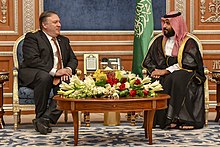
Prince Mohammed with U.S. Secretary of State
Mike Pompeo, on October 16, 2018
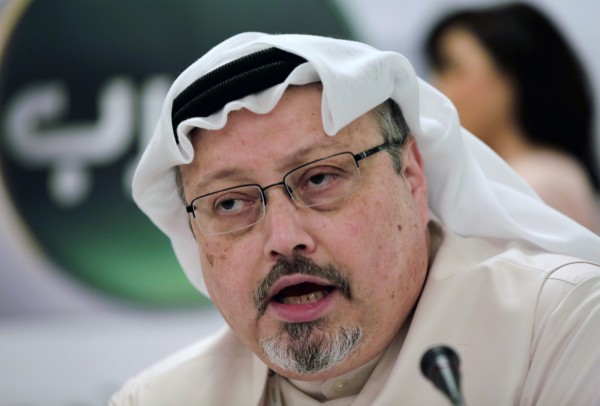
In October 2018, Jamal Khashoggi, a Saudi journalist and a critic of the crown prince went missing after entering the Saudi consulate in Istanbul. Turkish officials reportedly believe that Khashoggi was murdered at the consulate, claiming to have specific video and audio recordings proving that Khashoggi was first tortured and then murdered, and that a medical forensics expert was part of the 15-man Saudi team seen entering and leaving the consulate at the time of the journalist’s disappearance.[145]Saudi Arabia denied the accusations and Salman invited Turkish authorities to search the building as they “have nothing to hide". Saudi officials said they are "working to search for him".[146] The Washington Post reported that the Crown Prince had earlier sought to lure Khashoggi back to Saudi Arabia and detain him.[147]
According to one report, seven of the fifteen men suspected of killing Khashoggi are members of Mohammed bin Salman's personal bodyguard.[148]
Personal life[edit]
Mohammed bin Salman’s net worth is estimated at US$3.0 billion.[149] In 2015, he purchased the Italian-built and Bermuda-registered yacht Serene from Russian vodka tycoon Yuri Shefler for €500 million.[150][151] The New York Times has reported that he purchased the $300 millionChateau Louis XIV in France.[152]
In December 2017, a number of sources reported that the Crown Prince, using his close associate Prince Badr bin Abdullah bin Mohammed Al Farhan as an intermediary, had bought Leonardo da Vinci's Salvator Mundi; the sale in November at $450.3 million set a new record price for a work of art.[153][154][155][156] This report has been denied by the auctioneer Christie's, the Embassy of Saudi Arabia,[157] and the Government of the United Arab Emirates, which has announced that it is the actual owner of the painting.[158] The painting is presently located at its permanent home in the Louvre Museum's extension in Abu Dhabi, UAE.[159][160]
Mohammed has travelled extensively around the world, meeting with politicians, business leaders and celebrities.[151] In June 2016, he travelled to Silicon Valley and met key people in the US high tech industry, including Facebook founder Mark Zuckerberg.[161]
In early 2018, Prince Mohammed visited the United States where he met with many top politicians, business people and Hollywood stars, including President Trump, Bill andHillary Clinton, Henry Kissinger, Michael Bloomberg, George W. Bush, George H. W. Bush,Bill Gates, Jeff Bezos, Oprah Winfrey, Rupert Murdoch, Richard Branson, Mayor Eric Garcetti of Los Angeles, Michael Douglas, Morgan Freeman and Dwayne Johnson.[162][163]President Trump praised his relationship with Prince Mohammed.[164] rince also visited the United Kingdom where he met with Prime Minister Theresa May, Queen Elizabeth IIand Prince William.[165]
Mohammed bin Salman married Princess Sarah bint Mashhoor in 2008. They have four children.[166]
https://en.wikipedia.org/wiki/Mohammad_bin_Salman





.jpg)
.jpg)
.jpg)

.jpg)


.jpg)
_29.jpg)