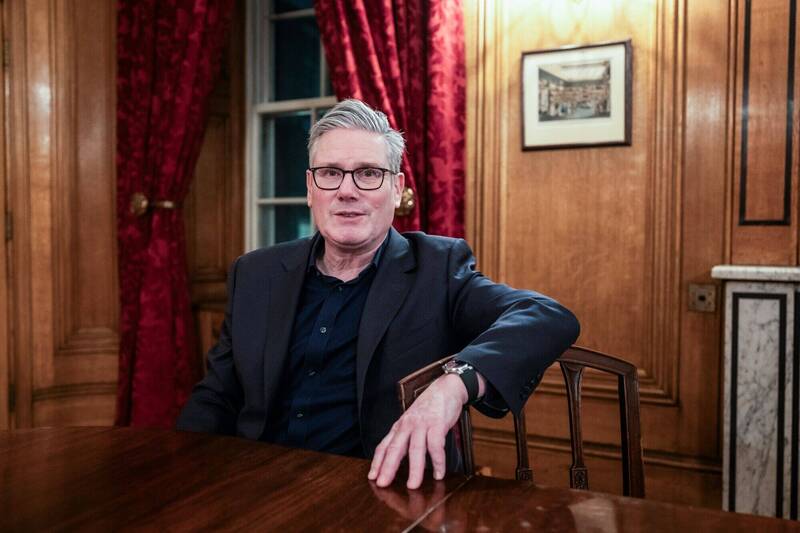
Starmer was born on 2 September 1962 in Southwark, London.[4][5] He grew up in the town of Oxted in Surrey.[6][7][8] He was the second of the four children of Josephine (née Baker), a nurse, and Rodney Starmer, a toolmaker.[8][9][10] His mother had Still's disease.[11][12] His parents were Labour Party supporters, and reportedly named him after the party's first parliamentary leader, Keir Hardie,[13][14] though Starmer said in 2015 that he did not know whether this is true.[15]
He passed the 11-plus examination and gained entry to Reigate Grammar School, then a voluntary aided selective grammar school.[14] The school was converted into an independent fee-paying school in 1976, while he was a student. The terms of the conversion were such that his parents were not required to pay for his schooling until he turned 16, and when he reached that point, the school, now a charity, awarded him a bursary that allowed him to complete his education there without any parental contribution.[16][17][18] The subjects that he chose for specialist study in his last two years at school were mathematics, music and physics, in which he achieved A level grades of B, B and C.[19] Among his classmates were the musician Norman Cook, alongside whom Starmer took violin lessons; Andrew Cooper, who went on to become a Conservative peer; and the future conservative journalist Andrew Sullivan. According to Starmer, he and Sullivan "fought over everything ... Politics, religion. You name it."[8]
Starmer became a barrister in 1987 at the Middle Temple, becoming a bencher there in 2009.[4] He served as a legal officer for the campaign group Liberty until 1990.[13] Starmer was a member of Doughty Street Chambers from 1990 onwards, primarily working on human rights issues.[11][13] He was called to the bar in several Caribbean countries,[27] where he defended convicts sentenced to the death penalty.[8] In 1999, Starmer was a junior barrister on Lee Clegg's appeal.[28] Starmer assisted Helen Steel and David Morris in the McLibel case, in the trial and appeal in English courts, also represented them at the European court.[29] Starmer was appointed Queen's Counsel on 9 April 2002, aged 39.[30] In the same year, he became joint head of Doughty Street Chambers. In 2005, Starmer stated "I got made a Queen’s Counsel, which is odd since I often used to propose the abolition of the monarchy".[31]
Starmer served as a human rights adviser to the Northern Ireland Policing Board and the Association of Chief Police Officers, and was also a member of the Foreign, Commonwealth and Development Office's death penalty advisory panel from 2002 to 2008.[4][13] The Northern Ireland board was an important part of bringing communities together following the Good Friday Agreement, and Starmer later cited his work on policing in Northern Ireland as being a key influence on his decision to pursue a political career: "Some of the things I thought that needed to change in police services we achieved more quickly than we achieved in strategic litigation ... I came better to understand how you can change by being inside and getting the trust of people".[32]
In February 2010, Starmer announced the CPS's decision to prosecute three Labour MPs and a Conservative peer for offences relating to false accounting in the aftermath of the parliamentary expenses scandal, who were all found guilty.[35][36] During the 2011 England riots, Starmer prioritised rapid prosecutions of rioters over long sentences, which he later thought had helped to bring "the situation back under control".[37][38] In February 2012, Starmer announced that Chris Huhne would be prosecuted for perverting the course of justice, saying in relation to the case that "[w]here there is sufficient evidence we do not shy away from prosecuting politicians".[39] In 2013, Starmer announced changes to how sexual abuse investigations are handled amid Operation Yewtree, including a panel to review historic complaints.[40][41][42]
My predecessor, the right hon. Frank Dobson, to whom I pay tribute, was a powerful advocate of the rights of everyone in Holborn and St Pancras throughout his highly distinguished parliamentary career. Widely respected and widely regarded, he served the people of Holborn and St Pancras for 36 years. Although I doubt I will clock up 36 years, I intend to follow in Frank Dobson's footsteps—albeit my jokes are likely to seem tame when compared with his, and I might give the beard a miss.
— Keir Starmer in his maiden speech to the House of Commons, May 2015
In his role as Shadow Brexit Secretary, Starmer questioned the government's destination for the UK outside of the European Union (EU), as well as calling for Brexit plans to be made public. On 6 December 2016, then prime minister Theresa May confirmed the publication of Brexit plans, in what some considered a victory for Starmer.[58] He argued that the government would be needed to pass a large number of new laws quickly, or risk what he called an "unsustainable legal vacuum", if Britain left the EU without a deal.[59] At the Labour Party Conference in September 2018, Starmer advocated for a referendum on the Brexit withdrawal agreement, saying that "our options must include campaigning for a public vote, and nobody is ruling out remain as an option".[60]
In January 2017, Starmer called for a reform to the EU free movement rules following Brexit and for a "fundamental rethink of immigration rules from start to finish".[61] In his first interview after being appointed to the shadow cabinet, Starmer said that immigration should be reduced after Britain left the EU by "making sure we have the skills in this country".[62] Starmer had told Politico in November 2016 that negotiations with the EU should start on the understanding that there must be "some change" to freedom of movement rules, given that remaining in the EU single market is no longer a reality.[63] In May 2017, Starmer said that "free movement has to go" but that it was important to allow EU citizens to migrate to the UK once they had a job offer, given the importance of immigration for the UK's economy.[64] Starmer was a supporter of a proposed second referendum on Brexit.[65]
Following the party's defeat at the 2019 general election, Corbyn announced that he would not lead Labour at the next general election.[66] Starmer began to distance himself from Corbyn's leadership and many of the policies he put forward at the election, revealing in 2024 that he was "certain that we would lose the 2019 election".[67] On 4 January 2020, Starmer announced his candidacy for the resultant leadership election.[68][69][70] By 8 January, it was reported that he had gained enough nominations from Labour MPs and MEPs to get onto the ballot paper, and that the trade union Unison was backing him. Unison, with 1.3 million members, said Starmer was the best placed candidate to unite the party and regain public trust.[71] He also gained support from former Labour Prime Minister Gordon Brown and Mayor of LondonSadiq Khan.[72] During the leadership election, Starmer ran a left-wing platform. He positioned himself in opposition to austerity, stating that Corbyn was "right" to position Labour as the "party of anti-austerity".[73][74] He indicated he would continue with the Labour policy of scrapping tuition fees as well as pledging "common ownership" of rail, mail, energy and water companies and called for ending outsourcing in the NHS, local governments and the justice system.[75] Starmer was announced as the winner of the leadership contest on 4 April 2020, defeating rivals Rebecca Long-Bailey and Lisa Nandy, with 56.2% of the vote in the first round.[76][77][78]
It is the honour and the privilege of my life to be elected as leader of the Labour Party. I want to thank Rebecca and Lisa for running such passionate and powerful campaigns and for their friendship and support along the way. I want to thank our Labour Party staff who worked really hard and my own amazing campaign team, full of positivity, with that unifying spirit. I want to pay tribute to Jeremy Corbyn, who led our party through some really difficult times, who energised our movement and who's a friend as well as a colleague. And to all of our members, supporters and affiliates I say this: whether you voted for me or not I will represent you, I will listen to you and I will bring our party together.
— Keir Starmer's acceptance speech, April 2020
Logo for Starmer's leadership bid
Having become Leader of the Opposition amid the COVID-19 pandemic, Starmer said in his acceptance speech that he would refrain from "scoring party political points" and would work with the government "in the national interest".[79] He later became more critical of the government's response to the pandemic following the Partygate scandal.[80] Amid the historic number of ministers resigning from Boris Johnson's government in July 2022, Starmer proposed a vote of no confidence in the government, stating that Johnson could not be allowed to remain in office given the large-scale revolt by his own ministers.[81][82]
rime_Minister%27s_Questions,_7_February_2024_01.jpg" class="mw-file-description" style="text-decoration-line: none; color: var(--color-progressive,#36c); background: none; border-radius: 2px; display: block; position: relative; border: 0px;">Starmer speaking during Prime Minister's Questions, 7 February 2024
As Labour Leader, Starmer focused on repositioning the party away from the left and the controversies that plagued Corbyn's leadership,[83] with promises of economic stability, tackling small boat crossings, cutting NHS waiting times, energy independence and infrastructure development, tackling crime, and recruiting 6,500 teachers.
Starmer considered quitting after the party's mixed results in the 2021 local elections, the first local elections of his leadership, but later felt "vindicated" by his decision to stay on, saying "I did [consider quitting] because I didn't feel that I should be bigger than the party and that if I couldn't bring about the change, perhaps there should be a change. But actually, in the end, I reflected on it, talked to very many people and doubled down and determined, no, it is the change in the Labour Party we need."[86]
A fairer, healthier, a more secure Britain, at the service of working people, with growth from every community. A Britain ready to restore that promise. The bond that reaches through the generations and says – this country will be better for your children. That is the change on offer on 4 July. That is our plan and I invite you all to join our mission to stop the chaos, turn the page and start to rebuild our country.
– Labour Manifesto Launch, 13 June 2024
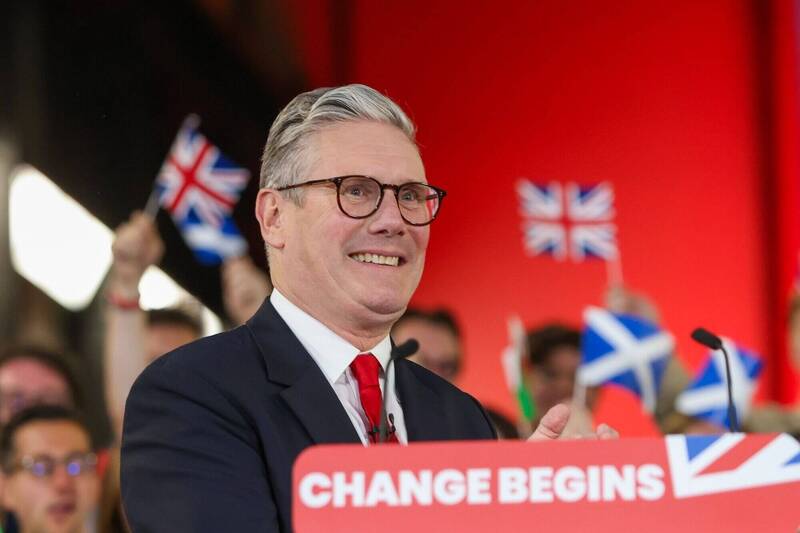
In June 2024, Starmer released the Labour Party manifesto Change, which focuses on economic growth, planning system reforms, infrastructure, what Starmer describes as "clean energy", healthcare, education, childcare, and strengthening workers' rights.[89][90] It pledges a new publicly owned energy company (Great British Energy), a "Green Prosperity Plan", reducing patient waiting times in the NHS, and renationalisation of the railway network (Great British Railways).[91] It includes wealth creation and "pro-business and pro-worker" policies.[92] The manifesto also pledged to give votes to 16 year olds, reform the House of Lords, and to tax private schools, with money generated going into improving state education.[93][94]
In July 2024, Starmer led Labour to a landslide victory in the 2024 general election, ending fourteen years of Conservative government with Labour becoming the largest party in the House of Commons.[2] In his victory speech, Starmer thanked party workers for their hard work – including nearly five years of revamping and rebranding Labour in the face of Tory dominance – and urged them to savour the moment, but warned them of challenges ahead and pledged his government would work for "national renewal":[95]
We did it! Thank you truly... you have changed our country. Four-and-a-half years of work changing this party... this is what it is for. A changed Labour... ready to restore Britain to the service of the working people.
Entering government
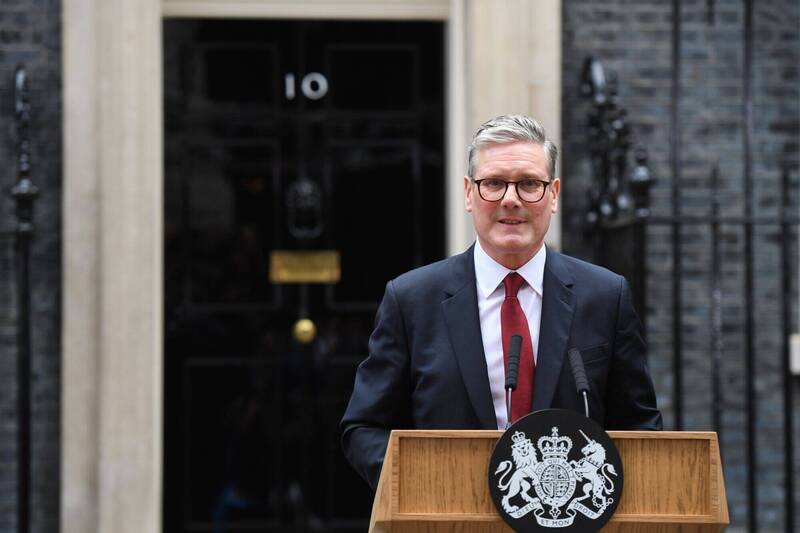
rime_Minister_Sir_Keir_Starmer_arrives_at_Number_10_Downing_St_(53836916571).jpg" class="mw-file-description" style="text-decoration-line: none; color: var(--color-progressive,#36c); background: none; border-radius: 2px; display: block; position: relative; border: 0px;">Starmer giving his first speech as prime minister, 5 July 2024
As the leader of the majority party in the House of Commons, Starmer was appointed as prime minister by Charles III on 5 July 2024, becoming the first Labour prime minister since Gordon Brown and the first one to win a general election since Tony Blair.[3] He was driven from Buckingham Palace to Downing Street, where he was greeted by a crowd of supporters and gave his first speech as prime minister. In his speech, Starmer paid tribute to Sunak, saying "his achievement as the first British Asian Prime Minister of our country should not be underestimated by anyone" and he also recognised "the dedication and hard work he brought to his leadership", but added that the people of Britain had voted for change:[96]
You have given us a clear mandate, and we will use it to deliver change. To restore service and respect to politics, end the era of noisy performance, tread more lightly on your lives, and unite our country. Four nations, standing together again, facing down, as we have so often in our past, the challenges of an insecure world. Committed to a calm and patient rebuilding. So with respect and humility, I invite you all to join this government of service in the mission of national renewal. Our work is urgent and we begin it today.
Other world leaders including Joe Biden and Justin Trudeau, as well as former Labour Prime Ministers Tony Blair and Gordon Brown, congratulated Starmer after he was appointed prime minister.[97]
The incoming Starmer ministry was noted for its female political representation, appointing women to a record half of the Cabinet, including the first female Chancellor in British history, and three of the five top political positions in the British government.[101][102]
Starmer's politics have been described as unclear and "hard to define".[103][104][105] When elected as Labour leader, he was widely believed to belong to the soft left of the Labour Party;[106] he has since moved to the political centre-ground,[107][108] and has been widely compared to Tony Blair's leadership and New Labour, having taken the party rightward to gain electability.[109] Despite this, it has been argued that "Labour under Starmer has advanced a politics of anti-neoliberalism like that of Jeremy Corbyn and John McDonnell", that it is "best understood as a party aspiring to restructure an economic model perceived to have failed", and that in that sense "it differs markedly from New Labour".[109] The term "Starmerism" has been coined to refer to Starmer's political ideology, and his supporters have been called Starmerites.[110][111] In June 2023, Starmer gave an interview to Time where he was asked to define Starmerism:[112]
Recognizing that our economy needs to be fixed. Recognizing that [solving] climate change isn't just an obligation; it's the single biggest opportunity that we've got for our country going forward. Recognizing that public services need to be reformed, that every child and every place should have the best opportunities and that we need a safe environment, safe streets, et cetera.
In April 2023, Starmer gave an interview to The Economist on defining Starmerism.[111][113] In this interview, two main strands of Starmerism were identified.[113] The first strand focused on a critique of the British state for being too ineffective and overcentralised. The answer to this critique was to base governance on five main missions to be followed over two terms of government; these missions would determine all government policy. The second strand was the adherence to an economic policy of "modern supply-side economics" based on expanding economic productivity by increasing participation in the labour market, reforming public services, increasing state intervention, mitigating the impact of Brexit and simplifying the construction planning process.[113]
Starmer has described the Labour Party as "deeply patriotic" and credits its most successful leaders, Clement Attlee, Harold Wilson, and Tony Blair, for policies "rooted in the everyday concerns of working people".[114] Starmer advocates a government based on "security, prosperity and respect". In a speech on 13 May 2023, Starmer stated:
Don't mistake me, the very best of progressive politics is found in our determination to push Britain forward. A hunger, an ambition, that we can seize the opportunities of tomorrow and make them work for working people. But this ambition must never become unmoored from working people's need for stability, for order, security. The Conservative Party can no longer claim to be conservative. It conserves nothing we value – not our rivers and seas, not our NHS or BBC, not our families, not our nation. We must understand there are precious things – in our way of life, in our environment, in our communities – that it is our responsibility to protect and preserve and to pass on to future generations. If that sounds conservative, then let me tell you: I don't care.
Starmer has moved the Labour Party towards the political centre.[116] He pledged to end antisemitism in the party during his acceptance speech, saying: "Antisemitism has been a stain on our party. I have seen the grief that it's brought to so many Jewish communities. On behalf of the Labour Party, I am sorry. And I will tear out this poison by its roots and judge success by the return of Jewish members and those who felt that they could no longer support us."[117][118] In October 2020, following the release of the Equality and Human Rights Commission (EHRC)'s report into antisemitism in the party, Starmer accepted its findings in full and apologised to Jews on behalf of the party.[119][120] In February 2023, Starmer's antisemitism reforms resulted in the party no longer being monitored by the EHRC.[121] His supporters praised him for his antisemitism reforms and for helping to improve Labour's credibility with the electorate, while his critics characterise him as dishonest and factional for discarding many of the policies he pledged to uphold and aggressively marginalising the party's left, with many prominent members (including his predecessor Corbyn) being deprived of the whip or outright expelled under his leadership.[122][123]
rime_Minister_Sir_Keir_Starmer_arrives_at_10_Downing_Street_(53837066630).jpg" class="mw-file-description" style="text-decoration-line: none; color: var(--color-progressive,#36c); background: none; border-radius: 2px; display: block; position: relative; border: 0px;">Starmer and his wife Victoria Starmer arriving at 10 Downing Street, July 2024
Starmer met Victoria Alexander, then a solicitor, in the early 2000s while he was a senior barrister with Doughty Street Chambers and they were working on the same case. The two eventually became close, becoming engaged in 2004 and married on 6 May 2007 on the Fennes Estate in Essex.[129][130] The couple have two children, a son, who was born a year after their wedding, and a daughter, born two years after that. Both are being brought up in the Jewish faith of their mother.[131][132] Until moving to Downing Street, the couple resided in Kentish Town, north London.[133][134][135]
Starmer is a pescatarian, and his wife is a vegetarian. They raised their children as vegetarians until they were 10 years old, at which point they were given the option of eating meat.[136] In an interview during the 2024 general election, Starmer revealed that the thing he feared most about becoming prime minister is the impact it may have on his children, due to their "difficult ages" and how it would be easier if they were younger or older.[137] Starmer said in a radio interview that he would try to avoid working after 6 p.m. on Fridays in order to observe Shabbat dinners and spend time with his family.[138]
Starmer is an atheist; he chose to take a "solemn affirmation" (rather than an oath) of allegiance to the monarch.[139] Starmer has said that he does not believe in God, but believes in the power of faith to bring people together.[140] He and his family occasionally attend a liberal synagogue,[141] and he stated in a 2022 interview that his children are being brought up to know the Jewish faith and background of their maternal grandparents.[131]
Starmer is a keen footballer, having played for Homerton Academicals, a north London amateur team,[14] and he supports Premier League side Arsenal.[8]
Awards and honours
In 2002, Starmer was appointed Queen's Counsel (QC).[142] He received the Bar Council's Sydney Elland Goldsmith Award in 2005 for his outstanding contribution to pro bono work in challenging the death penalty in Uganda, Kenya, Malawi, and the Caribbean.[143] He is also a Honorary Fellow of St Edmund Hall, Oxford.[144]





.jpg)