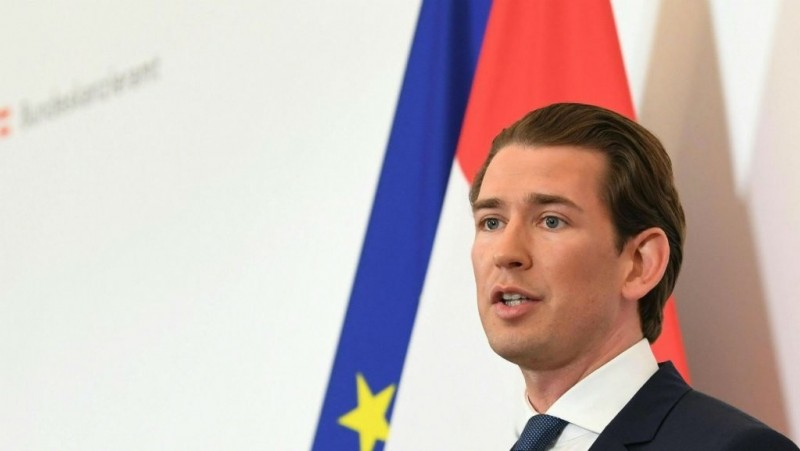
Sebastian Kurz (born 27 August 1986) is anAustrian politician who has been Austria'sMinister for Foreign Affairs and Integrationsince 2013. He became Europe's youngest Foreign Minister at the age of 27.[1] In May 2017 he became the chairman of the Austrian People's Party (ÖVP). Following elections that took place on 15 October 2017, Kurz has become the most likely politician to become the next Chancellor of Austria.
Early life and education[edit]
Kurz was born in Vienna and brought up in the city district of Meidling, where he still lives. He entered the Bundesgymnasium und Bundesrealgymnasium Erlgasse[2] in 1996 and after his final exam in 2004 Kurz completed the obligatory military service. In 2011, he decided to suspend his law studies at the University of Vienna and to pursue a political career instead.[3]
Political career[edit]
Youth branch and parliament[edit]
In 2009 Kurz was elected chairman of the youth branch of the Austrian People's Party. Between 2010 and 2011 he was member of Vienna's city council, where he focused on generational fairness and ensuring pensions.[4] In April 2011, he was appointed to the newly created post of State Secretary for Integration (part of the Ministry of the Interior).[citation needed]
In the 2013 general election, Kurz was elected as a member of parliament, winning the most direct votes of any member of parliament in the election.[5]
Foreign Minister of Austria, 2013–present[edit]
In December 2013, Kurz became Austria's Foreign Minister, whose portfolio was at his request widened to include Social integration. At the time of his swearing-in Kurz was Austria's youngest government minister since the foundation of the republic and the youngest foreign minister in the world.[citation needed]
His first trip abroad took Kurz to Croatia, marking the continuous Austrian support for an EU-membership of the country in Southeast Europe.[6] In February 2014, he hosted the first of several rounds of negotiations on the nuclear program of Iran in Vienna, strengthening Austria’s position as place of dialogue.[citation needed]
The negotiations were successfully concluded on 14 July 2015, when the Joint Comprehensive Plan of Action was signed by Iran, the P5+1 and the European Union. Following the signature[7] Sebastian Kurz said he was pleased with the outcome of the talks with Iran, and expressed his hope that “the Vienna Agreement will act as catalyst towards the global nuclear disarmament ambitions”.[8]
During his first year in office, Kurz chaired the Committee of Ministers of the Council of Europe until May 2014.[9]
In late 2014, he succeeded Radosław Sikorski as co-chair of the European People’s Party(EPP) Foreign Ministers Meeting, alongside Elmar Brok.[10]
In May 2014, as Chairman of the Committee of Ministers of the Council of Europe, Sebastian Kurz invited 30 Ministers of Foreign Affairs, among them Russian Foreign Minister Sergey Lavrov and his Ukrainian colleague Andrii Deshchytsia, to Vienna in order to negotiate solutions to end the Ukrainian crisis in Vienna.[11]
As part of the Humanitarian Initiative, Kurz hosted the Vienna Conference on the Humanitarian Impact of Nuclear Weapons in late 2014.[12] Following his proposal, Vienna later hosted the negotiations leading to the Joint Comprehensive Plan of Action for thenuclear program of Iran in 2015.[citation needed]
In November 2014, Sebastian Kurz was appointed to lead the European People's PartyForeign Affairs Ministers together with Elmar Brok, Chair of Foreign Affairs Committee in the EP.[13]
2015-17[edit]

Kurz with U.S. Secretary of State
John Kerry, 4 April 2016

Kurz with Russian Foreign Minister
Lavrov, 11 July 2017
In the course of the European migrant crisis in 2015, Kurz called for a more effective control of the EU external borders [14] and presented a 50-Point-Plan towards integration with special focus on the areas language and education, labour and job market, rule of law and values.[15]
In 2015, Kurz proposed a new Islamgesetz (Islam Law) prohibiting the funding of mosques by entities from abroad, paying imams' salaries, and regulating the version of theQuran that may be used in Austria.[16]
It provides Muslims with additional rights, such as the right to halal food and pastoral care in the military. Kurz said the changes were intended to "clearly combat" the influence ofradical Islam in Austria.[17] The law passed by the Austrian parliament in February 2015 did not call for an authorized version of the Quran.[citation needed]
Amid the Turkish government purge against members of its own civil and military service in reaction to a failed coup d'état in July 2016, Kurz summoned Turkey's ambassador to explain Ankara's links to demonstrations of thousands of people in Austria in support of Turkish president Recep Tayyip Erdoğan.[18]
Chairman of the Austrian People's Party, 2017–present[edit]
Kurz was appointed acting party leader after the former head Reinhold Mitterlehnerstepped down in May 2017. He was later formally elected chairman, receiving 98.7 percent of the votes at a party convention in Linz. The delegates approved changes to the party statute, which put more power in the party leader’s hands, including the power to set party policy, the power to appoint party ministers, and the power to name candidates to stand for election.[19][20]
The leader of Austria’s conservative People’s Party has declared victory in the country’s general elections, setting him up to become the world’s youngest head of government. Austrian Foreign Minister Sebastian Kurz claimed victory on Sunday night after projections showed his party to be well in the lead with over than 90 percent of the ballots counted.
Other activities[edit]
https://en.wikipedia.org/wiki/Sebastian_Kurz



_(cropped).jpg)

.jpg)
.jpg)
.jpg)




 ine;cpos:1;subsec:hl-view;uuid:eaa7d90c-55ef-3d36-8047-0e0c8ad54bb2;tar:lineit.line.me" aria-label="Line" class="line ButtonNaked My(0) nofollow O(0) Ov(v) P(0) Pos(r) Va(b) D(ib) rapid-noclick-resp react-button" href="https://lineit.line.me/share/ui?url=https%3A%2F%2Ftw.news.yahoo.com%2F%25E5%2585%25A8%25E7%2590%2583%25E6%259C%2580%25E5%25B9%25B4%25E8%25BC%2595%25E9%25A0%2598%25E8%25A2%2596%25E6%258F%259B%25E4%25BA%25BA-33%25E6%25AD%25B2%25E5%25BA%25AB%25E7%2588%25BE%25E8%258C%25A8%25E5%259B%259E%25E9%258D%258B%25E5%25A5%25A7%25E5%259C%25B0%25E5%2588%25A9%25E7%25B8%25BD%25E7%2590%2586-000052211.html%3Fsoc_src%3Dsocial-sh%26soc_trk%3Dli" target="_blank" data-reactid="20" style="background-color: transparent; color: rgb(88, 195, 69); text-decoration-line: none; display: inline-block; zoom: 1; margin-top: 0px; margin-bottom: 0px; outline: 0px; overflow: visible; padding: 0px; position: relative; vertical-align: bottom; margin-right: 0px; border-radius: 0px; border-width: 0px; width: 40px; height: 40px; line-height: 38px; max-width: 40px; min-width: 40px; max-height: 40px; min-height: 40px; border-color: rgb(88, 195, 69);">