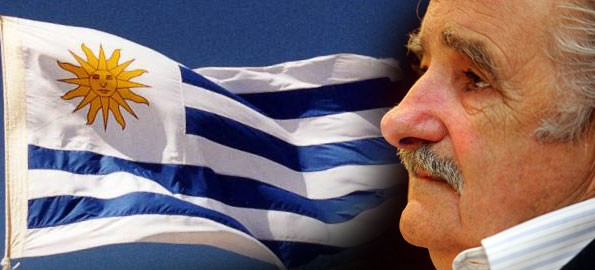
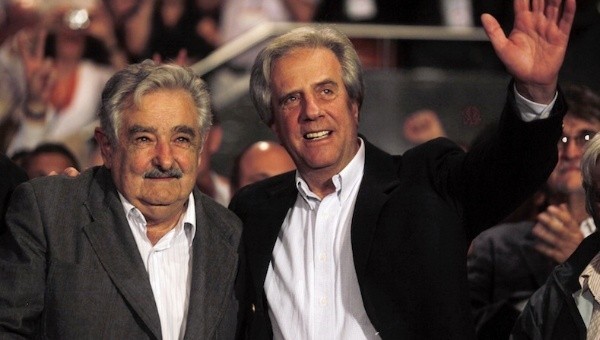
José Alberto "Pepe" Mujica Cordano(Spanish pronunciation: [xoˈse muˈxika]; born 20 May 1935) is a Uruguayan politician who wasPresident of Uruguay between 2010 and 2015. A former urban guerrilla fighter with theTupamaros and a member of the Broad Frontcoalition of left-wing parties, Mujica wasMinister of Livestock, Agriculture, and Fisheries from 2005 to 2008 and a Senator afterwards. As the candidate of the Broad Front, he won the 2009 presidential electionand took office as President on 1 March 2010.
He has been described as "the world's 'humblest' president", due to his austere lifestyle and his donation of around 90 percent of his $12,000 (£7,500) monthly salary to charities that benefit poor people and small entrepreneurs.[3][4]
Early life[edit]
Mujica was born on 20 May 1935, to Demetrio Mujica, of Spanish Basque ancestry,[5][6] and Lucy Cordano, a daughter of Italianimmigrants. Mujica's father was a small farmer who went bankrupt shortly before his death in 1940, when his son was five. His mother's parents were very poor immigrants fromLiguria. Lucy Cordano was born in Carmelo, where her parents had bought five acres in Colonia Estrella to cultivate vineyards. Between the ages of 13 and 17, Mujica cycled for several clubs in different categories. He was also active in the National Party, where he became close to Enrique Erro.
Guerrilla leader[edit]
In the mid-1960s, he joined the newly formed MLN-Tupamaros movement, an armed political group inspired by the Cuban Revolution.[7]He participated in the brief 1969 takeover of Pando, a town close to Montevideo, leading one of six squads assaulting strategic points in the city. Mujica's team was charged with taking over the telephone exchange and was the only one to complete the operation without any mishaps.[8] In March 1970 Mujica was gunned down while resisting arrest at a Montevideo bar; he injured two policeman and was in turn shot six times. The surgeon on call at the hospital saved his life. Tupamaros claimed that the surgeon was secretly Tupamaro and this is why his life was saved. In reality the doctor was simply following ordinary medical ethics.[9] At the time the president of Uruguay was the controversial Jorge Pacheco Areco, who had suspended certain constitutional guarantees in response to MLN and Communist unrest.[10][11]
In total Mujica was captured by the authorities on four occasions. He was among the more than 100 Tupamaros who escaped Punta Carretas Prison in September 1971 by digging a tunnel from inside the prison that opened up at the living room of a nearby home.[12] Mujica was re-captured less than a month after escaping, but escaped Punta Carretas once more in April 1972. On that occasion he and about a dozen other escapees fled riding improvised wheeled planks down the tunnel dug by Tupamaros from outside the prison.[13] He was re-apprehended for the last time in 1972, unable to resist arrest. In the months that followed the country underwent the military coup in 1973. In the meantime, Mujica and eight other Tupamaros were especially chosen to remain under military custody and in squalid conditions. In all, he spent 13 years in captivity. During the 1970s and 1980s, this included being confined to the bottom of an old, emptied horse-watering trough for more than two years.[14] During his time in prison, Mujica suffered a number of health crises, particularly mental issues. Although his two closest cellmates, Eleuterio Fernández Huidobro andMauricio Rosencof often managed to communicate with each other, they rarely managed to bring Mujica into the conversation. According to Mujica himself, at the time he was suffering from auditory hallucinations and related forms of paranoia.[15]
In 1985, when constitutional democracy was restored, Mujica was freed under an amnesty law that covered political and related military crimes committed since 1962.[16]
Several years after the restoration of democracy, Mujica and many Tupamaros joined other left-wing organizations to create the Movement of Popular Participation,[17] a political party that was accepted within the Broad Front coalition.
In the 1994 general elections, Mujica was elected deputy and in the elections of 1999 he was elected senator. Due in part to Mujica's charisma, the MPP continued to grow in popularity and votes, and by 2004, it had become the largest of any faction within theBroad Front. In the elections of that year, Mujica was re-elected to the Senate, and the MPP obtained over 300,000 votes, thus consolidating its position as the top political force within the coalition and a major force behind the victory of presidential candidate Tabaré Vázquez. Mujica was then elected in 2009 as president in the following elections. This was taking advantage of the excellent economic position that was acquired during President Battle's government.
Minister of Agriculture[edit]
On 1 March 2005, President Tabaré Vázquez designated Mujica as the Minister of Livestock, Agriculture and Fisheries (Mujica's own professional background was in the agricultural sector). Upon becoming minister, Mujica resigned his position as senator. He held this position until a cabinet change in 2008, when he resigned and was replaced byErnesto Agazzi. Mujica then returned to his seat in the Senate.
Political positions[edit]
ulaMujica.JPG">

Mujica's political ideology has evolved over the years from orthodox to pragmatist. In recent times he has expressed a desire for a more flexible political left.[18] His speaking style and manner is credited as part of his growing popularity since the late 1990s, especially among rural and poor sectors of the population.[19] He has been variously described as an "antipolitician"[20] and a man who "speaks the language of the people" while also receiving criticism for untimely or inappropriate remarks.[21] Unlike president Vázquez, who vetoed a bill put forward by parliament that would make abortions legal, Mujica has stated that should it come before him in the future, he would not veto such a bill.[22] In the sphere of international relations, he hopes to further negotiations and agreements between the European Union and the regional trade blocMercosur, of which Uruguay is a founding member.[23]
On the Uruguay River pulp mill dispute between Argentina and Uruguay, Mujica was more conciliatory toward the Argentine government than the previous administration, and in 2010 the two nations ended their long-running dispute and signed an agreement detailing an environmental monitoring plan of the river and the setting up of a binational commission. Good personal relations between Mujica and Argentinian counterpart Cristina Kirchnerhelped lead to the accord, although several bilateral issues remain unresolved, including the dredging of the shared Martin Garcia access channel of Río de la Plata (Silver River).[24][25]
Asked about Brazilian President Lula da Silva's decision to receive Mahmoud Ahmadinejad, he answered it was a "genius move" because "The more Iran is fenced in, the worse it will be for the rest of the world."[26][27]
Presidential candidate[edit]
Even though President Vázquez favored his Finance Minister Danilo Astori as presidential candidate of the then unified Broad Front to succeed him in 2010, Mujica's broad appeal and growing support within the party posed a challenge to the president. On 14 December 2008, The Extraordinary Congress "Zelmar Michelini" (a party convention) proclaimed Mujica as the official candidate of the Broad Front for primary elections of 2009, but four more precandidates were allowed to participate, including Astori. On 28 June 2009, Mujica won the primary elections becoming the presidential candidate of the Broad Front for the2009 general election. After that, Astori agreed to be his running mate. Their campaign was centered on the concept of continuing and deepening the policies of the highly popular administration of Vázquez, using the slogan “Un gobierno honrado, un país de primera" (An honest government, a first-class country) – indirectly referencing cases of administrative corruption within the former government of the major opposition candidate, conservativeLuis Alberto Lacalle. During the campaign, Mujica distanced himself from the governing style of presidents like Hugo Chávez (Venezuela) or Evo Morales (Bolivia), claiming the center-left governments of Brazilian Luis Inácio Lula da Silva or Chilean socialist Michelle Bachelet as regional examples upon which he would model his administration. Known for his informal style of dress, Mujica donned a suit (without a tie) for some stops in the presidential campaign, notably during visits to regional heads of state.[28]
In October 2009, Mujica won a plurality of over 48 percent of the votes compared to 30 percent for former president Lacalle, falling short of the majority required by theconstitution, while at the same time renewing the Broad Front's parliamentary majority for the next legislature (2010–2015). A runoff was then held on 29 November to determine the winner; on 30 November Mujica emerged as the victor, with more than 52% of the vote over Lacalle's 43%.[29] In his first speech as president-elect before a crowd of supporters, Mujica acknowledged his political adversaries and called for unity, stating that there would be no winners or losers ("Ni vencidos, ni vencedores"). He added that "it is a mistake to think that power comes from above, when it comes from within the hearts of the masses (...) it has taken me a lifetime to learn this".[30]
Government[edit]
Mujica formed a cabinet made up of politicians from the different sectors of the Broad Front, conceding the economics area to aides of his vice president Danilo Astori. The expectations were high, as Mujica is the first former guerrilla fighter to become President in Uruguay.
On June 21, 2012, the Argentine philosopher Eduardo Sanguinetti, from an editorial in the Uruguayan newspaper "La República" proposes to President José Mujica, the nobel peace prize. Arguing the philosopher: "who can not be anything in his life example of austerity, dignity and honesty, adding its actions in favor peace of peoples today in conflict".[31]
In June 2012, his government made a move to legalize state-controlled sales of marijuana in Uruguay in order to fight drug-related crimes and health issues, and stated that they would ask global leaders to do the same.[32][33] Mujica said that by regulating Uruguay's estimated $40 million-a-year marijuana business, the state will take it away from drug traffickers, and weaken the drug cartels. The state would also be able to keep track of all marijuana consumers in the country, and provide treatment to the most serious abusers, much like that which is done with alcoholics.[34]
In September 2013, Mujica addressed the United Nations General Assembly, with a very long discourse devoted to humanity and globalization.[35] The speech called on the international community to strengthen efforts to preserve the planet for future generations and highlighted the power of the financial systems and the impact of economic fallout on ordinary people. He urged a return to simplicity, with lives founded on human relationships, love, friendship, adventure, solidarity and family, instead of lives shackled to the economy and the markets.[36]
On 1 March 2015, Mujica's term as president came to a conclusion.[37]
Personal life[edit]
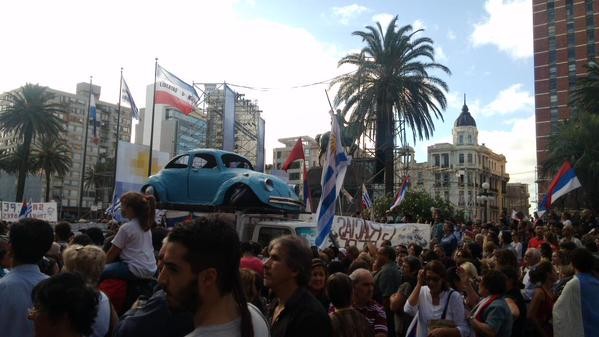
In 2005, Mujica married Lucía Topolansky, a fellowTupamaro member and current senator, after many years of co-habitation. They have no children and live on an austere farm in the outskirts of Montevideo where they cultivate chrysanthemums for sale, having declined to live in the opulent presidential palace or use its staff.[38] His humble lifestyle is reflected by his choice of an agingVolkswagen Beetle as transport.[39] In 2010, the value of the car was $1,800 and represented the entirety of the mandatory annual personal wealth declaration filed by Mujica for that year. In November 2014, the Uruguayan newspaper Búsqueda reported that he had been offered 1 million dollars for the car, which was manufactured in 1987; he said that if he did get 1 million dollars for the car it would be donated to house the homeless through a programme that he supports.[40] His wife owns the farm they live on. Some Uruguayans see him as "a roly-poly former guerrilla who grows flowers on a small farm and swears byvegetarianism".[3][41][42][43][44][45] He describes himself as atheist.[1] Also living at the farm is his three-legged dog, Manuela.[46]
International relevance[edit]
During the last months of 2013, the renowned Serbian film director Emir Kusturica started shooting a documentary film on the life of Mujica, whom he considers "the last hero of politics".[47]
During his talk before youngs, in the 28th Guadalajara International Book Fair (Mexico), on Sunday 7 December 2014, Mujica was interviewed by Mexican journalist Ricardo Rocha. Uruguay's President addressed several topics, such as drug trafficking, drug legalization, poverty and social injustice. "We live in the most unfair continent that exists, probably the richest, and the one that distributes worse."
About the Latin American subcontinent, José Mujica said. "I am passionate about the meeting of the Latin Americans, of what defines us as belonging to a great nation that is to be built. There are multinational states such as China and India, what Europe is doing with a history of wars." Mujica also addressed the language issue that unites Ibero-Americans, and said about the differences: "The Portuguese is a sweet Castilian, if you speak it slowly... and the more if it has feminine sweetness."
He added another element of unity among the countries in Latin America: "We have another identity, Christian and Catholic tradition."
"I see that there are many young people, as a veteran, as an old man, a little advice... Life can give us many pitfalls, many blows, we can fail a thousand times, in life, in love, in the social struggle, but if we seek, we have the strength to get up again and start over. The most beautiful thing of the day is that it dawns. It is always dawning after the night elapsed. Do not forget it, girls and boys. The only losers are those who stop fighting."[48]
http://en.wikipedia.org/wiki/Jos%C3%A9_Mujica