Points of LightPresident Bush devoted attention to voluntary service as a means of solving some of America's most serious social problems. He often used the "thousand points of light" theme to describe the power of citizens to solve community problems. In his 1989 inaugural address, President Bush said, "I have spoken of a thousand points of light, of all the community organizations that are spread like stars throughout the Nation, doing good."[142] Four years later, in his report to the nation on The Points of Light Movement, President Bush said, "Points of Light are the soul of America. They are ordinary people who reach beyond themselves to touch the lives of those in need, bringing hope and opportunity, care and friendship. By giving so generously of themselves, these remarkable individuals show us not only what is best in our heritage but what all of us are called to become."[142] In 1990, the Points of Light Foundation was created as a nonprofit organization in Washington to promote this spirit of volunteerism.[143] In 2007, the Points of Light Foundation merged with the Hands On Network with the goal of strengthening volunteerism, streamlining costs and services and deepening impact.[144] Points of Light, the organization created through this merger, has approximately 250 affiliates in 22 countries and partnerships with thousands of nonprofits and companies dedicated to volunteer service around the world. In 2012, Points of Light mobilized 4 million volunteers in 30 million hours of service worth $635 million.[145] On October 16, 2009, President Barack Obama held a Presidential Forum on Service hosted by former President George H. W. Bush and Points of Light at the George Bush Presidential Library Center on the campus of Texas A&M University. The event celebrated the contributions of more than 4,500 Daily Point of Light award winners and honored President Bush's legacy of service and civic engagement.[146] In 2011, Points of Light paid tribute to President George H. W. Bush and volunteer service at Washington, D.C.'s Kennedy Center. President Bush was joined by Presidents Jimmy Carter, Bill Clinton, and George W. Bush to highlight the role volunteer service plays in people's lives.[147] Daily Point of Light AwardPresident Bush created the Daily Point of Light Award in 1989 to recognize ordinary Americans from all walks of life taking direct and consequential voluntary action in their communities to solve serious social problems. The President focused great attention on these individuals and organizations, both to honor them for their tremendous work and to call the nation to join them and multiply their efforts. By the end of his administration, President Bush had recognized 1,020 Daily Points of Light representing all 50 states and addressing issues ranging from care for infants and teenagers with AIDS to adult illiteracy and from gang violence to job training for the homeless.[142] The Daily Point of Light continues to be awarded by Points of Light and President Bush continues to sign all of the awards.[148] On July 15, 2013, President Barack Obama welcomed President Bush to the White House to celebrate the 5,000th Daily Point of Light Award.[149] They bestowed the award on Floyd Hammer and Kathy Hamilton of Union, Iowa, for their work founding Outreach, a nonprofit that delivers free meals to hungry children in 15 countries.[150] Judicial appointmentsBush made two appointments to the Supreme Court of the United States: David Souter in 1990, and Clarence Thomas in 1991. Additionally, he appointed 42 judges to the United States Courts of Appeals and 148 judges to the United States district courts. Among these was Vaughn R. Walker, a gay man who ruled that California's Proposition 8 amendment was unconstitutional.[151] Bush also experienced a number of judicial appointment controversies, as 11 nominees for 10 federal appellate judgeships were not processed by the Democratically-controlled Senate Judiciary Committee.[152] Foreign policyPanamaIn the 1980s, Panamanian leader Manuel Noriega, a once U.S.-supportive leader who was later accused of spying forFidel Castro and using Panama to traffic drugs into the United States, was one of the most recognizable names in America and was constantly in the press. The struggle to remove him from power began in the Reagan administration, when economic sanctions were imposed on the country; this included prohibiting American companies and government from making payments to Panama and freezing $56 million in Panamanian funds in American banks. Reagan sent more than 2,000 American troops to Panama as well.[153] Unlike Reagan, Bush was able to remove Noriega from power, but his administration's unsuccessful post-invasion planning hindered the needs of Panama during the establishment of the young democratic government.[154] In May 1989, Panama held democratic elections, in which Guillermo Endara was elected president; the results were then annulled by Noriega's government. In response, Bush sent 2,000 more troops to the country, where they began conducting regular military exercises in Panamanian territory (in violation of prior treaties). Bush then removed an embassy andambassador from the country, and dispatched additional troops to Panama to prepare the way for an upcoming invasion.[153] Noriega suppressed an October military coup attempt and massive protests in Panama against him, but after a U.S. serviceman was shot by Panamanian forces in December 1989, Bush ordered 24,000 troops into the country with an objective of removing Noriega from power;[155] "Operation Just Cause" was a large-scale American military operation, and the first in more than 40 years that was not related to the Cold War.[154] The mission was controversial, but American forces achieved control of the country and Endara assumed the presidency.[156] Noriega surrendered to the United States and was convicted and imprisoned on racketeering and drug trafficking charges in April 1992.[157]President Bush and First Lady Barbara Bush visited Panama in June 1992, to give support to the first post-invasion Panamanian government. The visit was marred by protests that broke into gunfire and tear gas, forcing Bush to leave a rally.[158] Soviet UnionIn 1989, just after the fall of the Berlin Wall, Bush met withSoviet General Secretary Mikhail Gorbachev in a conference on the Mediterranean island of Malta. The administration had been under intense pressure to meet with the Soviets, but not all initially found the Malta Summitto be a step in the right direction; General Brent Scowcroft, among others, was apprehensive about the meeting, saying that it might be "premature" due to concerns where, according to Condoleezza Rice, "expectations [would be] set that something was going to happen, where the Soviets might grandstand and force [the U.S.] into agreements that would ultimately not be good for the United States." But European leaders, including François Mitterrand and Margaret Thatcher, encouraged Bush to meet with Gorbachev,[159] something that he did on December 2 and 3, 1989. Although no agreements were signed, the meeting was viewed largely as being an important one; when asked about nuclear war, Gorbachev responded, "I assured the President of the United States that the Soviet Union would never start a hot war against the United States of America. And we would like our relations to develop in such a way that they would open greater possibilities for cooperation.... This is just the beginning. We are just at the very beginning of our road, long road to a long-lasting, peaceful period."[160] The meeting was received as a very important step to the end of the Cold War.[161] resident_and_Mrs._Bush_show_Russian_President_Boris_Yeltsin_the_South_Grounds_of_the_White_House_and_stop_at_the..._-_NARA_-_186451.tif" class="image" style="text-decoration: none; color: rgb(11, 0, 128); background: none;"> 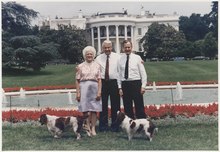 resident_and_Mrs._Bush_show_Russian_President_Boris_Yeltsin_the_South_Grounds_of_the_White_House_and_stop_at_the..._-_NARA_-_186451.tif" class="internal" title="Enlarge" style="text-decoration: none; color: rgb(11, 0, 128); display: block; text-indent: 15px; white-space: nowrap; overflow: hidden; width: 15px; height: 11px; -webkit-user-select: none; background: linear-gradient(transparent, transparent), url("data:image/svg+xml,%3Csvg xmlns=%22http://www.w3.org/2000/svg%22 viewBox=%220 0 11 15%22 width=%2215%22 height=%2211%22%3E %3Cg id=%22magnify-clip%22 fill=%22%23fff%22 stroke=%22%23000%22%3E %3Cpath id=%22bigbox%22 d=%22M1.509 1.865h10.99v7.919h-10.99z%22/%3E %3Cpath id=%22smallbox%22 d=%22M-1.499 6.868h5.943v4.904h-5.943z%22/%3E %3C/g%3E %3C/svg%3E");"> George and Barbara Bush with President Boris Yeltsin, Russia's first freely elected leader, at The White House, Washington D.C., 1992 Another summit was held in July 1991, where the Strategic Arms Reduction Treaty (START I) was signed by Bush and Gorbachev in Moscow. The treaty took nine years in the making and was the first major arms agreement since the signing of the Intermediate Ranged Nuclear Forces Treatyby Reagan and Gorbachev in 1987. The contentions in START would reduce the strategic nuclear weapons of the United States and the USSR by about 35% over seven years, and the Soviet Union's land-based intercontinental ballistic missiles would be cut by 50%. Bush described START as "a significant step forward in dispelling half a century of mistrust".[162] After the dissolution of the USSR in 1991, President Bush and Russian president Boris Yeltsin declared a U.S.–Russian strategic partnership, marking the end of the Cold War.[163] Gulf WarOn August 2, 1990, Iraq, led by Saddam Hussein, invaded its oil-rich neighbor to the south, Kuwait; Bush condemned the invasion[164] and began rallying opposition to Iraq in the US and among European, Asian, and Middle Eastern allies.[26] Secretary of Defense Richard Bruce "Dick" Cheney traveled to Saudi Arabia to meet with King Fahd; Fahd requested US military aid in the matter, fearing a possible invasion of his country as well.[164] The request was met initially with Air Force fighter jets. Iraq made attempts to negotiate a deal that would allow the country to take control of half of Kuwait. Bush rejected this proposal and insisted on a complete withdrawal of Iraqi forces.[26] The planning of a ground operation by US-led coalition forces began forming in September 1990, headed by General Norman Schwarzkopf.[164] Bush spoke before a joint session of the U.S. Congress regarding the authorization of air and land attacks, laying out four immediate objectives: "Iraq must withdraw from Kuwait completely, immediately, and without condition. Kuwait's legitimate government must be restored. The security and stability of the Persian Gulf must be assured. And American citizens abroad must be protected." He then outlined a fifth, long-term objective: "Out of these troubled times, our fifth objective – a new world order – can emerge: a new era – freer from the threat of terror, stronger in the pursuit of justice, and more secure in the quest for peace. An era in which the nations of the world, East and West, North and South, can prosper and live in harmony.... A world where the rule of law supplants the rule of the jungle. A world in which nations recognize the shared responsibility for freedom and justice. A world where the strong respect the rights of the weak."[165] With the United Nations Security Council opposed to Iraq's violence, Congress authorized the use of military force[164] with a set goal of returning control of Kuwait to the Kuwaiti government, and protecting America's interests abroad.[26] resident_Bush_meets_with_General_Colin_Powell,_General_Scowcroft,_Secretary_James_Baker,_Vice_President_Quayle..._-_NARA_-_186429.tif" class="image" style="text-decoration: none; color: rgb(11, 0, 128); background: none;">  resident_Bush_meets_with_General_Colin_Powell,_General_Scowcroft,_Secretary_James_Baker,_Vice_President_Quayle..._-_NARA_-_186429.tif" class="internal" title="Enlarge" style="text-decoration: none; color: rgb(11, 0, 128); display: block; text-indent: 15px; white-space: nowrap; overflow: hidden; width: 15px; height: 11px; -webkit-user-select: none; background: linear-gradient(transparent, transparent), url("data:image/svg+xml,%3Csvg xmlns=%22http://www.w3.org/2000/svg%22 viewBox=%220 0 11 15%22 width=%2215%22 height=%2211%22%3E %3Cg id=%22magnify-clip%22 fill=%22%23fff%22 stroke=%22%23000%22%3E %3Cpath id=%22bigbox%22 d=%22M1.509 1.865h10.99v7.919h-10.99z%22/%3E %3Cpath id=%22smallbox%22 d=%22M-1.499 6.868h5.943v4.904h-5.943z%22/%3E %3C/g%3E %3C/svg%3E");"> Bush meets with Robert Gates, General Colin Powell, Secretary Dick Cheney and others about the situation in the Persian Gulf and Operation Desert Shield, January 15, 1991 Early on the morning of January 17, 1991, allied forces launched the first attack, which included more than 4,000 bombing runs by coalition aircraft.[166] This pace would continue for the next four weeks, until a ground invasion was launched on February 24, 1991. Allied forces penetrated Iraqi lines and pushed toward Kuwait City while on the west side of the country, forces were intercepting the retreating Iraqi army. Bush made the decision to stop the offensive after a mere 100 hours.[167][168] Critics labeled this decision premature, as hundreds of Iraqi forces were able to escape; Bush responded by saying that he wanted to minimize U.S. casualties. Opponents further charged that Bush should have continued the attack, pushing Hussein's army back to Baghdad, then removing him from power.[26] Bush explained that he did not give the order to overthrow the Iraqi government because it would have "incurred incalculable human and political costs.... We would have been forced to occupy Baghdad and, in effect, rule Iraq."[169] Bush's approval ratings skyrocketed after the successful offensive.[26] Additionally, President Bush and Secretary of State Baker felt the coalition victory had increased U.S. prestige abroad and believed there was a window of opportunity to use the political capital generated by the coalition victory to revitalize the Arab-Israeli peace process. The administration immediately returned to Arab-Israeli peacemaking following the end of the Gulf War; this resulted in the Madrid Conference, later in 1991.[170] Somali Civil WarFaced with a humanitarian disaster in Somalia that was exacerbated by a complete breakdown in civil order, the United Nations had created the UNOSOM I mission in April 1992 to aid the situation through humanitarian efforts, though the mission failed.[171] The Bush administration proposed American aid to the region by assisting in creating a secure environment for humanitarian efforts and UN Resolution 794 was unanimously adopted by the Security Council on December 3, 1992.[172] A lame duck president, Bush launchedOperation Restore Hope the following day under which the United States would assume command in accordance with Resolution 794.[173] Fighting would escalate and continue into the Clinton administration.[174] JapanDuring an April 28, 1989 appearance in the press room of the White House, Bush announced that the U.S. would continue a deal with Japan to produce the FSX advanced fighter jet. He said that promises had been made that American jobs and technology would be safe and the proposal would bolster security for both the U.S. and Japan.[175] On November 21, 1989, Bush signed a measure that guaranteed reparations to Japanese-Americans who were relocated into internment camps during World War II. Congress authorized US$20,000 (equivalent to $39,485 in 2017) for each survivor.[176] On March 12, 1990, Bush met for an hour with former Prime Minister of Japan Noboru Takeshita to discuss shared economic issues and "the fact that their solution will require extraordinary efforts on both sides of the Pacific."[177] On December 6, 1991, Japanese Prime Minister Kiichi Miyazawa apologized to the United States for the attack on Pearl Harbor. The following day—which was the fiftieth anniversary of the attack—Bush accepted Japan's apology for the attack that drew the United States into World War II. Bush urged that progress be made in improving relations between the U.S. and Japan.[178] IsraelOn June 18, 1990, White House Press Secretary Marlin Fitzwater confirmed President Bush had sent Prime Minister of Israel Yitzhak Shamir a letter in which he congratulated the latter on his election and urged him to support the proposed "Shamir initiative for peace", which would involve the participation of Palestinian Arabians in local elections.[179] On June 20, Bush suspended American dialogue with the Palestine Liberation Organization for the latter's refusal to condemn the Palestinian guerrilla raid of an Israeli beach the previous month.[180] On August 11, 1992, following a meeting between President Bush and Prime MinisterYitzhak Rabin, Bush announced he would seek the approval of Congress to bestow Israel up to $10 billion in loan guarantees to assist the country with its absorbing of Soviet Union immigrants.[181][182] NAFTAThe Bush administration and the Progressive ConservativeCanadian Prime Minister Brian Mulroney spearheaded the negotiations of the North American Free Trade Agreement(NAFTA). The agreement would eliminate the majority oftariffs on products that were traded among the United States, Canada, and Mexico. This would encourage trade among the countries. The treaty also restricted patents, copyrights, and trademarks, and outlined the removal of investment restrictions among the three countries.[183]President Bush announced the completion of NAFTA during a Rose Garden appearance on August 12, 1992, calling it the "beginning of a new era".[184] The agreement came under heavy scrutiny amongst mainly Democrats, who charged that NAFTA resulted in a loss of American jobs.[26] NAFTA also contained no provisions for labor rights; according to the Bush administration, the trade agreement would generate economic resources necessary to enable Mexico's government to overcome problems of funding and enforcement of its labor laws. Bush needed a renewal of negotiating authority to move forward with the NAFTA trade talks. Such authority would enable the president to negotiate a trade accord that would be submitted to Congress for a vote, thereby avoiding a situation in which the president would be required to renegotiate with trading partners those parts of an agreement that Congress wished to change.[185] While initial signing was possible during his term, negotiations made slow, but steady, progress. President Clinton would go on to make the passage of NAFTA a priority for his administration, despite its conservative and Republican roots—with the addition of two side agreements—to achieve its passage in 1993.[186] The treaty has since been defended as well as criticized further. The American economy has grown 54% since the adoption of NAFTA in 1993, with 25 million new jobs created; this was seen by some as evidence of NAFTA being beneficial to the United States.[187] With talk in early 2008 regarding a possible American withdrawal from the treaty, Carlos M. Gutierrez, current United States Secretary of Commerce, writes, "Quitting NAFTA would send economic shock waves throughout the world, and the damage would start here at home."[187] But John J. Sweeney, President of the AFL-CIO, wrote in The Boston Globethat "the U.S. trade deficit with Canada and Mexico ballooned to 12 times its pre-NAFTA size, reaching $111 billion in 2004."[188] PardonsIn keeping with tradition, Bush issued a series of pardons during his last days in office. On December 24, 1992, he granted executive clemency to six former government employees implicated in the Iran-Contra scandal of the late 1980s, most prominently former Secretary of Defense Caspar Weinberger.[189] Bush described Weinberger, who was scheduled to stand trial on January 5, 1993, for criminal charges related to Iran-Contra, as a "true American patriot".[189] In addition to Weinberger, Bush pardoned Duane R. Clarridge, Clair E. George, Robert C. McFarlane, Elliott Abrams, and Alan G. Fiers Jr., all of whom had been indicted and/or convicted of criminal charges by an Independent Counsel headed by Lawrence Walsh.[190] Honorary degreesGeorge H.W. Bush received honorary degrees from several American and International Universities, including: | Year | School and location | Degree |
|---|
| 1981 | Howard University, Washington, D.C. | Doctor of Laws (LL.D)[191][192] | | 1981 | Sacred Heart University, Fairfield, Connecticut | Doctor of Laws (LL.D)[193][194] | | 1982 | Miami University, Oxford, Ohio | Doctor of Laws (LL.D)[195] | | 1983 | Ohio State University, Columbus, Ohio | Doctor of Humane Letters(L.H.D.)[196] | | 1989 | Texas A&M University, College Station, Texas | Doctorate[197] | | 1990 | Oklahoma State University, Stillwater, Oklahoma | Doctor of Economics[198] | | 1990 | Liberty University, Lynchburg, Virginia | Doctor of Humanities (HH.D.)[199] | | 1991 | Princeton University, Princeton, New Jersey | Doctor of Laws (LL.D)[200] | | 1995 | College of William & Mary, Williamsburg, Virginia | Doctor of Laws (LL.D) | | 1999 | Central Connecticut State University, New Britain, Connecticut | Doctor of Laws (LL.D)[201] | | 1999 | Washington College, Chestertown, Maryland | Doctor of Public Service (D.P.S.)[202] | | 2009 | University of Macau, Macau, China | Doctor of Social Sciences[203] | | 2011 | Dartmouth College, Hanover, New Hampshire | Doctor of Laws (LL.D)[204] | | 2014 | Harvard University, Cambridge, Massachusetts | Doctor of Laws (LL.D)[205][206] | | 2016 | National Intelligence University, Bethesda, Maryland | Doctor of Strategic Intelligence[207] |
Awards and honorsIn 1990, Time magazine named him the Man of the Year.[208] In 1991, the U.S. Navy Memorial Foundation awarded Bush its Lone Sailor award for his naval service and his subsequent government service.[209] In 1993, he was made an Honorary Knight Grand Cross of the Order of the Bath by Queen Elizabeth II.[210] In 2009, he received the PGA Tour Lifetime Achievement Award and was inducted into the World Golf Hall of Fame two years later.[211] 1992 presidential campaignIn early 1992, Bush announced that he would seek a second term. A coalition victory in the Persian Gulf War and high approval ratings made re-election seem likely. As a result, many leading Democrats declined to seek their party's presidential nomination.[212] On the negative side, Bush's popularity was reduced by an economic recession and doubts of whether he properly ended the Gulf War.[213][214] Conservative political columnist Pat Buchanan challenged Bush for the Republican nomination. He shocked political pundits by finishing second, with 37% of the vote in the New Hampshire primary. Bush responded by adopting more conservative positions on issues, in an attempt to undermine Buchanan's base.[26] Once he had secured the nomination, Bush faced his Democratic challenger, Arkansas Governor Bill Clinton. Clinton attacked Bush as a politician who was not doing enough to assist the working middle-class and being "out of touch" with the common man, a notion reinforced by reporter Andrew Rosenthal's false report that Bush was "astonished" to see a demonstration of a supermarket scanner.[215][216][217]  The 1992 presidential electoral votes by state In early 1992, the race took an unexpected twist when Texas billionaire H. Ross Perot launched a third party bid, claiming that neither Republicans nor Democrats could eliminate the deficit and make government more efficient. His message appealed to voters across the political spectrum disappointed with both parties' perceived fiscal irresponsibility.[218]  erot later bowed out of the race for a short time, then reentered.[219] erot later bowed out of the race for a short time, then reentered.[219] Clinton had originally been in the lead, until Perot reentered, tightening the race significantly.[220] As Election Day neared, the polls suggested that the race was a dead-heat,[20] but Clinton pulled out on top, with 370 electoral votes to Bush's 168 votes. Perot won 19% of the popular vote, one of the highest totals for a third party candidate in U.S. history, drawing equally from both major candidates, according to exit polls.[26][221][222] Several key factors led to Bush's defeat. The ailing economy that arose from recession may have been the main factor in Bush's loss. On Election Day, 7 in 10 voters said that the economy was either "not so good" or "poor".[223][224] On the eve of the 1992 election, after unemployment reports of 7.8% appeared (the highest since 1984),[225] Economic recessionhad contributed to a sharp decline in his approval rating – to just 37%.[226] Conservative Republicans pointed out that Bush's 1990 agreement to raise taxes contradicted his famous "Read my lips: no new taxes" pledge. In doing so, Bush alienated many members of his conservative base, losing their support for his re-election. According to one survey, of the voters who cited Bush's broken "No New Taxes" pledge as "very important", two thirds voted for Bill Clinton.[227] Bush had raised taxes in an attempt to address an increasing budget deficit, which has largely been attributed to the Reagan tax cuts and military spending of the 1980s. The tax revenue increase had not hurt his approval ratings to the extent that it prevented it from reaching 89% during the Gulf War, four months after the tax vote.[228] By February 1991 his approval rating rose to its highest level—89%.[229] Public imageGeorge Bush was widely seen as a "pragmatic caretaker" president who lacked a unified and compelling long-term theme in his efforts.[230][231][232] Indeed, Bush's sound bitewhere he refers to the issue of overarching purpose as "the vision thing" has become a metonym applied to other political figures accused of similar difficulties.[233][234][235][236][237][238] "He does not say why he wants to be there", wrote columnist George Will, "so the public does not know why it should care if he gets his way".[40] His Ivy League and prep school education led to warnings by advisors that his image was too "preppy" in 1980, which resulted in deliberate efforts in his 1988 campaign to shed the image, including meeting voters at factories and shopping malls, abandoning set speeches.[40] His ability to gain broad international support for the Gulf War and the war's result were seen as both a diplomatic and military triumph,[116] rousing bipartisan approval,[239] though his decision to withdraw without removing Saddam Hussein left mixed feelings, and attention returned to the domestic front and a souring economy.[240] A New York Timesarticle mistakenly depicted Bush as being surprised to see a supermarket barcode reader;[215][217] the report of his reaction exacerbated the notion that he was "out of touch".[215] Amid the early 1990s recession, his image shifted from "conquering hero" to "politician befuddled by economic matters".[216] Although Bush became the first elected Republican president since Hoover in 1932 to lose a reelection bid (facing a 34% approval rating leading up to the 1992 election), the mood did not last. Despite his defeat, Bush climbed back from election day approval levels to leave office in 1993 with a 56% job approval rating.[241] By December 2008, 60% of Americans gave Bush's presidency a positive rating.[242] Post-presidency (1993–2018)Clinton presidencyUpon leaving office, Bush retired with his wife, Barbara, and temporarily moved into a friend's house near the Tanglewood community of Houston as they prepared to build a permanent retirement house nearby.[243] Ultimately they built their retirement house in the community of West Oaks, near Tanglewood.[33] They had a presidential office within the Park Laureate Building on Memorial Drive.[244] Mimi Swartz of National Geographic wrote that "The Bushes are too studiously sedate to live in River Oaks".[245] They spent their summers at Walker's Point in Kennebunkport, Maine.[246] In 1993, Bush was awarded an honorary knighthood (GCB) by Queen Elizabeth II. He was the third American president to receive the honor, the others being Dwight D. Eisenhower and Ronald Reagan.[210] In 1993, Bush was targeted in an assassination plot when he visited Kuwait to commemorate the coalition's victory over Iraq in the Gulf War. Kuwaiti authorities arrested 17 people who were allegedly involved in using a car bomb to kill Bush. Through interviews with the suspects and examinations of the bomb's circuitry and wiring, the FBI established that the plot had been directed by the Iraqi Intelligence Service. A Kuwaiti court later convicted all but one of the defendants. Two months later, Clinton retaliated when he ordered the firing of 23 cruise missiles at Iraqi Intelligence Service headquarters inBaghdad. The day before the strike, U.S. Ambassador to the UN Madeleine Albright went before the Security Council to present evidence of the Iraqi plot. After the missiles were fired, Vice President Al Gore said the attack "was intended to be a proportionate response at the place where this plot" to assassinate Bush "was hatched and implemented".[247] In September 1993, Bush and other living former presidents were invited back to the White House for an Arab-Israeli peace accord. They also made the case to Clinton for a repeal ofNAFTA.[248] In April 1994, Bush attended the funeral of Richard Nixon.[249] In the 1994 gubernatorial elections, his sons George W. and Jeb concurrently ran forGovernor of Texas and Governor of Florida. The elder Bush frequently telephoned campaign headquarters for updates on the race.[250] George W. won his race against Ann Richards while Jeb lost to Lawton Chiles. After the results came in, the elder Bush told ABC, "I have very mixed emotions. Proud father, is the way I would sum it all up."[251] Jeb would again run for governor of Florida in 1998 and win at the same time that his brother George W. won re-election in Texas. It marked the second time in U.S. history that a pair of brothers served simultaneously as governors.[252] From 1993 to 1999, he served as the chairman of the board of trustees for Eisenhower Fellowships,[253] and from 2007 to 2009 was chairman of the National Constitution Center.[254] On September 28, 1994, Bush said he was opposed to sending American troops to Haiti, citing his loss of confidence in President of Haiti Jean-Bertrand Aristide while speaking to business and civic leaders in Houston.[255] In an October 22, 1994 speech in Cancún, Mexico, Bush said history would vindicate him for not attempting to force Saddam Hussein out of power while in office: "The Mideast peace talks that offer hope to the world would never have started if we had done that. The Arabs would never have talked to us."[256] On July 17, 1995, Bush returned to the White House for the unveiling of his official portrait in an East Room ceremony attended by former members of his administration.[257] In September 1995, Bush met with President of Vietnam Lê Đức Anh and party secretaryĐỗ Mười in Vietnam.[258] On September 2, Bush and his son George W. participated in a parade commemorating World War II in Fredericksburg, Texas, where the elder Bush reasoned the US had become united in the aftermath of the Pearl Harbor attack and stressed America would have to stay involved in world affairs to continue its unity.[259] On July 26, 1996, Bush met with Republican presidential candidate Bob Dole and pledged he would do everything in his power to aid in securing a victory for Dole in the upcomingpresidential election.[260] The two met again in October while Dole was preparing for upcoming debates with President Clinton. Bush's experience with debating Clinton prompting Dole to seek out his advice.[261] In April 1997, the Houston Intercontinental Airport was renamed George Bush Intercontinental Airport after a proposal received the unanimous approval of the Houston City Council.[262] The renaming took effect on May 2, with Bush presiding over the ceremonies as he took a 50-minute flight during the official changeover.[263] In February 1997, Bush endorsed the chemical weapon banning treaty supported by United States Secretary of State Madeleine Albright, saying the US would need to approve the treaty ahead of the April deadline.[264] In April 1997, Bush gave a speech at a convocation of a weekend conference analyzing his presidency[265] and joined President Bill Clinton, former President Ford, and Nancy Reagan in signing the "Summit Declaration of Commitment" in advocating for participation by private citizens in solving domestic issues within the United States.[266] In August 1997, Bush agreed to be interviewed by The New York Times, as long as he would not be portrayed as giving credit to himself over the balanced budget deal that was composed by President Clinton and House Speaker Newt Gingrich. During a telephone interview, he stated his belief that history would show that his administration laid the groundwork for the agreement .[267] President Bush was Honorary Chairman of Points of Light, an international nonprofit dedicated to engaging more people and resources in solving serious social problems through voluntary service.[268] In January 1999, Bush spoke in the Old Senate chamber as part of a lecture series for Senators in an address warning against the collapse of political decorum and invasions into the privacy of individuals.[269] In February 1999, Bush was part of the American delegation to the funeral of Hussein of Jordan in Amman.[270] In April 1999, Bush called for the release of former Chilean dictator Augusto Pinochet whenSpain had him arrested and sought to try him for human rights violations.[271] In May 1999, Bush and his wife Barbara honored six senior citizens during the annual Ageless Heroes honors in Chicago, Illinois.[272] George W. Bush presidency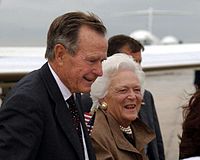 George and Barbara Bush, 2001 His eldest son, George W. Bush, was inaugurated as the 43rd president of the United States on January 20, 2001, and re-elected in 2004. Through previous administrations, the elder Bush had ubiquitously been known as "George Bush" or "President Bush", but following his son's election the need to distinguish between them has made retronymic forms such as "George H. W. Bush" and "George Bush senior" and colloquialisms such as "Bush 41" and "Bush the Elder" much more common. H.W. Bush was traveling to Minnesota for a speaking engagement on the day of the September 11 attacks. George W. made multiple calls to get in contact with his father before the two men reconnected after the elder Bush had gone to a Brookfield, Wisconsin motel.[273] Bush told biographer Jon Meacham that his son's vice president, Dick Cheney, underwent a change following the September 11 attacks: "His seeming knuckling under to the real hard-charging guys who want to fight about everything, use force to get our way in the Middle East.”[274] In December 2002, George W. sought counsel from the elder Bush regarding Iraq and informed him of "my efforts to rally the Saudis, Jordanians, Turks, and others in the Middle East".[275] Following the fall of Baghdad, Bush praised George W. in an April 2003 email to the incumbent president.[276] In a September 14, 2003 interview with BBC, Bush stated his support for a continuation of his son's war against terrorism and the US was in a better state in terms of protecting itself from terrorism than two years prior.[277] While visiting Houston VA Medical Center on December 17, Bush told reporters of his satisfaction with the capture of Saddam Hussein.[278] President and Mrs. Bush attended the state funeral of Ronald Reagan in June 2004,[279]and of Gerald Ford in January 2007.[280] One month later, he was awarded the Ronald Reagan Freedom Award in Beverly Hills, California, by former First Lady Nancy Reagan. Despite Bush's political differences with Bill Clinton, reports have acknowledged that the two former presidents have become friends.[281] He and Clinton appeared together in television ads in 2005, encouraging aid for victims of Hurricane Katrina and the 2004 Indian Ocean tsunami.[282] In October 2004, Bush endorsed Pete Sessions and Ted Poe in Texas congressional races.[283] In February 2006, Bush delivered a eulogy at the funeral ofCoretta Scott King.[284] On March 2, 2006, President Bush announced that his father would lead the American delegation to the inauguration of President-elect of the Republic of PortugalAnibal Cavaco Silva.[285] In September 2006, Bush campaigned for New Jersey Senate candidate Thomas Kean Jr., praising him as well as stating his respect for Kean calling on the resignation of US Defense Secretary Rumsfeld.[286] Kean went on to lose the election. The following month, he was honored by the National Italian American Foundation (NIAF) with the NIAF One America Award for fundraising, with Bill Clinton, for the victims of the 2004 tsunami andHurricane Katrina.[287] On February 18, 2008, Bush formally endorsed Senator John McCain for President of the United States.[288] The endorsement offered a boost to McCain's campaign, because theArizona Senator had been facing criticism among many conservatives.[289] During a trip toTokyo, Japan, Bush said that he would campaign vigorously against Senator Hillary Clintonif she were to initiate a presidential bid.[290] In March 2008, Bush met with President of the People's Republic of China Hu Jintao, who praised Bush for his attempts at harmonizing relations between the US and China.[291]  George H. W. Bush with son George W. Bush and China's President Hu Jintao in Beijing, People's Republic of China, August 10, 2008 During an address at the University of Kansas on November 16, 2008, Bush said that President-elect Obama would encounter diverse issues upon taking office and experience a wave of enthusiasm.[292] On January 10, 2009, George H. W. and George W. Bush were both present at the commissioning of USS George H.W. Bush (CVN-77), the tenth and last Nimitz-classsupercarrier of the United States Navy.[293][294] Bush paid a visit to the carrier again on May 26, 2009.[295] Obama presidencyIn June 2009, Bush came out in support for Sonia Sotomayor to receive fair hearings in her nomination for Associate Justice of the Supreme Court. "She was called by somebody a racist once. That's not right. I mean, that's not fair. It doesn't help the process. You're out there name-calling. So let them decide who they want to vote for and get on with it."[296] 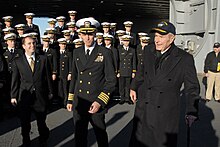 Capt. Kevin E. O'Flaherty, commanding officer of the aircraft carrier USS George H.W. Bush, escorts former President George H. W. Bush, 2009 In October 2009, Bush criticized the rampant criticism of the current times, reflecting that he did not receive such "day in and day out" during his presidency and namedKeith Olbermann and Rachel Maddow of MSNBC as examples; he called the two "sick puppies."[297] Also during that month, on October 16, Bush joined President Barack Obama onstage at Texas A&M University for a promotion of volunteering.[298] Following in the footsteps of his father and grandfather, Bush was an avid golfer. In 2011, he was inducted in theWorld Golf Hall of Fame.[299] On February 15, 2011, he was awarded the Presidential Medal of Freedom—the highest civilian honor in the United States—by President Barack Obama.[300] On March 29, 2012, Bush endorsed Mitt Romney for the Republican presidential nomination in the 2012 Presidential election. NBC News reported that Bush had chosen to support Romney three months prior.[301] In July 2013, Bush had his head shaved in a show of support for the two-year-old son of a member of his security detail, who had leukemia.[302] On July 7, Bush met with Gabrielle Giffords for part of her week-long Rights and Responsibilities Tour advocating expanded background checks in relation to firearm purchases.[303]  Bush meets President Barack Obama in the Oval Office, January 30, 2010 In April 2014, Frederick D. McClure, chief executive of the Bush library foundation, organized a three-day gathering inCollege Park, Texas, to mark the 25th anniversary of the Bush administration. Also in early 2014, the John F. Kennedy Library Foundation presented the Profile in Courage Award to Bush and Mount Vernon awarded him its first Cyrus A. Ansary rize.[304] The Kennedy foundation award was presented by Jack Schlossberg, the late president's grandson, to Lauren Bush Lauren, who accepted on her grandfather's behalf.[305] The Ansary prize was presented in Houston with Ansary, Barbara Lucas, Ryan C. Crocker, dean of the Bush school since January 2010, Barbara Bush, and Curt Viebranz in attendance with the former president. Bush directed $50,000 of the prize to the Bush school at Texas A&M, and $25,000 will fund an animation about the Siege of Yorktown for Mt. Vernon.[306] Viebranz and Lucas represented Mount Vernon at the presentation.[307][308] On June 12, 2014, Bush fulfilled a long-standing promise by skydiving on his 90th birthday. He made the parachute jump from a helicopter near his home at 11:15 a.m. in Kennebunkport, Maine. The jump marked the eighth time the former president had skydived, including jumps on his 80th and 85th birthday as well.[309] He had tweeted about the incident prior to the jump, saying "It's a wonderful day in Maine — in fact, nice enough for a parachute jump."[310][311] On December 7, 2016, Bush and former Senator Bob Dolecommemorated the 75th anniversary of the attack on Pearl Harbor by appearing at the Bush Center of Texas A&M University.[312] 2016 electionIn November 2014, George W. confirmed that his father wanted Jeb to launch a presidential bid in 2016.[313] Jeb decided to run for president, but struggled and withdrew from the Republican primary in the wave of anti-establishment sentiment led by Donald Trump.[314] Both Bushes emerged as frequent critics of Trump's policies and speaking style, with Trump frequently criticizing George W. Bush's presidency. George H.W. Bush later said that he voted for the Democratic nominee, Hillary Clinton, in the general election instead of Trump.[315] After Trump won the election, Bush sent him a congratulatory message.[316] Trump presidencyOn February 5, 2017, George and Barbara Bush participated in the coin toss for Super Bowl LI.[317] On May 18, 2017, after the death of Roger Ailes, Bush tweeted, "He wasn't perfect, but Roger Ailes was my friend & I loved him. Not sure I would have been President w/o his great talent, loyal help. RIP."[318] On August 16, 2017, Bush and his son George W. released a joint statement in which they condemned the violence at the Unite the Right rally.[319] On September 7, 2017, Bush partnered with former presidents Carter, Clinton, George W. Bush, and Obama to work with One America Appeal to help the victims of Hurricane Harveyand Hurricane Irma in the Gulf Coast and Texas communities.[320] Personal lifeFaithBush's Christian faith was shaped by his upbringing in the Episcopal Church, though by the end of his life his apparent religious beliefs have been considered more in line withEvangelical Christian doctrine and practices. Several key moments in Bush's life led to a deepening of his faith in Jesus Christ, including his narrow escape from Japanese forces in 1944 and the tragic death of his three-year-old child, Robin, in 1953. This strong faith would inspire many themes that later would become apparent in his public life, such as hisThousand Points of Light speech, his support for prayer in schools, and his strong support of the pro-life movement.[321] After his wife's death in April 2018, Bush released a statement through his spokesman, saying in part, "We have faith she is in heaven, and we know life will go on – as she would have it. So cross the Bushes off your worry list."[322] Health and longevityIn 1991, The New York Times revealed that Bush was suffering from Graves' disease, a non-contagious thyroid condition that his wife Barbara also had.[323] On February 24, 2000, Bush was standing at a reception for 90 minutes when he felt lightheaded. He was admitted to a hospital with an irregular heartbeat.[324] When Bush was released three days later, his doctors said that he had retained the irregularity in his heartbeat.[325] On March 11, 2007, Bush fainted on a golf course and was admitted to theEisenhower Medical Center in Rancho Mirage, but was released the following morning.[326] In July 2015, Bush suffered a severe neck injury. At age 91 in October that year, he was wearing a neck brace in his first public engagement since the accident when he threw theceremonial first pitch for the Houston Astros at Minute Maid Park.[327] Bush wrote a letter to president-elect Donald Trump in January 2017 to inform him that because of his poor health, he would not be able to attend Trump's inauguration on January 20; he gave him his best wishes. On January 18, he was admitted to the intensive care unit at Houston Methodist Hospital, where he was sedated for a procedure to treat an acute respiratory problem that was stemming from pneumonia.[328] Three months later, he experienced a recurrence of pneumonia and was hospitalized.[329] On November 25, 2017, Bush became the longest-lived U.S. president when he surpassed the 93 years and 165 days lifespan of Gerald Ford, who died in 2006.[330] Bush became the nation's oldest living president as well as the oldest living vice president. He was also the first president to reach the age of 94, reaching that milestone on June 12, 2018.[331]The longest-lived U.S. vice president is John Nance Garner, who died on November 7, 1967, 15 days short of his 99th birthday.[332] On April 22, 2018—the day after his wife's funeral—the former president was hospitalized with a blood infection.[333][334] The infection led to sepsis.[335] One month later, he was briefly hospitalized again, after experiencing fatigue and low blood pressure.[336][337] Sexual misconduct allegationsIn October 2017, during the #MeToo movement, actress Heather Lind accused Bush ofgroping her and telling an inappropriate joke. Several other women subsequently made similar allegations, including Christina Baker Kline and Roslyn Corrigan (who was 16 years old at the time of the alleged incident).[338] Bush apologized for these incidents through his spokesman, Jim McGrath.[339][340][341] Both Parkinson's and anti-parkinsonian medication are associated with a lack of impulse control.[342] DeathBush suffered from vascular parkinsonism, a form of Parkinson's disease that had forced him to use a motorized scooter or wheelchair since at least 2012.[343][344] Bush died on November 30, 2018, aged 94,[345] at his home in Houston.[346] Tributes and condolences were offered by former Presidents George W. Bush and Barack Obama, along with the daughters of President Richard Nixon.[347] In a statement, President Donald Trump praised Bush's leadership and accomplishments.[348] Presidential library The George Bush Presidential Library on the west campus of Texas A&M University in College Station, Texas The George Bush Presidential Library is the nation's tenthpresidential library and was built between 1995 and 1997.[349] It contains the presidential and vice presidential papers of Bush and the vice presidential papers of Dan Quayle.[350] It was dedicated on November 6, 1997, and opened to the public shortly thereafter; the architectural firm of Hellmuth, Obata and Kassabaum designed the complex.[351][352] The George Bush Presidential Library and Museum is located on a 90-acre (360,000 m2) site on the west campus of Texas A&M University in College Station, Texas, on a plaza adjoining the Presidential Conference Center and the Texas A&M Academic Center.[353] The Library operates underNARA's administration and the provisions of the Presidential Libraries Act of 1955.[354] The Bush School of Government and Public Service is a graduate public policy school at Texas A&M University in College Station, Texas, that was established in 1995.[353] The graduate school is part of the presidential library complex, and offers four programs: two master's degree programs (Public Service and Administration, and International Affairs) and three certificate programs (Advanced International Affairs, Nonprofit Management, andHomeland Security).[355] |





.jpg)




,_New_Orleans,_former_President_George_H._Bush_sits_down_to_eat_with_military_personnel.jpg)


