Bernardo Bertolucci |
|---|
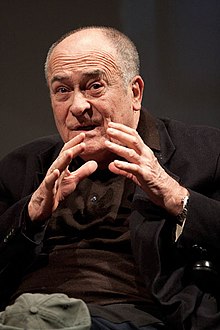 Bertolucci in 2011 |
| Born | 16 March 1941
|
|---|
| Died | 26 November 2018 (aged 77)
|
|---|
| Occupation | |
|---|
| Years active | 1962–2018 |
|---|
| Parent(s) | |
|---|
|
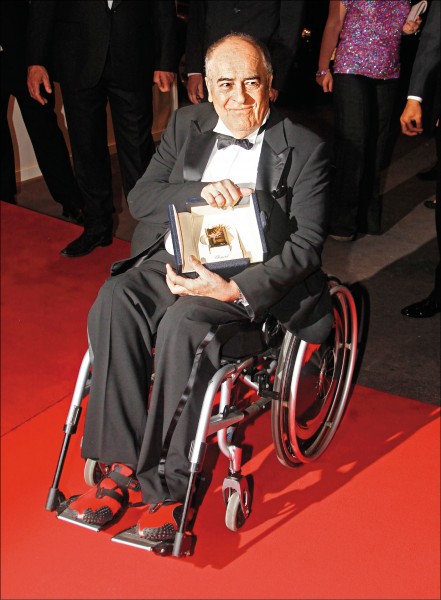
Bernardo Bertolucci (Italian: [berˈnardo bertoˈluttʃi]; 16 March 1941 – 26 November 2018) was an Italian director and screenwriter, whose films include The Conformist, Last Tango in Paris, 1900, The Last Emperor (for which he won the Academy Award for Best Director and the Academy Award for Best Adapted Screenplay), The Sheltering Sky,Little Buddha, Stealing Beauty and The Dreamers. In recognition of his work, he was presented with the inaugural Honorary Palme d'Or Award at the opening ceremony of the2011 Cannes Film Festival.[2] From 1979 until his death in 2018, he was married to screenwriter Clare Peploe.[3]
Early life
Bertolucci was born in the Italian city of Parma, in the region of Emilia-Romagna. He was the elder son of Ninetta (Giovanardi), a teacher, and Attilio Bertolucci, who was a poet, a reputed art historian, anthologist and film critic.[4] His mother was born in Australia, to an Italian father and an Irish mother.[5][6] Having been raised in an artistic environment, Bertolucci began writing at the age of fifteen, and soon after received several prestigious literary prizes including the Premio Viareggio for his first book. His father's background helped his career: the elder Bertolucci had helped the Italian filmmaker Pier Paolo Pasolinipublish his first novel, and Pasolini reciprocated by hiring Bertolucci as first assistant in Rome on Accattone (1961).
Bertolucci had one brother, the theatre director and playwright Giuseppe (27 February 1947 – 16 June 2012). His cousin was the film producer Giovanni Bertolucci (24 June 1940 – 17 February 2005), with whom he worked on a number of films.
Career
Directorial breakthrough
Bertolucci initially wished to become a poet like his father. With this goal in mind, he attended the Faculty of Modern Literature of the University of Rome from 1958 to 1961, where his film career as an assistant director to Pasolini began.[7] Shortly after, Bertolucci left the University without graduating. In 1962, at the age of 22, he directed his first feature film, produced by Tonino Cervi with a screenplay by Pasolini, called La commare secca(1962). The film is a murder mystery, following a prostitute's homicide. Bertolucci uses flashbacks to piece together the crime and the person who committed it. The film which shortly followed was his acclaimed Before the Revolution (Prima della rivoluzione, 1964).
The boom of Italian cinema, which gave Bertolucci his start, slowed in the 1970s as directors were forced to co-produce their films with several of the American, Swedish, French, and German companies and actors due to the effects of the global economic recession on the Italian film industry.
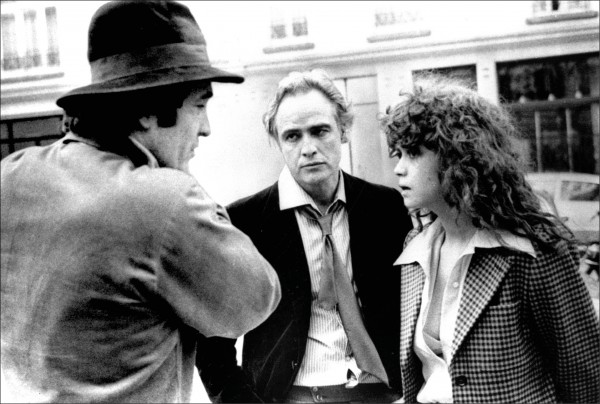
Bertolucci caused controversy in 1972 with the film Last Tango in Paris, starring Marlon Brando, Maria Schneider, Jean-Pierre Léaud and Massimo Girotti. The film presents Brando's character, Paul, as he copes with his wife’s suicide by emotionally and physically dominating a young woman, Jeane (Schneider). The depictions of Schneider, then 19 years old, were regarded as exploitative. In one scene, Paul anally rapes Jeane using butter as a lubricant. The use of butter was not in the script; Bertolucci and Brando had discussed it, but they did not tell Schneider. She said in 2007 that she had cried "real tears" during the scene and had felt humiliated and "a little raped".[8][9][10] In 2013 Bertolucci said that he had withheld the information from Schneider to generate a real "reaction of frustration and rage".[9] Brando alleged that Bertolucci had wanted the characters to have real sex, but Brando and Schneider both said it was simulated.[8] In 2016 Bertolucci released a statement where he clarified that Schneider had known of the violence to be depicted in the scene, but had not been told about the use of butter.[11]
Following the scandal surrounding the film's release, Schneider became a drug addict and suicidal.[12] She later became a women's rights advocate, in particular fighting for more female film directors, more respect for female actors and better representation of women in film and media.[13] Criminal proceedings were brought against Bertolucci in Italy for the rape scene; the film was sequestered by the censorship commission and all copies were ordered destroyed. An Italian court revoked Bertolucci's civil rights for five years and gave him a four-month suspended prison sentence.[14] In 1978 the Appeals Court of Bolognaordered three copies of the film to be preserved in the national film library with the stipulation that they could not be viewed, until Bertolucci was later able to re-submit it for general distribution with no cuts.[15][16][17][18]
Bertolucci increased his fame with his next few films, from1900 (1976), an epic depiction of the struggles of farmers inEmilia-Romagna from the beginning of the 20th century up toWorld War II with an international cast (Robert De Niro,Gérard Depardieu, Donald Sutherland, Sterling Hayden, Burt Lancaster, Dominique Sanda) to La Luna, set in Rome and inEmilia-Romagna, in which Bertolucci deals with the thorny issue of drugs and incest, and finally La tragedia di un uomo ridicolo (1981), with Ugo Tognazzi. Bertolucci appeared on the Radio Four programme Front Row on April 29, 2013, where he chose La Dolce Vita, a film directed by Federico Fellini, for the "Cultural Exchange".
During the making of Last Tango in Paris, Bertolucci toyed with the idea of adaptingDashiell Hammett's book Red Harvest into a feature film. That material had formed the basis for Akira Kurosawa’s Yojimbo, which in turn was the basis for Sergio Leone’s A Fistful of Dollars (Per un pugno di dollari). Countless others have used its premise since. The reason for this was his wanting to branch out into other forms of cinema. Bertolucci wrote two screenplays.[citation needed] The first draft was written almost entirely as a political film, from which emerged a story inspired by socialist syndicalism of the late 1920s in America. The second draft was more faithful to Hammett's original story and changed the setting to 1934. Actors considered for the role of The Continental Op were Robert Redford,Clint Eastwood and Jack Nicholson. In Rome, Bertolucci and Warren Beatty talked in great detail about the film, and in 1982 Bertolucci left Europe for Los Angeles, where he was to shoot Red Harvest, but five years went by and the film was never made.
The Last Emperor and later career
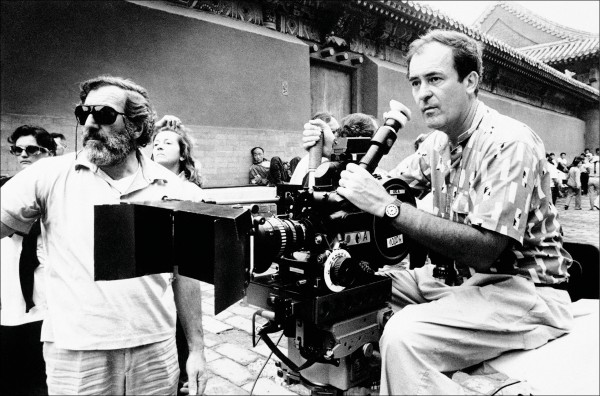
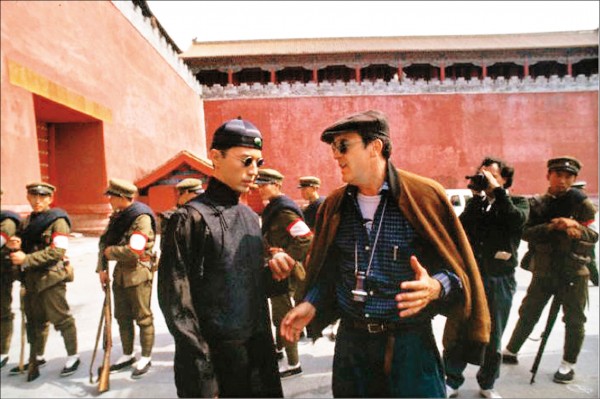
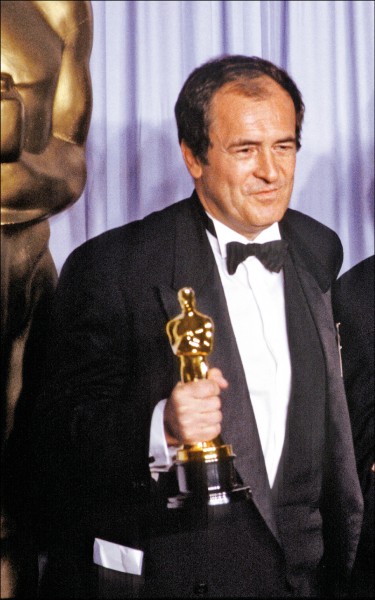
In 1987, Bertolucci directed the epic The Last Emperor, a biographical film telling the life story of Aisin-Gioro Puyi, the last Emperor of China. The film was independently produced by British producer Jeremy Thomas, who Bertolucci worked with almost exclusively from then on. The film was independently financed and three years in the making. Bertolucci won the Academy Award for Best Director. Bertolucci co-wrote the film with Mark Peploe.The Last Emperor uses Puyi's life as a mirror that reflects China's passage from feudalismthrough revolution to its current state.
At the 60th Academy Awards, The Last Emperor won all nine Oscars for which it was nominated: Best Picture, Best Director, Best Writing, Screenplay Based on Material from Another Medium, Best Cinematography, Best Film Editing, Best Costume Design, Best Art Direction-Set Decoration, Best Music, Original Score and Best Sound.
The Last Emperor was the first feature film ever authorized by the government of the People's Republic of China to film in the Forbidden City. Bertolucci had proposed the film to the Chinese government as one of two possible projects. The other film was La Condition Humaine by André Malraux. The Chinese government preferred The Last Emperor, and made no restrictions on the content. The Last Emperor became the first western film made in China and about the country to be produced with full Chinese government cooperation since 1949.
After The Last Emperor, and Little Buddha, the director went back to Italy to film, as well as to his old themes with varying results from both critics and the public. He filmed Stealing Beauty in 1996,[19] then The Dreamers in 2003, which describes the political passions and sexual revolutions of two siblings in Paris in 1968.[20]
In 2007, he received the Golden Lion Award at the Venice Film Festival for his life's work, and in 2011 he also received the Palme d'Or at the Cannes Film Festival.[21]
In 2012, his final film, Me and You was screened out of competition at the 2012 Cannes Film Festival[22][23] and was released early in 2013 in the UK. The film is an adaptation ofNiccolò Ammaniti's young-adult's book Io e te (You and Me). The screenplay for the movie was written by Bertolucci himself, Umberto Contarello and Niccolò Ammaniti.[24] Bertolucci originally intended to shoot the film in 3D but later changed his mind about this, calling the idea "vulgarly commercial".[25]
In April 2018, in an interview with the Italian edition of Vanity Fair, Bertolucci announced that he was preparing a new film. He stated, "The theme will be love, lets call it that. In reality, the theme is communication and therefore also lack of communication. The favorite subject of Michelangelo Antonioni and the condition I found myself facing when I moved on from my films of the sixties to a larger cinema ready to meet a larger audience."
As a screenwriter, producer and actor
Bertolucci also penned many screenplays, both for his own films as well as for films directed by others, two of which he also produced.
His only experience as an actor was in the film Golem: The Spirit of Exile, directed byAmos Gitai in 1992.
Politics and personal beliefs
Bertolucci was an atheist.[26]
Bertolucci's films are often very political. He was a professed Marxist and, like Luchino Visconti, who similarly employed many foreign artists during the late 1960s, Bertolucci used his films to express his political views; hence they are often autobiographical as well as highly controversial. His political films were preceded by others re-evaluating history. The Conformist (1970) criticised Fascist ideology, touched upon the relationship between nationhood and nationalism, as well as issues of popular taste and collective memory, all amid an international plot by Benito Mussolini to assassinate a politically active leftistprofessor of philosophy in Paris. 1900 also analyses the struggle of Left and Right.
On 27 September 2009, Bertolucci was one of the signers of the appeal to the Swiss government to release Roman Polanski, who was being held while waiting to be extradited to the United States.[27]
On Twitter on 24 April 2015, Bertolucci participated in #whomademyclothes, Fashion Revolution's anti-sweatshop campaign commemorating the 2013 Savar building collapse, the deadliest accident in the history of the garment industry.[28]
Death
Bertolucci died in Rome on 26 November 2018, at the age of 77 of cancer.[29][30][31]
Awards
Cinematographic awards
Honours
- Grand-Officer of the Order of Merit of the Italian Republic of Italy (Rome, 2 June 1988), under proposal of the Council of Ministers.
- Gold Medal of the Italian Medal of Merit for Culture and Art of Italy (Rome, 21 February 2001). For having been able to combine poetry and great cinema as in the history of Italian cinema. For having known how to make different cultures and worlds dialogue, remaining strongly rooted in the culture of your country. For having been able to represent with passion and courage the political, social and cultural history of the last hundred years.
- Laurea Magistrale Honoris Causa in Storia e critica delle arti e dello spettacolo. Bernardo Bertolucci is one of the greatest and recognized filmmakers in the world. His cinema is a reference point for entire generations of directors, has thrilled millions of viewers, also arousing extensive cultural debates that have gone well beyond the film industry, and is the subject of significant historical and theoretical studies published in all more languages in the world.
https://en.wikipedia.org/wiki/Bernardo_Bertolucci