Joan Didion (; December 5, 1934 – December 23, 2021) was an American writer who launched her career in the 1960s after winning an essay contest sponsored by Vogue magazine.[2] Her writing during the 1960s through the late 1970s engaged audiences in the realities of the counterculture of the 1960s and the Hollywood lifestyle. Her political writing often concentrated on the subtext of political and social rhetoric. In 1991, she wrote the earliest mainstream media article to suggest the Central Park Five had been wrongfully convicted.[2] In 2005, she won the National Book Award for Nonfiction and was a finalist for both the National Book Critics Circle Award and the Pulitzer Prize for Biography/Autobiography for The Year of Magical Thinking. She later adapted the book into a play, which premiered on Broadway in 2007. Didion was profiled in the Netflix documentary The Center Will Not Hold, directed by her nephew Griffin Dunne, in 2017.
Early life and education[edit]
Didion was born on December 5, 1934, in Sacramento, California,[3][4] to Frank Reese and Eduene (née Jerrett) Didion.[3] Didion recalled writing things down as early as the age of five,[3] though she said that she never saw herself as a writer until after her work had been published. She identified as a "shy, bookish child" who pushed herself to overcome social anxiety through acting and public speaking. She read everything she could get her hands on. She spent her adolescence typing out Ernest Hemingway's works to learn more about how sentence structures work.[4]
Didion's early education was not traditional. She attended kindergarten and first grade, but because her father was a finance officer in the Army Air Corps and the family constantly relocated, she did not attend school regularly.[5] In 1943 or early 1944, her family returned to Sacramento, and her father went to Detroit to negotiate defense contracts for World War II. Didion wrote in her 2003 memoir Where I Was From that moving so often made her feel like a perpetual outsider.[4]
Didion received a Bachelor of Arts degree in English from the University of California, Berkeley in 1956.[6] During her senior year, she won first place in the "Prix de Paris"[7] essay contest sponsored by Vogue, and was awarded a job as a research assistant at the magazine, having written a story on the San Francisco architect William Wurster.[8]
During her seven years at Vogue, Didion worked her way up from promotional copywriter to associate feature editor.[7] Mademoiselle published Didion's article "Berkeley’s Giant: The University of California" in January 1960.[9] While at Vogue, and homesick for California, she wrote her first novel, Run, River (1963), about a Sacramento family as it comes apart.[3] Writer and friend John Gregory Dunne helped her edit the book and they moved into an apartment together. A year later they married, and Didion returned to California with her new husband; they also adopted daughter Quintana Roo.[3] Didion and Dunne wrote many newsstand-magazine assignments. "She and Dunne started doing that work with an eye to covering the bills, and then a little more," Nathan Heller reported in The New Yorker. "Their [Saturday Evening] Post rates allowed them to rent a tumbledown Hollywood mansion, buy a banana-colored Corvette Stingray, raise a child, and dine well."[10] She published her first work of nonfiction, Slouching Towards Bethlehem, a collection of magazine pieces about her experiences in California, in 1968.[11][8] The New York Times referred to it as containing "grace, sophistication, nuance, [and] irony".[12]
Didion's novel Play It as It Lays, set in Hollywood, was published in 1970, and A Book of Common Prayer appeared in 1977. In 1979, she published The White Album, another collection of magazine pieces that previously appeared in Life, Esquire, The Saturday Evening Post, The New York Times, and The New York Review of Books.[8]
Didion's book-length essay Salvador (1983) was written after a two-week trip to El Salvador with her husband. The next year, she published the novel Democracy, the story of a long but unrequited love affair between a wealthy heiress and an older man, a CIA officer, against the background of the Cold War and the Vietnam War. Her 1987 nonfiction book Miami looked at the different communities in that city.[5]
In a prescient New York Review of Books piece of 1991, a year after the various trials of the Central Park Five had ended, Didion dissected serious flaws in the prosecution's case, becoming the earliest mainstream writer to view the guilty verdicts as a miscarriage of justice.[13] She suggested the defendants were found guilty because of a sociopolitical narrative with racial overtones that clouded the court's judgment.[14][15][16]
In 1992, she published After Henry, a collection of twelve geographical essays and a personal memorial for Henry Robbins, who was Didion's friend and editor from 1966 until his death in 1979. She published The Last Thing He Wanted, a romantic thriller, in 1996. Dunne and Didion worked closely together for most of their careers. Much of their writing is therefore intertwined. They co-wrote a number of screenplays, including a 1972 film adaptation of her novel Play It as It Lays that starred Anthony Perkins and Tuesday Weld. They also spent several years adapting the biography of journalist Jessica Savitch into the Robert Redford and Michelle Pfeiffer film Up Close & Personal.[5]
Didion began writing The Year of Magical Thinking, a narrative of her response to the death of her husband and the severe illness of their daughter, Quintana Roo Dunne Michael, on October 4, 2004, and finished the manuscript 88 days later on New Year's Eve.[17] Written at the age of seventy, this was her first nonfiction book that was not a collection of magazine assignments.[10] She went on a book tour following the book's release, doing many readings and promotional interviews, and said that she found the process very therapeutic during her period of mourning.[18]
Everyman's Library published We Tell Ourselves Stories in Order to Live, a 2006 compendium of much of Didion's writing, including the full content of her first seven published nonfiction books (Slouching Towards Bethlehem, The White Album, Salvador, Miami, After Henry, Political Fictions, and Where I Was From), with an introduction by her contemporary, the critic John Leonard.[citation needed]
Didion began working with English playwright and director David Hare on a one-woman stage adaptation of The Year of Magical Thinking in 2007. Produced by Scott Rudin, the Broadway play featured Vanessa Redgrave. Although she was hesitant to write for the theater, eventually she found the genre, which was new to her, quite exciting.[18]
Didion wrote early drafts of the screenplay for an HBO biopic directed by Robert Benton on The Washington Post publisher Katharine Graham. It was untitled. Sources say it may trace the paper's reporting on the Watergate scandal which led to President Richard Nixon's resignation.[19]
Knopf published Blue Nights, a memoir about aging, in 2011, which also focused on Didion's daughter, who died just before The Year of Magical Thinking was published.[20] The book addresses their relationship with "stunning frankness."[21] More generally, the book deals with the anxieties Didion experienced about adopting and raising a child, as well as the aging process.[22]
Didion published Let Me Tell You What I Mean, a collection of 12 essays she wrote between 1968 and 2000, in 2021.[23]
A photo of Didion shot by Juergen Teller was used as part of the spring/summer 2015 campaign of the luxury French brand Céline.[24]
Writing style[edit]
New Journalism[edit]
Didion's Slouching Towards Bethlehem exemplifies much of what New Journalism represents as it explores the cultural values and experiences of American life in the 1960s. She included her personal feelings and memories in this first-person narrative and described the chaos of individuals and the way in which they perceived the world. Rejecting conventional journalism, she created a subjective approach to essays and a style that was her own.[citation needed]
Writing style and themes[edit]
Didion viewed the structure of the sentence as essential to her work. In the New York Times article "Why I Write" (1976),[25] Didion remarked, "To shift the structure of a sentence alters the meaning of that sentence, as definitely and inflexibly as the position of a camera alters the meaning of the object photographed... The arrangement of the words matters, and the arrangement you want can be found in the picture in your mind...The picture tells you how to arrange the words and the arrangement of the words tells you, or tells me, what's going on in the picture."[25]
Didion was heavily influenced by Ernest Hemingway, whose writing taught her the importance of how sentences work in a text. Her other influences included Henry James, who wrote "perfect, indirect, complicated sentences", and George Eliot.[26]
Didion was also an observer of journalists,[27] believing the difference between the process of fiction and nonfiction is the element of discovery that takes place in nonfiction, which happens not during the writing, but the research.[26]
Rituals were a part of Didion's creative process. At the end of the day, she would take a break from writing to remove herself from the "pages",[26] saying that without the distance, she could not make proper edits. She would then end the day by cutting out and editing prose, and reviewing the work the following day. She would sleep in the same room as her book, saying "That's one reason I go home to Sacramento to finish things. Somehow the book doesn't leave you when you're right next to it."[26]
In a notorious 1980 essay, "Joan Didion: Only Disconnect", Barbara Grizzuti Harrison called Didion a "neurasthenic Cher" whose style was "a bag of tricks" and whose "subject is always herself".[28] In 2011, New York magazine reported that the criticism "still gets her (Didion's) hackles up, decades later".[29]
Awards and honors[edit]
Didion was elected to the American Academy of Arts and Letters in 1981.[30]
She was awarded the Edward MacDowell Medal in 1996.[31]
She received the St. Louis Literary Award from the Saint Louis University Library Associates in 2002.[32][33]
Didion was widely honored for The Year of Magical Thinking, which received the National Book Award for Nonfiction in 2005 and the Prix Medicis Essais in 2007.[34] Documenting the grief she experienced after the sudden death of her husband, the book was called a "masterpiece of two genres: memoir and investigative journalism".[18]
She received the Golden Plate Award of the American Academy of Achievement presented by Awards Council member Justice Anthony M. Kennedy in 2006.[35][36] That same year, she was elected to the American Philosophical Society.[37]
Didion received the National Book Foundation's annual Medal for Distinguished Contribution to American Letters in 2007. From the citation: "An incisive observer of American politics and culture for more than forty-five years, her distinctive blend of spare, elegant prose and fierce intelligence has earned her books a place in the canon of American literature as well as the admiration of generations of writers and journalists."[38] That year, Didion also won the Evelyn F. Burkey Award from the Writers Guild of America.[39]
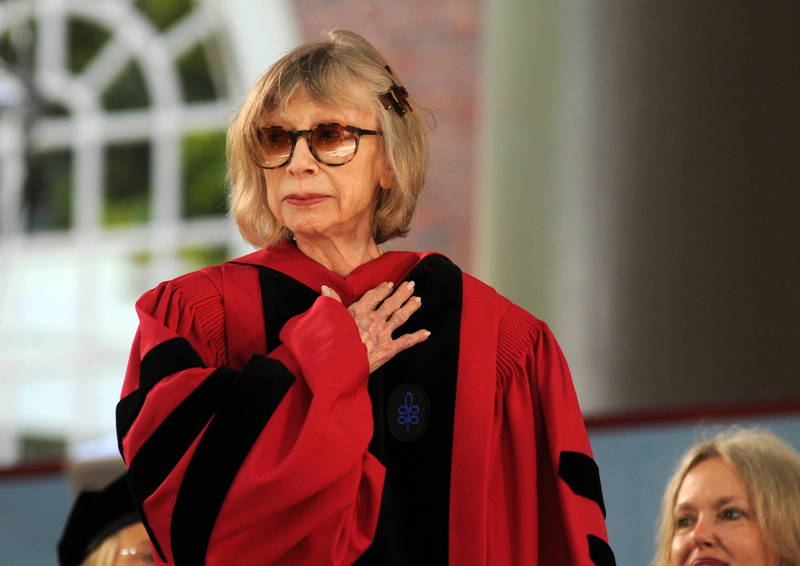
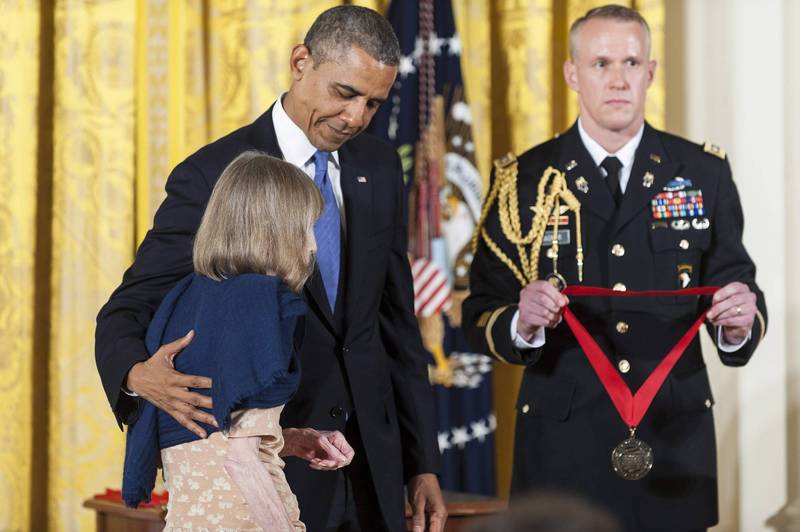
Didion was awarded an honorary Doctor of Letters degree by Harvard University in 2009.[40] Yale University conferred another honorary Doctor of Letters upon her in 2011.[41] On July 3, 2013, the White House announced her as one of the recipients of the National Medal of Arts, presented by President Barack Obama.[42]
Personal life[edit]
While in New York and working at Vogue, Didion met John Gregory Dunne, her future husband, who was writing for Time magazine. He was the younger brother of the author, businessman, and television mystery show host Dominick Dunne. The couple married in 1964 and moved to Los Angeles, intending to stay only temporarily, but California remained their home for the following 20 years. They adopted a baby, whom they named Quintana Roo Dunne, in March 1966 as their daughter.[43] Didion lived in Los Feliz from 1963 to 1971; in 1979, she was living in Brentwood Park, a quiet, affluent, residential neighborhood of Los Angeles.[44][45]
In the title essay of The White Album, Didion documents a nervous breakdown she experienced in the summer of 1968. After undergoing psychiatric evaluation, she was diagnosed as having had an attack of vertigo and nausea. She was also diagnosed with multiple sclerosis.[46] In her essay "In Bed", Didion explains that she experienced chronic migraines.[47]
In 2003, her daughter Quintana Roo Dunne had pneumonia that progressed to septic shock, and was comatose in ICU when Didion's husband died of a heart attack on December 30.[5] Didion delayed his funeral arrangements for approximately three months until Quintana was well enough to attend.[5] Visiting Los Angeles after her father's funeral, Quintana fell at the airport, hit her head on the pavement and required brain surgery for hematoma.[17] After progressing toward recovery in 2004, she died of acute pancreatitis on August 26, 2005, aged 39, during Didion's New York promotion for The Year of Magical Thinking.[18] Didion wrote about Quintana's death in the 2011 book Blue Nights.
Didion was living in an apartment on East 71st Street in New York City in 2005.[17] Her nephew Griffin Dunne directed a 2017 Netflix documentary about her, Joan Didion: The Center Will Not Hold.[48] Didion discusses her writing and personal life, including the deaths of her husband and daughter, adding context to her books The Year of Magical Thinking and Blue Nights.[49]
Didion died from complications of Parkinson's disease at her home in Manhattan on December 23, 2021, at the age of 87.[3]
Fiction
Nonfiction
Screenplays
Plays
https://en.wikipedia.org/wiki/Joan_Didion