| Burt Reynolds |
|---|
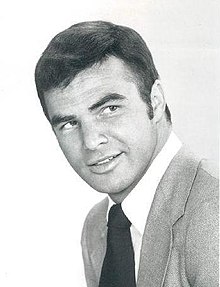 Reynolds in a publicity photo for Dan August(1970) |
| Born | Burton Leon Reynolds Jr.[1]
February 11, 1936
Lansing, Michigan, U.S. |
|---|
| Died | September 6, 2018 (aged 82)
Jupiter, Florida, U.S. |
|---|
| Occupation | Actor, director, producer |
|---|
| Years active | 1958–2018 |
|---|
| Spouse(s) |
|
|---|
| Partner(s) | Sally Field (1977–1982) |
|---|
| Children | 1 |
|---|
Burton Leon Reynolds Jr. (February 11, 1936 – September 6, 2018) was an American actor, director and producer. He first rose to prominence starring in television series such as Gunsmoke (1962–1965), Hawk (1966), andDan August (1970–1971).
His breakout film role was as Lewis Medlock inDeliverance (1972). Reynolds played the leading role in a number of subsequent box office hits, such as The Longest Yard (1974),Smokey and the Bandit (1977), Semi-Tough(1977), Hooper (1978), Smokey and the Bandit II (1980), The Cannonball Run (1981) and The Best Little Whorehouse in Texas(1982).
After a few box office failures, Reynolds returned to television, starring in the sitcomEvening Shade (1990–1994). He was nominated for the Academy Award for Best Supporting Actor for his performance inBoogie Nights (1997).[2][3][4]
Early life

Reynolds as Quint Asper in
Gunsmoke 1962
Burton Leon Reynolds Jr. was the son of Harriette Fernette "Fern" (née Miller; 1902–1992) and Burton Milo Reynolds (1906–2002). He had Dutch, English, Scots-Irish, and Scottish ancestry, and is also said to have had Cherokee roots, although this has been contested.[5][6] During his career, he often claimed to have been born in Waycross, Georgia, but said in 2015 that he was actually born in Lansing, Michigan.[7] He was born on February 11, 1936,[8] and in his autobiography stated that Lansing is where his family lived when his father was drafted into the United States Army.[9][10] He, his mother, and his sister joined his father at Fort Leonard Wood, Missouri, and lived there for two years. When his father was sent to Europe, the family moved to Lake City, Michigan, where his mother had been raised.[11] In 1946, the family moved to Riviera Beach, Florida. His father became Chief of Police of Riviera Beach, which is adjacent to the north side of West Palm Beach, Florida.
During 10th grade at Palm Beach High School, Reynolds was named First Team All State and All Southern as a fullback, and received multiple scholarship offers.[12]
College
After graduating from Palm Beach High, he attended Florida State University on a footballscholarship and played halfback.[13] While at Florida State, he roomed with college football broadcaster and analyst Lee Corso, and also became a brother of the Phi Delta Thetafraternity.[14] He hoped to be named to All-American teams and have a career in professional football, but he injured his knee in the first game of his sophomore season, and later that year lost his spleen and injured his other knee by a car accident.[15] These injuries hampered his abilities on the field, and after being beaten in coverage for the game-winning touchdown in a 7-0 loss to North Carolina State on October 12, 1957, he decided to give up football.
Ending his college football career, Reynolds thought of becoming a police officer, but his father suggested he finish college and become a parole officer. To keep up with his studies, he began taking classes at Palm Beach Junior College (PBJC) in neighboring Lake Park. In his first term at PBJC, he was in an English class taught by Watson B. Duncan III. Duncan pushed him into trying out for a play he was producing, Outward Bound. He cast him in the lead role based on having heard him read Shakespeare in class, leading to his winning the 1956 Florida State Drama Award for his performance. In his autobiography, he referred to Duncan as his mentor and the most influential person in his life.[16]
Career
Theatre

Reynolds with the Citrus Queen at Garnet and Gold Football Game, Florida State University, 1963
The Florida State Drama Award included a scholarship to the Hyde Park Playhouse, a summer stock theatre, in Hyde Park, New York. Reynolds saw the opportunity as an agreeable alternative to more physically demanding summer jobs, but did not yet see acting as a possible career. While working there, Reynolds met Joanne Woodward, who helped him find an agent, and was cast inTea and Sympathy at the Neighborhood Playhouse in New York City. After his Broadway debut Look, We've Come Through, he received favorable reviews for his performance and went on tour with the cast, driving the bus and appearing on stage.[17]
After the tour, Reynolds returned to New York and enrolled in acting classes, along withFrank Gifford, Carol Lawrence, Red Buttons and Jan Murray. After a botched improvisation in acting class, Reynolds briefly considered returning to Florida, but he soon gained a part in a revival of Mister Roberts, in which Charlton Heston played the starring role. After the play closed, the director, John Forsythe, arranged a film audition with Joshua Logan for Reynolds. The film was Sayonara (1957). Reynolds was told that he could not be in the film, because he looked too much like Marlon Brando. Logan advised Reynolds to go toHollywood, but Reynolds did not feel confident enough to do so.[18] He worked in a variety of jobs, such as waiting tables, washing dishes, driving a delivery truck and as a bouncer at the Roseland Ballroom. Reynolds wrote that, while working as a dockworker, he was offered $150 to jump through a glass window on a live television show.[19]
Early Television & Riverboat
oni_Anderson_and_Burt_Reynolds.jpg" class="image" style="text-decoration: none; color: rgb(11, 0, 128); background: none;">

oni_Anderson_and_Burt_Reynolds.jpg" class="internal" title="Enlarge" style="text-decoration: none; color: rgb(11, 0, 128); display: block; text-indent: 15px; white-space: nowrap; overflow: hidden; width: 15px; height: 11px; -webkit-user-select: none; background: linear-gradient(transparent, transparent), url("data:image/svg+xml,%3Csvg xmlns=%22http://www.w3.org/2000/svg%22 viewBox=%220 0 11 15%22 width=%2215%22 height=%2211%22%3E %3Cg id=%22magnify-clip%22 fill=%22%23fff%22 stroke=%22%23000%22%3E %3Cpath id=%22bigbox%22 d=%22M1.509 1.865h10.99v7.919h-10.99z%22/%3E %3Cpath id=%22smallbox%22 d=%22M-1.499 6.868h5.943v4.904h-5.943z%22/%3E %3C/g%3E %3C/svg%3E");">
Reynolds and Loni Anderson at the
43rd Primetime Emmy Awards 1991
He began acting on television in the late 1950s, guest starring on shows like Flight, M Squad, Schlitz Playhouse,The Lawless Years and Pony Express.
Reynolds' first big break came when he was cast alongsideDarren McGavin in the lead of the TV series Riverboat(1959-61), playing Ben Frazer. According to a contemporary report Reynolds was considered "a double for Marlon Brando.[20] The show went for two seasons but Reynolds quit after only 20 episodes, claiming he did not get along with McGavin or the executive producer, and that he had "a stupid part".[21]
Reynolds returned to guest starring on television shows. As he put it, "I played heavies in every series in town"[21] appearing in episodes of Playhouse 90, Johnny Ringo, Alfred Hitchcock Presents, Lock Up, The Blue Angels, Michael Shayne, Zane Grey Theater, The Aquanauts and The Brothers Brannagan.
Reynolds made his film debut in the low budget Angel Baby (1961), billed fourth. He followed it with a role in a war film, Armored Command (1961). "It was the one picture that Howard Keel didn't sing on," reminisced Reynolds later. "That was a terrible mistake."[22]
In 1961 he returned to Broadway to appear in Look, We've Come Through under the direction of Jose Quintero, but it only lasted five performances.[23]
Reynolds continued to guest star on shows such as Naked City, Ripcord, Everglades,Route 66, Perry Mason, and The Twilight Zone ("The Bard"). He later said "I learned more about my craft" in these guest shots "than I did standing around and looking virile onRiverboat."[24]
Gunsmoke
In 1962 Dennis Weaver wanted to leave the cast of Gunsmoke, one of the top rated shows in the country. The producers developed a new character, "halfbreed" blacksmith Quint Asper, Reynolds was cast, beating over 300 other contenders. Reynolds announced he would stay on the show "until it ends. I think it's a terrible mistake for an actor to leave a series in the middle of it."[21]
Reynolds wound up leaving Gunsmoke in 1965. He was cast in his first lead in a feature, the low budget action film Operation CIA (1965). He guest starred on Flipper, The FBI and12 O'Clock High.
Hawk and Leading Roles in Films
Reynolds was given the title role in a TV series, Hawk (1966-67), playing Native American detective John Hawk. It ran for 17 episodes before being cancelled.[25]
He played another Native American in the spaghetti western Navajo Joe (1966) shot in Spain."It wasn't my favorite picture," he said later. "I had two expressions - mad and madder."[26]
He guest starred on Gentle Ben and made a pilot for a TV series, Lassiter, that was not picked up.
Reynolds then made a series of films in quick succession. Shark! (1968), shot in Mexico, was directed by Sam Fuller who took his name off it; it's release was held up a number of years. Fade-In which he described as "the best thing I've ever done,"[27] was not released for a number of years, and the director took his name off. Impasse (1969), was a war movie shot in the Philippines. He played the title role Sam Whiskey (1969) which he later claimed was "way ahead of its time. I was playing light comedy and nobody cared."[28]
He supported Jim Brown and Raquel Welch in a Western, 100 Rifles (1969), later saying "I spent the entire time refereeing fights between Jim Brown and Raquel Welch."[29] then
Reynolds was in Skullduggery (1970), shot in Jamaica. He was in the TV films Hunters Are for Killing (1970) and Run, Simon, Run (1970).
Dan August
Reynolds played the title character in police drama Dan August (1970–71). He later disparaged the series, telling Johnny Carson that Dan August had "two forms of expression: mean and meaner".
Reynolds appeared on ABC's The American Sportsman hosted by outdoors journalist Grits Gresham, who took celebrities on hunting, fishing and shooting trips around the world. Saul David considered Reynolds to star in Our Man Flint, but Lew Wasserman rejected him.[30][31] Albert R. Broccoli asked Reynolds to play James Bond, but he turned the role down, saying "An American can't play James Bond. It just can't be done."[32]
Major Star
Reynolds had his breakout role in Deliverance and gained notoriety when he posed naked in the April 1972 issue of Cosmopolitan.[33][34][35]
"I've waited 15 years to do a really good movie," he said in 1972. "I made so many bad pictures. I was never able to turn anyone down. The greatest curse in Hollywood is to be a well known unknown."[36]
During the 1970s, Reynolds played leading roles in a series of action films and comedies, such as White Lightning (1973), The Man Who Loved Cat Dancing (also 1973), Lucky Lady (1975) or Smokey and the Bandit (1977). He made his directorial debut in 1976 withGator, the sequel to White Lightning. During the 1980s, his leading roles included The Cannonball Run (1981), Malone (1987) and All Dogs Go to Heaven (1989). After starring in Paul Thomas Anderson's second film Boogie Nights (1997), Reynolds refused to star in Anderson's third film, Magnolia (1999). Despite this, Reynolds was nominated for theAcademy Award for Best Supporting Actor for Boogie Nights.[4][37]
He voiced Avery Carrington in Grand Theft Auto: Vice City, released in 2002.[38] He had support parts in Miss Lettie and Me (2003) and Without a Paddle (2004), and two high-profile films: the remake of The Longest Yard (2005) and The Dukes of Hazzard (2005).[39]Reynolds turned in a critically acclaimed performance in the drama The Last Movie Star(2017), one of his last films.[40] In May 2018, he joined the cast for Quentin Tarantino's filmOnce Upon a Time in Hollywood,[41] but died before shooting his scenes.[42]
Author
Reynolds co-authored the 1997 children's book Barkley Unleashed: A Pirate's Tail, a "whimsical tale [that] illustrates the importance of perseverance, the wonders of friendship and the power of imagination".[43]
Music
In 1973, Reynolds released the album Ask Me What I Am and in 1983 sang along withDolly Parton in The Best Little Whorehouse in Texas.[44]
Bankruptcy
Despite his lucrative career, in 1996 he filed for Chapter 11 bankruptcy, due in part to an extravagant lifestyle, a divorce from Loni Anderson and failed investments in some Florida restaurant chains.[45][46] Reynolds emerged from bankruptcy two years later.[3]
Personal life
Reynolds was married to English actress Judy Carne from 1963 to 1965. He and American singer-actress Dinah Shore were in a relationship in the early 1970s for about five years.[47] He had a relationship from about 1977 to 1982 with American actress Sally Field.[48] Reynolds was married to American actress Loni Anderson from 1988 to 1993. They adopted a son, Quinton.[49]He and Anderson separated after he fell in love with a cocktail waitress, with whom he later traded lawsuits which were settled out of court.[3]
Reynolds' close friends were Johnny Carson, James Hampton,Dom DeLuise, Jerry Reed, Charles Nelson Reilly, Tammy Wynette, Lucie Arnaz, Adrienne Barbeau, Tawny Little, Dinah Shore and Chris Evert.[50]
In the late 1970s, Reynolds opened Burt's Place, a nightclub restaurant in the Omni International Hotel in the Hotel District of Downtown Atlanta, and briefly operated a second version at Lenox Square.[51] He was a life-long fan of American football, a result of his collegiate career, and was a minority owner of the Tampa Bay Bandits of the USFL from 1982 to 1986.[52][53] The team's name was inspired by the Smokey and the Bandit trilogy and Skoal Bandit, a primary sponsor for the team as a result of also sponsoring Reynolds' motor racing team.[54]
Reynolds co-owned a NASCAR Winston Cup team, Mach 1 Racing, with Hal Needham, which ran the #33 "Skoal Bandit" car with driver Harry Gant.[55] He was awarded anhonorary doctorate from Florida State University in 1981 and later endorsed the construction of a new performing arts facility in Sarasota, Florida.[56] He also owned a private theater in Jupiter, Florida, with a focus on training young performers looking to enter show business.[57] In 1984, he opened a restaurant in Fort Lauderdale, "Burt & Jacks", that he co-owned with Jack Jackson.[58]
While filming City Heat, Reynolds was struck in the face with a metal chair and hadtemporomandibular joint dysfunction. He lost thirty pounds from not eating. The painkillershe was prescribed led to addiction, which lasted several years. He underwent back surgery in 2009 and a quintuple coronary artery bypass surgery in February 2010.[3]
On August 16, 2011, Merrill Lynch Credit Corporation filed foreclosure papers, claiming Reynolds owed US$1.2 million on his home in Hobe Sound, Florida.[59] He owned the Burt Reynolds Ranch, where scenes for Smokey and the Bandit were filmed and which once had a petting zoo, until its sale during bankruptcy.[60] In April 2014, the 153-acre (62 ha) rural property was rezoned for residential use and the Palm Beach County school system could sell it to residential developer K. Hovnanian Homes.[61] Reynolds also once purchased a mansion on a tract of land in Loganville, Georgia, while married to Loni Anderson.[62][63]
Death
Reynolds died at a Florida hospital on September 6, 2018.[64] He had heart problems for a number of years.[65] He was 82. His ex-wife Loni Anderson issued a statement including that she and their son Quinton would miss him and "his great laugh".[66]
On the day of Reynolds' death, Antenna TV, which airs The Tonight Show nightly, aired an episode of The Tonight Show Starring Johnny Carson from February 11, 1982, featuring an interview and a This Is Your Life-style skit with Reynolds. The local media in Atlanta and elsewhere in the state noted on their television news programs that evening that he was the first to make major films in Georgia, all of which were successful, which helped make the state one of the top filming locations in the country.[67][68][69][70]
Filmography
Discography
Singles
| Year | Title | Chart positions | Album | Songwriter |
|---|
| US Country | US | CAN Country |
|---|
| 1980 | "Let's Do Something Cheap and Superficial" | 51 | 88[72] | 33 | Smokey and the Bandit II Soundtrack | Richard Levinson |
Accolades
Other honors
Works
https://en.wikipedia.org/wiki/Burt_Reynolds



