Golden State Killer |
|---|
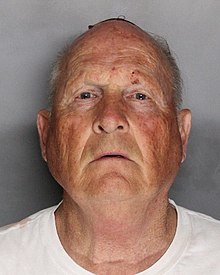 2018 mugshot of DeAngelo |
| Born | Joseph James DeAngelo Jr.
November 8, 1945 (age 74)
|
|---|
| Other names | |
|---|
| Occupation | Retired Police Officer |
|---|
| Height | ≈5 ft 10 in (1.78 m) |
|---|
| Spouse(s) | Sharon Marie Huddle ( m. 1973; div. 2019) |
|---|
| Children | 3 daughters |
|---|
|
| Conviction(s) | Murder and kidnapping |
|---|
| Details |
|---|
| Victims | - 13+ murdered
- 50+ raped
- 120+ burglarized
|
|---|
Span of crimes | 1974–1986 (unless more crimes are attributed to DeAngelo) |
|---|
| Country | United States |
|---|
| State(s) | California |
|---|
Date apprehended | April 24, 2018 |
|---|
The Golden State Killer is an American serial killer, serial rapist, burglar, and former police officer who committed at least 13 murders, more than 50 rapes, and over 100 burglaries in California between 1974 and 1986.[4][6] Joseph James DeAngelo Jr. (born November 8, 1945) is a United States Navy veteran and worked in law enforcement from 1973 to 1979. He pleaded guilty to the 13 murders of the Golden State Killer in June 2020.[7] He was responsible for at least three crime sprees throughout California, each of which spawned a different nickname in the press, before it became evident that they were committed by the same offender. He began as a burglar (the Visalia Ransacker) before moving to the Sacramento area, where he was known as the East Area Rapist and was linked by modus operandi to additional attacks in Contra Costa County, Stockton, and Modesto.[8][9] He was later known for his southern California crimes as the Original Night Stalker (Richard Ramirez later receiving the "Night Stalker" nickname). He taunted and threatened victims and police in obscene phone calls, and possibly written communications.
During the decades-long investigation, several suspects were cleared through DNA evidence, alibi, or other investigative methods.[2][10] In 2001, DNA testing indicated that the East Area Rapist and the Original Night Stalker were the same person, giving him the moniker EARONS (ronunciation_respelling_key" title="Help ronunciation respelling key" style="text-decoration-line: none; color: rgb(11, 0, 128); background: none;">eer-onz). The case was a factor in the establishment of California's DNA database, which collects DNA from all accused and convicted felons in California[11] and has been called second only to Virginia's in effectiveness in solving cold cases.[12] To heighten awareness that the uncaught killer operated throughout California, crime writer Michelle McNamara coined the name Golden State Killer in early 2013.
The Federal Bureau of Investigation (FBI) and local law-enforcement agencies held a news conference on June 15, 2016, to announce a renewed nationwide effort, offering a $50,000 reward for his capture.[13] On April 24, 2018, authorities charged 72-year-old DeAngelo with eight counts of first-degree murder, based upon DNA evidence.[14][15] Specifically, investigators identified members of DeAngelo's family through the use of forensic genetic genealogy.[16] This was also the first announcement connecting the Visalia Ransacker crimes to DeAngelo.[17] Owing to California's statute of limitations on pre-2017 rape cases,[18] DeAngelo cannot be charged with 1970s rapes,[19] but he was charged in August 2018 with 13 related kidnapping and abduction attempts.[20] On June 29, 2020, DeAngelo pleaded guilty to multiple counts of murder.[21] As part of the plea bargain, DeAngelo was also required to admit to crimes he had not been formally charged with, including rape.[22]
Joseph James DeAngelo Jr.[edit]
DeAngelo was born on November 8, 1945, in Bath, New York, to Joseph James DeAngelo Sr., a US Army Sergeant, and Kathleen Louise Bosanko.[23] He has two sisters and a brother, all younger than him. A relative reported that when DeAngelo was 9 or 10 years old he witnessed his 7-year-old sister being raped by two airmen in a warehouse in West Germany, where the family was stationed at the time.[24]
Between 1959 and 1960 he attended Mills Junior High School in Rancho Cordova. Beginning in 1961, he attended Folsom High School, from which he received a GED certificate in 1964. He played on the school's junior varsity baseball team.[25][26]
DeAngelo joined the U.S. Navy in September 1964,[27] and served for 22 months during the Vietnam War as a damage controlman on the cruiser USS Canberra[28] and USS Piedmont.[29] Beginning August 1968, DeAngelo attended Sierra College in Rocklin, California; he graduated with an associate degree in police science, with honors.[30]
In May 1970, DeAngelo became engaged to Bonnie Jean Colwell, a classmate at Sierra College, but she reportedly broke off the relationship. Investigators believe this might be connected to the offender's saying, "I hate you, Bonnie!", during one of the attacks.[31][32]
In 1971, he attended Sacramento State University, where he earned a bachelor's degree in criminal justice.[26][27] He later took post-graduate courses[27] and further police training at the College of the Sequoias in Visalia, then completed a 32-week police internship at the Roseville  olice Department.[33][34]
From May 1973 to August 1976, he was a burglary unit police officer in Exeter (a town of about 5,000 people, near Visalia),[35] having relocated from Citrus Heights.[25][34] By 1976, DeAngelo had been promoted to sergeant and was in charge of the Exeter Police Department's "Joint Attack on Burglary" program.[36] He then served in Auburn from August 1976 to July 1979, when he was arrested for shoplifting a hammer and dog repellent; he was sentenced to six months probation and fired that October.[31][37]
In November 1973, he married Sharon Marie Huddle in Placer (now known as Loomis). In 1980, they purchased the house in Citrus Heights where he was eventually arrested.[29] Huddle became an attorney in 1982, and they had three daughters, two of whom were born in Sacramento and one in Los Angeles, before the couple separated in 1991.[citation needed] In July 2018, Huddle filed for a divorce.[25][32][38] They were divorced in 2019.[39]
His employment history in the 1980s is unknown.[31] From 1990 until his retirement in 2017, he worked as a truck mechanic at a Save Mart Supermarkets distribution center in Roseville.[25][40] He was arrested in 1996 over an incident at a gas station; the charge was dismissed.[41]
His brother-in-law said that DeAngelo casually brought up the East Area Rapist in conversation around the time of the original crimes. Neighbors reported that DeAngelo frequently engaged in loud, profane outbursts.[37] One neighbor reported that his family received a phone message from DeAngelo threatening to "deliver a load of death" because of their barking dog.[42] He was living with a daughter and granddaughter at the time of his arrest.[31]
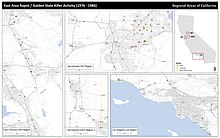
A map of attacks attributed to the Golden State Killer
DNA evidence links the Golden State Killer to eight murders in Goleta, Ventura, Dana Point, and Irvine; two other murders in Goleta, lacking DNA evidence, are linked by modus operandi.[43][44] Investigators suspect the same killer was involved in three other murders: two in Rancho Cordova, and one in Visalia.[2] The offender also committed more than 50 known rapes in the California counties of Sacramento, Contra Costa, Stanislaus, San Joaquin, Alameda, Santa Clara, and Yolo, in addition to hundreds of incidents of burglaries, thefts, vandalism, peeping, stalking, and prowling.[45]
Visalia Ransacker (April 1974 – December 1975)[edit]
It was long suspected that the training ground of the criminal who became the Golden State Killer was Visalia, California[46][47][48][49] (although earlier Visalia crimes dating back as early as May 1973 and other sprees like the 'Cordova Cat Burglar'[50] or the 'Exeter Ransacker',[51] as well as burglaries that took place after the McGowen shooting, are now suspected to be linked as well).[35][52] Over a period of 20 months, the Ransacker is believed to have been responsible for one murder and around 120 burglaries.[53] Most of the Ransacker's activities involved breaking into houses, going through (or vandalizing) the owners' possessions, scattering women's underclothing, stealing coins and low-value or personal items, while often ignoring banknotes and other valuable items in plain sight.[54]
In late April 2018, the Visalia chief of police stated that while there is no DNA linking DeAngelo to the Central Valley cases, his department has other evidence that will play a role in the investigation, and that he was "confident that the Visalia Ransacker has been captured."[55] Though the statutes of limitations for the burglaries have each expired,[8][56] DeAngelo was formally charged on August 13, 2018, with the first degree murder of Claude Snelling in 1975.[56][57] In 2020, DeAngelo pleaded guilty to the murder of Claude Snelling, confirming that he was the Visalia Ransacker.[58]
East Area Rapist (June 1976 – July 1979)[edit]
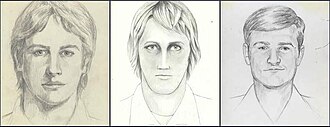
Three sketches on which the FBI focused when it reopened the case in June 2016
The Golden State Killer was believed to have moved to the Sacramento area, progressing from burglary to rape in mid-1976.[citation needed] The crimes initially centered on the then-unincorporated areas of Carmichael, Citrus Heights and Rancho Cordova, east of Sacramento.[6] His initial modus operandi was to stalk middle-class neighborhoods at night in search of women who were alone in one-story homes, usually near a school, creek, trail or other open space that would provide a quick escape.[59] He was seen a number of times, but always successfully fled; on one occasion, he shot and seriously wounded a young pursuer.[2]:187–188

Additional sketches of the suspect
[60]Most victims had seen (or heard) a prowler on their property before the attacks, and many had experienced break-ins. Police believed that the offender would conduct extensive reconnaissance in a targeted neighborhood — looking into windows and prowling in yards — before selecting a home to attack. It was believed that he sometimes entered the homes of future victims to unlock windows, unload guns, and plant ligatures for later use. He frequently telephoned future victims, sometimes for months in advance, to learn their daily routines.[61]
Although he originally targeted women alone in their homes or with children,[10][62] the offender eventually preferred attacking couples.[10][63] His usual method was to break in through a window or sliding glass door and awaken the sleeping occupants with a flashlight, threatening them with a handgun.[10] Victims were then bound with ligatures (often shoelaces) which he found or brought with him, blindfolded and gagged with towels which he had ripped into strips. The female victim was usually forced to tie up her male companion before she was bound.[64] The bindings were often so tight that the victims' hands were numb for hours after being untied.[2]:434 He separated the couple, often stacking dishes on the male's back and threatening to kill everyone in the house if he heard them rattle. He moved the woman to the living room and often raped her repeatedly, sometimes for several hours.[10][64][65]
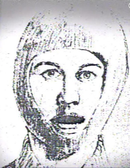
A victim described the
East Area Rapist's face as young and round, with wide eyes and a broad mouth.
[3]The offender sometimes spent hours in the home ransacking closets and drawers,[66] eating food in the kitchen, drinking beer, raping the female again or making additional threats. Victims sometimes thought he had left the house before he "jump[ed] from the darkness."[64] The offender typically stole items, often personal objects and items of little value but occasionally cash and firearms. He then crept away, leaving victims uncertain if he had left. The offender was believed to escape on foot through a series of yards and then use a bicycle to go home or to a car, making extensive use of parks, schoolyards, creek beds and other open spaces which kept him off the street.[2]
The rapist operated in Sacramento County from the first attacks in June 1976 until May 1977. After a three-month gap, he struck in nearby San Joaquin County in September before returning to Sacramento for all but one of the next ten attacks. The rapist attacked five times during the summer of 1978 in Stanislaus and Yolo counties before disappearing again for three months. Attacks then moved primarily to Contra Costa County in October and lasted until July 1979.
|
| 1 | Friday, June 18, 1976 | 4:00 a.m. | Rancho Cordova[67][68][69] | Sacramento |
| 2 | Saturday, July 17, 1976 | 2:00 a.m. | Del Dayo Dr., Carmichael[68][69] | Sacramento |
| 3 | Sunday, August 29, 1976 | 3:20 a.m. | Rancho Cordova[68][69] | Sacramento |
| 4 | Saturday, September 4, 1976 | 11:30 p.m. | Citrus Heights[68][69] | Sacramento |
| 5 | Tuesday, October 5, 1976 | 6:45 a.m. | Citrus Heights[68][69][70] | Sacramento |
| 6 | Saturday, October 9, 1976 | 4:30 a.m. | Rancho Cordova[68][69] | Sacramento |
| 7 | Monday, October 18, 1976 | 2:30 a.m. | Del Dayo Dr., Carmichael[68][69] | Sacramento |
| 8 | Monday, October 18, 1976 | 11:00 p.m. | Rancho Cordova[68][69] | Sacramento |
| 9 | Wednesday, November 10, 1976 | 7:30 p.m. | Greenback Ln., Citrus Heights | Sacramento |
| 10 | Saturday, December 18, 1976 | 7:00 p.m. | Carmichael | Sacramento |
| 11 | Tuesday, January 18, 1977 | 11:00 p.m. | Glenbrook/College Greens, Sacramento[71] | Sacramento |
| 12 | Monday, January 24, 1977 | 12:00 a.m. | Primrose Dr., Citrus Heights[72] | Sacramento |
| 13 | Monday, February 7, 1977 | 6:45 a.m. | Crestview Drive and Madison Ave., Citrus Heights[73] | Sacramento |
| 14 | Wednesday, February 16, 1977 | 10:30 p.m. | Ripon Court[74] | Sacramento |
| 15 | Tuesday, March 8, 1977 | 4:00 a.m. | Robertson and Whitney Ave., Sacramento[75] | Sacramento |
| 16 | Friday, March 18, 1977 | 10:45 p.m. | Rancho Cordova[76] | Sacramento |
| 17 | Saturday, April 2, 1977 | 3:20 a.m. | Madison and Main Ave., Orangevale | Sacramento |
| 18 | Friday, April 15, 1977 | 2:30 a.m. | Madison and Manzanita Avenues, Crestview[77] | Sacramento |
| 19 | Tuesday, May 3, 1977 | 3:00 a.m. | Glenbrook/College Greens, Sacramento[78] | Sacramento |
| 20 | Thursday, May 5, 1977 | 2:40 a.m. | Orangevale[78] | Sacramento |
| 21 | Saturday, May 14, 1977 | 3:45 a.m. | Greenback Ln. and Birdcage St., Citrus Heights[79] | Sacramento |
| 22 | Tuesday, May 17, 1977 | 1:30 a.m. | Sand Bar Circle, Del Dayo Dr., Carmichael[80] | Sacramento |
| 23 | Saturday, May 28, 1977 | 1:00 a.m. | Fourth Parkway, South Area, Sacramento[81] | Sacramento |
| 24 | Tuesday, September 6, 1977 | 1:30 a.m. | Lincoln Village West[82] | San Joaquin |
| 25 | Saturday, October 1, 1977 | 1:30 a.m. | La Riviera and Tuolumne Dr., Rancho Cordova[83] | Sacramento |
| 26 | Friday, October 21, 1977 | 3:00 a.m. | Elkhorn Blvd./Diablo Dr., Foothill Farms[84] | Sacramento |
| 27 | Saturday, October 29, 1977 | 1:45 a.m. | Woodson Ave., Sacramento[85] | Sacramento |
| 28 | Thursday, November 10, 1977 | 3:00 a.m. | La Riviera Dr. near Watt Ave., Sacramento[86] | Sacramento |
| 29 | Friday, December 2, 1977 | 11:30 p.m. | Brett and Revelstoke Dr. Foothill Farms[87] | Sacramento |
| 30 | Saturday, January 28, 1978 | 10:15 p.m. | Winding Way, east of Walnut Ave., Carmichael[88] | Sacramento |
| 31 | Saturday, March 18, 1978 | 11:00 p.m. | Parkwoods, Stockton[89] | San Joaquin |
| 32 | Friday, April 14, 1978 | 10:00 p.m. | Seamas and Riverside Aves., South Sacramento[90][91] | Sacramento |
| 33 | Monday, June 5, 1978 | 2:30 a.m. | Northeastern Modesto[91][92] | Stanislaus |
| 34 | Wednesday, June 7, 1978 | 3:55 a.m. | UC Davis, Davis[93] | Yolo |
| 35 | Friday, June 23, 1978 | 1:30 a.m. | Northeastern Modesto | Stanislaus |
| 36 | Saturday, June 24, 1978 | 3:15 a.m. | Rivendell, Davis | Yolo |
| 37 | Thursday, July 6, 1978 | 2:50 a.m. | Westwood Division, Davis[94] | Yolo |
| 38 | Saturday, October 7, 1978 | 2:30 a.m. | Concord[95] | Contra Costa |
| 39 | Friday, October 13, 1978 | 4:30 a.m. | Concord[96] | Contra Costa |
| 40 | Saturday, October 28, 1978 | 4:30 a.m. | San Ramon[97] | Contra Costa |
| 41 | Saturday, November 4, 1978 | 3:30 a.m. | San Jose | Santa Clara |
| 42 | Saturday, December 2, 1978 | 4:30 a.m. | San Jose | Santa Clara |
| 43 | Saturday, December 9, 1978 | 2:00 a.m. | Danville | Contra Costa |
| 44 | Monday, December 18, 1978 | 6:30 p.m. | San Ramon[98][99] | Contra Costa |
| 45 | Tuesday, March 20, 1979 | 5:00 a.m. | Rancho Cordova[98][99] | Sacramento |
| 46 | Wednesday, April 4, 1979 | 1:00 a.m. | Fremont[100] | Alameda |
| 47 | Saturday, June 2, 1979 | 11:30 p.m. | Walnut Creek[101] | Contra Costa |
| 48 | Monday, June 11, 1979 | 4:00 a.m. | Danville[102] | Contra Costa |
| 49 | Monday, June 25, 1979 | 4:00 a.m. | Walnut Creek[103] | Contra Costa |
| 50 | Thursday, July 5, 1979 | 3:45 a.m. | Danville[104] | Contra Costa |
Murders[edit]

Sketches of two suspects in the Maggiore murders
A young Sacramento couple, Brian Maggiore, a military policeman at Mather Air Force Base, and Katie Maggiore, were walking their dog in the Rancho Cordova area on the night of February 2, 1978, near where five East Area Rapist attacks had occurred.[105] The Maggiores fled after a confrontation in the street, but were chased down and shot dead.[106] Some investigators suspected that they had been murdered by the East Area Rapist because of their proximity to the other attacks' location, and a shoelace was found nearby.[2] The FBI announced on June 15, 2016, that it was confident that the East Area Rapist murdered the Maggiores.[107] On June 29, 2020 DeAngelo entered a plea of guilty to these murders. [108]
Original Night Stalker (October 1979 – May 1986)[edit]
Shortly after the rape committed on July 5, 1979, the East Area Rapist moved to southern California and first struck in Santa Barbara County in October. The attacks lasted until 1981 (with a lone 1986 attack), and the rapist began to kill his victims. Only the couple in the first attack survived, alerting neighbors and forcing the intruder to flee; the other victims were murdered by gunshot or bludgeoning. Since the East Area Rapist was not linked to these crimes for decades, he was known as the Night Stalker in the area before being renamed the Original Night Stalker after serial killer Richard Ramirez received the former nickname.[109]
Crimes|
| 1 | Monday, October 1, 1979 | None (attempted murder; botched attack) | Queen Ann Lane, Goleta[110] | Santa Barbara |
| 2 | Sunday, December 30, 1979 | Robert Offerman, Debra Manning | Goleta[111] | Santa Barbara |
| 3 | Thursday, March 13, 1980 | Charlene & Lyman Smith | Ventura[112] | Ventura |
| 4 | Tuesday, August 19, 1980 | Keith & Patrice Harrington | Dana Point[113] | Orange |
| 5 | Friday, February 6, 1981 | Manuela Witthuhn | Irvine[113][114] | Orange |
| 6 | Monday, July 27, 1981 | Cheri Domingo, Gregory Sanchez | Goleta[115] | Santa Barbara |
| 7 | Sunday, May 4, 1986 | Janelle Cruz | Irvine[44][116] | Orange |
On October 1, an intruder broke in and tied up a Goleta couple.[2]:434 Alarmed by hearing him say "I'll kill 'em" to himself,[2]:435 [10] the man and woman tried to escape when he left the room and the woman screamed. Realizing that the alarm had been raised, the intruder fled on a bicycle.[10] A neighbor (an FBI agent) responded to the noise and pursued the perpetrator, who abandoned the bicycle and a knife and fled on foot through local backyards.[2]:435 The attack was later linked to the Offerman–Manning murders by shoe prints and twine used to bind the victims.[2]:438
On December 30, 44-year-old Robert Offerman and 35-year-old Debra Alexandra Manning were found shot dead at Offerman's condominium on Avenida Pequena in Goleta.[117] Offerman's bindings were untied, indicating that he had lunged at the attacker. Neighbors had heard gunshots.[117] aw prints of a large dog were found at the scene, leading to speculation that the killer may have brought one with him.[2]:446 The killer also broke into the vacant adjoining residence and stole a bicycle, later found abandoned on a street north of the scene, from a third residence in the complex.[3]
On March 13, 33-year-old Charlene Smith and 43-year-old Lyman Smith were found murdered in their Ventura home;[118] Charlene Smith had been raped.[10] A log from a woodpile on the side of the house was used to bludgeon the victims to death.[2]:440[119] Their wrists and ankles had been bound with drapery cord.[2]:441[10] An unusual Chinese knot, a diamond knot, was used on Charlene's wrists;[2]:441 the same knot was noted in the Sacramento East Area Rapist attacks, at least one confirmed case of which was publicly known.[3] The murderer was, therefore, briefly given the name Diamond Knot Killer.[120]
On August 19, 24-year-old Keith Eli Harrington and 27-year-old Patrice Briscoe Harrington were found bludgeoned to death in their home on Cockleshell Drive in Dana Point's Niguel Shores gated community.[121] atrice Harrington had also been raped.[10][122] Although there was evidence that the Harringtons' wrists and ankles were bound, no ligatures or murder weapon were found at the scene.[121] The Harringtons had been married for three months at the time of their deaths.[121] atrice was a nurse in Irvine, and Keith was a medical student at UC Irvine.[2][121] Keith's brother Bruce later spent nearly $2 million supporting California Proposition 69 authorizing DNA collection from all California felons and certain other criminals.[10][111]
On February 6, 28-year-old Manuela Witthuhn was raped and murdered in her Irvine home.[10][123] Although Witthuhn's body had signs of being tied before she was bludgeoned,[10] no ligatures or murder weapon were found. The victim was married; her husband was away hospitalized and she was alone at the time of the attack.[123] Witthuhn's television was found in the backyard, possibly the killer's attempt to make the crime appear to be a botched robbery.[2]
On July 27, 35-year-old Cheri Domingo and 27-year-old Gregory Sanchez were the Original Night Stalker's 10th and 11th murder victims.[124] Both were attacked in Domingo's residence on Toltec Way in Goleta[2]:444 (several blocks south of Robert Offerman's condominium), where she was living temporarily; it was owned by a deceased relative and up for sale.[125] The offender entered the house through a small bathroom window. Sanchez had not been tied,[2]:445 and was shot and wounded in the cheek before he was bludgeoned to death with a garden tool.
Some believe that Sanchez may have realized he was dealing with the man responsible for the Offerman–Manning murders, and tried to tackle the killer rather than be tied up. Again, no neighbors responded to the gunshot.[2]:445[125] Sanchez's head was covered with clothes pulled from the closet.[2]:444 Domingo was raped and bludgeoned; bruises on her wrists and ankles indicated that she had been tied,[2]:445 although the restraints were missing.[126] A piece of shipping twine was found near the bed, and fibers from an unknown source were scattered over her body.[127] Authorities believed that the attacker may have worked as a painter or in a similar job at the Calle Real Shopping Centre.[126][128][129]
On May 4, 18-year-old Janelle Lisa Cruz was found after she was raped[44][116] and bludgeoned to death in her Irvine home.[130] Her family was on vacation in Mexico at the time of the attack.[10][123] A pipe wrench, reported missing by Cruz's stepfather, was thought to be the murder weapon.[2]:458
The southern California murders were not initially thought to be connected by investigators in their respective jurisdictions. A Sacramento detective strongly believed that the East Area Rapist was responsible for the Goleta attacks, but the Santa Barbara County Sheriff's Department attributed them to a local career criminal who was later murdered. Investigating the crimes not committed in Goleta caused local police to follow false leads related to men who were close to the female victims. One person, later cleared, was charged with two murders. The cases were linked almost entirely by DNA testing, many years later.[2]
Suspect profile[edit]
Known physical characteristics[edit]
These physical characteristics are considered factual based on crime-scene evidence and nearly-universal agreement by victims and law enforcement:
- White male
- About 5 ft 10 in (1.78 m) tall
- Slender, athletic build
- Size 9 to 9 1⁄2 shoe
- Type A blood
- Non-secretor: His sperm does not contain blood-group antigens.[131]
- Physically agile and capable of sprinting, bicycling, and scaling fences
Probable characteristics[edit]
These physical characteristics are considered probable; a small percentage of victims described the perpetrator differently:
- 18–25 years old when the rapes began in 1976; authorities believed him to be between 60 and 75 years old in 2018.[132]
According to the Sacramento County Sheriff's Department, microscopic paint chips were found at three crime scenes (two homicides and a rape).[133] This suggests that the Golden State Killer may have worked in construction, possibly using a paint spray gun.[134] Construction work had been ongoing near the 1979 Goleta murder scene, and a cold-case investigator contacted the developer in 2013 to identify subcontractors working at the site and obtain employment records.[133]
Psychological profile[edit]
After criminologists matched serological evidence found at the southern California murder scenes, a speculative psychological profile of the Golden State Killer was compiled based on a probabilistic analysis. According to Leslie D'Ambrosia, primary author of the profile, the Golden State Killer probably had the following characteristics:[131]
- An emotional age equivalent to a 26- to 30-year-old at the time the murders began in 1979
- Engaged in paraphilic behavior and brutal sex in his personal life
- Engaged in sex with prostitutes
- Had some knowledge of police investigative methods and evidence-gathering techniques
- Sexually functional, capable of ejaculation with consenting and non-consenting partners
- Dressed well and would not stand out in upscale neighborhoods
- Lived or worked near Ventura, California, in 1980
- Good physical condition
- Skilled, experienced cat burglar, and may have begun as such
- Had a criminal record as a teenager which was expunged
- Had some means of income, but did not work in the early-morning hours
- Hated women for actual (or perceived) wrongs
- Intelligent and articulate
- Neat and well-organized in his personal life, and drove a well-maintained car
- Peeped in the windows of many people who were not attacked
- Self-assured and confident
The profile speculated that the killer might have been incarcerated after Janelle Cruz's murder or killed in the commission of a similar crime; it suggested a review of late-1980s hot prowl burglaries in which a lone male offender had been killed. It indicated a slight chance that the Golden State Killer committed suicide, and that he was unlikely to be confined in a mental institution.[131]
According to the profile, teleprinter bulletins were broadcast to law-enforcement agencies throughout the United States after the original homicides. The bulletins requested information on similar home invasions involving sexual assault, murder, bludgeoning, multiple victims, and bondage. As of 2015, no similar crimes had been reported. The profile posited that the Golden State Killer could have continued committing his crimes in another country whose records were not linked.[131]
Communications[edit]
Written[edit]
"Excitement's Crave" poem[edit]
In December 1977, someone claiming to be the East Area Rapist sent a poem, "Excitement's Crave", to The Sacramento Bee, the Sacramento mayor's office, and television station KVIE.[2] On December 11, a masked man eluded pursuit by law-enforcement personnel after alerting authorities by telephone that he would strike on Watt Avenue that night.[135]
Excitement's Crave
All those mortal's surviving birth / Upon facing maturity,
Take inventory of their worth / To prevailing society.
Choosing values becomes a task; / Oneself must seek satisfaction.
The selected route will unmask / Character when plans take action.
Accepting some work to perform / At fixed pay, but promise for more,
Is a recognized social norm, / As is decorum, seeking lore.
Achieving while others lifting / Should be cause for deserving fame.
Leisure tempts excitement seeking, / What's right and expected seems tame.
"Jessie James" has been seen by all, / And "Son of Sam" has an author.
Others now feel temptations call. / Sacramento should make an offer.
To make a movie of my life / That will pay for my planned exile.
Just now I' d like to add the wife / Of a Mafia lord to my file.
Your East Area Rapist
And deserving pest.
See you in the press or on T.V.[2]:p. 304
Homework pages and punishment map (December 9, 1978)[edit]

Front of "Mad is the Word"
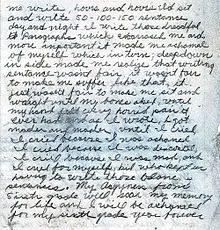
Reverse of "Mad is the Word"
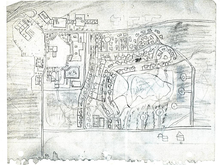
Front of the "punishment" map
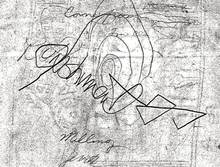
Reverse of the map, with the word "punishment" scrawled across the page
During the investigation of the 42nd attack in Danville, investigators discovered three sheets of notebook paper near where a suspicious vehicle had reportedly been parked. The first sheet contains what appears to be an essay on General George Armstrong Custer.
The second sheet contains a journal-style entry describing a teacher who made students write lines, which the author found humiliating:
"Mad is the word, the word that reminds me of 6th grade. I hated that year ... I wish I had know what was going to be going on during my 6th grade year, the last and worst year of elementary school. Mad is the word that remains in my head about my dreadful year as a 6th grader. My Madness was one that was caused by disapointments that hurt me very much. Dissapointments from my teacher, such as feild trips that were planed, then canncled. My 6th grade teacher gave me a lot of dissapointments which made me very mad and made me built a state of haterd in my heart, no one ever let me down that hard before and I never hated anyone as much as I did him. Disapointment wasn't the only reason that made me mad in my sixth grade class, another was getting in trouble at school espeically talking thats what really bugged me was writing sentances, those awful sentance that my teacher made ... me write, hours and hours Id sit and write 50-100-150 sentance day and night I write those dreadful Paragraphs which embarrased me and more inportant it made me ashamed of myself which in turn, deep down in side made me realize that writing sentance wasn't fair it wasn't fair to make me suffer like that, it just wasn't fair to make me sit and wright until my bones aked, until my hand felt every horrid pain it ever had and as I wrote, I got mader and mader until I cried, I cried because I was ashamed I cried because I was discusted, I cried because I was mad, and I cried for myself, kid who kept on having to write those dane sentances. My Angryness from Sixth grade will scar my memory for life and I will be ashamed for my sixth grade year forever"
On the last sheet was a hand-drawn map of what appears to be a suburban neighborhood, with the word "punishment" scrawled across the reverse side.[129] Investigators were unable to identify the area depicted in the map, although the artist clearly had knowledge of architectural layout and landscape design.[136] According to Detective Larry Pool, the map is a fantasy location representing the rapist's desired striking ground.
Phone calls[edit]
"I'm the East Side Rapist" (March 18, 1977)[edit]
On March 18, 1977, the Sacramento County Sheriff's Office received three calls from a man claiming to be the East Area Rapist; none was recorded.[137] The first two calls, received at 4:15 and 4:30 p.m., were identical and ended with the caller laughing and hanging up. The final call came in at 5:00 p.m., with the caller saying: "I'm the East Side Rapist and I have my next victim already stalked and you guys can't catch me."
"You're never gonna catch me" (December 2, 1977)[edit]
A man claiming to be the rapist called the Sacramento Police, saying: "You're never gonna catch me, East Area Rapist, you dumb fuckers, I'm gonna fuck again tonight. Careful!" The call was recorded and later released.[61] Similarly to the previous call, the next victim was attacked the same night.
"Merry Christmas" (December 9, 1977)[edit]
A previous victim received a phone call during the 1977 Christmas season which she attributed to her attacker. The caller said, "Merry Christmas, it's me again!"[2]:301
"Watt Avenue" (December 10, 1977)[edit]
Shortly before 10:00 p.m. on December 10, 1977, Sacramento authorities received two identical calls, saying: "I am going to hit tonight. Watt Avenue." Both were recorded, and the caller was identified as the same person who placed the December 2 call. Law-enforcement patrols were increased that night,[2] and at 2:30 a.m. a masked man eluded officers after being seen bicycling on the Watt Avenue bridge. When spotted again at 4:30 a.m., he discarded the bicycle[135] and fled on foot. The bicycle had been stolen.
"Gonna kill you" (January 2, 1978)[edit]
The first known rape victim received a wrong-number call asking for "Ray" on January 2, 1978. The call was recorded, and police suspect that it may be the same caller who made a threatening call to her later that evening.[138] That call was also recorded and identified by the victim as the voice of her assailant.[2] The caller said, "Gonna kill you ... gonna kill you ... gonna kill you ... bitch ... bitch ... bitch ... bitch ... fuckin' whore."[61]
Counseling service (January 6, 1978)[edit]
A man claiming to be the East Area Rapist called the Contact Counseling Service and said: "I have a problem. I need help because I don't want to do this anymore." After a short conversation the caller said, "I believe you are tracing this call" and hung up.[2]:310–315[139]
Later calls (1982–1991)[edit]
In 1982, a previous victim received a call at her place of work — a restaurant — during which the rapist threatened to rape her again. According to Contra Costa County investigator Paul Holes, the rapist must have chanced to patronize the restaurant and recognized his victim there.[140][141]
In 1991, a previous victim received a phone call from the perpetrator and spoke with him for one minute. She could hear a woman and children in the background, leading to speculation that he had a family.[6]
Final call (2001)[edit]
On April 6, 2001, one day after an article in the Sacramento Bee linked the Original Night Stalker and the East Area Rapist, a victim of the rapist received a call from him; he asked, "Remember when we played?"[141]
Investigation[edit]

This billboard advertisement appeared nationwide in June 2016.
Before officially connecting the Original Night Stalker to the East Area Rapist in 2001, some law-enforcement officials (particularly from the Sacramento County Sheriff's Department) sought to link the Goleta cases as well.[142] The links were primarily due to similarities in MO. One of the already-linked Original Night Stalker double murders occurred in Ventura, 40 miles (64 km) southeast of Goleta, and the remaining murders were committed in Orange County, an additional 90 miles (140 km) southeast. In 2001, several rapes in Contra Costa County believed to have been committed by the East Area Rapist were linked by DNA to the Smith, Harrington, Whithuhn, and Cruz murders. A decade later, DNA evidence indicated that the Domingo–Sanchez murders were committed by the Golden State Killer.[2][143][16]
On June 15, 2016, the FBI released further information related to the crimes, including new composite sketches and crime details;[105] a $50,000 reward was also announced.[144] The initiative included a national database to support law enforcement investigating the crimes and handle tips and information.[145] Eventually "through the use of genetic genealogy searching on GEDmatch, investigators identified distant relatives of DeAngelo—including family members directly related to his great- great-great-great grandfather dating back to the 1800s. Based on this information, investigators built about 25 different family trees. The tree that eventually linked to [DeAngelo] alone contained approximately 1,000 people. Over the course of a few months, investigators used other clues like age, sex and place of residence to rule out suspects populating these trees, eliminating suspects one by one until only DeAngelo remained."[16]
During the investigation, several people were considered and later eliminated as suspects:
- Brett Glasby, from Goleta, was considered a suspect by Santa Barbara County investigators. He was murdered in Mexico in 1982, before the murder of Janelle Cruz; this eliminated him as a suspect.[146]
- Paul "Cornfed" Schneider, a high-ranking member of the Aryan Brotherhood, was living in Orange County when the Harringtons, Manuela Witthuhn, and Janelle Cruz were killed. A DNA test cleared him in the 1990s.[147][148]
- Joe Alsip, a friend and business partner of the victim Lyman Smith: Alsip's pastor said that Alsip had confessed to him during a family-counseling session. Alsip was arraigned for the Smith murders in 1982, but the charges were later dropped,[149][150] and his innocence was confirmed by DNA testing in 1997.[151]
On April 24, 2018, Sacramento County Sheriff's deputies arrested DeAngelo.[152] He was charged with eight counts of first-degree murder with special circumstances.[15][153] On May 10, the Santa Barbara County District Attorney's office charged DeAngelo with four additional counts of first-degree murder.[154]
Identification of DeAngelo had begun four months earlier when officials, led by detective Paul Holes and FBI lawyer Steve Kramer, uploaded the killer's DNA profile from a Ventura County rape kit to the personal genomics website GEDmatch.[155] The website identified 10 to 20 people who had the same great-great-great grandparents as the Golden State Killer; a team of five investigators working with genealogist Barbara Rae-Venter used this list to construct a large family tree.[156] From this tree, they established two suspects; one was ruled out by a relative's DNA test, leaving DeAngelo the main suspect.[157]
On April 18, a DNA sample was surreptitiously collected from the door handle of DeAngelo's car,[35] and later another sample was collected from a tissue found in DeAngelo's curbside garbage can.[158] Both were matched to samples associated with Golden State Killer crimes.[19] After DeAngelo's arrest, some commentators[who?] raised concerns about the ethics of the secondary use of personally identifiable information.[159]
DeAngelo offered up a confession of sorts after his arrest that cryptically referred to an inner personality named "Jerry" that had apparently forced him to commit the wave of crimes that ended abruptly in 1986. According to Sacramento County prosecutor Thien Ho, DeAngelo said to himself while alone in a police interrogation room after his arrest in April 2018: "I didn’t have the strength to push him out. He made me. He went with me. It was like in my head, I mean, he's a part of me. I didn't want to do those things. I pushed Jerry out and had a happy life. I did all those things. I destroyed all their lives. So now I've got to pay the price."[160]
DeAngelo cannot be charged with rapes or burglaries, as the statute of limitations has expired for those offenses, but he has been charged with 13 counts of murder and 13 counts of kidnapping. DeAngelo was arraigned in Sacramento on August 23, 2018. In November 2018, prosecutors from six involved counties collectively estimated that the case could cost taxpayers $20 million and last 10 years.[161] At an April 10, 2019, court proceeding, prosecutors announced that they would seek the death penalty, and the judge ruled that cameras could be allowed inside the courtroom during the trial.[162] On March 4, 2020, DeAngelo offered to plead guilty if the death penalty was taken off the table, which was not accepted at the time. DeAngelo plead guilty to 13 murder charges and kidnapping charges related to as many rapes on June 29, in a deal to avoid the death penalty.[163]
See also[edit]



