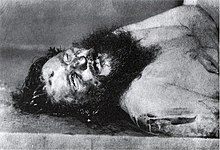
| Grigori Rasputin |
 |
| Born |
21 January 1869
Pokrovskoye, Siberia, Russian Empire |
| Died |
30 December 1916 (aged 47)
Petrograd |
|
Cause of death |
Homicide |
| Occupation |
peasant, wanderer, healer, advisor |
| Religion |
Russian Orthodox |
| Spouse(s) |
Praskovia Fedorovna Dubrovina |
| Children |
Dmitri (1895–1937)
Matryona (1898–1977)
Varvara (1900–1925) |
| Parents |
Efim Vilkin Rasputin
Anna Parshukova |
Grigori Yefimovich Rasputin (Russian: Григорий Ефимович Распутин;IPA: [ɡrʲɪˈɡorʲɪj jɪˈfʲiməvʲɪtɕ rɐˈsputʲɪn]; baptized on 22 January [O.S. 10 January] 1869 – murdered on 30 December [O.S. 17 December] 1916[1]) was aRussian peasant, mystic, faith healer and private adviser to the Romanovs. He became an influential figure in Saint Petersburg after August 1915 when Tsar Nicolas II took command of the army at the front.
There is much uncertainty over Rasputin's life and the degree of influence he exerted over the Tsar and his government.[2] Accounts are often based on dubious memoirs, hearsay and legend.[note 1] While his influence and role may have been exaggerated, historians agree that his presence played a significant part in the increasing unpopularity of the Tsar and Alexandra Feodorovna his wife, and the downfall of the Russian Monarchy. Rasputin was killed as he was seen by both the left and right to be the root cause of Russia's despair duringWorld War I.[4]
Early life[edit]

Pokrovskoye, along the
Tura River in 1912, with the church that was built around 1906 and destroyed in 1950
[5]
Grigori Rasputin was born the son of a well-to-do peasant in the small but prosperous village of Pokrovskoye in the Tobolsk guberniya (now Yarkovsky Districtin the Tyumen Oblast) in the immense West Siberian Plain. The parish registercontains the following entry for 9 January 1869: "In the village of Pokrovskoe, in the family of the peasant Yefim Yakovlevich Rasputin and his wife, both Orthodox, was born a son, Grigory."[6][7] The next day he was baptized and named after Gregory of Nyssa, whose feast day is on 10 January.[8]
Grigori was the fifth of nine children. He never attended school; according to thecensus of 1897 almost everybody in the village was illiterate.[9] In Pokrovskoye the young Rasputin was regarded as an outsider, but one endowed with mysterious gifts. "His limbs jerked, he shuffled his feet and always kept his hands occupied. Despite physical tics, he commanded attention."[10] The little that is known about his childhood was passed down by his daughter Maria.[11] On 2 February 1887, Rasputin married the three-years-older Praskovia Fyodorovna Dubrovina. The couple had three children: Dmitri, Varvara and Maria; two earlier sons died young. In 1892 [12] Rasputin abruptly left his village, his wife, children and parents. He spent several months in a monastery inVerkhoturye; Spiridovich suggests after the death of a child,[13] but the monastery was enlarged in those years to receive pilgrims.[14] Outside the monastery lived a hermit by the name of Brother Makary. Makary had a strong influence on Rasputin, which led to Grigori giving up drinking, smoking, and eating meat. When he arrived home he had learned to read and write and had become a zealous convert.[15][16]
Turn to religious life[edit]
Rasputin's claimed vision of Our Lady of Kazan turned him towards the life of a religious mystic. Around 1893 he travelled to Mount Athos, but left shocked and profoundly disillusioned, as he told Makary.[17][18]
By 1900 Rasputin was identified as a strannik, a wandering pilgrim,[19] although he always went home to help his family with the harvest. He was regarded as a staretsand a yurodiviy ("holy fool")[20] by his followers, who also believed him to be apsychic and faith healer.[2] Rasputin himself did not consider himself to be a starets.[21] Rasputin spoke an almost incomprehensible Siberian dialect[22] and seldom preached or spoke in public.
In 1903 Rasputin spent some time in Kiev where he visited the Monastery of the Caves. In Kazan he attracted the attention of the bishop and members of the upper class.[23][24][25] Rasputin then travelled to the capital to meet with John of Kronstadt.Pierre Gilliard writes that Rasputin arrived in 1905,[26] Although Nelipa thinks it was in autumn 1904, Iliodor believed it was in December 1903.[27] He carried an introduction to Ivan Stragorodsky, the rector of the theological faculty.[28] Rasputin stayed at Alexander Nevsky Lavra; there he met with Hermogenes and Theophanes of Poltava who was amazed by his psychological perspicacity. He was invited byMilica of Montenegro and her sister Anastasia, who were interested in Persian mysticism,[29] spiritism and occultism. Milica presented Rasputin to Tsar Nicholas and his wife Alexandra on 1 November 1905 (O.S.).[30]
Prior to his meeting with Rasputin, the Tsar had to deal with the Russo-Japanese War, Bloody Sunday, the Revolution of 1905, bombs and a nation-wide railway strike. In a city without electricity the Emperor and Autocrat of All the Russias was forced on the 17th by Sergei Witte to sign the October Manifesto, to agree with the establishment of the State Duma and give up part of his unlimited autocracy.[31] For the next six months Witte was the Prime Minister, but the real ruler of the country was general Dmitri Trepoff.
http://en.wikipedia.org/wiki/Grigori_Rasputin



b.jpg)