Pablo Escobar |
|---|
ablo_Escobar_Mug.jpg" class="image" style="text-decoration-line: none; color: rgb(11, 0, 128); background: none;">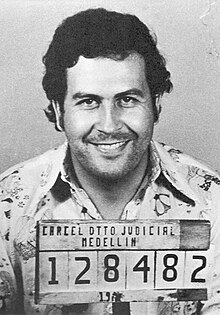 Escobar in a 1976 mugshot |
| Born | Pablo Emilio Escobar Gaviria
1 December 1949
|
|---|
| Died | 2 December 1993 (aged 44)
|
|---|
| Cause of death | Gunshot wound to the head |
|---|
| Other names | - Don Pablo (Sir Pablo)
- El Padrino (The Godfather)
- El Patrón (The Boss)
|
|---|
| Net worth | US $30 billion (1993 estimate; equivalent to $59 billion as of 2019) |
|---|
| Spouse(s) | Maria Victoria Henao ( m. 1976) |
|---|
| Children | Sebastián Marroquín and Manuela Escobar |
|---|
|
| Conviction(s) | Illegal drug trade, assassinations, bombing, bribery, racketeering, murder |
|---|
| Criminal penalty | Five years' imprisonment |
|---|
Pablo Emilio Escobar Gaviria (; 1 December 1949 – 2 December 1993) was a Colombian drug lord and narcoterrorist who was the founder and sole leader of the Medellín Cartel. Dubbed "The King of Cocaine," Escobar is the wealthiest criminal in history, having amassed an estimated net worth of US $30 billion by the time of his death—equivalent to $59 billion as of 2019—while his drug cartel monopolized the cocaine trade into the United States in the 1980s and 1990s.[1][2]
Born in Rionegro and raised in Medellín, Escobar studied briefly at Universidad Autónoma Latinoamericana of Medellín, but left without graduating; he instead began engaging in criminal activity, selling illegal cigarettes and fake lottery tickets, as well as participating in motor vehicle theft. In the early 1970s, he began to work for various drug smugglers, often kidnapping and holding people for ransom.
In 1976, Escobar founded the Medellín Cartel, which distributed powder cocaine, and established the first smuggling routes into the U.S. Escobar's infiltration into the U.S. created exponential demand for cocaine, and by the 1980s, it was estimated Escobar led monthly shipments of 70 to 80 tons of cocaine into the country from Colombia. As a result, he quickly became one of the richest people in the world,[3][4] but consistently battled rival cartels domestically and abroad, leading to massacres and the murders of police officers, judges, locals, and prominent politicians,[5] making Colombia the murder capital of the world.[6]
In the 1982 parliamentary election, Escobar was elected as an alternate member of the Chamber of Representatives as part of the Liberal Alternative movement. Through this, he was responsible for community projects, such as the construction of houses and football fields, which gained him popularity among the locals of the towns that he frequented. However, Escobar was vilified by the Colombian and U.S. governments,[7] who routinely stifled his political ambitions and pushed for his arrest, with Escobar widely believed to have orchestrated the DAS Building and Avianca Flight 203 bombings in retaliation.
In 1991, Escobar surrendered to authorities, and was sentenced to five years' imprisonment on a host of charges, but struck a deal of no extradition with Colombian President Cesar Gaviria, with the ability of being housed in his own, self-built prison, La Catedral. In 1992, Escobar escaped and went into hiding when authorities attempted to move him to a more standard holding facility, leading to a nation-wide manhunt.[8] As a result, the Medellín Cartel crumbled, and in 1993, Escobar was killed in his hometown by Colombian National Police, a day after his 44th birthday.[9]
Escobar's legacy remains controversial; while many denounce the heinous nature of his crimes, he was seen as a "Robin Hood-like" figure for many in Colombia, as he provided many amenities to the poor, while his killing was mourned and his funeral attended by over 25,000 people.[10] Additionally, his private estate, Hacienda Nápoles, has been transformed into a theme park,[11] and he has been praised and criticized for importing hippopotamuses to Colombia.[12] His life has also served as inspiration for or has been dramatized in film, television, and in music.
Early life
anoramica_Centro_De_Medellin.jpg" class="image" style="text-decoration-line: none; color: rgb(11, 0, 128); background: none;">
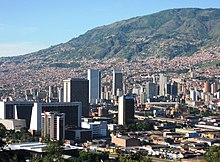
anoramica_Centro_De_Medellin.jpg" class="internal" title="Enlarge" style="text-decoration-line: none; color: rgb(11, 0, 128); background: linear-gradient(transparent, transparent), url("/w/resources/src/mediawiki.skinning/images/magnify-clip-ltr.svg?8330e"); display: block; text-indent: 15px; white-space: nowrap; overflow: hidden; width: 15px; height: 11px; user-select: none;">
The city of
Medellín, where Escobar grew up and began his criminal career.
Pablo Emilio Escobar Gaviria was born on 1 December 1949, in Rionegro, in the Antioquia Department of Colombia. He was the third of seven children of the farmer Abel de Jesús Dari Escobar Echeverri (1910–2001),[13] with his wife Hilda de Los Dolores Gaviria Berrío (d. 2006),[14] an elementary school teacher.[15]
Raised in the nearby city of Medellín, Escobar is thought to have begun his criminal career as a teenager, allegedly stealing gravestones and sanding them down for resale to local smugglers. His brother, Roberto Escobar, denies this, instead claiming that the gravestones came from cemetery owners whose clients had stopped paying for site care and that he had a relative who had a monuments business.[16] Escobar's son, Sebastián Marroquín, claims his father's foray into crime began with a successful practice of selling counterfeit high school diplomas,[4] generally counterfeiting those awarded by the Universidad Autónoma Latinoamericana of Medellín. Escobar studied at the University for a short period, but left without obtaining a degree.[17]
Escobar eventually became involved in many criminal activities with Oscar Benel Aguirre, with the duo running petty street scams, selling contraband cigarettes, fake lottery tickets, and stealing cars.[18] In the early 1970s, prior to entering the drug trade, Escobar acted as a thief and bodyguard, allegedly earning US$100,000 by kidnapping and holding a Medellín executive for ransom.[19] Escobar began working for Alvaro Prieto, a contraband smuggler who operated around Medellín, aiming to fulfill a childhood ambition to have COL $1 million by the time he was 22.[20] He is known to have had a bank deposit of COL 100 million (more than US$3 million), when he turned 26.[21]
Criminal career
Cocaine distribution

International drug routes.
In The Accountant's Story, Roberto Escobar discusses how Pablo rose from middle-class simplicity and obscurity to one of the world's wealthiest men. Beginning in 1975, Pablo started developing his cocaine operation, flying out planes several times, mainly between Colombia and Panama, along smuggling routes into the United States. When he later bought fifteen bigger airplanes, including a Learjet and six helicopters, according to his son, a dear friend of Pablo's died during the landing of an airplane, and the plane was destroyed. Pablo reconstructed the airplane from the scrap parts that were left and later hung it above the gate to his ranch at Hacienda Nápoles.
In May 1976, Escobar and several of his men were arrested and found in possession of 39 pounds (18 kg) of white paste, attempting to return to Medellín with a heavy load from Ecuador. Initially, Pablo tried to bribe the Medellín judges who were forming a case against him and was unsuccessful. After many months of legal wrangling, he ordered the murder of the two arresting officers, and the case was later dropped. Roberto Escobar details this as the point where Pablo began his pattern of dealing with the authorities, by either bribery or murder.[22]
Roberto Escobar maintains Pablo fell into the drug business simply because other types of contraband became too dangerous to traffic. As there were no drug cartels then, and only a few drug barons, Pablo saw it as untapped territory he wished to make his own. In Peru, Pablo would buy the cocaine paste, which would then be refined in a laboratory in a two-story house in Medellín. On his first trip, Pablo bought a paltry 30 pounds (14 kg) of paste in what was noted as the first step towards building his empire. At first, he smuggled the cocaine in old plane tires, and a pilot could return as much as US$500,000 per flight, dependent on the quantity smuggled.[23]
Rise to prominence

Powder cocaine was manufactured, packaged, and sold by Pablo Escobar and
his associates, and eventually distributed to the U.S. drug market.
Soon, the demand for cocaine was greatly increasing in the United States, and Escobar organized more smuggling shipments, routes, and distribution networks in South Florida, California, and other parts of the country. He and cartel co-founder Carlos Lehder worked together to develop a new trans-shipment point in the Bahamas, an island called Norman's Cay about 220 miles (350 km) southeast of the Florida coast. According to his brother, Escobar did not purchase Norman's Cay; it was, instead, a sole venture of Lehder's. Escobar and Robert Vesco purchased most of the land on the island, which included a 1 kilometre (3,300 ft) airstrip, a harbor, a hotel, houses, boats, and aircraft, and they built a refrigerated warehouse to store the cocaine. From 1978 to 1982, this was used as a central smuggling route for the Medellín Cartel. With the enormous profits generated by this route, Escobar was soon able to purchase 7.7 square miles (20 km2) of land in Antioquia for several million dollars, on which he built the Hacienda Nápoles. The luxury house he created contained a zoo, a lake, a sculpture garden, a private bullring, and other diversions for his family and the cartel.[24]
At one point it was estimated that 70 to 80 tons of cocaine were being shipped from Colombia to the United States every month. In the mid-1980s, at the height of its power, the Medellín Cartel was shipping as much as 11 tons per flight in jetliners to the United States (the biggest load shipped by Escobar was 51,000 pounds (23,000 kg) mixed with fish paste and shipped via boat, as confirmed by his brother in the book Escobar). Roberto Escobar also claimed that, in addition to using planes, his brother employed two small submarines to transport the enormous loads.[5]
Established drug network
In 1982 Escobar was elected as an alternate member of the Chamber of Representatives of Colombia, as part of a small movement called Liberal Alternative. Earlier in the campaign he was a candidate for the Liberal Renewal Movement, but had to leave it because of the firm opposition of Luis Carlos Galán, whose presidential campaign was supported by the Liberal Renewal Movement.[25][26] Escobar was the official representative of the Colombian government for the swearing-in of Felipe González in Spain.
Escobar quickly became known internationally as his drug network gained notoriety; the Medellín Cartel controlled a large portion of the drugs that entered the United States, Mexico, Puerto Rico, the Dominican Republic, Venezuela, and Spain. The production process was also altered, with coca from Bolivia and Peru replacing the coca from Colombia, which was beginning to be seen as substandard quality than the coca from the neighboring countries. As demand for more and better cocaine increased, Escobar began working with Roberto Suárez Goméz, helping to further the product to other countries in the Americas and Europe, as well as being rumored to reach as far as Asia.
Palace of Justice siege
alacioDeJusticia2004-7-9Bogota.jpg" class="image" style="text-decoration-line: none; color: rgb(11, 0, 128); background: none;">
alacioDeJusticia2004-7-9Bogota.jpg" class="internal" title="Enlarge" style="text-decoration-line: none; color: rgb(11, 0, 128); background: linear-gradient(transparent, transparent), url("/w/resources/src/mediawiki.skinning/images/magnify-clip-ltr.svg?8330e"); display: block; text-indent: 15px; white-space: nowrap; overflow: hidden; width: 15px; height: 11px; user-select: none;">
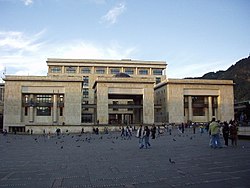
Escobar was held directly responsible by various media publications for the 1985
storming of the Colombian Supreme Court.
It is alleged that Escobar backed the 1985 storming of the Colombian Supreme Court by left-wing guerrillas from the 19th of April Movement, also known as M-19. The siege, a retaliation motivated by the Supreme Court studying the constitutionality of Colombia's extradition treaty with the U.S., resulted in the murders of half the judges on the court.[28] M-19 were paid to break into the Palace and burn all papers and files on Los Extraditables, a group of cocaine smugglers who were under threat of being extradited to the U.S. by the Colombian government. Escobar was listed as a part of Los Extraditables. Hostages were also taken for negotiation of their release, thus helping to prevent extradition of Los Extraditables to the U.S. for their crimes.[29]
Escobar at the height of his power
During the height of its operations, the Medellín Cartel brought in more than US$70 million per day (roughly $26 billion in a year). Smuggling 15 tons of cocaine per day, worth more than half a billion dollars, into the United States, the cartel spent over US$1,000 per week purchasing rubber bands to wrap the stacks of cash, storing most of it in their warehouses. Ten percent (10%) of the cash had to be written off per year because of "spoilage", due to rats creeping in and nibbling on the bills they could reach.[20]
When questioned about the essence of the cocaine business, Escobar replied with "[the business is] simple: you bribe someone here, you bribe someone there, and you pay a friendly banker to help you bring the money back."[30] In 1989, Forbes magazine estimated Escobar to be one of 227 billionaires in the world with a personal net worth of approaching US$3 billion[31] while his Medellín Cartel controlled 80% of the global cocaine market.[32] It is commonly believed that Escobar was the principal financier behind Medellín's Atlético Nacional, which won South America's most prestigious football tournament, the Copa Libertadores, in 1989.[33]
uisCarlosGalan_RodrigoLaraBonilla_NancyRestrepodeLara.jpg" class="image" style="text-decoration-line: none; color: rgb(11, 0, 128); background: none;">
uisCarlosGalan_RodrigoLaraBonilla_NancyRestrepodeLara.jpg" class="internal" title="Enlarge" style="text-decoration-line: none; color: rgb(11, 0, 128); background: linear-gradient(transparent, transparent), url("/w/resources/src/mediawiki.skinning/images/magnify-clip-ltr.svg?8330e"); display: block; text-indent: 15px; white-space: nowrap; overflow: hidden; width: 15px; height: 11px; user-select: none;">
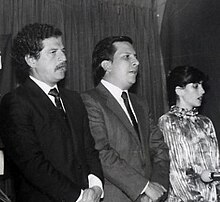
The Justice Minister
Rodrigo Lara (center) and presidential candidate
Luis Carlos Galán (left) were both assassinated by orders of Escobar
While seen as an enemy of the United States and Colombian governments, Escobar was a hero to many in Medellín, especially to the poor. He was a natural at public relations, and he worked to create goodwill among the poor of Colombia. A lifelong sports fan, he was credited with building football fields and multi-sports courts, as well as sponsoring children's football teams.[20] Escobar was also responsible for the construction of houses and football fields in western Colombia, which gained him popularity among the poor.[34][35] He worked hard to cultivate his Robin Hood image and frequently distributed money through housing projects and other civic activities, which gained him notable popularity among the locals of the towns that he frequented. Some people from Medellín often helped Escobar avoid police capture by serving as lookouts, hiding information from authorities, or doing whatever else they could to protect him. At the height of his power, drug traffickers from Medellín and other areas were handing over between 20% and 35% of their Colombian cocaine-related profits to Escobar, as he was the one who shipped cocaine successfully to the United States.[citation needed]
The Colombian cartels' continuing struggles to maintain supremacy resulted in Colombia quickly becoming the world's murder capital with 25,100 violent deaths in 1991 and 27,100 in 1992.[36] This increased murder rate was fueled by Escobar's giving money to his hitmen as a reward for killing police officers, over 600 of whom died as a result.[7]
La Catedral prison
After the assassination of Luis Carlos Galán, the administration of César Gaviria moved against Escobar and the drug cartels. Eventually, the government negotiated with Escobar and convinced him to surrender and cease all criminal activity in exchange for a reduced sentence and preferential treatment during his captivity. Declaring an end to a series of previous violent acts meant to pressure authorities and public opinion, Escobar surrendered to Colombian authorities in 1991. Before he gave himself up, the extradition of Colombian citizens to the United States had been prohibited by the newly approved Colombian Constitution of 1991. This act was controversial, as it was suspected that Escobar and other drug lords had influenced members of the Constituent Assembly in passing the law. Escobar was confined in what became his own luxurious private prison, La Catedral, which featured a football pitch, giant dollhouse, bar, jacuzzi, and waterfall. Accounts of Escobar's continued criminal activities while in prison began to surface in the media, which prompted the government to attempt to move him to a more conventional jail on 22 July 1992. Escobar's influence allowed him to discover the plan in advance and make a successful escape, spending the remainder of his life evading the police.[37][38]
Search Bloc and Los Pepes
Following Escobar's escape, the United States Joint Special Operations Command (consisting of members of DEVGRU (SEAL Team Six) and Delta Force) and Centra Spike joined the manhunt for Escobar. They trained and advised a special Colombian police task force known as the Search Bloc, which had been created to locate Escobar. Later, as the conflict between Escobar and the governments of the United States and Colombia dragged on, and as the numbers of Escobar's enemies grew, a vigilante group known as Los Pepes (Los Perseguidos por Pablo Escobar, "People Persecuted by Pablo Escobar") was formed. The group was financed by his rivals and former associates, including the Cali Cartel and right-wing paramilitaries led by Carlos Castaño, who would later fund the Peasant Self-Defense Forces of Córdoba and Urabá. Los Pepes carried out a bloody campaign, fueled by vengeance, in which more than 300 of Escobar's associates, his lawyer[39] and relatives were slain, and a large amount of the Medellín cartel's property was destroyed.
Members of the Search Bloc, and Colombian and United States intelligence agencies, in their efforts to find Escobar, either colluded with Los Pepes or moonlighted as both Search Bloc and Los Pepes simultaneously. This coordination was allegedly conducted mainly through the sharing of intelligence to allow Los Pepes to bring down Escobar and his few remaining allies, but there are reports that some individual Search Bloc members directly participated in missions of Los Pepes death squads.[35][page needed] One of the leaders of Los Pepes was Diego Murillo Bejarano (also known as "Don Berna"), a former Medellín Cartel associate who became a rival drug kingpin and eventually emerged as a leader of one of the most powerful factions within the Self-Defence of Colombia.
Personal life
Family and relationships
In March 1976, the 26-year-old Escobar married María Victoria Henao, who was 15. The relationship was discouraged by the Henao family, who considered Escobar socially inferior; the pair eloped.[21] They had two children: Juan Pablo (now Sebastián Marroquín) and Manuela.
In 2007, the journalist Virginia Vallejo published her memoir Amando a Pablo, odiando a Escobar (Loving Pablo, Hating Escobar), in which she describes her romantic relationship with Escobar and the links of her lover with several presidents, Caribbean dictators, and high-profile politicians.[40] Her book inspired the movie Loving Pablo (2017).[41]
A drug distributor, Griselda Blanco is also reported to have conducted a clandestine, but passionate, relationship with Escobar; several items in her diary link him with the nicknames "Coque de Mi Rey" (My Coke King) and "Polla Blanca" (White Dick).[42]
Properties
After becoming wealthy, Escobar created or bought numerous residences and safe houses, with the Hacienda Nápoles gaining significant notoriety. The luxury house contained a colonial house, a sculpture park, and a complete zoo with animals from various continents, including elephants, exotic birds, giraffes, and hippopotamuses. Escobar had also planned to construct a Greek-style citadel near it, and though construction of the citadel was started, it was never finished.[43]
Escobar also owned a home in the US under his own name: a 6,500 square foot (604 m²), pink, waterfront mansion situated at 5860 North Bay Road in Miami Beach, Florida. The four-bedroom estate, built in 1948 on Biscayne Bay, was seized by the government in the 1980s. Later, the dilapidated property was owned by Christian de Berdouare, proprietor of the Chicken Kitchen fast-food chain, who had bought it in 2014. De Berdouare would later hire a documentary film crew and professional treasure hunters to search the edifice before and after demolition, for anything related to Escobar or his cartel. They would find unusual holes in floors and walls, as well as a safe that was stolen from its hole in the marble flooring before it could be properly examined.[44]
Escobar also owned a huge Caribbean getaway on Isla Grande, the largest of the cluster of the 27 coral cluster islands comprising Islas del Rosario, located about 22 miles (35 km) from Cartagena. The compound, now half-demolished and overtaken by vegetation and wild animals, featured a mansion, apartments, courtyards, a large swimming pool, a helicopter landing pad, reinforced windows, tiled floors, and a large, unfinished building to the side of the mansion.[45]
Death
eath_of_Pablo_Escobar.jpg" class="image" style="text-decoration-line: none; color: rgb(11, 0, 128); background: none;">

eath_of_Pablo_Escobar.jpg" class="internal" title="Enlarge" style="text-decoration-line: none; color: rgb(11, 0, 128); background: linear-gradient(transparent, transparent), url("/w/resources/src/mediawiki.skinning/images/magnify-clip-ltr.svg?8330e"); display: block; text-indent: 15px; white-space: nowrap; overflow: hidden; width: 15px; height: 11px; user-select: none;">
Members of
Search Bloc celebrate over Escobar's body on 2 December 1993. His death ended a 16-month search effort, costing hundreds of millions of dollars.
ablo_Escobar_Tomb.jpg" class="image" style="text-decoration-line: none; color: rgb(11, 0, 128); background: none;">

ablo_Escobar_Tomb.jpg" class="internal" title="Enlarge" style="text-decoration-line: none; color: rgb(11, 0, 128); background: linear-gradient(transparent, transparent), url("/w/resources/src/mediawiki.skinning/images/magnify-clip-ltr.svg?8330e"); display: block; text-indent: 15px; white-space: nowrap; overflow: hidden; width: 15px; height: 11px; user-select: none;">
The tomb of Pablo Escobar and family in the Monte Sacro Cemetery, Itagüí
Sixteen months after his escape from La Catedral, Pablo Escobar died in a shootout on 2 December 1993, amid another of his attempts to elude the Search Bloc.[46] A Colombian electronic surveillance team, led by Brigadier Hugo Martínez,[47] used radio trilateration technology to track his radiotelephone transmissions and found him hiding in Los Olivos, a middle-class barrio in Medellín. With authorities closing in, a firefight with Escobar and his bodyguard, Álvaro de Jesús Agudelo (alias "El Limón"), ensued. The two fugitives attempted to escape by running across the roofs of adjoining houses to reach a back street, but both were shot and killed by Colombian National Police.[9] Escobar suffered gunshots to the leg and torso, and a fatal gunshot through the ear.
It has never been proven who actually fired the final shot into his ear, or determined whether this shot was made during the gunfight or as part of a possible execution, with wide speculation remaining regarding the subject. Some of Escobar's relatives believe that he had committed suicide.[8][48] His two brothers, Roberto Escobar and Fernando Sánchez Arellano, believe that he shot himself through the ear. In a statement regarding the topic, the duo stated that Pablo "had committed suicide, he did not get killed. During all the years they went after him, he would say to me every day that if he was really cornered without a way out, he would 'shoot himself through the ear'."[49][page needed]
Aftermath of his death
Soon after Escobar's death and the subsequent fragmentation of the Medellín Cartel, the cocaine market became dominated by the rival Cali Cartel until the mid-1990s when its leaders were either killed or captured by the Colombian government. The Robin Hood image that Escobar had cultivated maintained a lasting influence in Medellín. Many there, especially many of the city's poor whom Escobar had aided while he was alive, mourned his death, and over 25,000 people attended his funeral. Some of them consider him a saint and pray to him for receiving divine help.[50]
Virginia Vallejo's testimony
On 4 July 2006, Virginia Vallejo, a television anchorwoman romantically involved with Escobar from 1983 to 1987, offered Attorney General Mario Iguarán her testimony in the trial against former Senator Alberto Santofimio, who was accused of conspiracy in the 1989 assassination of presidential candidate Luis Carlos Galán. Iguarán acknowledged that, although Vallejo had contacted his office on 4 July, the judge had decided to close the trial on 9 July, several weeks before the prospective closing date. The action was seen as too late.[51][52]
On 18 July 2006, Vallejo was taken to the United States on a special flight of the Drug Enforcement Administration (DEA), for "safety and security reasons" due to her cooperation in high-profile criminal cases.[53][54] On 24 July, a video in which Vallejo had accused Santofimio of instigating Escobar to eliminate presidential candidate Galán was aired by RCN Television of Colombia. The video was seen by 14 million people, and was instrumental for the reopened case of Galán's assassination. On 31 August 2011 Santofimio was sentenced to 24 years in prison for his role in the crime.[55][56]
Role in the Palace of Justice siege
Among Escobar's biographers, only Vallejo has given a detailed explanation of his role in the 1985 Palace of Justice siege. The journalist stated that Escobar had financed the operation, which was committed by M-19; but she blamed the army for the killings of more than 100 people, including 11 Supreme Court magistrates, M-19 members, and employees of the cafeteria. Her statements prompted the reopening of the case in 2008; Vallejo was asked to testify, and many of the events she had described in her book and testimonial were confirmed by Colombia's Commission of Truth.[57][58] These events led to further investigation into the siege that resulted with the conviction of a high-ranking former colonel and a former general, later sentenced to 30 and 35 years in prison, respectively, for the forced disappearance of the detained after the siege.[59][60] Vallejo would subsequently testify in Galán's assassination.[61] In her book, Amando a Pablo, odiando a Escobar (Loving Pablo, Hating Escobar), she had accused several politicians, including Colombian presidents Alfonso López Michelsen, Ernesto Samper and Álvaro Uribe of having links to drug cartels.[62] Due to threats, and her cooperation in these cases, on 3 June 2010 the United States granted political asylum to the Colombian journalist.
Relatives
Escobar's widow (María Henao, now María Isabel Santos Caballero), son (Juan Pablo, now Juan Sebastián Marroquín Santos) and daughter (Manuela) fled Colombia in 1995 after failing to find a country that would grant them asylum.[63] Despite Escobar's numerous and continual infidelities, Maria remained supportive of her husband, though she urged him to eschew violence. Members of the Cali Cartel even replayed their recordings of her conversations with Pablo for their wives to demonstrate how a woman should behave.[64] This attitude proved to be the reason the cartel did not kill her and her children after Pablo's death, although the group demanded (and received) millions of dollars in reparations for Escobar's war against them. Henao even successfully negotiated for her son's life by personally guaranteeing he would not seek revenge against the cartel or participate in the drug trade.[65]
After escaping first to Mozambique, then to Brazil, the family settled in Argentina.[66] Living under her assumed name, Henao became a successful real estate entrepreneur until one of her business associates discovered her true identity, and Henao absconded with her earnings. Local media were alerted, and after being exposed as Escobar's widow, Henao was imprisoned for eighteen months while her finances were investigated. Ultimately, authorities were unable to link her funds to illegal activity, and she was released.[67] According to her son, Henao fell in love with Escobar "because of his naughty smile [and] the way he looked at [her]. [He] was affectionate and sweet. A great lover. I fell in love with his desire to help people and his compassion for their hardship. We [would] drive to places where he dreamed of building schools for the poor. From [the] beginning, he was always a gentleman."[68] María Victoria Henao de Escobar, with her new identity as María Isabel Santos Caballero, continues to live in Buenos Aires with her son and daughter.[69] On 5 June 2018, the Argentine federal judge Nestor Barral accused her and her son, Sebastián Marroquín Santos, of money laundering with two Colombian drug traffickers.[70][71][72] The judge ordered the seizing of assets for about $1m each.[73]
Argentinian filmmaker Nicolas Entel's documentary Sins of My Father (2009) chronicles Marroquín's efforts to seek forgiveness, on behalf of his father, from the sons of Rodrigo Lara, Colombia's justice minister who was assassinated in 1984, as well as from the sons of Luis Carlos Galán, the presidential candidate who was assassinated in 1989. The film was shown at the 2010 Sundance Film Festival and premiered in the US on HBO in October 2010.[74] In 2014, Marroquín published Pablo Escobar, My Father under his birth name. The book provides a firsthand insight into details of his father's life and describes the fundamentally disintegrating effect of his death upon the family. Marroquín aimed to publish the book in hopes to resolve any inaccuracies regarding his father's excursions during the 1990s.[75]
Escobar's sister, Luz Maria Escobar, also made multiple gestures in attempts to make amends for the drug baron's crimes. These include making public statements in the press, leaving letters on the graves of his victims and on the 20th anniversary of his death organizing a public memorial for his victims.[76] Escobar's body was exhumed on 28 October 2006 at the request of some of his relatives in order to take a DNA sample to confirm the alleged paternity of an illegitimate child and remove all doubt about the identity of the body that had been buried next to his parents for 12 years.[77] A video of the exhumation was broadcast by RCN, angering Marroquín, who accused his uncle, Roberto Escobar, and cousin, Nicolas Escobar, of being "merchants of death" by allowing the video to air.[78]
Hacienda Nápoles
After Escobar's death, the ranch, zoo and citadel at Hacienda Nápoles were given by the government to low-income families under a law called Extinción de Dominio (Domain Extinction). The property has been converted into a theme park surrounded by four luxury hotels overlooking the zoo.[43]
Escobar Inc
In 2014, Roberto Escobar founded Escobar Inc with Olof K. Gustafsson and registered Successor-In-Interest rights for his brother Pablo Escobar in California, United States.[79]
Hippos
Escobar kept four hippos in a private menagerie at Hacienda Nápoles. They were deemed too difficult to seize and move after Escobar's death, and hence left on the untended estate. By 2007, the animals had multiplied to 16 and had taken to roaming the area for food in the nearby Magdalena River.[80][81] In 2009, two adults and one calf escaped the herd and, after attacking humans and killing cattle, one of the adults (called "Pepe") was killed by hunters under authorization of the local authorities.[81][82] As of early 2014, 40 hippos have been reported to exist in Puerto Triunfo, Antioquia, from the original four belonging to Escobar.[83] Without management the population size is likely to more than double in the next decade.[84]
The National Geographic Channel produced a documentary about them titled Cocaine Hippos.[85] A report published in a Yale student magazine noted that local environmentalists are campaigning to protect the animals, although there is no clear plan for what will happen to them.[86] In 2018, National Geographic published another article on the hippos which found disagreement among environmentalists on whether they were having a positive or negative impact, but that conservationists and locals - particularly those in the tourism industry - were mostly in support of their continued presence.[87]
Apartment demolition
On 22 February 2019, at 11:53 AM local time, Medellín authorities demolished the six-story Edificio Mónaco apartment complex in the El Poblado neighborhood where, according to retired Colombian general Rosso José Serrano, Escobar planned some of his most brazen attacks. The building was initially built for Escobar's wife but was gutted by a Cali Cartel car bomb in 1988 and had remained unoccupied ever since, becoming an attraction to foreign tourists seeking out Escobar's physical legacy. Mayor Federico Gutierrez had been pushing to raze the building and erect in its place a park honoring the thousands of cartel victims, including four presidential candidates and some 500 police officers. Colombian President Ivan Duque said the demolition "means that history is not going to be written in terms of the perpetrators but by recognizing the victims," hoping the demolition would showcase that the city had evolved significantly and had more to offer than the legacy left by the cartels.[88]
In popular culture
Books
abloescopaint.png" class="image" style="text-decoration-line: none; color: rgb(11, 0, 128); background: none;">

abloescopaint.png" class="internal" title="Enlarge" style="text-decoration-line: none; color: rgb(11, 0, 128); background: linear-gradient(transparent, transparent), url("/w/resources/src/mediawiki.skinning/images/magnify-clip-ltr.svg?8330e"); display: block; text-indent: 15px; white-space: nowrap; overflow: hidden; width: 15px; height: 11px; user-select: none;">
's portrayal of Escobar's death
Escobar has been the subject of several books, including the following:
- Escobar (2010), by Roberto Escobar, written by his brother shows how he became infamous and ultimately died.[89]
- Escobar Gaviria, Roberto (2016). My Brother - Pablo Escobar. Escobar, Inc. ISBN 978-0692706374.
- Kings of Cocaine (1989), by Guy Gugliotta, retells the history and operations of the Medellín Cartel, and Escobar's role within it.[90]
- Killing Pablo: The Hunt for the World's Greatest Outlaw (2001), by Mark Bowden,[91][92] relates how Escobar was killed and his cartel dismantled by US special forces and intelligence, the Colombian military, and Los Pepes.[93]
- Pablo Escobar: My Father (2016), by Juan Pablo Escobar, translated by Andrea Rosenberg .[94]
- Pablo Escobar: Beyond Narcos (2016), by Shaun Attwood, tells the story of Pablo and the Medellin Cartel in the context of the failed War on Drugs; ISBN 978-1537296302
- American Made: Who Killed Barry Seal? Pablo Escobar or George HW Bush (2016), by Shaun Attwood, tells Pablo's story as a suspect in the murder of CIA pilot Barry Seal; ISBN 978-1537637198
- Loving Pablo, Hating Escobar (2017) by Virginia Vallejo, originally published by Penguin Random House in Spanish in 2007, and later translated to 16 languages.
Films
Two major feature films on Escobar, Escobar (2009) and Killing Pablo (2011), were announced in 2007.[95] Details about them, and additional films about Escobar, are listed below.
- Blow, a 2001 American biographical film based on George Jung, a member of the Medellín Cartel; Escobar was portrayed by Cliff Curtis.
- Pablo Escobar: The King of Coke (2007) is a TV movie documentary by National Geographic, featuring archival footage and commentary by stakeholders.[96][97]
- Escobar (2009) was delayed because of producer Oliver Stone's involvement with the George W. Bush biopic W. (2008). As of 2008, the release date of Escobar remained unconfirmed.[when?].[98] Regarding the film, Stone said: "This is a great project about a fascinating man who took on the system. I think I have to thank Scarface, and maybe even Ari Gold."[99]
- Killing Pablo (2011), was supposedly in development for several years, directed by Joe Carnahan. It was to be based on Mark Bowden's 2001 book of the same title, which in turn was based on his 31-part Philadelphia Inquirer series of articles on the subject.[92][93] The cast was reported to include Christian Bale as Major Steve Jacoby and Venezuelan actor Édgar Ramírez as Escobar.[100][101] In December 2008, Bob Yari, producer of Killing Pablo, filed for bankruptcy.[102]
- Escobar: Paradise Lost: a romantic thriller in which a naive Canadian surfer falls in love with a girl who turns out to be Escobar's niece.
- Loving Pablo: a 2017 Spanish film based on Virginia Vallejo's book Loving Pablo, Hating Escobar with Javier Bardem as Escobar, and Penélope Cruz as Virginia Vallejo.[103]
- American Made, a 2017 American biographical film based on Barry Seal; Escobar was portrayed by Mauricio Mejía.[104]
Television
- In 2005, Court TV (now TruTV) crime documentary series Mugshots released an episode on Escobar titled "Pablo Escobar – Hunting The Druglord".[105]
- In the 2007 HBO television series, Entourage, actor Vincent Chase (played by Adrian Grenier) is cast as Escobar in a fictional film entitled Medellín.[106]
- One of ESPN's 30 for 30 series films, The Two Escobars (2010), by directors Jeff and Michael Zimbalist, looks back at Colombia's World Cup run in 1994 and the relationship between sports and the country's criminal gangs — notably the Medellín narcotics cartel run by Escobar. The other Escobar in the film title refers to former Colombian defender Andrés Escobar (no relation to Pablo), who was shot and killed one month after conceding an own goal that contributed to the elimination of the Colombian national team from the 1994 FIFA World Cup.[107]
- Caracol TV produced a television series, Pablo Escobar: El Patrón del Mal (Pablo Escobar, The Boss Of Evil), which began airing on 28 May 2012, and stars Andrés Parra as Pablo Escobar. It is based on Alonso Salazar's book La parábola de Pablo.[108]
- A Netflix original television series depicting the story of Escobar, titled Narcos, was released on 28 August 2015, starring Brazilian actor Wagner Moura as Pablo.[109] Season two premiered on the streaming service on 2 September 2016.[110]
- National Geographic in 2016 broadcast a biography series Facing that included an episode featuring Escobar.[111]
- On 24 January 2018 Netflix released the 68-minute-long documentary Countdown to Death: Pablo Escobar directed by Santiago Diaz and Pablo Martin Farina.[112][113]
Music
- The 2013 song "Pablo" by American rapper E-40 serves as an ode to the legacy of Pablo Escobar.[114]



