1969年,她與賽日發表一首歌I love you... me neither(Je t'aime... moi non plus),這首歌是克里斯伯所寫兩人合唱,由於此歌明顯的性暗示,因此立即引爆了兩人之間的緋聞。雖然這首歌在義大利、西班牙與英國被禁播,卻也因此席捲整個歐洲。這首歌的成功之處,在於它伴隨著男女的喘息聲,而這首歌的結尾也在(性)高潮之後結束。
This article is currently being heavily edited because its subject has recently died. Knowledge about the circumstances of the death and surrounding events may change rapidly as more facts come to light. Initial news reports may be unreliable, and the most recent updates to this article may not reflect the most current information.lease feel free to improve this article (but note that updates without valid and reliable references will be removed) or discuss changes on the talk page. (Learn how and when to remove this template message)
Jane Mallory BirkinOBE (14 December 1946 – 16 July 2023) was a British-French[a] singer and actress. She attained international fame and notability for her decade-long musical and romantic partnership with Serge Gainsbourg. She also had a prolific career as an actress, mostly in French cinema.
A native of London, Birkin began her career as an actress, appearing in minor roles in Michelangelo Antonioni's Blowup (1966), and Kaleidoscope (1966). In 1968, she met Serge Gainsbourg while co-starring with him in Slogan, which marked the beginning of a years-long working and personal relationship.[3] The duo released their debut album Jane Birkin/Serge Gainsbourg (1969), and Birkin also appeared in the controversial film Je t'aime moi non plus (1976) under Gainsbourg's direction. Though she mostly worked in France where she had become a major star, Birkin occasionally appeared in English-language films such as the Agatha Christie adaptations Death on the Nile (1978) and Evil Under the Sun (1982).
After separating from Gainsbourg in 1980, Birkin continued to work as both an actress and a singer, appearing in various independent films and recording numerous solo albums. In 1991, she appeared in the miniseries Red Fox and in the American drama film A Soldier's Daughter Never Cries, in 1998. In 2016, she starred in the Academy Award-nominated short filmLa femme et le TGV, which she said would be her final film role.
Birkin lived mainly in France from the late 1960s onwards. She was the mother of photographer Kate Barry, with her first husband John Barry; actress and singer Charlotte Gainsbourg, with Serge Gainsbourg; and musician Lou Doillon, with Jacques Doillon. In addition to her acting and musical credits, she lent her name to the HermèsBirkin handbag.
Jane Mallory Birkin was born on 14 December 1946,[4] in Marylebone, London.[5] Her mother, Judy Campbell, was an English actress, best known for her work on stage. Her father, David Birkin, was a Royal Navylieutenant commander and World War IIspy. Her brother is screenwriter and director Andrew Birkin. Theatre and opera director Sophie Hunter was her niece.[6][7] Birkin was raised in Chelsea,[8] and described herself as a "shy English girl".[9] She said that she was bullied for her looks; "I suffered a lot because of my physique, especially at boarding school. The others said I was half boy, half girl. I had no breasts, not even a developing bosom. It was horrible."[10][11]
Birkin attended Miss Ironside's School in Kensington.[12][13] She was also educated at Upper Chine School, Isle of Wight.[11] At the age of 17, she met composer John Barry, whom she married in 1965, and had her first daughter, Kate, in 1967. After Barry left for the United States, the couple divorced in 1968 and Birkin returned to live with her family in London.[10] Birkin began auditioning for film and television roles in England and in Los Angeles.[9]
Birkin emerged in the Swinging London scene of the 1960s, appearing in an uncredited part in The Knack ...and How to Get It (1965).[14] She had a small role in Michelangelo Antonioni's Blowup (1966) as a blonde model. At the time, the movie gained notoriety because of Birkin's nude scene, which she later said she did because John Barry had told her she would not have the courage to show up naked on set.[15][10] Birkin also said that on the day of her audition, she had no idea who Antonioni was.[10] She had a more substantial role in the counterculture era film Kaleidoscope (1966) and appeared as a fantasy-like model in the psychedelic film Wonderwall (1968).
In 1968, she auditioned for the lead female role in the French film Slogan (1969).[16] Though she did not speak French[17] she won the role, co-starring alongside Serge Gainsbourg, and she performed with him on the film's theme song, "La Chanson de Slogan", the first of many collaborations between the two. After filming Slogan, Birkin relocated to France permanently.[18] She had a role in the French thriller La Piscine (1969). She stated that it was this movie which enabled her to stay in France after finishing Slogan: "The film saved me and enabled me to stay in France. I just finished Slogan and was due to go back to England."[10] Her heavy accent in French eventually became an asset, as French audiences found it charming. She later stated: "Without my accent, I would have had a different career."[10]
In 1969, Gainsbourg and she released the duet "Je t'aime... moi non plus" ("I love you ... me neither"). Gainsbourg had originally written the song for Brigitte Bardot. Birkin said it was "jealousy" that drove her to sing the song.[10] It caused a scandal for its sexual explicitness, and was banned by radio stations in Italy,[19] Spain, and the United Kingdom.[20]
[It is] very flattering to have the most beautiful songs, probably, in the French language written for [you]. [But] how much talent did I really have? Perhaps not that much.
— Birkin reflecting on her working relationship with Gainsbourg, 2013[21]
"Je t'aime" made UK chart history in that on 4 October 1969 and the following week on 11 October, the song was at two different chart positions, despite being the same song, the same artists, and the same recorded version, the only difference being that they were on different record labels. It was originally released on the Fontana label, but due to the controversy, Fontana withdrew the record, which was then released on the Major Minor label. Because Fontana singles were still in the shops, along with the Major Minor release, on 4 October 1969, the Major Minor release was at number three and the Fontana single at number 16. Also at that time, it was the biggest-selling single ever for a completely foreign-language record. Birkin appeared on Gainsbourg's 1971 album Histoire de Melody Nelson, portraying the Lolita-like protagonist in song and on the cover.[22] Reflecting on being a muse and collaborator of Gainsbourg's, Birkin commented: "[It is] very flattering to have the most beautiful songs, probably, in the French language written for one. [But] how much talent did I really have? Perhaps not that much."[21]
Birkin recorded the song "Beauty" on French producer Hector Zazou's album Strong Currents (2003).[23] The cover art of Have You Fed the Fish? (2002) by singer-songwriter Badly Drawn Boy features her image and backing vocals by her daughter, Charlotte Gainsbourg.[23] In 2006 she recorded and released the album Fictions,[18] and in 2010, recorded a duet with Brazilian singer Sérgio Dias, which appeared on We Are the Lilies, an album by Dias and French band Tahiti Boy and the Palmtree Family; the album also featured contributions from Iggy Pop and others.[27]
On 24 March 2017, Birkin released Birkin/Gainsbourg: Le Symphonique, a collection of songs Gainsbourg had written for her during and after their relationship, reworked with full orchestral arrangements.[8] In September 2017, she performed live in Brussels to promote the album.[8]
In 1965, Birkin married British composer and conductor John Barry. They met when Barry cast Birkin in his musical Passion Flower Hotel. Their daughter was photographer Kate Barry (8 April 1967 – 11 December 2013).[30] The marriage ended in 1968.[31]
Birkin had a romantic and creative relationship with the French musician Serge Gainsbourg, whom she met on the set of Slogan in 1968. They were together for 12 years[32] but never married, despite rumours and misreporting to the contrary.[33][34][35] She eventually became a French citizen.[1]
In 1971, Birkin and Gainsbourg had a daughter, actress and singer Charlotte Gainsbourg. They separated in 1980, due to Gainsbourg's alcoholism and violence.[36][37][38][39] She described him as "a very difficult man to live with",[40] and said during recording sessions he would scream at her and beat her with a ruler if she could not sing a part.[41][42] She took credit for helping him develop his style later in life, saying: "It's all about me, he listened to me a lot."[10]
On 4 September 1982, she gave birth to her third daughter, Lou Doillon, from her relationship with director Jacques Doillon.[43] She said: "Meeting Jacques was a real turning point in my career. In my private life, after I left Serge, Jacques and I lived together for thirteen years, and had Lou."[10] They separated in the 1990s. The Observer reported in 2007 that Doillon "could not compete with her grief for Gainsbourg" (who died in 1991), and that she had lived alone since their separation.[44] Birkin said that Doillon lost interest in casting her in his movies, and she felt "pain for Jacques going off with all these young girls making all these films all the time". Later, Birkin had a relationship with French writer Olivier Rolin.[45]
Birkin often spent time with her grandchildren.[46][47] Her daughter, Kate Barry, died in December 2013 after falling from a fourth floor apartment in Paris.[48]
Jane Birkin mainly resided in Paris from the late 1960s onwards.[49][8] In 2020, recalling 1970s Paris, she said: "it was a time of great innocence, and I don't think social problems were as they are today."[40]
On 6 September 2021, it was reported that Birkin was doing well after having suffered a stroke.[50]
On 16 July 2023, Birkin was found dead at her home in Paris. She was 76 years old.[1]
As a child, Birkin demonstrated in the streets of London against capital punishment. In the 1970s, she campaigned for the right to abortion. She appeared at the Bobigny trial [rocès de Bobigny" style="text-decoration-line: none; color: rgb(51, 102, 204); background: none;">fr], in support of four women accused of having helped the high school student Marie-Claire Chevalier to have an abortion following a rape.[52]
Birkin also demonstrated support for immigrants, denouncing the French government's policy towards undocumented migrants in 2010. The same year, she protested outside the residence of the Minister of Immigration, Éric Besson. She also announced that she was sponsoring a young Congolese who had requested political asylum. In 2015, she marched in support of refugees in Paris.[52]
In September 2018, following the resignation of French environment minister Nicolas Hulot, Birkin was one of the 200 signers of an open letter published on the front page of the daily Le Monde and titled "The Greatest Challenge in the History of Mankind", which urged politicians to act "firmly and immediately" in fighting climate change and the "collapse of biodiversity".[53]
She won the "Best Actress" award at the 1985 Orleans Film Festival for Leave All Fair. The jury of the 1985 Venice Film Festival recognised Birkin's performance in Dust as amongst the best of the year, but decided not to award a best actress prize because all of the actresses they judged to have made the best performances were in films that won major awards. Dust won the Silver Lion prize.[58] In 2018, she was awarded the Order of the Rising Sun in the Spring Conferment for her efforts in promoting cultural exchanges between Japan and France.[59]
Birkin was described as having carried a hand-woven straw basket from Castro Marim in Algarve, Portugal, everywhere she went[60]—from the market, to nightclubs, to formal events—until Jacques Doillon intentionally ran over it with his car.[61][62][63][64]
In 1983, Hermès chief executive Jean-Louis Dumas was seated next to Birkin on a flight from Paris to London. Birkin had just placed her straw basket in the overhead compartment of her seat, but the contents fell to the floor, leaving her to scramble to replace the contents. Birkin explained to Dumas that it had been difficult to find a leather weekend bag she liked.[65] In 1984, he created a black supple leather bag for her: the Birkin bag,[66] based on a 1982 design. She used the bag initially, but later changed her mind because she was carrying too many things in it: "What's the use of having a second one?" she said laughingly. "You only need one and that busts your arm; they're bloody heavy. I'm going to have an operation for tendonitis in the shoulder."[67] Nonetheless, Birkin did use the bag for some time.[68] The Birkin bag has, over the years, become a status symbol, with prices ranging from US$10,000 to $500,000.[69]
In 2015, Birkin wrote a public letter to Hermès requesting her name be removed from the bag,[69] stating she wanted the company to "debaptise the Birkin Croco until better practices in line with international norms can be put in place," referring to the cruel methods used to acquire the skins for the bags.[70] Hermès announced soon afterwards that it had satisfied Birkin with new reassurances on this.[71]



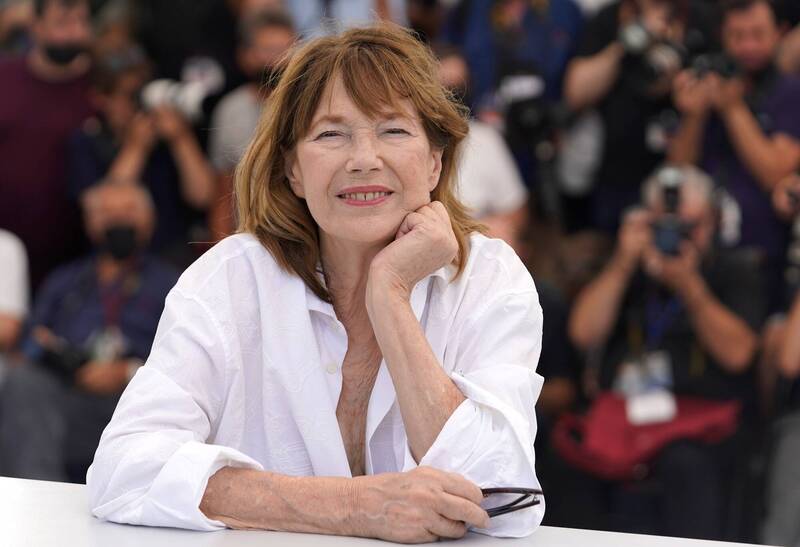 英國傳奇女星珍柏金過世,享壽76歲。(美聯社)
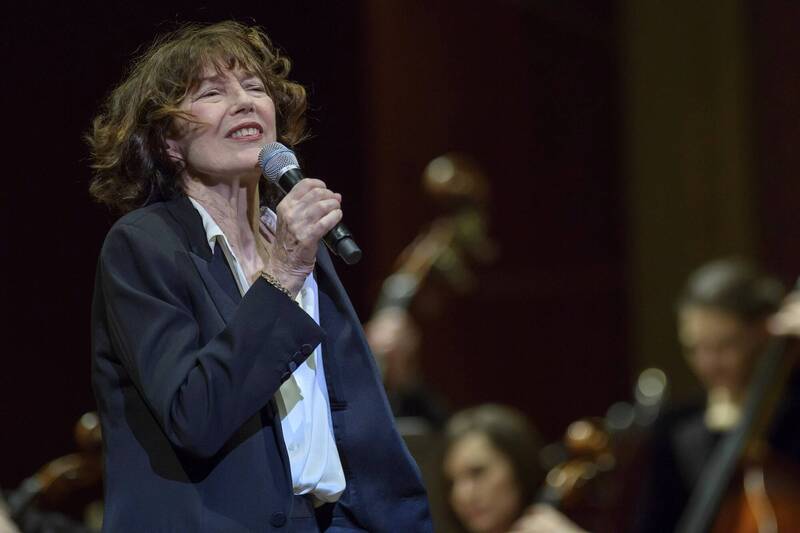 珍柏金曾經向愛馬仕總裁抱怨當時的包包都太小,催生出柏金包。(美聯社)


_crop.jpg)


_Ribbon.svg)


 lease feel free to


