Jim Jones |
|---|
 Jones at an anti-eviction protest in front of the International Hotel in 1977 |
| Born | James Warren Jones
May 13, 1931
|
|---|
| Died | November 18, 1978 (aged 47)
|
|---|
| Cause of death | Suicide by gunshot wound to the head |
|---|
| Nationality | American |
|---|
| Occupation | Cult leader |
|---|
| Known for | Leader of Peoples Temple cult |
|---|
| Spouse(s) | Marceline Baldwin Jones ( m. 1949; died ) |
|---|
| Children | 9 |
|---|
James Warren Jones (May 13, 1931 – November 18, 1978) was an American cult leader, preacher, self-professed faith healer, and civil rights activist who conspired with his inner circle to direct a mass murder-suicide of himself and his followers in his jungle commune at Jonestown, Guyana on November 18, 1978. He launched the Peoples Temple in Indiana during the 1950s.
Rev. Jones was ordained in 1957 by the Independent Assemblies of God and in 1964 by the Disciples of Christ.[note 1] He moved his congregation to California in 1965 and gained notoriety with its activities in San Francisco in the 1970s. He then left the United States, bringing many members to a Guyana jungle commune called Jonestown.
In 1978, media reports surfaced of human-rights abuses in the Peoples Temple in Jonestown. U.S. Representative Leo Ryan led a delegation to the commune to investigate. While boarding a return flight with some former cult members who had wished to leave, Ryan was assassinated and four others were murdered by gunfire. Jones then ordered and likely coerced a mass suicide and mass murder of 918 commune members, 304 of them children, almost all by cyanide-poisoned Flavor Aid.
Early life[edit]
Jones was born on May 13, 1931, in a rural area of Crete, Indiana[3][4] to James Thurman Jones (1887–1951), a World War I veteran, and Lynetta Putnam (1902–1977).[5][6] Jones was of Irish and Welsh descent;[7] he later claimed partial Cherokee ancestry through his mother, but his maternal second cousin said this was untrue.[7][note 2] Economic difficulties during the Great Depression led the family to Lynn, Indiana in 1934, where Jones grew up in a shack without plumbing.[8][9]
Jones was a voracious reader who studied Stalin, Marx, Mao, Gandhi, and Hitler.[10] He also developed an intense interest in religion. One writer suggests this was primarily because he found it difficult to make friends.[7] Childhood acquaintances recalled him as a "really weird kid" who was obsessed with religion and death. They alleged that he frequently held funerals for small animals on his parents' property, and that he had stabbed a cat to death.[11] One childhood acquaintance noted that after German POWs arrived in the town, one patted young Jimmy on the back of the head and then Jones responded by giving the Hitler salute and shouting "Heil Hitler!" [12]
Jones and a childhood friend both claimed his father was associated with the Ku Klux Klan, which had become very popular in Depression-era Indiana.[9] Jones recounted how he and his father argued on the issue of race, and how he did not speak with his father for "many, many years" after he refused to allow one of Jones' black friends into the house. Jones' parents separated, and Jones relocated with his mother to Richmond, Indiana.[13] In December 1948, he graduated from Richmond High School early with honors.[14]
Jones married nurse Marceline Baldwin (1927–1978) in 1949, and the two relocated to Bloomington, Indiana. She died with him in Jonestown.[11] He attended Indiana University Bloomington, where he was impressed with a speech by Eleanor Roosevelt about the plight of African-Americans.[11] In 1951, the couple relocated to Indianapolis. Jones attended Indiana University for two years and then took night classes at Butler University, earning a degree in secondary education in 1961—ten years after enrolling.[15]
Founding of the Peoples Temple[edit]
Indiana beginnings[edit]
In 1951, 20-year-old Jones began attending gatherings of the Communist Party USA in Indianapolis.[16] He became flustered with harassment during the McCarthy Hearings,[16] particularly regarding an event that he attended with his mother focusing on Paul Robeson, after which she was harassed by the FBI in front of her co-workers for attending.[17] He also became frustrated with the persecution of open and accused communists in the United States, especially during the trial of Julius and Ethel Rosenberg.[18] Jones said he asked himself, "How can I demonstrate my Marxism? The thought was, infiltrate the church."[16][17]
Jones was surprised when a Methodist district superintendent helped him get a start in the church, even though he knew Jones to be a communist.[18] In 1952, he became a student pastor at the Sommerset Southside Methodist Church, but later claimed he left the church because its leaders forbade him from integrating blacks into his congregation.[16] Around this time, Jones witnessed a faith-healing service at a Seventh Day Baptist Church.[16] He observed that it attracted people and their money, and he concluded that he could accomplish his social goals with financial resources from such services.[16]
Jones organized a mammoth religious convention to take place June 11–15, 1956 in Cadle Tabernacle. Needing a well-known religious figure to draw crowds, he arranged to share the pulpit with Rev. William M. Branham, a healing evangelist and religious author who was as highly revered as Oral Roberts.[6] Jones was able to begin his own church after the convention, which had various names until it became the Peoples Temple Christian Church Full Gospel.[16] The Peoples Temple was initially an interracial mission.
Jones was known to regularly study Adolf Hitler and Father Divine to learn how to manipulate members of the cult. Divine told Jones personally to "find an enemy" and "to make sure they know who the enemy is" as it will unify those in the group and make them subservient to him.[19]
Racial integrationist[edit]
The New York Times reported that, in 1953:[20]
[D]eclaring that he was outraged at what he perceived as racial discrimination in his white congregation, Mr. Jones established his own church and pointedly opened it to all ethnic groups. To raise money, he imported monkeys and sold them door to door as pets.
In 1960, Indianapolis Mayor Charles Boswell appointed Jones director of the local Human Rights Commission.[21] Jones ignored Boswell's advice to keep a low profile, however, finding new outlets for his views on local radio and television programs.[21] The mayor and other commissioners asked him to curtail his public actions, but he resisted. He was wildly cheered at a meeting of the NAACP and Urban League when he yelled for his audience to be more militant, and then climaxed with, "Let my people go!"[22]
During this time, Jones also helped to racially integrate churches, restaurants, the telephone company, the Indianapolis Police Department, a theater, an amusement park, and the Indiana University Health Methodist Hospital.[16] Swastikas were painted on the homes of two black families, and Jones walked through the neighborhood comforting local black people and counseling white families not to move.[23] He set up sting operations to catch restaurants refusing to serve black customers[23] and wrote to American Nazi leaders, passing their responses to the media.[24] He was accidentally placed in the black ward of a hospital after a collapse in 1961, but refused to be moved; he began to make the beds and empty the bedpans of black patients. Political pressures resulting from Jones' actions caused hospital officials to desegregate the wards.[25]
Jones received considerable criticism in Indiana for his integrationist views.[16] Likewise, white-owned businesses and locals were critical of him.[23] A swastika was placed on the Temple, a stick of dynamite was left in a Temple coal pile, and a dead cat was thrown at Jones' house after a threatening phone call.[24] Other incidents occurred, but one could theorize that Jones himself was involved in at least some of them.[24]
"Rainbow Family"[edit]
Jones and his wife adopted several non-white children, referring to the household as his "rainbow family,"[26] and stating: "Integration is a more personal thing with me now. It's a question of my son's future."[11] He also portrayed the Temple as a "rainbow family."
In 1954, he and his wife adopted Agnes, who was part Native American.[11][16][27]
The couple adopted three Korean-American children named Lew, Stephanie, and Suzanne, the latter of whom was adopted at age six in 1959.[27] Jones encouraged Temple members to adopt orphans from war-ravaged Korea.[28] He was also critical of U.S. opposition to communist leader Kim Il-sung's 1950 invasion of South Korea, calling it the "war of liberation" and stating that South Korea "is a living example of all that socialism in the north has overcome."[17]
In June 1959 the couple had their only biological child, naming him Stephan Gandhi.[16] In 1961, they became the first white couple in Indiana to adopt a black child.[29] They also adopted a white son, originally named Timothy Glen Tupper (shortened to Tim),[16] whose birth mother was a member of the Peoples Temple.[11]
Travel to Brazil[edit]
Jones's Brazilian locations
Jones traveled with his family to Belo Horizonte, Brazil with the idea of setting up a new Temple location, after preaching at the Temple about the fears of a nuclear holocaust and reading an article in the January 1962 issue of Esquire Magazine which listed the city as a safe place in nuclear war.[30] On his way to Brazil, he made his first trip to Guyana, a British colony at the time.[31]
The family rented a modest three-bedroom home in Belo Horizonte.[32] Jones studied the local economy and receptiveness of racial minorities to his message, although language remained a barrier.[33] He also explored local Brazilian syncretistic religions.[34] Careful not to portray himself as a communist in a foreign territory, he spoke of an apostolic communal lifestyle rather than of Castro or Marx.[35] Ultimately, the lack of resources in the locale led the family to move to Rio de Janeiro in mid-1963[36] where they worked with the poor in the slums.[36]
Jones became plagued by guilt for leaving behind the Indiana civil-rights struggle and possibly losing what he had tried to build there.[36] His associate preachers in Indiana told him the Temple was about to collapse without him, so he returned.[37]
Move to California[edit]
Some of the Peoples Temple's California locations
Jones returned from Brazil in December 1963[38] and told his Indiana congregation that the world would be engulfed by nuclear war on July 15, 1967, leading to a new socialist Eden on Earth, and that the Temple had to move to Northern California for safety.[16][39] Accordingly, the Temple began moving to Redwood Valley, California, near the city of Ukiah.[16]
According to religious studies professor Catherine Wessinger, Jones always spoke of the Social Gospel's virtues, but he chose to conceal that his gospel was actually communism until the late 1960s.[16] By that time, he began partially revealing the details of his "Apostolic Socialism" concept in Temple sermons.[16] He also taught that "those who remained drugged with the opiate of religion had to be brought to enlightenment—socialism."[40] He often mixed these ideas, such as preaching:[41]
If you're born in capitalist America, racist America, fascist America, then you're born in sin. But if you're born in socialism, you're not born in sin.
By the early 1970s, Jones began deriding Christianity as "fly away religion," rejecting the Bible as being a tool to oppress women and non-whites, and denouncing a "Sky God" who was no God at all.[16] He wrote a booklet titled "The Letter Killeth", criticizing the King James Bible.[42] Jones also began preaching that he was the reincarnation of Gandhi, Father Divine, Jesus, Gautama Buddha, and Vladimir Lenin. Former Temple member Hue Fortson, Jr. quoted him as saying:[11]
What you need to believe in is what you can see.… If you see me as your friend, I'll be your friend. As you see me as your father, I'll be your father, for those of you that don't have a father.… If you see me as your savior, I'll be your savior. If you see me as your God, I'll be your God.
In a 1976 phone conversation with John Maher, Jones alternately said he was an agnostic and an atheist.[43] Marceline Jones admitted in a 1977 New York Times interview that Jones was trying to promote Marxism in the U.S. by mobilizing people through religion, citing Mao as his inspiration: "Jim used religion to try to get some people out of the opiate of religion."[39] He had slammed the Bible on the table yelling "I've got to destroy this paper idol!"[39] In one sermon, Jones said:[44]
You're gonna help yourself, or you'll get no help! There's only one hope of glory; that's within you! Nobody's gonna come out of the sky! There's no heaven up there! We'll have to make heaven down here!
Focus on San Francisco[edit]
Within five years of moving to California, the Temple experienced a period of exponential growth and opened branches in cities including San Fernando, San Francisco, and Los Angeles. By the early 1970s, Jones began shifting his focus to major cities because of limited expansion opportunities in Ukiah, California. He eventually moved the Temple's headquarters to San Francisco, which was a major center for radical protest movements, where both Jones and the Temple became influential in San Francisco politics, culminating in the Temple's instrumental role in George Moscone's mayoral victory in 1975. Moscone subsequently appointed Jones as the chairman of the San Francisco Housing Authority Commission.[11]
Jones was able to gain contact with prominent politicians at the local and national level. For example, he and Moscone met privately with vice presidential candidate Walter Mondale on his campaign plane days before the 1976 election, leading Mondale to publicly praise the Temple.[45][46] First Lady Rosalynn Carter also met with Jones on multiple occasions, corresponded with him about Cuba, and spoke with him at the grand opening of the San Francisco headquarters—where he received louder applause than she did.[45][47][48]
In September 1976, California assemblyman Willie Brown served as master of ceremonies at a large testimonial dinner for Jones attended by Governor Jerry Brown and Lieutenant Governor Mervyn Dymally.[49] At that dinner, Brown touted Jones as "what you should see every day when you look in the mirror" and said he was a combination of Martin Luther King, Jr., Angela Davis, Albert Einstein, and Mao Tse-tung.[50] Harvey Milk spoke to audiences during political rallies held at the Temple,[51] and he wrote to Jones after one such visit:[52][53]
Rev Jim, It may take me many a day to come back down from the high that I reach today. I found something dear today. I found a sense of being that makes up for all the hours and energy placed in a fight. I found what you wanted me to find. I shall be back. For I can never leave.
Jones hosted local political figures at his San Francisco apartment for discussions, including Angela Davis.[54] He spoke with publisher Carlton Goodlett of the San Francisco Sun-Reporter about his remorse over not being able to travel to socialist countries such as the People's Republic of China and the Soviet Union, speculating that he could be Chief Dairyman of the U.S.S.R.[55] His criticisms led to increased tensions with the Nation of Islam, so Jones spoke at a huge rally in the Los Angeles Convention Center that was attended by many of his closest political acquaintances, hoping to close the rift between the two groups.[56]
Jones also forged alliances with key columnists and others at the San Francisco Chronicle and other press outlets,[57] although the move to San Francisco also brought increasing media scrutiny. Encountering resistance[by whom?] to publishing an exposé, Chronicle reporter Marshall Kilduff brought his story to New West magazine.[58] In the summer of 1977, Jones and several hundred Temple members abruptly decided to move to the Temple's compound in Guyana after they learned the contents of Kilduff's article, which included allegations by former Temple members that they were physically, emotionally, and sexually abused.[48][59]
Jones named the settlement "Jonestown" after himself.
Formation and operation of Jonestown[edit]
Peoples Temple Agricultural Project ("Jonestown", Guyana)
Jones had started building Jonestown (formally known as the "Peoples Temple Agricultural Project") several years before the New West article was published. It was promoted as a means to create both a "socialist paradise" and a "sanctuary" from the media scrutiny in San Francisco.[60] Jones purported to establish it as a model communist community, adding that the Temple comprised "the purest communists there are."[61] He did not, however, permit members to leave Jonestown.[62]
Religious scholar Mary McCormick Maaga argues that Jones' authority decreased after he moved to the isolated commune because he was not needed for recruitment and he could not hide his drug addiction from rank-and-file members.[63] In spite of the allegations prior to Jones' departure, he was still respected by some for setting up a racially-mixed church which helped the disadvantaged; 68% of Jonestown residents were black.[64] Jones began to propagate his belief in what he termed "Translation" once they were in Jonestown, where he and his followers would all die together and move to another planet and live blissfully.[65]
New children[edit]
Jones claimed he was the biological father of child John Victor Stoen, though the birth certificate listed Temple attorney Timothy Stoen and his wife Grace as the parents of the child.[66] The Temple repeatedly claimed that Jones fathered the child in 1971 when Stoen had requested that Jones have sex with Grace to keep her from defecting.[67] Grace left the Temple in 1976 and began divorce proceedings the following year. Jones ordered Tim to take the boy to Guyana in February 1977 in order to avoid a custody dispute with Grace.[68] After Tim, himself, defected in June 1977, the Temple kept John Stoen in Jonestown.[69] He also fathered Jim Jon (Kimo) with Temple member Carolyn Louise Moore Layton.[70]
Pressure and waning political support[edit]
In the autumn of 1977, Tim Stoen and others who had left the Temple formed a "Concerned Relatives" group because they had family members in Jonestown.[71] Stoen traveled to Washington, D.C. in January 1978 to visit with State Department officials and members of Congress, and he wrote a white paper detailing his grievances against Jones and the Temple.[72] His efforts aroused the curiosity of California Congressman Leo Ryan, who wrote a letter on Stoen's behalf to Guyanese Prime Minister Forbes Burnham.[73] The Concerned Relatives also began a legal battle with the Temple over the custody of Stoen's son, John.[74]
Most of Jones's political allies broke ties after his departure,[75] though some did not. Willie Brown spoke out against enemies[who?] at a rally that was attended by Harvey Milk and Assemblyman Art Agnos.[76] On February 19, 1978, Milk wrote a letter to President Jimmy Carter defending Jones as "a man of the highest character," and he claimed that escaped Temple members were trying to "damage Rev. Jones's reputation" with "apparent bold-faced lies."[77] Moscone's office issued a press release saying Jones had broken no laws.[78]
On April 11, 1978, the Concerned Relatives distributed a packet of documents, letters, and affidavits to the Peoples Temple, members of the press, and members of Congress which they titled an "Accusation of Human Rights Violations by Rev. James Warren Jones."[79] In June 1978, escaped Temple member Deborah Layton provided the group with a further affidavit detailing crimes by the Temple and substandard living conditions in Jonestown.[80]
Jones was facing increasing scrutiny in the summer of 1978 when he hired JFK assassination conspiracy theorists Mark Lane and Donald Freed to help make the case of a "grand conspiracy" against the Temple by U.S. intelligence agencies. Jones told Lane that he wanted to "pull an Eldridge Cleaver," referring to a fugitive member of the Black Panthers who was able to return to the U.S. after repairing his reputation.[81]
Visit by Congressman Ryan and mass murder at Jonestown[edit]
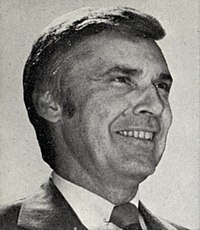
Congressman
Leo Ryan was shot and killed on Jones's orders as he and others attempted to leave Jonestown in November 1978.
In November 1978, Congressman Leo Ryan led a fact-finding mission to Jonestown to investigate allegations of human-rights abuses.[82] His delegation included relatives of Temple members, an NBC camera crew, and reporters for various newspapers.[83] The group arrived in the Guyanese capital of Georgetown on November 15.[82] Two days later, they traveled by airplane to Port Kaituma, then were transported to the Jonestown encampment in a limousine.[84] Jones hosted a reception for the delegation that evening at the central pavilion in Jonestown.
The delegation left hurriedly the afternoon of November 18, after Temple member Don Sly attacked Ryan with a knife, though the attack was thwarted.[85] Ryan and his delegation managed to take along 15 Temple members who had expressed a wish to leave,[86] and Jones made no attempt to prevent their departure at that time.[87]
Port Kaituma Airstrip shootings[edit]
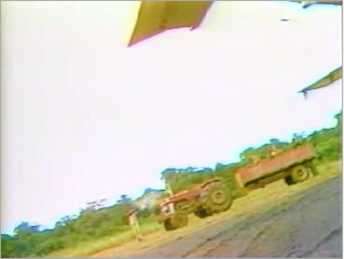
As members of the delegation boarded two planes at the airstrip, Jones's armed guards, called the "Red Brigade," arrived on a tractor and trailer and began shooting at them.[88] The gunmen killed Ryan and four others near a Guyana Airways Twin Otter aircraft.[89] At the same time, one of the supposed defectors, Larry Layton, drew a weapon and began firing on members of the party who had already boarded a small Cessna.[90] An NBC cameraman was able to capture footage of the first few seconds of the shooting at the Otter.[89]
The five killed at the airstrip were Ryan; NBC reporter Don Harris; NBC cameraman Bob Brown; San Francisco Examiner photographer Greg Robinson; and Temple member Patricia Parks.[89] Surviving the attack were future Congresswoman Jackie Speier, at the time a Ryan staff member; Richard Dwyer, Deputy Chief of Mission from the U.S. Embassy at Georgetown; Bob Flick, an NBC producer; Steve Sung, an NBC sound engineer; Tim Reiterman, a San Francisco Examiner reporter; Ron Javers, a San Francisco Chronicle reporter; Charles Krause, a Washington Post reporter; and several defecting Temple members.[89]
Mass murder-suicide in Jonestown[edit]

Houses in Jonestown, Guyana, the year after the mass murder-suicide, 1979
Later that same day, 909 inhabitants of Jonestown,[91] 304 of them children, died of apparent cyanide poisoning, mostly in and around the settlement's main pavilion.[92] This resulted in the greatest single loss of American civilian life (murder + suicide, though not on American soil) in a deliberate act until the September 11 attacks.[93] The FBI later recovered a 45-minute audio recording of the suicide in progress.[94]
On that tape, Jones tells Temple members that the Soviet Union, with whom the Temple had been negotiating a potential exodus for months, would not take them after the airstrip murders. The reason given by Jones to commit suicide was consistent with his previously stated conspiracy theories of intelligence organizations allegedly conspiring against the Temple, that men would "parachute in here on us," "shoot some of our innocent babies," and "they'll torture our children, they'll torture some of our people here, they'll torture our seniors." Jones' prior statements that hostile forces would convert captured children to fascism would lead many members who held strong opposing views to fascism to view the suicide as valid.[95]
With that reasoning, Jones and several members argued that the group should commit "revolutionary suicide" by drinking cyanide-laced grape-flavored Flavor Aid. Later-released Temple films show Jones opening a storage container full of Kool-Aid in large quantities. However, empty packets of grape Flavor Aid found on the scene show that this is what was used to mix the solution, along with a sedative. One member, Christine Miller, dissents toward the beginning of the tape.[95]
When members apparently cried, Jones counseled, "Stop these hysterics. This is not the way for people who are socialists or communists to die. No way for us to die. We must die with some dignity." Jones can be heard saying, "Don't be afraid to die;" that death is "just stepping over into another plane" and that it's "a friend." At the end of the tape, Jones concludes: "We didn't commit suicide; we committed an act of revolutionary suicide protesting the conditions of an inhumane world."[95]
According to escaping Temple members, children were given the drink first by their own parents; families were told to lie down together.[96] Mass suicide had been previously discussed in simulated events called "White Nights" on a regular basis.[80][97] During at least one such prior White Night, members drank liquid that Jones falsely told them was poison.[80][97]
Following the mass murder-suicide, Jones was found dead on the floor; he was resting on a pillow near his deck chair, with a gunshot wound to his head which Guyanese coroner Cyrill Mootoo said was consistent with suicide.[98] His body was later dragged outside for examination and embalming. The official autopsy conducted in December 1978 also confirms his death as a suicide. Jones' son Stephan believes his father may have directed someone else to shoot him, but that is speculation.[99] An autopsy of Jones' body also showed levels of the barbiturate pentobarbital, which may have been lethal to humans who had not developed physiological tolerance.[100] A sign could be seen hanging above Jones's deck chair; Jones had borrowed a quote from George Santayana: "Those who do not remember the past are condemned to repeat it."[101]
Sexuality[edit]
Jones married Marceline Baldwin in 1949. He began his first known affair in 1968 with a woman named Carolyn Layton whom he was with until the end. Another woman he became very close to was Maria Katsaris. Their relationship began in 1974 and she was also one of his mistresses up until his death. He also had many other mistresses during the 1970s, both before the move to Jonestown and while living in Jonestown. The book The Road to Jonestown by Jeff Guinn states: "Jones had occasional sex with male followers" but "never as often as he did with women." It states he was most likely bisexual, but his main physical and sexual attraction was towards women.
On December 13, 1973, Jones was arrested and charged with lewd conduct for masturbating in a movie theater restroom near MacArthur Park in Los Angeles.[102] The decoy was an undercover LAPD vice officer. Jones is on record as later telling his followers he was "the only true heterosexual."
While Jones banned sex among Temple members outside marriage, he voraciously engaged in sexual relations with both male and female Temple members.[103][104] Jones, however, claimed that he detested engaging in homosexual activity and did so only for the male temple adherents' own good, purportedly to connect them symbolically with him (Jones).[103]
The International Peace Mission movement leader Father Divine was one of Jones's sources of inspiration.[105]
Family aftermath[edit]
Marceline[edit]
On the final morning of Ryan's visit, Jones's wife Marceline took reporters on a tour of Jonestown.[106] Later in the day, she was found dead at the pavilion, having been poisoned.[107]
Surviving sons[edit]
Stephan, Jim Jr., and Tim Jones did not take part in the mass suicide because they were playing with the Peoples Temple basketball team against the Guyanese national team in Georgetown.[16][108] At the time of events in Jonestown, Stephan and Tim were both nineteen and Jim Jones Jr. was eighteen.[109] Tim's biological family, the Tuppers, which consisted of his three biological sisters,[110][111][112] biological brother,[113] and biological mother,[114] all died at Jonestown. Three days before the tragedy, Stephan Jones refused, over the radio, to comply with an order by his father to return the team to Jonestown for Ryan's visit.[115]
During the events at Jonestown, Stephan, Tim, and Jim Jones Jr. drove to the U.S. Embassy in Georgetown in an attempt to receive help. The Guyanese soldiers guarding the embassy refused to let them in after hearing about the shootings at the Port Kaituma airstrip.[116] Later, the three returned to the Temple's headquarters in Georgetown to find the bodies of Sharon Amos and her three children.[116] Guyanese soldiers kept the Jones brothers under house arrest for five days, interrogating them about the deaths in Georgetown.[116]
Stephan Jones was accused of being involved in the Georgetown deaths, and was placed in a Guyanese prison for three months.[116] Tim Jones and Johnny Cobb, another member of the Peoples Temple basketball team, were asked to go to Jonestown and help identify the bodies of people who had died.[116] After returning to the United States, Jim Jones Jr. was placed under police surveillance for several months while he lived with his older sister, Suzanne, who had previously turned against the Temple.[116]

Chaeoke Jones, Lew Jones, and Terry Carter Jones. Father, mother, and child all died in the mass suicide.
[117]When Jonestown was first being established, Stephan had originally avoided two attempts by his father to relocate him to the settlement. He eventually moved to Jonestown after a third attempt. He has since said that he gave in to his father's wishes to move to Jonestown because of his mother.[118] Stephan Jones is now a businessman, and married with three daughters. He appeared in the documentary Jonestown: Paradise Lost which aired on the History Channel and Discovery Channel. He stated he will not watch the documentary and has never grieved for his father.[119] One year later, he appeared in the documentary Witness to Jonestown where he responds to rare footage shot inside the Peoples Temple.[120]
Jim Jones Jr., who lost his wife and unborn child at Jonestown, returned to San Francisco. He remarried and has three sons from this marriage,[108] including Rob Jones, a high-school basketball star who went on to play for the University of San Diego before transferring to Saint Mary's College of California.[121]
Lew, Agnes, and Suzanne Jones[edit]
Lew and Agnes Jones both died at Jonestown. Agnes Jones was thirty-five years old at the time of her death.[122] Her husband[123] and four children[124][125][126][127] all died at Jonestown. Lew Jones, who was twenty-one years old at the time of his death, died alongside his wife Terry and son Chaeoke.[128][129][130] Stephanie Jones had died at age five in a car accident in May 1959.[16]
Suzanne Jones married Mike Cartmell; they both turned against the Temple and were not in Jonestown on November 18, 1978. After this decision to abandon the Temple, Jones referred to Suzanne openly as "my damned, no good for nothing daughter" and said she was not to be trusted.[131] In a signed note found at the time of her death, Marceline Jones directed that the Joneses' funds were to be given to the Communist Party of the Soviet Union and specified: "I especially request that none of these are allowed to get into the hands of my adopted daughter, Suzanne Jones Cartmell."[132][133] Cartmell had two children and died of colon cancer in November 2006.[134][135]
John Stoen and Kimo[edit]
Specific references to Tim Stoen, the father of John Stoen, including the logistics of possibly murdering him, are made on the Temple's final "death tape," as well as a discussion over whether the Temple should include John Stoen among those committing "revolutionary suicide."[95] At Jonestown, John Stoen was found poisoned in Jim Jones's cabin.[74]
Jim Jon (Kimo) and his mother, Carolyn Louise Moore Layton, both died during the events at Jonestown.[136]
In popular culture[edit]
uestion_book-new.svg" class="image" style="text-decoration-line: none; color: rgb(11, 0, 128); background: none;">  | |
Documentaries[edit]
Television[edit]
Fictional literature[edit]
- Jonestown, by Wilson Harris. London: Faber and Faber, 1996.
- We Agreed to Meet Just Here, by Scott Blackwood. Kalamazoo, Michigan: West Michigan University Press, 2009.
- Children of Paradise, by Fred D'Aguiar. New York: HarperCollins, 2014.
- Before White Night, by Joseph Hartmann. Richmond, Virginia: Belle Isle Books, 2014.
- White Nights, Black Paradise, by Sikivu Hutchinson. Infidel Books, 2015.
- Beautiful Revolutionary, by Laura Elizabeth Woollett. London: Scribe. 2018.
- The Brian Jonestown Massacre (band)
- "Ultraviolence" by Lana Del Rey from the album Ultraviolence (2014)
- "Carnage in the Temple of the Damned" by Deicide from the album Deicide (1990)[141]
- "Guyana (Cult of the Damned)" by Manowar from the album Sign of the Hammer (1984)[141][142]
- "A Lilac Harry Quinn" by Half Man Half Biscuit from the album McIntyre, Treadmore and Davitt (1991)
- "Hypnotized" by Heathen from the album Victims of Deception (1991)[141]
- "Jimmie Jones" by The Vapors from the album, Magnets (1981)[141]
- "Jonestown" by The Acacia Strain, from the album Wormwood (2010)[141]
- "Sects" by French band Trust, also covered by American thrash metal band Anthrax
- "Jonestown" by Concrete Blonde, from the album Mexican Moon (1993)[141]
- "Jonestown" by Evan Williams, at the University of Cincinnati’s College-Conservatory of Music (2015)[143]
- "Jonestown" by Frank Zappa, from the album Boulez Conducts Zappa: The Perfect Stranger (1984)[144]
- "Koolaid" by Accept, from the album The Rise of Chaos (2017)[141]
- "Last Call in Jonestown" by Polkadot Cadaver, from the album Last Call in Jonestown (2013)[141]
- "Reverend" by Church of Misery, from the album Early Works Compilation (2011)[141]
- "La Dee Da" by Foo Fighters, from the album "Concrete and Gold" (2017)
- "1998 TRUMAN" by Brockhampton from the single "1998 TRUMAN" (2018)
- "Jonestown (interlude)" by Post Malone from the album Beerbongs and Bentleys (2018)
- "Leaders (feat. NAV)" by Lil Uzi Vert from the album Eternal Atake (2020)
- "Jonestown" by Sofia Talvik from the album Jonestown (Sofia Talvik album) (2008)
- "Go Outside" by Cults (band) from the album Cults (album) (2011)
- "White Nights" by The Agony Scene from the album Get Damned (2007)
- "Jim Jones" by SKYND from the album Chapter II (2019)[145]
- "Mao Tse Tung Said" by Alabama 3 from the album Exile On Coldharbour Lane (1997)
- Bill of Rights, by Fred D'Aguiar. London: Chatto & Windus, 1998.
- The Jonestown Arcane, by Jack Hirschman. Los Angeles: Parentheses Writing Series, 1991.
- Jonestown Lullaby, by Teri Buford O'Shea. Bloomington, IN: iUniverse, 2011.
- Jonestown and Other Madness, by Pat Parker. Ithaca, NY: Firebrand Books, 1985.
- I. at jonestown, by Lucille Clifton. Next. Brockport: BOA, 1989.
Theater[edit]
- The Peoples Temple. Written by Leigh Fondakowski, with Greg Pierotti, Stephen Wangh, and Margo Hall. Premiered in 2005.[146]
https://en.wikipedia.org/wiki/Jim_Jones






2.jpg)


 lease help