| Jerry Lewis |

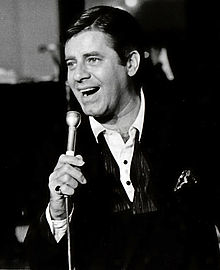
Lewis in the 1960s |
| Birth name |
Joseph Levitch |
| Born |
March 16, 1926
Newark, New Jersey, U.S. |
| Died |
August 20, 2017 (aged 91)
Las Vegas, Nevada, U.S. |
| Medium |
Stage, film, television, radio |
| Genres |
Character comedy, physical comedy |
| Spouse |
- Patti Palmer (m. 1944; div. 1980)
- SanDee Pitnick (m. 1983)
|
| Children |
7 including Gary Lewis |
| Signature |
 |
| Website |
jerrylewiscomedy.com |
Jerry Lewis (born Joseph or Jerome Levitch, depending on the source;[1] March 16, 1926 – August 20, 2017) was an American actor,comedian, singer, film producer, film director,screenwriter, and humanitarian. He was known for his slapstick humor in film, television, stage and radio. He and Dean Martin were partners as the hit popular comedy duo of Martin and Lewis. Following that success, he was a solo star in motion pictures,nightclubs, television shows, concerts, album recordings, and musicals.
Lewis served as national chairman of the Muscular Dystrophy Association and hosted the live Labor Day weekend broadcast of the Jerry Lewis MDA Telethon for 44 years. He received several awards for lifetime achievement from the American Comedy Awards, Los Angeles Film Critics Association,Venice Film Festival and Academy of Motion Picture Arts and Sciences, and was honored with two stars on the Hollywood Walk of Fame.
Early life
Lewis was born on March 16, 1926, at Newark Beth Israel Hospital in Newark, New Jersey, toRussian Jewish parents.[2] His father, Daniel Levitch (1902–1980), was a master of ceremoniesand vaudeville entertainer[3][4][5] who used the professional name Danny Lewis.[6] His mother, Rachel ("Rae") Levitch (née Brodsky),[7] was a piano player for a radio station. Lewis started performing at age five and would often perform alongside his parents in the Catskill Mountains inNew York State.[8] By 15, he had developed his "Record Act" in which he exaggeratedly mimed the lyrics to songs on a phonograph.
He used the professional name Joey Lewis but soon changed it to Jerry Lewis to avoid confusion with comedian Joe E. Lewis and heavyweight boxing champion Joe Louis.[9] Lewis then dropped out of Irvington High School in the tenth grade. He was a "character" even in his teenage years, pulling pranks in his neighborhood including sneaking into kitchens to steal fried chicken and pies. During World War II, he was rejected for military service because of a heart murmur.[10]
Career
Teaming with Dean Martin
ewis_and_Martin.jpg">

Lewis initially gained attention as part of a double act with singer Dean Martin, who served as straight man to Lewis' zany antics in the Martin and Lewis comedy team. The performers were different from most other comedy acts of the time because they relied on their interaction instead of planned skits. After forming in 1946, they quickly rose to national prominence, first with their popular nightclub act, next as stars of their own programThe Martin and Lewis Show on the NBC Red Network.[11] The two men made many appearances on early live television, their first on the June 20, 1948, debut broadcast of Toast of the Town on CBS (later officially renamed The Ed Sullivan Show on September 25, 1955).[12]
This was followed on October 3, 1948, by an appearance on the NBC series Welcome Aboard, then a stint as the first of a series of hosts of The Colgate Comedy Hour in 1950. Just before appearing on The Colgate Comedy Hour, Lewis hired Norman Lear and Ed Simmons to become regular writers for the Martin and Lewis bits.[13][14] The duo began their Paramount film careers as ensemble players in My Friend Irma (1949), based on the popular radio series of the same name. This was followed by a sequel My Friend Irma Goes West (1950).
ean_Martin_Jerry_Lewis_1955_Colgate_Comedy_Hour.JPG">

ean_Martin_Jerry_Lewis_1955_Colgate_Comedy_Hour.JPG">
Martin and Lewis in 1955
Starting with At War with the Army (1950), Martin and Lewis were the stars of their own vehicles in fourteen additional titles, That's My Boy (1951), Sailor Beware(1952), Jumping Jacks (1952; also appearing in theCrosby and Hope film, Road to Bali as cameos), The Stooge (1952), Scared Stiff (1953), The Caddy (1953),Money from Home (1953), Living It Up (1954), 3 Ring Circus (1954), You're Never Too Young (1955), Artists and Models (1955) and Pardners (1956) at Paramount, ending with Hollywood or Bust (1956). All sixteen movies were produced by Hal B. Wallis. Attesting to the comedy team's popularity, DC Comics published the best-sellingThe Adventures of Dean Martin and Jerry Lewis comics from 1952 to 1957. In 1954, the team appeared on episode 191 of What's My Line? as mystery guests. As Martin's roles in their films became less important over time, the partnership came under strain. Martin's participation became an embarrassment in 1954 when Look magazine published a publicity photo of the team for the magazine cover but cropped Martin out.[15] The partnership ended on July 24, 1956.
Both Martin and Lewis went on to successful solo careers, and neither would comment on the split nor consider a reunion. They made occasional public appearances together until 1961, but were not seen together again until a surprise reunion on a Muscular Dystrophy Telethon in 1976, arranged by Frank Sinatra.[16] The pair eventually reconciled in the late 1980s after the death of Martin's son, Dean Paul Martin, in 1987. The two men were seen together on stage for the last time when Martin was making what would be his final live performance at Bally's Hotel and Casino in Las Vegas in 1989. Lewis wheeled out a cake for Martin's 72nd birthday, sang "Happy Birthday" to him, and joked, "Why we broke up, I'll never know."[17]
Going solo
After his partnership with Martin ended, he and his wife Patty took a vacation in Las Vegas to consider the direction of his career. He felt his life was in a crisis state: "I was unable to put one foot in front of the other with any confidence. I was completely unnerved to be alone ..."[10] While there, he received an urgent request from his friend Sid Luft, who was Judy Garland's husband and manager, saying that she couldn't perform that night in Las Vegas because of strep throat,[10] and asking Lewis to fill in. However, Lewis had not sung on a stage since he was five years old, twenty-five years before. But he appeared before the audience of a thousand nonetheless, doing jokes and clowning with the audience while Garland sat off-stage, watching. He then sang a rendition of a song he'd learned as a child, "Rock-A-Bye Baby", along with "Come Rain or Come Shine." Lewis recalled, "When I was done, the place exploded. I walked off the stage knowing I could make it on my own..."[10] At his wife's pleading, Lewis used his own money to record the songs on a single.[18]
Capitol Records heard it and insisted he do an album.[19] The album, Jerry Lewis Just Sings, went to number 3 on the Billboard charts, staying near the top for four months and selling a million and a half copies.[10][20] Having now proven he could sing and do live shows, he began performing regularly at the Sands Hotel in Las Vegas beginning in late 1956, which marked a turning point in his life and career. The Sands signed him for five years, to perform six weeks each year, and paid him the same amount they had paid Martin and Lewis as a team.[19] The critics gave him positive reviews: "Jerry was wonderful. He has proved that he can be a success by himself," wrote one.[19] He appeared on his first solo television show for NBC in January 1957, followed by performances for clubs in Miami, New York, Chicago and Washington. In February he followed Judy Garland at the Palace Theater in New York; ex-partner Martin called during this period to wish him the best of luck.[19] "I've never been happier," said Lewis. "I have peace of mind for the first time."[19]
Lewis rose to stardom as a solo act in television and movies starting with the first of six appearances on What's My Line? from 1956 to 1966, then starred in "The Jazz Singer" episode of Startime. Lewis remained at Paramount and became a comedy star in his own right with his first film as a solo comic, The Delicate Delinquent (1957). Meanwhile, DC Comics published a new comic book series titled The Adventures of Jerry Lewis, running from 1957 to 1971. Teaming with director Frank Tashlin, whose background as a Warner Bros. Looney Tunescartoon director suited Lewis's brand of humor, he starred in five more films, The Sad Sack(1957), Rock-A-Bye Baby (1958), The Geisha Boy (1958), Don't Give Up The Ship (1959) and even appeared uncredited as Itchy McRabbitt in Li'l Abner (1959). By the end of his contract with producer Hal B. Wallis, Lewis had several productions of his own under his belt. In 1959, a contract between Paramount Pictures and Jerry Lewis Productions was signed specifying a payment of $10 million plus 60% of the profits for 14 films over a seven-year period.[21] In 1960, Lewis finished his contract with Wallis with Visit to a Small Planet (1960) and wrapped up work on his own production Cinderfella, which was postponed for a Christmas 1960 release and Paramount, needing a quickie feature film for its summer 1960 schedule, held Lewis to his contract to produce one.[22]
Lewis came up with The Bellboy (1960). Using the Fontainebleau Hotel in Miami as his setting—and on a small budget, with a very tight shooting schedule, and no script—Lewis shot the film by day and performed at the hotel in the evenings.[22] Bill Richmond collaborated with him on the many sight gags. Lewis later revealed that Paramount was not happy financing a 'silent movie' and withdrew backing. Lewis used his own funds to cover the $950,000 budget. Lewis would next star in an episode of Celebrity Golf. During production Lewis pioneered the technique of using video cameras and multiple closed circuit monitors,[23] which allowed him to review his performance instantly. His techniques and methods of video assist, documented in his book and his USC class, enabled him to complete most of his films on time and under budget. He popularized the practice, though he did not explicitly invent it.[24][25] Lewis followed The Bellboyby directing several more films that he co-wrote with Richmond while some were directed by Tashlin, including The Ladies Man (1961), The Errand Boy (1961), It's Only Money (1962) andThe Nutty Professor (1963). Lewis did a cameo appearance in It's a Mad, Mad, Mad, Mad World (1963). Further on, more Lewis films were Who's Minding the Store? (1963), The Patsy(1964) and The Disorderly Orderly (1964). Also in 1961, Lewis guest starred in an episode ofThe Garry Moore Show. Lewis hosted two different versions of The Jerry Lewis Show (a 1963 lavish, big-budget 13-week show for ABC and a 1967 one-hour variety show for NBC).[26]
In
The Jerry Lewis Show (1973)
Lewis directed and co-wrote The Family Jewels (1965) about a young heiress who must choose among six uncles, one of whom is up to no good and out to harm the girl's beloved bodyguard who practically raised her. Lewis played all six uncles and the bodyguard. Lewis would next appear in Boeing Boeing (1965).[27] Also in 1965, Lewis made television appearances on Ben Casey, The Andy Williams Show and Hullabaloo. By 1966, Lewis, then 40, was no longer an angular juvenile, his routines seemed more labored and his box office appeal waned to the point where Paramount Pictures new executives felt no further need for the Lewis comedies and did not wish to renew his 1959 profit sharing contract.[citation needed] Undaunted, Lewis packed up and went to Columbia Pictures, where he made Three On A Couch (1966), then appeared in Way...Way Out (1966) for 20th Century Fox. During 1966, Lewis guest starred in Batman, Password and in a pilot for Sheriff Who. Lewis continued with more movies, such as The Big Mouth (1967) and Don't Raise the Bridge, Lower the River(1968).
Lewis appeared on an episode of Playboy After Dark. He then starred in Hook, Line & Sinker(1969). Lewis taught a film directing class at the University of Southern California in Los Angeles for a number of years and his students included Steven Spielberg and George Lucas.[28] In 1968, he screened Spielberg's early film Amblin' and told his students, "That's what filmmaking is all about."[29] In 1970, Lewis guest appeared on The Red Skelton Show, then directed an episode of The Bold Ones. Lewis guest starred in an episode of The Engelbert Humperdinck Show.
He then directed and made his first offscreen voice performance as a bandleader in One More Time (1970), which starred Sammy Davis Jr. (a friend of Lewis) and also produced, directed and starred in Which Way to the Front? (1970). He would then make and star in the unreleased The Day the Clown Cried (1972), a drama set in a Nazi concentration camp. Lewis rarely discusses the film, but once suggested that litigation over post-production finances prevented the film's completion and release. However, he admitted during his book tour for Dean and Me that a major factor for the film's burial is that he is not proud of the effort. In 1973, Lewis was a guest on The Dick Cavett Show, then appeared on Celebrity Sportsman in 1974. Lewis appeared in a revival of Hellzapoppin' with Lynn Redgrave in 1976, but it closed on the road before reachingBroadway.[30] In 1979, Lewis guest hosted (as ringmaster) in Circus of the Stars.
After an absence of 11 years, Lewis returned to film inHardly Working (1981), a movie in which he both directed and starred. Despite being panned by critics, it eventually earned $50 million. Lewis next appeared inMartin Scorsese's film The King of Comedy (1983), in which he portrayed a late-night television host plagued by two obsessive fans, played by Robert De Niro andSandra Bernhard. Lewis guest hosted Saturday Night Live and also appeared in Cracking Up a.k.a.Smorgasbord (1983) and Slapstick (Of Another Kind)(1984). In France, Lewis starred in both To Catch a Copa.k.a. The Defective Detective (1984) and How Did You Get In? We Didn't See You Leave (1984). Lewis has stated that as long as he has control over distribution of those movies, they will never have an American release. Meanwhile, a syndicated talk show Lewis hosted for Metromedia in 1984 was not continued beyond the scheduled five shows.
Lewis starred in the ABC televised drama movie Fight For Life (1987) with Patty Duke. He starred in five episodes of Wiseguy, then appeared in Cookie (1989). Lewis had a cameo in Mr. Saturday Night (1992) then in 1993, guest appeared in an episode of Mad About You as an eccentric billionaire. Lewis made his Broadway debut, as a replacement cast member playing the devil in a revival of Damn Yankees, choreographed by Rob Marshall.[31] while also starring in the film Arizona Dream (1994), as a car salesman uncle. Lewis then starred as a father of a young comic in Funny Bones (1995). In 2003, Lewis did a guest voice as Professor Frink's dad in an episode of The Simpsons then in 2006, guest appeared in an episode of Law & Order: Special Victims Unit as Munch's uncle.
Lewis has remained popular in France, evidenced by consistent praise by French critics in the magazineCahiers du Cinéma for his absurd comedy, in part because he had gained respect as an auteur who had total control over all aspects of his films, comparable toHoward Hawks and Alfred Hitchcock. Liking Lewis has long been a common stereotype about the French in the minds of many English-speakers, and is often the object of jokes in English-speaking world pop culture.[32] "That Americans can't see Jerry Lewis's genius is bewildering," says N. T. Binh, a French film magazine critic. Such bewilderment was the basis of the book Why the French Love Jerry Lewis.[33]
In 2012, Lewis directed a musical theatre version of The Nutty Professor[34][35] at the Tennessee Performing Arts Center in Nashville from July 31 to August 19 over the summer. In Brazil, Lewis appeared in Till Luck Do Us Part 2 (2013). He then next starred in a small role in the crime drama The Trust (2016). Lewis made a comeback in a lead role in Max Rose (2016).[36][37]
In December 2016, Lewis expressed interest in making another film.[38]
Muscular dystrophy activism and partnership with MDA
Throughout his entire adult life and career, Lewis was a world-renowned humanitarian who supported fundraising for research into muscular dystrophy. Until 2011, he served as national chairman of and spokesman for theMuscular Dystrophy Association (formerly, the Muscular Dystrophy Associations of America).[39] Lewis began hosting telethons to benefit the company from 1952 to 1959, then every Labor Day weekend from 1966 to 2010, he hosted the annual live Jerry Lewis MDA Telethon(also referred to as Jerry Lewis Extra Special Special,Jerry Lewis Super Show and Jerry Lewis Stars Across America). Over nearly half a century, he raised over $2.6 billion in donations for the cause.[40]
On August 3, 2011, it was announced that Lewis would no longer host the MDA telethons[41] and is no longer associated with the Muscular Dystrophy Association.[42] On May 1, 2015, it was announced that in view of "the new realities of television viewing and philanthropic giving", the telethon was being discontinued.[43] In early 2016, Lewis broke a five-year silence by making an online video statement for the organization on its website in honor of its rebranding, marking his first (and as it turned out, his final) appearance in support of MDA since his last telethon in 2010 and the end of his tenure as national chairman in 2011.
Other ventures
Theater chain
In 1969, Lewis agreed to lend his name to "Jerry Lewis Cinemas", offered by National Cinema Corporation as a franchise business opportunity for those interested in theatrical movie exhibition. Jerry Lewis Cinemas stated that their theaters could be operated by a staff of as few as two with the aid of automation and support provided by the franchiser in booking film and other aspects of film exhibition. A forerunner of the smaller rooms typical of later multi-screen complexes, a Jerry Lewis Cinema was billed in franchising ads as a "mini-theatre" with a seating capacity of between 200 and 350. In addition to Lewis's name, each Jerry Lewis Cinemas bore a sign with a cartoon logo of Lewis in profile.[44]
Initially 158 territories were franchised, with a buy-in fee of $10,000 or $15,000 depending on the territory, for what was called an "individual exhibitor". For $50,000, Jerry Lewis Cinemas offered an opportunity known as an "area directorship", in which investors controlled franchising opportunities in a territory as well as their own cinemas.[45] The success of the chain was hampered by a policy of only booking second-run, family-friendly films. Eventually the policy was changed, and the Jerry Lewis Cinemas were allowed to show more competitive movies. but after a decade the chain failed and both Lewis and National Cinema Corporation declared bankruptcy in 1980.[46]
Jerry's House
In 2010, Lewis met with seven-year-old Lochie Graham, who shared his idea for "Jerry's House", a place for vulnerable and traumatized children. Lewis and Graham entered into a joint partnership for an Australian and a U.S.-based charity and began raising funds to build the facility in Melbourne, Australia.[47][48]
Political views
Lewis kept a low political profile for many years, having taken advice given to him by his friend, President John F. Kennedy, who told him "Don't get into anything political. Don't do that because they will usurp your energy".[49] Lewis also once stated that politics "did not belong" at theOscars.[50] In a 2004 interview, Lewis was asked what he was least proud of, to which he answered politics – not his, but the world's. He lamented citizens' lack of pride in their country, stating, "President Bush is my president. I will not say anything negative about the president of the United States. I don't do that. And I don't allow my children to do that. Likewise when I come to England don't you do any jokes about 'Mum' to me. That is the Queen of England, you moron".[51]
In a December 2015 interview on EWTN's World Over with Raymond Arroyo, Lewis expressed opposition to the United States letting in Syrian refugees, saying "No one has worked harder for the human condition than I have, but they're not part of the human condition if 11 guys in that group of 10,000 are ISIS. How can I take that chance?"[52] In the same interview, he criticized President Barack Obama for not being prepared for ISIS, while expressing support for Donald Trump, saying he would make a good president because he was a good "showman". He also added that he admired Ronald Reagan's presidency.[53][54][55][56]
Filmography
Awards and other honors
Personal life
Family
Lewis was married twice:
- Patti Palmer (née Esther Grace Calonico),[65] a former singer with Ted Fio Rito;[66] married October 3, 1944, divorced September 1980[67]
- SanDee Pitnick; married February 13, 1983; a 32-year-old Las Vegas dancer; married in Key Biscayne, Florida[68]
He had six sons (one adopted) and one daughter (adopted):
- With Patti Palmer
- Gary Lewis (born July 31, 1946);[69] known for his 1960s pop group Gary Lewis & the Playboys[70]
- Ronald Steven "Ronnie" Lewis (born December 1949 [adopted])
- Scott Anthony Lewis[71] (born February 22, 1956)
- Christopher Lewis (born October 1957)
- Anthony Lewis (born October 1959)
- Joseph Lewis (January 1964 – October 24, 2009 [from a narcotics overdose])[72]
- With SanDee Pitnick
- Danielle Sara Lewis (adopted March 1992)[67]
Illness and death
Lewis had a number of illnesses and addictions related both to aging and a back injury sustained in a comedic pratfall from a piano while performing at the Sands Hotel on the Las Vegas Strip on March 20, 1965.[73][74] The accident almost left him paralyzed. In its aftermath, Lewis became addicted to the painkiller Percodan for thirteen years.[73] He said he had been off the drug since 1978.[74] In April 2002, Lewis had a Medtronic "Synergy" neurostimulatorimplanted in his back,[75] which helped reduce the discomfort. He was one of the company's leading spokesmen.[74][75]
In the 2011 documentary Method to the Madness of Jerry Lewis, Lewis said he had his first heart attack while filming Cinderfella in 1960.[76][77] In December 1982, he had another heart attack. En route to San Diego from New York City on a cross-country commercial airline flight on June 11, 2006, he had another.[78] It was discovered that he had pneumonia as well as a severely damaged heart. He underwent a cardiac catheterization and two stents were inserted into one of his coronary arteries, which was 90 percent blocked. The surgery resulted in increased blood flow to his heart and allowed him to continue his rebound from earlier lung problems. Having the cardiac catheterization meant canceling several major events from his schedule, but Lewis fully recuperated in a matter of weeks.
In 1999, Lewis' Australian tour was cut short when he had to be hospitalized in Darwin with viralmeningitis. He was ill for more than five months. It was reported in the Australian press that he had failed to pay his medical bills. However, Lewis maintained that the payment confusion was the fault of his health insurer. The resulting negative publicity caused him to sue his insurer for US$100 million.[79] Lewis had had prostate cancer,[80] diabetes,[74] pulmonary fibrosis,[73] and a decades-long history of heart disease. Prednisone[73] treatment in the late 1990s for pulmonary fibrosis resulted in weight gain and a noticeable change in his appearance.
In September 2001, Lewis was unable to perform at a planned London charity event at theLondon Palladium. He was the headlining act, and he was introduced, but did not appear. He had suddenly become unwell, apparently with heart problems. He was subsequently taken to the hospital. Some months thereafter, Lewis began an arduous, months-long therapy that weaned him off prednisone and enabled him to return to work. On June 12, 2012, he was treated and released from a hospital after collapsing from hypoglycemia at a New York Friars' Club event. This latest health issue forced him to cancel a show in Sydney.[81]
In an October 6, 2016, interview with Inside Edition, Lewis acknowledged that he might not star in any more films given his advanced age, while admitting, through tears, that he was afraid of dying, as it would leave his wife and daughter alone.[82] In June 2017, Lewis was hospitalized at a Las Vegas hospital for a urinary tract infection.[83]
Lewis died at his home in Las Vegas, Nevada, at 9:15 a.m. (PDT) on August 20, 2017, at the age of 91.[84] The cause was end-stage cardiac disease and peripheral vascular disease..[85]
Bibliography
Documentary
https://en.wikipedia.org/wiki/Jerry_Lewis



