Martha Elizabeth McSally (born March 22, 1966) is a United States Air Force combat veteran and politician serving as the juniorU.S. Senator for Arizona. A Republican, she previously served as the U.S. Representativefor Arizona's 2nd congressional district.
McSally served in the United States Air Force(USAF) from 1988 to 2010 and rose to the rank of colonel before retiring. One of the highest-ranking female pilots in the history of the Air Force, McSally was the first American woman to fly in combat following the 1991 lifting of the prohibition on female combat pilots. McSally flew the Fairchild Republic A-10 Thunderbolt II close air support aircraft over Iraq and Kuwait during Operation Southern Watch. She was also the first female commander of a USAF fighter squadron (the354th Fighter Squadron (354 FS), based atDavis-Monthan Air Force Base). In 2001, she sued the United States Department of Defensein McSally v. Rumsfeld, challenging the military policy that required United States and United Kingdom servicewomen stationed in Saudi Arabia to wear the body-covering abayawhen traveling off base in the country.
Following two unsuccessful congressional bids in 2012, McSally was first elected to the U.S. House of Representatives in 2014. She served two terms as the U.S. Representative for Arizona's 2nd congressional district. McSally was the Republican nominee in Arizona's 2018 U.S. Senate election, losing 50–48% to Democratic Congresswoman Kyrsten Sinema, while Democrat Ann Kirkpatrick won McSally's seat in the House elections. Following that election, interim U.S. Senator Jon Kylannounced his resignation from the state's other Senate seat, and Republican GovernorDoug Ducey appointed McSally to succeed Kyl.
Early life and education[edit]
McSally was born in 1966[1] in Warwick, Rhode Island, the youngest of five children. In 1978, her father, Bernard, a lawyer, died of a heart attack. Her mother, Eleanor, worked as a reading specialist to support the family.[2]
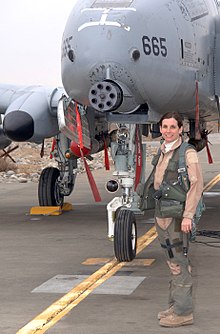
McSally with an A-10 Thunderbolt II
McSally was the valedictorian at St. Mary's Academy, Bayview in 1984.[2]
During an interview with The Wall Street Journal in April 2018, McSally alleged her track and field coach pressured her into a sexual relationship during her senior year at the Catholic girls' school. She told the Journal that the coach used "emotional manipulation" to keep her compliant. She did not reveal the incident to friends or family until ten years after her graduation.[3][4]
She earned an appointment to the United States Air Force Academy, graduating in 1988.[2] She earned a master's degree from Harvard University's John F. Kennedy School of Government following graduation from USAFA and then proceeded to pilot training.[5] McSally was first in her class at the Air War College.
Military career[edit]
McSally earned her USAF pilot's wings in 1991 after completing Undergraduate Pilot Training at Williams AFB east of Phoenix, Arizona. Following graduation, she was assigned to Laughlin AFB, Texas, as a First Assignment Instructor Pilot (FAIP) in the T-37 trainer. When the military's combat aircraft restriction for female pilots was removed, McSally went on to Lead-in Fighter Training (LIFT) in 1993.[6]
McSally then completed Replacement Training Unit for the A-10 Thunderbolt II at Davis-Monthan AFB, Arizona, and was assigned to an operational A-10 squadron that deployed toKuwait in January 1995.[7] During this deployment, McSally flew combat patrols over Iraq in support of Operation Southern Watch, enforcing the no-fly zone over southern Iraq and became "the first female U.S. fighter pilot to fly in combat and the first woman to command a fighter squadron."[8]
In 1999, she deployed to Europe in support of Operation Allied Force. McSally was selected as one of seven active duty Air Force officers for the Legislative Fellowship program. She lived in Washington, D.C. working as an advisor to Senator Jon Kyl (R-AZ) on defense and foreign affairs policy.[9]
Promoted to Major, she reported to Joint Task Force Southwest Asia (JTF-SWA) in Riyadh, Saudi Arabia in 2000 for an Operation Southern Watch temporary assignment. Following her promotion to Lieutenant Colonel, she took command of the A-10 equipped 354th Fighter Squadron at Davis-Monthan AFB in July 2004. She was then subsequently deployed to Afghanistan under Operation Enduring Freedom, dispatching weapons for the first time from her A-10 in combat. In 2005, McSally and her squadron were awarded the David C. Shilling Award, given by the Air Force Association for the best aerospace contribution to national defense.[10]
Lawsuit against the U.S. Department of Defense (McSally v. Rumsfeld)[edit]
McSally was represented by the Rutherford Institute in a successful 2001 lawsuit against the Department of Defense, challenging the military policy that required U.S. and U.K. servicewomen stationed in Saudi Arabia to wear the body-covering abaya when traveling off base in the country.[11][12] At the time of the lawsuit McSally, as a Major (O-4), was the highest ranking female fighter pilot in the U.S. Air Force. Her suit alleged "the regulations required her to send the message that she believes women are subservient to men."[13] In addition to the issue of religious garb, McSally noted that policies also included other requirements.
In a "60 Minutes" interview broadcast on CBS on January 20, 2002, she described the discrimination she experienced under the policy:
"I have to sit in the back and at all times I must be escorted by a male ... [who], when questioned, is supposed to claim me as his wife," she said. "I can fly a single-seat aircraft in enemy territory, but [in Saudi Arabia] I can't drive a vehicle.[13]
She was granted audience with several high-level officials, including two Secretaries of Defense, William Cohen and Donald Rumsfeld. General Tommy Franks, then commander of the United States Central Command (USCENTCOM), announced in 2002 that U.S. military servicewomen would no longer be required to wear the abaya, although they would be "encouraged" to do so as a show of respect for local customs. Commenting on the change, Central Command spokesman Colonel Rick Thomas said it was not made because of McSally's lawsuit, but had already been "under review" before the lawsuit was filed. News reports noted that McSally had been fighting for a change in the policy for seven years and had filed the lawsuit after she had been threatened with a court martial if she did not comply and wear the abaya.[14]
Critics of the policy noted that while female U.S. military personnel had been required to wear the abaya outside of military installations in Saudi Arabia, the situation was not the same for "women diplomats" of the U.S. Department of State assigned to the U.S. Embassy in Riyadh, who were actually encouraged not to wear the abaya when they were involved in official business, "...because they are representing the United States." Others noted that the two departments frequently have different policies and procedures in foreign countries such as alcohol consumption in Afghanistan which is permitted by the State Department but prohibited for military personnel by General Order #1. Embassy officials stated that, "...in their personal time, embassy employees can choose how to dress." According to these U.S. officials, "...the Saudi government does not require non-Muslim women to wear a dark robe known as an abaya.... The official guidance, issued by the Saudi Embassy in Washington, says that foreigners should dress conservatively but they are not required to wear the robe."[15]
The U.S. Congress passed legislation prohibiting anyone in the military from "requiring or encouraging servicewomen to put on abayas in Saudi Arabia or to use taxpayers' money to buy them.[when?][16] Following her USAF career, McSally has continued to speak out about gender relations in Saudi Arabia.[17][18]
Retirement[edit]
McSally retired from active duty with 22 years of commissioned service in the U.S. Air Force on May 6, 2010. After retiring from the U.S. Air Force, she worked as a professor at the George C. Marshall European Center for Security Studies in Garmisch-Partenkirchen,Germany.[19]
U.S. House of Representatives[edit]
2012 elections[edit]

Candidate Martha McSally with Governor
Jan Brewer at the Arizona Chamber of Commerce & Industry's 2014 Legislative Forecast Luncheon in Phoenix
On February 9, 2012, McSally announced her candidacy for the special election for Arizona's 8th congressional district vacancy created by the resignation of Gabrielle Giffords. She was an unsuccessful candidate in the Republican primary for the special election, finishing second to Jesse Kelly.[20]
McSally then ran for and won the Republican nomination in the regular election for the district, which had been renumbered the 2nd district. She faced incumbent Democrat Ron Barber and Libertarian nominee Anthony Powell in the November 2012 election.[21] She was endorsed by the National Federation of Independent Businesses, United States Chamber of Commerce, National Association of Wholesalers-Distributors, National Association of Home Builders, and Associated Builders and Contractors.[22]
The race was one of the closest in the nation. McSally led on election night by a few hundred votes, but the race was deemed too close to call due to a large number of provisional ballots. Barber eventually overtook McSally as more ballots were counted. By November 16, most of the outstanding ballots were in heavily Democratic precincts near Tucson. The Arizona Republic determined that McSally would not be able to pick up enough votes to overcome Barber's lead.[23] By November 17, Barber's lead over McSally had grown to 1,400 votes. That day, the Associated Press determined that there weren't enough ballots outstanding for McSally to regain the lead, and called the race for Barber.[24] She conceded the race later that morning.[23]
2014 election[edit]
McSally declared her intention of running again for the 2nd district seat in 2014. She won the June 3 primary against two opponents, taking nearly 70% of the vote.[25] In the November 4 general election, the race was too close to call by the end of election night, and eventually became the final federal election of the 2014 cycle to be decided. With 100% of the votes counted, McSally had a 161-vote lead and declared victory on November 12, 2014, but because the margin of victory was less than 1%, an automatic recount was called on December 1.[26] On December 17, the official recount declared McSally the winner by 167 votes.[27] She is only the second Republican ever to represent asouthern Arizona-based district in the U.S. House of Representatives; the first was Jim Kolbe, who represented what is now the 2nd district, from 1985 to 2007. McSally is also the first female Republican representative from Arizona.[28]
2016 election[edit]
McSally ran for reelection in 2016, and was unopposed in the Republican primary.[29] She defeated Democratic opponent Matt Heinz by a margin of 57 to 43 percent in the general election.[30]
McSally's house portraits during the
114th (left) and
115th (right) congress
In her freshman term in Congress, McSally had seven bills approved by the U.S. House.[31]Among all members of the U.S. House, McSally was tied for third as of 2016 in the number of bills she had authored that have made it through the House. Her bills are generally "narrowly drawn proposals to improve homeland security or to help veterans."[29]
McSally has a reputation as a political moderate, garnered from representing a swing district.[32] For the 114th United States Congress, McSally was ranked the 30th most bipartisan member of the U.S. House of Representatives and the second most bipartisan member of the U.S. House of Representatives from Arizona by the The Lugar Center and the McCourt School of Public Policy, which ranks members of the United States Congress by their degree of bipartisanship (measuring how often each member's bills attract co-sponsors from the opposite party and each member's co-sponsorship of bills by members of the opposite party).
After she was elected to the U.S. House, McSally hired C.J. Karamargin, who was formerly the communications director for Democratic U.S. Representative Gabrielle Giffords, as her district director.[33]
As of January 2018, McSally had voted with her party in 91.2% of votes in the 115th United States Congress and voted in line with President Trump's position in 96.7% of the votes.[34][35]
According to The Arizona Republic, McSally has been "one of the most prolific fundraisers among House members not holding a leadership role, while cultivating a reputation as a conscientious and moderate lawmaker."[36]
Elle wrote that McSally is a political moderate and pragmatic conservative "who seeks to engage in rational discussion based on mutually agreed facts." According to Elle, McSally is both "a fresh and interesting attack dog for the Republicans on foreign and security affairs" and someone who "earns the right wing's ire primarily for refusing to vote to shut down the government over various ultimatums they attach to legislation going to the president for approval, or to toe the line when ideological showdowns come to the House floor."[37]
In 2015, The Douglas Dispatch published an editorial criticizing McSally for blocking their access to meetings in her district.[38][39]  olitical analyst Stuart Rothenberg, Tucson Weekly, and Ozy have been critical of McSally for not taking clear positions on policy issues such as the United States federal government shutdown of 2013 and immigration reform.[40][41][42]
She was a member of the Republican Main Street Partnership and the Tuesday Group.[43][37]
Committee assignments[edit]
U.S. Senate[edit]
2018 election[edit]

McSally at the announcement of her U.S. Senate campaign in Phoenix, Arizona.
On January 12, 2018, McSally announced her candidacy for the U.S. Senate seat being vacated by the retirement of U.S. Senator Jeff Flake. McSally announced her campaign in Tucson, then flew to Phoenix and Prescott for subsequent campaign announcement rallies.[44][45] An online video announcing McSally's campaign featured her telling Washington D.C. Republicans "to grow a pair of ovaries." The announcement represented a "sharp right turn" from McSally's centrist reputation.[46][47]
McSally was expected to run as the establishment candidate in the Republican primary, where her opponents included former State Senator Kelli Ward and former Maricopa County Sheriff Joe Arpaio.[48] McSally, a strong fundraiser, was the preferred candidate of national Republicans and Arizona Governor Doug Ducey. McSally's history of criticizing President Donald Trump drew rebuke from conservative groups including the Club for Growth, the Senate Conservatives Fund, and FreedomWorks.[49] McSally has historically maintained some distance from Trump, choosing not to endorse him in 2016 and calling his comments about sexual assault "disgusting" and "unacceptable."[43] In the lead-up to announcing her candidacy for the U.S. Senate, McSally began to embrace Trump, running advertising campaigns echoing his conservative immigration policy positions.[50] Politicowrote: "Martha McSally wants to make one thing clear before she launches an Arizona Senate campaign: She's a big fan of President Donald Trump."[51]

McSally speaking at a rally hosted by President Donald Trump in October 2018.
In an August 2018 candidate forum hosted by the Arizona Republic in advance of the Republican U.S. Senate primary, McSally and opponent Kelli Ward both said they were unconcerned with Trump's personal character, viewing it as a nonissue in the race.[52] McSally criticized what she said was the media's and Democrats' "obsession" with Trump's character.[52]
McSally won the August 28 Republican primary with 53 percent of the vote and faced Democratic nominee Kyrsten Sinema in the November general election.[53] The general election remained undecided for several days after election night until all ballots were counted in the close contest.[54]McSally held a lead by the end of election night, but it narrowed over the next few days as more ballots were counted.[54] During this time, both McSally and Sinema voiced support for counting all the ballots.[54] There was no evidence of any fraud.[55] On November 12, McSally conceded to Sinema, congratulating her on becoming Arizona's first female Senator.[56][57]
After longtime U.S. senator John McCain died and his appointed successor, Senator Jon Kyl, resigned, Arizona's other Senate seat was to become vacant at the beginning of 2019. On December 18, 2018, Governor Doug Ducey announced that he was appointing McSally to the seat.[58] Ducey stated that McSally would be the junior senator, to "respect the will of the voters."[59][60] McSally is the second woman to serve as a U.S. senator from Arizona (with Sinema being the first), and makes Arizona one of six states with two women serving as its senators (the others being California, Minnesota, Nevada, New Hampshire, andWashington). There is only one prior instance where two female senators representing the same state at the same time have been of different parties.[61] McSally is the first senator ever appointed to serve alongside someone she initially lost an election against, and the first to serve alongside a colleague she lost against in the election immediately preceding the inauguration.[62] McSally and Sinema are the second pair of senators to serve together while having campaigned against each other the year before; the first such instance occurred in 1996-1997 in Oregon.[63]
A special election for the seat will be held in 2020 to determine who will serve the last two years of the term. McSally has not yet announced whether she will run in that election.[64]The regular election for the seat's six-year term will be held in 2022.
On February 5, 2019, McSally voted for the Strengthening America's Security in the Middle East Act of 2019.[65] Seven days later, along with fellow Arizona Senator Kyrsten Sinema, she voted for S.47, a public land package.[66] On February 14, McSally voted to confirmWilliam Barr as Attorney Genral.[67] On February 28, she voted to confirm Andrew Wheeleras EPA Administrator.[68]
Committee assignments[edit]
Political positions[edit]
McSally has been a member of the Republican Main Street Partnership, a group focused on presenting what it describes as centrist policies.[69][70] She is also a member of theTuesday Group, a congressional caucus of moderate Republicans.[71] According to an analysis by FiveThirtyEight, which tracks congressional votes, only 29% of "congressional Republicans were more moderate than" McSally.[72]
Based on ratings from political action committees and special interest groups, McSally has a mixed record. The American Conservative Union gives McSally a lifetime 72% conservative rating; she received a 58% conservative rating in 2015.[73] The fiscally conservative political action committee Americans for Prosperity gave her a rating of 87% in 2018.[73] Conservative Review gave McSally a 37% conservative score in 2018, andHeritage Action for America gave her a 59% conservative rating.[74] Conversely, theAmerican Civil Liberties Union, a liberal organization, gave McSally a rating of 23% in 2016 and the Americans for Democratic Action, a progressive PAC, gave her a 5% liberal quotient.[73] According to FiveThirtyEight, she has voted with President Trump's legislative positions 95.2% of the time as of March 2019.[75]
Abortion[edit]
McSally identifies as pro-life with three exceptions.[76][77] She "opposes abortions in nearly all cases, with exceptions for rape, incest and the mother's health and life."[78] During her 2014 campaign for Congress, McSally did not respond to a question from The Arizona Republic on whether she would vote for a bill backed by House Republicans to ban abortions after 20 weeks.[78] In May 2015, however, McSally voted for the 20-week abortion ban, joining other Republicans in what was mostly a party-line vote.[79] She has voted to defund Planned Parenthood and in support of banning federal funding for abortions,[80] but has said she does not support a government shutdown over defunding Planned Parenthood.[81][82]
Asked whether the Supreme Court's decision in Roe v. Wade should be overturned, McSally did not take a position; instead, she asserted that she votes for independent-minded judges.[77]
Planned Parenthood, which supports legal abortion, gives McSally a lifetime rating of 12% and Population Connection, which is pro-choice and supports voluntary family planning, gave her a 33% score in 2016.[83] NARAL Pro-Choice America gave her a 7% pro-choicerating.[84] National Right to Life Committee, which opposes legal abortion, gave her a rating of 87% pro-life in 2018.[85] In 2018, she was endorsed by Arizona Right to Life, which opposes legal abortion.[86]
Donald Trump[edit]
McSally distanced herself from then-candidate Donald Trump during her 2016 congressional campaign, but aligned herself with him in her 2018 campaign for the Republican nomination in the U.S. Senate election in Arizona.[50][51][87] McSally did not endorse Trump in the 2016 presidential election and did not take a position on whether she recommended voters in her district to vote for him.[88] She called Trump's comments in theAccess Hollywood tape "disgusting" and "unacceptable."[43]
In February 2017, McSally voted with her party against a resolution that would have directed the House to request 10 years of Trump's tax returns, which would then have been reviewed by the House Ways and Means Committee in a closed session.[89]
Education[edit]
She supports local control of education, stating that "education for our kids should not be dictated by Washington bureaucrats but by local experts with parent involvement and rewards for excellence. Hard-earned middle-class-taxpayer money should not go to D.C. to strip funds off the top, then return to the states with conditions, paperwork and mandates resulting in cookie-cutter educational recipes."[90][91]
Environment and energy[edit]
In 2017, McSally introduced the Humane Cosmetics Act, which prohibits testing cosmetics on animals.[92] This bill would effectively stop animal testing for cosmetics and perfumes in the United States.
McSally supported the Apache Solar Project in 2016.[93] In October 2017, once construction was completed, McSally gave the keynote address at its dedication, calling it a "great example of member-driven co-ops, from the bottom up, figuring out ways to provide reliable power to the community, instead of top-down bureaucrats telling them what to do."[94] She viewed the project as a "case study" for the rest of the country in that other communities could learn how to provide customers with "low-cost, competitive renewable power."[94]
In 2015, McSally co-sponsored the Mexican Wolf Transparency Act, a bill that would delist the Mexican wolf as an endangered species and halt a United States Fish and Wildlife Service recovery program that aims to reintroduce the wolf to areas in Arizona.[95]
Foreign and defense policy[edit]
Politico described her as "hawkish" in 2016.[96] She criticized the international nuclear agreement with Iran and has praised defense contractors.[97] During the House consideration of the National Defense Authorization Act for Fiscal Year 2016, McSally, along with John McCain, fought to increase military spending, particularly on theTomahawk missile and other programs of Raytheon Co., one of the largest employers in Arizona.[98][99] She has been an ardent opponent of the retirement of the A-10 'Warthog', a warplane that has a strong presence at the Davis-Monthan Air Force Base near Tucson.[99][100] She opposes the budget sequestration's effects on military spending.[99]
McSally has introduced legislation to reduce funding for U.S. military bands.[96][101][102]McSally supports the indefinite detentions at the Guantanamo Bay detention camp and opposed President Obama's efforts to close the camp.[103][104]
In 2015, McSally said the air strikes taking place against ISIL were not effective but did not give an opinion on whether the U.S. should send ground troops into Iraq and Syria.[105]
In January 2019, McSally was one of 11 Republican senators to vote to advance legislation intended to prevent President Trump from lifting sanctions against three Russian companies.[106]
Health care[edit]
McSally is in favor of repealing the Affordable Care Act (Obamacare).[90] In January 2017, she voted for a Republican-sponsored budget resolution that began the process of repealing the Act.[107]
McSally supported the March 2017 version of the American Health Care Act,[108] and voted on May 4, 2017, to repeal the Patient Protection and Affordable Care Act (Obamacare) and pass a revised version of the American Health Care Act.[109][110] Before voting on the bill, she declined to answer questions by reporters on where she stood, saying "I'm not publicly sharing my position".[111] According to the Associated Press, on the date of the vote McSally stood up at a meeting of the House Republican Conference and told her colleagues to get this "fucking thing" done.[112][113][114] The version of the American Health Care Act that she voted for had not been scored by the nonpartisan Congressional Budget Office; the previous version of the bill was estimated to cause 24 million Americans to become uninsured by 2026.[115][114] The revised version of the bill allows states to ask for a waiver that would allow insurers to charge individuals with preexisting conditions more.[115] McSally said the bill was "not perfect" but that it was better than the "failed system" of the Affordable Care Act.[114] After the AHCA passed, McSally proposed a stand-alone bill to strike the exemption of Congress from state waiver provisions; it passed by a 429-0 vote and would require 60 votes to pass the U.S. Senate.[116]
When running for the Senate in 2018, McSally said "We cannot go back to where we were before Obamacare."[117]
Immigration[edit]
In December 2014, McSally criticized President Obama's executive actions on immigration (the Deferred Action for Childhood Arrivals (DACA) program and the Deferred Action for Parents of Americans (DAPA) program), saying that it was "absolutely inappropriate" of Obama to take these actions rather than "allowing the new Congress to sit and try to sort it out."[118] In January 2015, McSally was one of 26 Republicans who voted against an amendment to a spending bill that would end DACA.[119] She said it would be unfair to deport undocumented immigrants brought to the US as children.[120] In September 2017, McSally was one of 10 Republicans who sent a letter to Speaker Paul Ryan asking for a legislative solution for those under DACA status. While criticizing Obama's action in creating the program, the letter said, "It would be wrong to go back on our word and subject these individuals to deportation".[121] In May 2018, while facing a primary challenge from the right, McSally pulled her support and cosponsorship of a DACA bill that she had sponsored since April 2017.[122] Instead, she expressed support for a more conservative bill that would cut legal immigration, dramatically increase spending on border security, and provide indefinite stay for DREAMers but not give them a path to citizenship.[122][123] In June 2018, CNN reported that the McSally campaign had removed a video from her website in which she praised DACA.[123] According to The Arizona Republic, McSally sought through these actions during the primary to "to downplay and hide" her past support for DACA.[124]
In January 2017, after Trump issued an executive order suspending the entry of foreigners from seven Muslim-majority countries into the United States, McSally issued a statement saying the U.S. should look at "gaps in our vetting processes" but that she had "concerns about certain individuals being denied entry."[125][126]
McSally did not fault the Trump administration for the family separation policy but indicated that she preferred a different outcome than separating immigrant children from their parents.[127][128] McSally instead criticized Congress for the family separation policy that the Trump administration implemented.[129] When the Trump administration backtracked on the family separation policy, McSally said it was "welcome news."[128]
The PAC Numbers USA, which seeks to reduce legal and illegal immigration, gives McSally a 68% lifetime rating and the Federation for American Immigration Reform, which also supports reducing legal immigration, gave her a 69% rating in 2016.[130]
LGBT rights[edit]
McSally has said that "Philosophically, I believe marriage is between one man and one woman, and it should be left to the states."[131] After the U.S. Supreme Court issued its decision in Obergefell v. Hodges, which upheld a constitutional right to same-sex marriage, McSally said she would "respect the Supreme Court's decision" but expressed the view that "this debate belongs at the state level."[132]
She has declined to take a position on the Employment Non-Discrimination Act (ENDA), which would bar employers with more than 15 employees from engaging in employment discrimination on the basis of an "actual or perceived sexual orientation or gender identity."[133] During her 2010 campaign, McSally indicated on a Center for Arizona Policyquestionnaire that she opposes such additions to anti-discrimination law.[133]
In May 2016, McSally voted for a bill that would have dismantled Obama's executive action that made it illegal for government contractors to discriminate against people based on sexual orientation.[134] The Human Rights Campaign, a LGBT civil rights advocacy group, criticized her for her vote.[135] Also in 2016, McSally was one of 43 House Republicans to vote in favor of two amendments that prohibited discrimination on the basis of sexual orientation and gender identity if the business or organization receives federal funding.[136]During the 114th Congress, the Human Rights Campaign gave her a score of 48%, higher than most Republicans but lower than most Democrats.[137] She received a 23% rating in 2014 and a 0% in 2018 from Stonewall Democrats of Arizona, a partisan Democratic organization that supports same-sex marriage and gay rights.[138]
In July 2018, McSally issued a statement touting Trump's actions to prevent "Russian aggression": she listed sanctions, the expulsion of diplomats, and working with NATO as some of them. At the same time, she posited Trump's words were not as strong as his actions.[139]
Taxes, budget and entitlements[edit]
McSally voted in favor of the Tax Cuts and Jobs Act of 2017.[140] She cited the need for tax reform and her belief that the act will "put our economy into afterburner." She discounted polls showing the bill as unpopular among voters, calling it "hysteria" and "misinformation" and saying that "the best counter to that is when people see money in their paychecks."[141]
She supports a balanced budget amendment being passed by Congress.[142]
In 2012, McSally expressed support for entitlement reform in the form of raising the retirement age and allowing young workers to invest rather than put their earnings towards Social Security.[143] She described the existing system as "currently unsustainable."[143]
Women's rights[edit]
In October 2012, during an appearance on national television, McSally said, "You want to talk about a war on women? Walk in my shoes down the streets of Kabul. Walk in my shoes down the streets of Riyadh, where women have to be covered up. Where they're stoned, where they're honor killed if they've been raped, where they can't drive and they can't travel without the permission of a male relative. That's a war on women."[144] In 2016 McSally created a working group in the House to examine the causes of obstacles women face, and to find ways to overcome them.[145]
Electoral history[edit]
Personal life[edit]
McSally was married to Air Force officer Donald Frederick Henry from 1997 to 1999; the marriage was annulled.[148][149] She is a triathlete.[2] McSally's rescue Golden Retriever, Boomer, frequently appears alongside her at events and in videos.[150]
In April 2018, a Tucson man was sentenced to 15 months in prison for threatening to assault and kill McSally.[151]
On March 6, 2019, during a hearing on Sexual Assault and Misconduct in the Military at theUnited States Senate Armed Services Subcommittee on Personnel, McSally informed her colleagues that she had been raped by a superior officer while serving in the Air Force: "I also am a military sexual assault survivor, but unlike so many brave survivors, I didn’t report being sexually assaulted. Like so many women and men, I didn’t trust the system at the time. I blamed myself. I was ashamed and confused. I thought I was strong but felt powerless. The perpetrators abused their position of power in profound ways. In one case I was preyed upon and raped by a superior officer." McSally did not name the officer, but said she shares the disgust at the failures of the military system and many commanders to address sexual violence. Her revelation came over a month after fellow Senator Joni Ernstrevealed that she was raped while in college.[152]



.jpg)
.jpg)
.jpg)