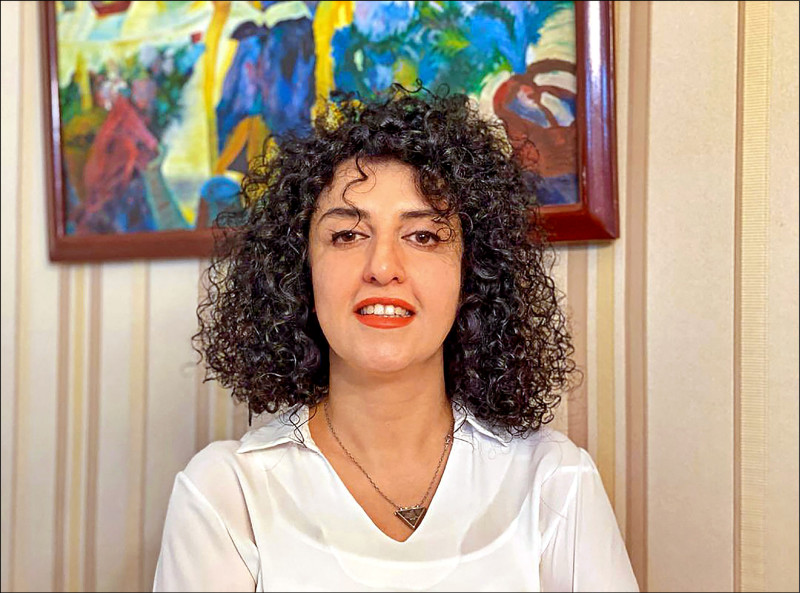
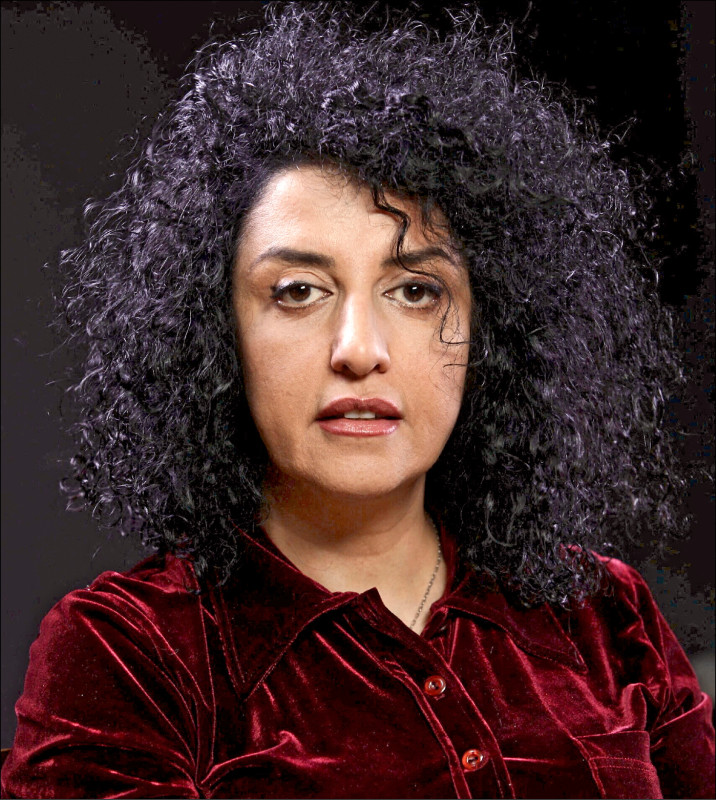
Narges Mohammadi (Persian: نرگس محمدی; born 21 April 1972) is an Iranian human rights activist, Nobel laureate, and scientist. She is the vice president of the Defenders of Human Rights Center (DHRC), headed by fellow Nobel Peace Prize laureate Shirin Ebadi.[3] She is a vocal proponent of mass feminist civil disobedience against hijab in Iran and a vocal critic of the hijab and chastity program of 2023.[4][5] In May 2016, she was sentenced in Tehran to 16 years' imprisonment for establishing and running "a human rights movement that campaigns for the abolition of the death penalty."[6] She was released in 2020 but sent back to prison in 2021, where she has since given reports of the abuse of detained women.
In October 2023, while in prison, she was awarded the 2023 Nobel Peace Prize "for her fight against the oppression of women in Iran and her fight to promote human rights and freedom for all."[7][8] The Foreign Ministry of Iran condemned the decision to award Mohammadi.[9]
Mohammadi was born on 21 April 1972[10] in Zanjan, Iran and grew up in Qorveh, Karaj, and Oshnaviyeh.[11] She attended Qazvin International University, receiving a degree in physics, and became a professional engineer. During her university career, she wrote articles supporting women's rights in the student newspaper and was arrested at two meetings of the political student group Tashakkol Daaneshjuyi Roshangaraan ("Enlightened Student Group").[10][12] She was also active in a mountain climbing group but was later banned from joining climbs due to her political activities.[10]
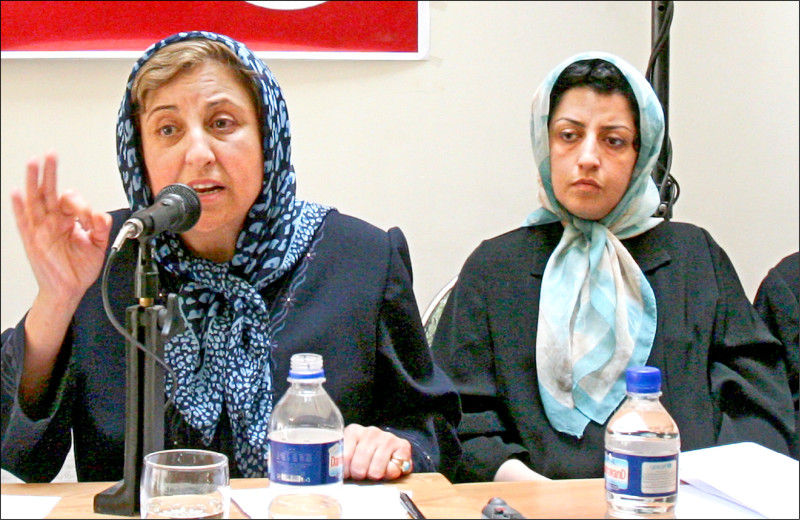
Mohammadi went on to work as a journalist for several reformist newspapers and published a book of political essays titled The reforms, the Strategy and the Tactics.[12] In 2003, she joined the Defenders of Human Rights Center (DHRC), headed by Nobel Peace Prize laureate Shirin Ebadi;[10] she later became the organization's vice president.[3]
In 1999, she married fellow pro-reform journalist Taghi Rahmani, who was soon arrested for the first time.[10][12] Rahmani moved to France in 2012 after serving 14 years of prison sentences, while Mohammadi remained to continue her human rights work.[3] Mohammadi and Rahmani have twin children.[10][3]
Mohammadi was first arrested in 1998 for her criticisms of the Iranian government and spent a year in prison.[12] In April 2010, she was summoned to the Islamic Revolutionary Court for her membership in the DHRC. She was briefly released on a US$50,000 bail but re-arrested several days later and detained at Evin Prison.[10][13] Mohammadi's health declined while in custody, and she developed an epilepsy-like disease, causing her to periodically lose muscle control. After a month, she was released and allowed to seek medical treatment.[13]
In July 2011, Mohammadi was prosecuted again[10] and found guilty of "acting against the national security, membership of the DHRC and propaganda against the regime."[13] In September, she was sentenced to 11 years' imprisonment. Mohammadi stated that she had learned of the verdict only through her lawyers and had been "given an unprecedented 23-page judgement issued by the court in which they repeatedly likened my human rights activities to attempts to topple the regime."[13] In March 2012, the sentence was upheld by an appeals court, though it was reduced to six years.[14] On 26 April, she was arrested to begin her sentence.[3]
On 31 October 2014, Mohammadi made a speech at the gravesite of Sattar Beheshti, stating, "How is it that the Parliament Members are suggesting a Plan for the Promotion of Virtue and Prevention of Vice, but nobody spoke up two years ago when an innocent human being by the name of Sattar Beheshti died under torture in the hands of his interrogator?" The video of her speech quickly went viral on social media networks, resulting in Evin Prison court summoning her.
In the summons I received on 5 November 2014, it is stated that I must turn myself in 'for charges', but there is no further explanation about these charges.[19]
— Narges Mohammadi
On 5 May 2015, Mohammadi was once again arrested on the basis of new charges.[20] Branch 15 of the Revolutionary Court sentenced her to ten years' imprisonment on the charge of "founding an illegal group" in reference to Legam (the Campaign for Step by Step Abolition of the Death Penalty), five years for "assembly and collusion against national security," a year for "propaganda against the system" for her interviews with international media and her March 2014 meeting with the EU's then High Representative for Foreign Affairs and Security Policy, Catherine Ashton.[21] In January 2019, Mohammadi began a hunger strike with the detained British-Iranian citizen Nazanin Zaghari-Ratcliffe in Evin Prison to protest being denied access to medical care.[22] In July 2020, she showed symptoms of a COVID-19 infection, from which she appeared to have recovered by August.[23] On 8 October 2020, Mohammadi was released from prison.[24]
Investigation of potential copyright issue
Please note this is about the text of this Wikipedia article; it should not be taken to reflect on the subject of this article.
If you have just labeled this page as a potential copyright issue, please follow the instructions for filing at the bottom of the box.
The previous content of this page or section has been identified as posing a potential copyright issue, as a copy or modification of the text from the source(s) below, and is now listed at Copyright problems(listing):
Unless the copyright status of the text of this page or section is clarified and determined to be compatible with Wikipedia's content license, the problematic text and revisions or the entire page may be eletion_policy" title="Wikipediaeletion policy" style="text-decoration-line: none; color: rgb(51, 102, 204); background: none; margin-left: auto; margin-right: auto;">deleted one week after the time of its listing (i.e. after 18:45, 13 October 2023 (UTC)).
Temporarily, the original posting is still accessible for viewing in the page history.
Posting copyrighted material without the express permission of the copyright holder is considered copyright infringement, which is both illegal and against Wikipedia policy.
If you have express permission, this must be verified either by explicit release at the source or by e-mail or letter to the Wikimedia Foundation. See eclaration_of_consent_for_all_enquiries" title="Wikipediaeclaration of consent for all enquiries" style="text-decoration-line: none; color: rgb(51, 102, 204); background: none;">Wikipediaeclaration of consent for all enquiries.
Policy requires that we block those who repeatedly post copyrighted material without express permission.
Instructions for filing
If you have tagged the article for investigation, please complete the following steps:
To hide a section instead of an entire article, add the template to the beginning of the section and {{Copyvio/bottom}} at the end of the portion you intend to blank.
In March 2021, Mohammadi penned the foreword to the Iran Human Rights Annual Report on the Death Penalty in Iran:
The execution of people like Navid Afkari and Ruhollah Zam in the past year, have been the most ambiguous executions in Iran. Issuing the death penalty for Ahmadreza Djalali is one of the most erroneous sentences and the reasons for the issuance of these death sentences need to be carefully examined. These people have been sentenced to death after being held in solitary confinement and subjected to horrific psychological and mental torture, that is why I do not consider the judicial process to be fair or just; I see keeping defendants in solitary confinement, forcing them to make untrue and false confessions that are used as the key evidence in issuing these sentences. That’s why I am particularly worried about the recent arrests in Sistan and Baluchistan and Kurdistan, and I hope that anti-death penalty organisations will pay special attention to the detainees because I fear that we will be facing another wave of executions over the coming year. — "Narges Mohammadi: Violence of Death Penalty is Worse Than War", Iran Human Rights, 30 March 2021, retrieved 10 April 2021
In May 2021, Branch 1188 of Criminal Court Two in Tehran sentenced Mohammadi to two-and-a-half years in prison, 80 lashes, and two separate fines for charges including "spreading propaganda against the system". Four months later, she received a summons to begin serving this sentence, which she did not respond to as she considered the conviction unjust.[26]
In December 2022, during the Mahsa Amini protests, the BBC published a report by Mohammadi detailing the sexual and physical abuse of detained women.[29] In January 2023, she gave a report from prison detailing the condition of women in Evin Prison, including a list of 58 prisoners and the interrogation process and tortures they have gone through.[30] 57 of these women have spent 8350 days in total under solitary confinement.[31] 56 of these women are sentenced to 3300 months in total.[32]
I declare once more that this is a cruel and inhumane punishment, I will not rest until it is abolished.[33]
— Narges Mohammadi
Mohammadi has been an outspoken critic of solitary confinement, calling it "White Torture" in her 2022 book of the same name which includes interviews with twelve other Iranian women prisoners.[34] In September 2023, she supported Mehdi Yarrahi after his arrest for the protest song Roosarito.[35]
2023 Nobel Peace Prize "for her fight against the oppression of women in Iran and her fight to promote human rights and freedom for all"[43] Four other Iranian women were also candidated Niloufar Hamedi, Elahe Mohamadi, Masih Alinejad, Nargest Setude.[44]OTUS congratulated her and mentioned Armita Gravand.[45] High Council of Human Rights condemned her as well as calling her a criminal.[46]
In 2010, when Nobel Peace laureate Shirin Ebadi won the Felix Ermacora Human Rights Award she dedicated it to Mohammadi. "This courageous woman deserves this award more than I do," Ebadi said.[47]





.jpg)


.jpg)

 eletion policy" style="text-decoration-line: none; color: rgb(51, 102, 204); background: none; margin-left: auto; margin-right: auto;">deleted one week after the time of its listing (i.e. after 18:45, 13 October 2023 (UTC)).
 OTUS congratulated her and mentioned Armita Gravand.