Agnès Varda |
|---|
 |
| Born | Arlette Varda
30 May 1928
|
|---|
| Died | 29 March 2019 (aged 90)
|
|---|
| Occupation | Director, screenwriter, editor, actor, producer, installation artist, photographer |
|---|
| Years active | 1951–2019 |
|---|
Notable work | |
|---|
| Spouse(s) | |
|---|
| Children | Rosalie Varda
Mathieu Demy |
|---|
Agnès Varda (French: [aɲɛs vaʁda]; 30 May 1928 – 29 March 2019) was a Belgian-born French film director. Her films, photographs, and art installations focused on documentary realism, feminist issues, and social commentary with a distinctive experimental style.
Film historians have cited Varda's work as central to the development of the French New Wave; her employment of location shootingand non-professional actors were unconventional in the context of 1950s French cinema.[1] Among other awards and nominations over her career, she received honorary Palme d'or and Academy Awards, won a Golden Lion and was nominated for theAcademy Award for Best Documentary Feature.
Early life[edit]
Varda was born Arlette Varda on 30 May 1928 in Ixelles, Brussels, Belgium, the daughter of Christiane (née Pasquet) and Eugène Jean Varda, an engineer.[2] Her mother was fromSète, France, and her father came from a family of Greek refugees from Asia Minor. She was the third of five children. When she was 18 Varda legally changed her name to Agnès. During World War II Varda lived on a boat in Sète with the rest of her family. Varda attended the Lycée Victor-Duruy and received a Bachelor's degree in literature and psychology from the Sorbonne.[3] She described her relocation to Paris as a "truly excruciating" one that gave her "a frightful memory of my arrival in this grey, inhumane, sad city." She did not get along with her fellow students at the Sorbonne and described classes there as "stupid, antiquated, abstract, [and] scandalously unsuited for the lofty needs one had at that age."[4]
Career as a still photographer[edit]
Varda intended to become a museum curator and studied art history at the École du Louvre,[3] but decided to study photography at the Vaugirard school of photography instead.[4]
Varda began her career as a still photographer before becoming one of the major voices of the Left Bank Cinema and the French New Wave. However, she maintained a fluid interrelationship between photographic and cinematic forms: "I take photographs or I make films. Or I put films in the photos, or photos in the films."[5]
Varda discussed her beginning with the medium of still photography: "I started earning a living from photography straightaway, taking trivial photographs of families and weddings to make money. But I immediately wanted to make what I called 'compositions.' And it was with these that I had the impression I was doing something where I was asking questions with composition, form and meaning."[5]
In 1951, her friend (and fellow Sète transplant) Jean Vilar opened the Théâtre National Populaire and hired Varda as its official photographer. Before accepting her position there, she worked as a stage photographer for the Theatre Festival of Avignon.[3] She worked at the Théâtre National Populaire for ten years from 1951-1961, during which time her reputation grew and she eventually got photo-journalist jobs throughout Europe.[4]
Varda's still photography would sometimes inspire her subsequent motion pictures.[6] She recounted: "When I made my first film, La Pointe Courte — without experience, without having been an assistant before, without having gone to film school — I took photographs of everything I wanted to film, photographs that are almost models for the shots. And I started making films with the sole experience of photography, that's to say, where to place the camera, at what distance, with which lens and what lights?" Furthermore, she recalled another example: "I made a film in 1982 called Ulysse, which is based on another photograph I took in 1954, one I'd made with the same bellows camera, and I startedUlysse with the words, "I used to see the image upside down." There's an image of a goat on the ground, like a fallen constellation, and that was the origin of the photograph. With those cameras, you'd frame the image upside down, so I saw Brassaï through the camera with his head at the bottom of the image."[5]
Early film career[edit]
The beginning of her career pre-dates the start of the Nouvelle vague (French New Wave), but contains many elements specific to that movement.[7]:3 While working as a photographer, Varda became interested in making a film, although she stated that she knew little about the medium and had only seen around twenty films by the age of twenty-five. She later said she wrote her first screenplay "just the way a person writes his first book. When I'd finished writing it, I thought to myself: 'I'd like to shoot that script,' and so some friends and I formed a cooperative to make it." She found the filmmaking process difficult because it didn't allow the same freedom as writing a novel; however she said that her approach was instinctive and feminine. In an interview with The Believer, Varda stated that she wanted to make films that related to her time (in reference to La Pointe Courte), rather than focusing on traditions or classical standards.[8]
La Pointe Courte (1954)[edit]
Varda liked photography but was interested in moving into film. After spending a few days filming the small French fishing town of La Pointe Courte for a terminally ill friend who could no longer visit on his own, Varda decided to shoot a feature film of her own. Thus in 1954, Varda's first film, La Pointe Courte, about an unhappy couple working through their relationship in a small fishing town, was released. The film is a stylistic precursor to theFrench New Wave.[9] At the time, Varda was influenced by the philosophy of Gaston Bachelard, under whom she once studied at the Sorbonne. "She was particularly interested in his theory of 'l'imagination des matières,' in which certain personality traits were found to correspond to concrete elements in a kind of psychoanalysis of the material world." This idea arrives in La Pointe Courte as the characters' personality traits clash, shown through the opposition of objects such as wood and steel. To further her interest in character abstraction, Varda used two professional actors, Silvia Monfort and Philippe Noiret, combined with the residents of La Pointe Courte to provide a realistic element that lends itself to a documentary aesthetic inspired by neorealism. Varda would continue to use this combination of fictional and documentary elements in her films.[10]
It was edited by friend and fellow Left Bank filmmaker Alain Resnais, who was reluctant to work on the film because it was "so nearly the film he wanted to make himself" and its structure was very similar to his own Hiroshima mon amour (1959). While editing the film in Varda's apartment, Resnais kept annoying her by comparing the film to works by Luchino Visconti, Michelangelo Antonioni and others that she was unfamiliar with "until I got so fed up with it all that I went along to the Cinémathèque to find out what he was talking about." Resnais and Varda remained lifelong friends, with Resnais stating that they had nothing in common "apart from cats."[4]
The film was immediately praised by Cahiers du Cinéma. André Bazin called it "a miraculous film. In its existence and in its style" and François Truffaut called it "an experimental work, ambitious, honest and intelligent." Varda said that the film "hit like a cannonball because I was a young woman, since before that, in order to become a director you had to spend years as an assistant." However the film was a financial failure and Varda only made short films for the next seven years.[4]
Varda is considered the grandmother and the mother of the French New Wave. La Pointe Courte is unofficially but widely considered to be the first film of the movement.[11] It was the first of many films she would make that focused on issues faced by ordinary people. Late in her life, she said showed a disinterest in accounts of people in power. Instead she was "much more interested in the rebels, the people who fight for their own life".[12]
Cléo from 5 to 7 (1961)[edit]
Following La Pointe Courte, Varda made several documentary short films; two were commissioned by the French tourist office. These shorts include one of Varda's favorites of her own works, L'opéra-mouffe, a film about the Rue Mouffetard street market which won Varda an award at the Brussels Experimental Film Festival in 1958.[4]
Cléo from 5 to 7 follows a pop singer through two extraordinary hours in which she awaits the results of a recent biopsy. At first glance, the film is about a woman coming to terms with her mortality, which is a common auteurist trait for Varda.[13] On a deeper level, Cléo from 5 to 7 confronts the traditionally objectified woman by giving Cléo her own vision. She is unable to be constructed through gaze of others which is often represented through a motif of reflections and Cleo's ability to strip her body of to-be-looked-at-ness attributes (clothing items, wigs, etc.). Stylistically, Cléo from 5 to 7 borders documentary and fiction as La Pointe Courte had. Although many believe that the ninety-minute film represents the diegetic action, which occurs between 5 p.m. and 7 p.m., in real time, there is actually a half-hour difference.[10]
Later career[edit]
In 1971, Varda was one of the 343 women who signed the Manifesto of the 343 admitting they had had an abortion despite it being illegal in France at the time and asking for abortions to be made legal.[14]
In 1977, Varda founded her own production company, Cine-Tamaris, in order to have more control in shooting and editing.[15]
In 2013, the Los Angeles County Museum of Art held Varda's first American exhibition called "Agnes Varda in Californialand." The exhibition featured a sculptural installation, several photographs, and short films, and was inspired by time she spent in Los Angeles in the 1960s.[16]
Vagabond (1985)[edit]
In 1985, Varda made Sans toit ni loi (known in most English-speaking countries asVagabond), which is a drama about the death of a young female drifter named Mona. The death is investigated by an unseen and unheard interviewer who focuses on the people who have last seen her. The story of Vagabond is told through nonlinear techniques, with the film being divided into forty-seven episodes, and each episode about Mona being told from a different person's perspective. Vagabond is considered to be one of Agnès Varda's greater feminist works in how the film deals with the de-fetishization of the female body from the male perspective.[17]
Jacquot de Nantes (1991)[edit]
From 1962 until his death in 1990, Varda was married to the film director Jacques Demy, with whom she had one son, Mathieu Demy. Jacques Demy also legally adopted Rosalie Varda, Varda's daughter from a previous union with actor Antoine Bourseiller, who starred in her early film Cléo from 5 to 7. In 1991, shortly after Jacques Demy's death, Varda created the film Jacquot de Nantes, which is about his life and death. The film is structured at first as being a recreation of his early life, being obsessed with the various crafts used for filmmaking like animation and set design. But then Varda provides elements of documentary by inserting clips of Demy's films as well as footage of him dying. The film continues with Varda's common theme of accepting death, but at its heart it is considered to be Varda's tribute to her late husband and their work.[13]
The Gleaners and I (2000)[edit]
Les Glaneurs et la Glaneuse, or The Gleaners and I, is a documentary made in 2000 that focuses on Varda's interactions with gleaners (harvesters) who live in the French countryside, and also includes subjects who create art through recycled material, as well as an interview with psychoanalyst Jean Laplanche. The Gleaners and I is notable for its fragmented and free-form nature along with it being the first time Varda used digital cameras. This style of filmmaking is often interpreted as a statement that great things like art can still be created through scraps, yet modern economies encourage people to only use the finest product.[18]
Faces Places (2017)[edit]
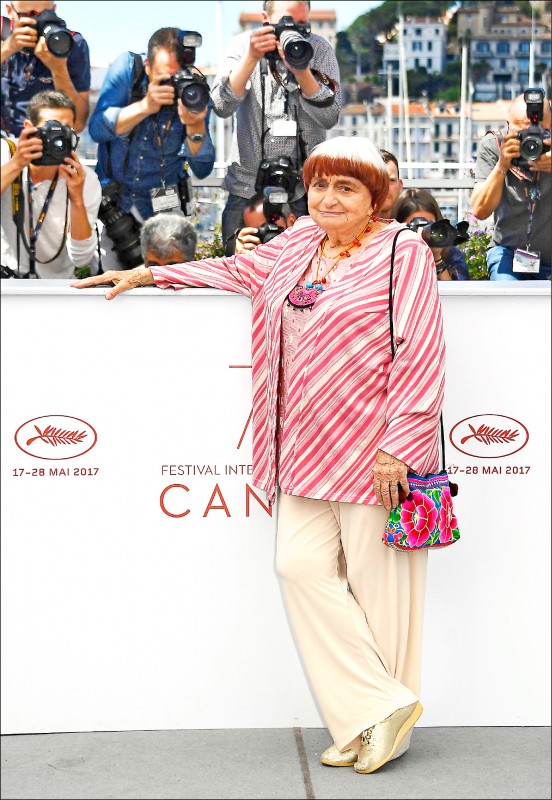
In 2017, Varda co-directed Faces Places with the artist JR. The film was screened out of competition at the 2017 Cannes Film Festival[19][20] where it won the L'Œil d'or award.[21] The film follows Varda and JR traveling around rural France, creating portraits of the people they come across. Varda was nominated for the Academy Award for Best Documentary Feature for this film, making her the oldest person to be nominated for a competitive Oscar.[22] Although the nomination was her first, Varda did not regard it as important, stating: "There is nothing to be proud of, but happy. Happy because we make films to love. We make films so that you love the film."[23][24]
Many of Varda's films use protagonists that are marginalized or rejected members of society, and are documentarian in nature. She did two short films on the Black Panthers (Huey and Black Panthers) after seeing their leader was arrested for killing a policeman. Their focus was on the demonstrations that people lead in support of him and the Free Huey campaign.[25]
Like many other French New Wave directors, Varda was likely influenced by auteur theory, creating her own signature style by using the camera "as a pen." Varda describes her method of filmmaking as cinécriture (cinematic writing or "writing on film"). The term was created by merging "cinema" and "writing" in French.[7]:12 Rather than separating the fundamental roles that contribute to a film (cinematographer, screenwriter, director, etc.), Varda believed that all roles should be working together simultaneously to create a more cohesive film, and all elements of the film should contribute to its message. She claims to make most of her discoveries while editing, seeking the opportunity to find images or dialogue that create a motif.[26]
Because of her photographic background, still images are often of significance in her films. Still images may serve symbolic or narrative purposes, and each element of them is important. There is sometimes conflict between still and moving images in her films, and she often mixes still images (snapshots) in with moving images.[7]:13 Varda pays very close attention to detail and is highly conscious of the implications of each cinematic choice she makes. Elements of the film are rarely just functional, each element has its own implications, both on its own and that it lends to the entire film's message.[7]:15
Many of her influences are artistic or literary. Some of her influences are: Surrealism,William Faulkner, Franz Kafka, and Nathalie Sarraute.[7]:6, 12, 106
Involvement in the French New Wave[edit]
Because of her literary influences, and because her work predates the French New Wave, Varda's films belong more precisely to the Left Bank (Rive Gauche) cinema movement, along with Chris Marker, Alain Resnais, Marguerite Duras, Alain Robbe-Grillet, Jean Cayroland Henri Colpi. Categorically, the Left Bank side of the New Wave movement embraced a more experimental style than the Cahiers du Cinema group; however, this distinction is ironic considering the New Wave itself was considered experimental in its treatment of traditional methodologies and subjects.[27]
Left Bank Cinema was strongly tied to the nouveau roman movement in literature. The members of the group had in common a background in documentary filmmaking, a left wing political orientation, and a heightened interest in experimentation and the treatment of film as art. Varda and other Left Bank filmmakers crafted a mode of filmmaking that blends one of film's most socially motivated approaches, documentary, with one of its most formally experimental approaches, the avant-garde. Its members would often collaborate with each other. According to scholar Delphine Bénézet, Varda has resisted the "norms of representation and diktats of production."[28]:6
Varda as a feminist filmmaker[edit]
Varda's work is often considered feminist because of her use of female protagonists and creating a female cinematic voice.[15] Varda has been quoted stating, "I'm not at all a theoretician of feminism, I did all that—my photos, my craft, my film, my life—on my terms, my own terms, and not to do it like a man."[4]:1142–1148 Though she was not actively involved in any strict agendas of the feminist movement, Varda often focused on women's issues thematically and never tried to change her craft to make it more conventional or masculine.[29][30]
Historically, Varda is seen as the New Wave's mother. Film critic Delphine Bénézet has argued for Varda's importance as "au feminin singulier," a woman of singularity and of the utmost importance in film history. Varda embraced her femininity with distinct boldness.[28]
Personal life[edit]
In 1958, while living in Paris, Varda met her future husband, Jacques Demy, also a French director. They moved in together in 1959. She was married to Demy from 1962 until his death in 1990. Varda had two children: a daughter, Rosalie Varda (born 1958), with Antoine Bourseiller, and a son, Mathieu Demy (born 1972), with Demy.[31] Varda worked on Academy nominated documentary Faces Places with her daughter.[23]
Varda was the cousin of the painter Jean Varda. In 1967, while living in California, Varda met her father's cousin for the first time. He is the subject of her short documentary Uncle Yanco, named after Jean Varda who referred to himself as Yanco and was affectionately called "uncle" by Varda due to the difference in age between them.[32][33]
Varda died from cancer on 29 March 2019 in Paris, at the age of 90.[34][35]
Awards and honors[edit]
- For the 1985 documentary-style feature film Vagabond/Without Roof or Rule she received the Golden Lion of the Venice Film Festival.[36]
- She was a member of the jury at the Cannes Film Festival in 2005 and a member of the jury at the Venice Film Festival in 1983.[37][38]

Varda's handprints at Cannes
- In 2002 Agnès Varda was the recipient of the French Academy prize, René Clair Award.[39]
- On 4 March 2007, she was appointed a Grand Officer of the National Order of Merit of France.[40]
- In 2009 The Beaches of Agnès won the best documentary film of the César Award.[41]
- On 12 April 2009, she was made Commandeur de laLégion d'honneur.[42]
- In May 2010 Varda received Directors' Fortnight's 8th Carosse d'Or award for lifetime achievement at the Cannes Film Festival.[43]
- On 22 September 2010, Varda received an honorary degree from Liège University Belgium.[44]
- On 14 May 2013, Varda was promoted to Grand Cross of the National Order of Merit of France.[40]
- On 22 May 2013, Varda received the 2013 FIAF Award for her work in the field of film preservation and restoration.[45]
- On 10 August 2014, Varda received the Leopard of Honour award at the 67th Locarno Film Festival.[46] She was the second female to receive the award after Kira Muratova.[47]
- On 13 December 2014, Varda received the honorary Lifetime Achievement Award, presented by the European Film Academy.[48]
- On 24 May 2015, Varda received an honorary Palme d'or. She is the first woman to receive an honorary Palme d'or.[49]
- On 16 April 2017, Varda was promoted to Grand officier de la Légion d'honneur.[50]
- On 11 November 2017, Varda received an Academy Honorary Award for her contributions to cinema, making her the first female director to receive such an award.[51][52][53] The prize was presented at the 2017 Governors Awards ceremony. As explained by the Academy of Motion Picture Arts and Sciences president John Bailey, the award is intended to "reflect the breadth of international, independent and mainstream filmmaking." The Honorary Award, an Oscar statuette, is given "to honor extraordinary distinction in lifetime achievement, exceptional contributions to the state of motion picture arts and sciences, or for outstanding service to the Academy."[54] In response, Varda was quoted, "I'm totally honored, I'm totally pleased, I'm touched to tears that they did such a long trip to be with me." She has also joked that she is "not so excited" to be presented with lifetime achievement awards, which "make me think [that the industry is saying], 'Okay, stop now. Get this and go home.'"[55] She was later nominated two months later for the Academy Award for Best Documentary Feature for her documentary Faces Places, becoming the oldest nominated person at the show (she was eight days older than fellow nominee James Ivory).[56]
- Varda was included in Cinema Eye's 2017 list of "Unforgettables."[57]
Filmography[edit]
Feature films[edit]
|
| 1955 | La Pointe Courte | — | Director, Writer |
| 1962 | Cléo de 5 à 7 | Cléo from 5 to 7 | Director, Writer |
| 1965 | Le Bonheur | Happiness | Director, Writer |
| 1966 | Les Créatures | The Creatures | Director, Writer |
| 1967 | Loin du Vietnam | Far from Vietnam | Co-Director |
| 1969 | Lions Love | Lions Love | Director, Writer, Producer |
| 1975 | Daguerréotypes | — | Director, Writer |
| 1977 | L'Une chante, l'autre pas | One Sings, the Other Doesn't | Director, Writer |
| 1981 | Mur murs | Mural Murals | Director, Writer |
| 1981 | Documenteur | Documenteur | Director, Writer |
| 1985 | Sans toit ni loi | Vagabond | Director, Writer, Editor |
| 1988 | Jane B. par Agnes V | Jane B. by Agnes V. | Director, Writer, Editor |
| 1987 | Le petit amour | Kung Fu Master | Director, Writer |
| 1991 | Jacquot de Nantes | Jacquot | Director, Writer |
| 1993 | Les demoiselles ont eu 25 ans | The Young Girls Turn 25 | Director, Writer |
| 1994 | Les Cent et une nuits de Simon Cinéma | A Hundred and One Nights | Director, Writer |
| 1995 | L'univers de Jacques Demy | The World of Jacques Demy | Director, Writer |
| 2000 | Les Glaneurs et la glaneuse | The Gleaners and I | Director, Writer, Producer, Editor |
| 2002 | Les Glaneurs et la glaneuse... deux ans après | The Gleaners and I: Two Years Later | Director, Editor |
| 2004 | Cinévardaphoto | Cinévardaphoto | Director, Writer |
| 2006 | Quelques veuves de Noirmoutier | Some Widows of Noirmoutier | Director, Writer |
| 2008 | Les plages d'Agnès | The Beaches of Agnès | Director, Writer, Producer |
| 2017 | Visages Villages | Faces Places | Director |
| 2019 | Varda par Agnès | Varda by Agnès | Director |
Short films[edit]
|
| 1958 | L'opéra-mouffe | Diary of a Pregnant Woman | Director, Writer |
| 1958 | La cocotte d'azur | - | Director, Writer |
| 1958 | Du côté de la côte | Along the Coast | Director, Writer |
| 1958 | Ô saisons, ô châteaux | - | Director, Writer |
| 1961 | Les fiancés du pont MacDonald ou (Méfiez-vous des lunettes noires) | - | Director, Writer |
| 1963 | Salut les cubains | - | Director, Star |
| 1965 | Elsa la rose | - | Director, Writer |
| 1967 | Oncle Yanco | Uncle Yanco | Director, Writer, Star |
| 1968 | Black Panthers | Black Panthers | Director |
| 1968 | Huey | | Director |
| 1975 | Réponse de femmes: Notre corps, notre sexe | Women Reply | Director, Writer, Star |
| 1976 | Plaisir d'amour en Iran | - | Director, Writer |
| 1984 | Les dites cariatides | The So-Called Caryatids | Director, Writer, Star |
| 1984 | 7p. cuis., s. de b., ... à saisir | - | Director, Writer |
| 1986 | T'as de beaux escaliers, tu sais | You've Got Beautiful Stairs, You Know | Director, Writer |
| 1982 | Ulysse | Ulysse | Director, Writer, Star |
| 2003 | Le lion volatil | - | Director, Writer |
| 2004 | Ydessa, les ours et etc. | Ydessa, the Bears and etc. | Director, Writer |
| 2004 | Der Viennale '04-Trailer | Venice International Film Festival 2004 - Trailer | Director, Writer, Star |
| 2005 | Les dites cariatides bis | - | Director, Writer |
| 2005 | Cléo de 5 à 7: souvenirs et anecdotes | Cléo from 5 to 7: Remembrances and Anecdotes | Director |
| 2015 | Les 3 Boutons | The Three Buttons | Director, Writer |
Television work[edit]
|
| 1970 | Nausicaa (TV movie) | - | Writer, Director |
| 1983 | Une minute pour une image (TV series Documentary) | - | Director |
| 2010 | P.O.V., episode 3, season 23, "The Beaches of Agnes" | - | Director, Writer, Producer, Cinematographer |
| 2011 | Agnès de ci de là Varda, 5 episodes (TV series documentary) | - | Director, Writer, Star |
Publications[edit]
- (in French)Les Plages d'Agnès: texte illustré du film d'Agnès Varda, collection Mémoires de César, éditions de l'Œil, 108 pp. (2010)
- (in French)L'île et elle: Agnès Varda, Actes sud, 81 pp. (2006)
- (in French)Sans toit ni loi: un film d'Agnès Varda, L'Avant-scène Cinéma, 92 pp. (2003)
- (in French)Varda par Agnès, Les Cahiers du Cinéma (1994, reprint 2005)
- (in French)La Côte d'Azur, d'azur, d'azur, d'azur, collection Lieu-dit, Les éditions du Temps (1961)





_(cropped).jpg)


