Jacinda Kate Laurell Ardern[2] (;[1] born 26 July 1980) is a New Zealand politician who has served as the 40th Prime Minister of New Zealand and Leader of the Labour Party since 2017. She has been the Member of Parliament (MP) for Mount Albert since March 2017, having first been elected to the House of Representatives as a list MP in 2008.[3]
Born in Hamilton, Ardern grew up in Morrinsville and Murupara, where she attended a state school. After graduating from the University of Waikato in 2001, Ardern began her career working as a researcher in the office of Prime Minister Helen Clark. She later worked in London, within the Cabinet Office, and was elected President of the International Union of Socialist Youth.[4][5] Ardern was first elected as an MP in the 2008 general election, when Labour lost power after nine years. She was later elected to represent the Mount Albert electorate in a by-election in February 2017.
Ardern was unanimously elected as Deputy Leader of the Labour Party on 1 March 2017, following the resignation of Annette King. Just five months later, with an election due, Labour Leader Andrew Little resigned after a historically low opinion polling result for the party, with Ardern elected unopposed as Leader of the Labour Party in his place.[6] She led her party to gain 14 seats at the 2017 general election on 23 September, winning 46 seats to the National Party's 56.[7] After a period of negotiations, New Zealand First chose to enter a minority coalition government with Labour, supported by the Green Party, with Ardern as Prime Minister; she was sworn in by the Governor-General on 26 October 2017.[8] She became the world's youngest female head of government at age 37.[9] Ardern later became the world's second elected head of government to give birth while in office (after Benazir Bhutto) when her daughter was born on 21 June 2018.[10]
Ardern describes herself as a social democrat and a progressive.[11][12] The Labour–NZ First Government has focused particularly on the New Zealand housing crisis, child poverty, and social inequality. In March 2019, she led the country through the aftermath of the Christchurch mosque shootings, rapidly introducing strict gun laws in response. She has been praised for her handling of the COVID-19 pandemic in New Zealand.
Early life and education
Born in Hamilton, New Zealand,[13] Ardern grew up as a Mormon[14][15] in Morrinsville and Murupara, where her father, Ross Ardern, worked as a police officer,[16] and her mother, Laurell Ardern (née Bottomley), worked as a school catering assistant.[17][18] She studied at Morrinsville College,[19] where she was the student representative on the school's Board of Trustees.[20] Whilst still at school she found her first job, working at a local fish-and-chip shop.[21] She then attended the University of Waikato, graduating in 2001 with a Bachelor of Communication Studies (BCS) in politics and public relations.[22]
Ardern was brought into politics by her aunt, Marie Ardern, a longstanding member of the Labour Party, who recruited the teenaged Ardern to help her with campaigning for New Plymouth MP Harry Duynhoven during his re-election campaign at the 1999 general election.[23]
Ardern joined the Labour Party at the age of 17,[24] and became a senior figure in the Young Labour sector of the party. After graduating from university, she spent time working in the offices of Phil Goff and of Helen Clark as a researcher. After a period of time in New York City, where she volunteered at a soup kitchen[25] and worked on a workers' rights campaign,[26] Ardern moved to London where she became a senior policy adviser in an 80-person policy unit of then-British prime minister Tony Blair.[4] She did not meet Blair in London, but did question him about the invasion of Iraq at an event in New Zealand in 2011.[27] Ardern was also seconded to the Home Office to help with a review of policing in England and Wales.[22]
In early 2008, Ardern was elected as the president of the International Union of Socialist Youth,[5] a role which saw her spend time in several countries, including Jordan, Israel, Algeria and China.[22]
Early political career
Member of Parliament
Ahead of the 2008 election, Ardern was ranked 20th on Labour's party list. This was a very high placement for someone who was not already a sitting MP, and virtually assured her of a seat in Parliament. Accordingly, Ardern returned from London to campaign full-time.[28] She also became Labour's candidate for the safe National electorate of Waikato. Ardern was unsuccessful in the electorate vote, but her high placement on Labour's party list allowed her to enter Parliament as a list MP.[29] Upon election, she became the youngest sitting MP in Parliament, succeeding fellow Labour MP Darren Hughes, and remained the youngest MP until the election of Gareth Hughes on 11 February 2010.[30]
Opposition leader Phil Goff promoted Ardern to the front bench, naming her Labour's spokesperson for Youth Affairs and as associate spokesperson for Justice (Youth Affairs).[31]
She made regular appearances on TVNZ's Breakfast programme as part of the "Young Guns" feature, in which she appeared alongside National MP (and future National leader) Simon Bridges.[32]
Ardern contested the seat of Auckland Central for Labour in the 2011 general election, standing against incumbent National MP Nikki Kaye for National and Greens candidate Denise Roche. Despite targeting Green voters to vote strategically for her, she lost to Kaye by 717 votes. However, she returned to Parliament via the party list, on which she was ranked 13th.[33] Ardern maintained an office within the electorate while she was a list MP based in Auckland Central.[34]
After Goff resigned from the Party leadership following his defeat at the 2011 election, Ardern supported David Shearer over David Cunliffe. She was elevated to the fourth-ranking position in the Shadow Cabinet on 19 December 2011, becoming a spokesperson for social development under new leader David Shearer.[31]
Ardern stood again in Auckland Central at the 2014 general election. She again finished second though increased her own vote and reduced Kaye's majority from 717 to 600.[35] Ranked 5th on Labour's list Ardern was still returned to Parliament where she became Shadow spokesperson for Justice, Children, Small Business, and Arts & Culture under new leader Andrew Little.[36]
Mount Albert by-election
Ardern put forward her name for the Labour nomination for the Mount Albert by-election to be held in February 2017[37] following the resignation of David Shearer on 8 December 2016. When nominations for the Labour Party closed on 12 January 2017, Ardern was the only nominee and was selected unopposed. On 21 January, Ardern participated in the 2017 Women's March, a worldwide protest in opposition to Donald Trump, the newly inaugurated president of the United States.[38] She was confirmed as Labour's candidate at a meeting on 22 January.[39][40] Ardern won a landslide victory, gaining 77 per cent of votes cast in the preliminary results.[41][42]
Deputy Leader of the Labour Party
Following her win in the by-election, Ardern was unanimously elected as deputy leader of the Labour Party on 7 March 2017, following the resignation of Annette King who was intending to retire at the next election.[43] Ardern's vacant list seat was taken by Raymond Huo.[44]
Leader of the Opposition
On 1 August 2017, just seven weeks before the 2017 general election, she assumed the position of leader of the Labour Party, and consequently became leader of the Opposition, following the resignation of Andrew Little. Little stood down due to the party's historically low polling.[45] Ardern was unanimously confirmed in an election to choose a new leader at a caucus meeting the same day.[46] At 37, Ardern became the youngest leader of the Labour Party in its history.[14] She is also the second female leader of the party after Helen Clark.[47] According to Ardern, Little had previously approached her on 26 July and said he thought she should take over as Labour leader then as he was of the opinion he couldn't turn things around for the party, although Ardern declined and told him to "stick it out".[48]
At her first press conference after her election as leader, she said that the forthcoming election campaign would be one of "relentless positivity".[24] Immediately following her appointment, the party was inundated with donations by the public, reaching NZ$700 per minute at its peak.[49] Ardern's election was followed by a spate of positive coverage from many sections of the media, including international outlets such as CNN,[50] with commentators referring to a 'Jacinda effect' and 'Jacindamania'.[51][52]
After Ardern's ascension to the leadership, Labour rose dramatically in opinion polls. By late August the party had reached 43 per cent in the Colmar Brunton poll (having been 24 per cent under Little's leadership) as well as managing to overtake National in opinion polls for the first time in over a decade.[48] Detractors noted that her positions were substantially similar to those of Andrew Little, and suggested that Labour's sudden increase in popularity were due to her youth and good looks.[14]
In mid-August 2017, Ardern stated that a Labour government would establish a tax working group to explore the possibility of introducing a capital gains tax but ruled out taxing family homes.[53][54] In response to negative publicity, Ardern abandoned plans to introduce a capital gains tax during the first term of a Labour government.[55][56] Finance spokesperson Grant Robertson later clarified that Labour would not introduce new taxes until after the 2020 election. The policy shift accompanied strident allegations by Minister of Finance Steven Joyce that Labour had a $11.7 billion "hole" in its tax policy.[57][58]
The Labour and Green parties' proposed water and pollution taxes also generated criticism from farmers. On 18 September 2017, the farming lobby group Federated Farmers staged a protest against the taxes in Ardern's hometown of Morrinsville. New Zealand First leader Winston Peters attended the protest to campaign, but was jeered at by the farmers because they suspected he was also in favour of the taxes. During the protest, one farmer displayed a sign calling Ardern a "pretty Communist". This was criticised as misogynistic by former Prime Minister Helen Clark.[59][60]
In the final days of the general election campaign the opinion polls narrowed, with National taking a slight lead.[61]
2017 general election
Preliminary results from the general election indicated that Labour received 35.79 per cent of the vote to National's 46.03 per cent. After special votes were counted, Labour increased its vote share to 36.89 while National dropped back to 44.45. Labour gained 14 seats, increasing its parliamentary representation to 46 seats. This was the best result for the party since losing power in 2008.[62][63] After the election, Ardern and deputy leader Kelvin Davis negotiated with the Greens and New Zealand First parties about forming a coalition, as the rival National Party lacked sufficient seats to govern alone. Under the country's mixed-member proportional (MMP) voting system, New Zealand First held the balance of power and was, therefore, able to choose the party that would lead a coalition government.[64][65]
Prime Minister of New Zealand
On 19 October 2017, New Zealand First leader Winston Peters agreed to form a coalition with Labour,[8] making Ardern the next prime minister.[66][67] This coalition receives confidence and supply from the Green Party.[68] Ardern named Peters as Deputy Prime Minister and Minister of Foreign Affairs. She also gave New Zealand First five posts in her government, with Peters and three other ministers serving in Cabinet.[69][70]
On 20 October, Ardern confirmed that she would hold the ministerial portfolios of National Security and Intelligence; Arts, Culture and Heritage; and Vulnerable Children; reflecting the shadow positions she held as Leader of the Opposition.[71] However, as of 25 October 2017, her position as Minister for Vulnerable Children had been replaced with the role of Minister for Child Poverty Reduction, while New Zealand First MP Tracey Martin took on the role of Minister for Children.[72] She was officially sworn in by Governor-General Dame Patsy Reddy on 26 October, alongside her ministry.[73] Upon taking office, Ardern said that her government would be "focused, empathetic and strong".[74]
Ardern is New Zealand's third female prime minister after Jenny Shipley (1997–1999) and Helen Clark (1999–2008).[75][76] She is a member of the Council of Women World Leaders.[77] Entering office aged 37, Ardern is also the youngest individual to become New Zealand's head of government since Edward Stafford, who became premier in 1856.[78]
On 19 January 2018, Ardern announced that she was pregnant, and that Winston Peters would take the role of acting prime minister for six weeks after the birth.[79] Following the birth of a daughter, she took her maternity leave from 21 June to 2 August 2018.[80][81][82]
Domestic affairs
Ardern intends to halve child poverty in New Zealand within a decade.[83] In July 2018, Ardern announced the start of her government's flagship Families Package.[84] Among its provisions, the package gradually increased paid parental leave to 26 weeks and paid $60-a-week to low and middle-income families with young children.[85] In 2019, the government began the roll-out of a school lunches programme to assist in reducing child poverty numbers.[86] Other efforts to reduce poverty have included an increase to main welfare benefits,[87] expanding free doctor's visits, providing free menstrual hygiene products in schools[88] and adding to state housing stock.[89]
Economically, Ardern's government has implemented steady increases to the country's minimum wage[90] and introduced the Provincial Growth Fund to invest in rural infrastructure projects.[91]
Ardern's government cancelled the National Party's planned tax cuts, saying instead it would prioritise expenditure on healthcare and education.[92] The first year of post-secondary education was made free from 1 January 2018 and, after industrial action, the government agreed to increase primary teachers' pay by 12.8 (for beginning teachers) and 18.5 per cent (for senior teachers without other responsibilities) by 2021.[93]
Ardern is opposed to criminalising people who use cannabis in New Zealand, and pledged to hold a referendum on the issue.[94] New Zealand will vote on a non-binding referendum to legalise cannabis as part of the next general election, which will be held on 19 September 2020.[95]
On 2 February 2018, Ardern travelled to Waitangi for the annual Waitangi Day commemoration; she stayed in Waitangi for five days, an unprecedented length.[96] Ardern became the first female prime minister to speak from the top marae. Her visit was largely well-received by Māori leaders, with commentators noting a sharp contrast with the acrimonious responses received by several of her predecessors.[96][97]
On 24 August 2018, Ardern removed Broadcasting Minister Clare Curran from Cabinet after she failed to disclose an official meeting. Curran remained a minister outside Cabinet, and Ardern was criticised by the Opposition for not dismissing Curran from her portfolio. On 7 September, Ardern accepted Curran's resignation.[98][99]
Despite the Labour Party campaigning on a capital gains tax for the last three elections, Ardern pledged in April 2019 that the government would not implement a capital gains tax under her leadership.[100][101]
In September 2019, Ardern was criticised for her handling of an allegation of sexual assault against a Labour Party staffer. She said she had been told the allegation did not involve sexual assault or violence before a report about the incident was published in The Spinoff on 9 September.[102] Media questioned her account, with one journalist stating that Ardern's claim was "hard to swallow".[103][104]
Foreign affairs
On 5 November 2017, Ardern made her first official overseas trip to Australia, where she met Australian Prime Minister Malcolm Turnbull for the first time. Relations between the two countries had been strained in the preceding months because of Australia's treatment of New Zealanders living in the country, and shortly before taking office, Ardern had spoken of the need to rectify this situation, and to develop a better working relationship with the Australian government.[105] Turnbull described the meeting in cordial terms: "we trust each other...The fact we are from different political traditions is irrelevant".[106] Ardern flew to Vietnam on 9 November for her first visit to an APEC summit.[107]
In November 2017, the Trade and Export Growth Minister David Parker and Ardern announced that the government would continue participating in the Trans-Pacific Partnership negotiations despite opposition from the Green Party.[108] On 25 October 2018, New Zealand ratified the revised agreement, the Comprehensive and Progressive Agreement for Trans-Pacific Partnership,[109] which Ardern had described as being better than the original TPP agreement.[110]
In December 2017, Ardern voiced support for the UN resolution criticising US President Donald Trump's decision to recognise Jerusalem as the capital of Israel, saying that some decisions "that we saw by international actors like the United States recently ... took us backwards, not forwards."[111]
On 20 April 2018, Ardern attended the Commonwealth Heads of Government Meeting 2018 in London, where she was selected to deliver a toast to the Commonwealth at a state banquet of world leaders. She also had her first private audience with Queen Elizabeth II.[112]
On 5 September, Ardern travelled to Nauru, where she attended the Pacific Islands Forum. Media and political opponents criticised her decision to travel separately from the rest of her contingent so that she could spend more time with her daughter. Critics charged that the additional flight would cost taxpayers up to NZ$100,000.[113] Ardern had earlier rebuffed suggestions that she should not attend the Forum, citing tradition; she would have been the first New Zealand prime minister since 1971 to not attend the Forum outside an election cycle.[114] She was later criticised for not meeting refugees in Nauru.[115]
On 24 September, Ardern became the first female head of government to attend the United Nations General Assembly meeting with her infant present.[116][117] Her address to the General Assembly on 27 September praised the United Nations for its multilateralism, expressed support for the world's youth, and called for immediate attention to the effects and causes of climate change, for the equality of women, and for kindness as the basis for action.[118]
In October 2018, Ardern raised the issue of Xinjiang re-education camps and human rights abuses against the Uyghur Muslim minority in China.[119][120] China has imprisoned more than 1 million Uyghurs and other predominantly Muslim ethnic minorities in China's north-western province of Xinjiang in internment camps, where they are held without charge or any terms of release.[120] Ardern has raised concerns over the persecution of the Rohingya Muslims in Myanmar.[121] In November 2018, she met with Myanmar's leader Aung San Suu Kyi and offered any help New Zealand could give to resolve the Rohingya crisis.[122]
On 23 September 2019, at a United Nations summit in New York City, Ardern had her first formal meeting with Donald Trump. She reported that the US President showed "interest" in New Zealand's gun buyback scheme.[123][124]
On 28 February 2020, Ardern criticised Australia's policy of deporting New Zealanders, many of whom had lived in Australia but had not taken up Australian citizenship as "corrosive" and damaging to Australia–New Zealand relations.[125][126][127]
Christchurch mosque shootings
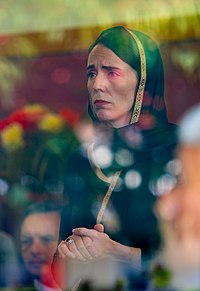
Ardern visits members of the Muslim community at the
Phillipstown Community Centre, 16 March 2019. Captured through a glass window, the photo was widely shared at the time and described by
The Guardian as "an image of hope".
[128][129]On 15 March 2019, 51 people were fatally shot and 49 injured in two mosques in Christchurch. In a statement broadcast on television, Ardern offered condolences and stated that the shootings had been carried out by suspects with "extremist views" that have no place in New Zealand, or anywhere else in the world.[130] She also described it as a well-planned terrorist attack.[131]
Announcing a period of national mourning, Ardern was the first signatory of a national condolence book that she opened in the capital, Wellington.[132] She also travelled to Christchurch to meet first responders and families of the victims.[133] Ardern received international praise for her response to the shootings,[134][135][136][137] and a photograph of her hugging a member of the Christchurch Muslim community with the word "peace" in English and Arabic was projected onto the Burj Khalifa, the world's tallest building.[138] A 25-metre mural of this photograph was unveiled in May 2019.[139]
In response to the shootings, Ardern announced her government's intention to introduce stronger firearms regulations.[140] She said that the attack had exposed a range of weaknesses in New Zealand's gun law.[141] On 10 April 2019, less than one month after the attack, the New Zealand Parliament passed a law that bans most semiautomatic weapons and assault rifles, parts that convert guns into semiautomatic guns, and higher capacity magazines.[142]
According to Sri Lankan Defence Minister Ruwan Wijewardene the 2019 Sri Lanka Easter bombings were retaliation for the Christchurch mosque shootings.[143] However this has been questioned by Ardern who stated that the bombings were likely planned before the Christchurch attack.[144]
On 15 May 2019, Ardern and French President Emmanuel Macron co-chaired the Christchurch Call summit, which aimed to "bring together countries and tech companies in an attempt to bring to an end the ability to use social media to organise and promote terrorism and violent extremism".[145]
Coronavirus pandemic
On 14 March 2020, Ardern announced in response to the coronavirus pandemic in New Zealand that the government would be requiring anyone entering the country from midnight 15 March to isolate themselves for 14 days.[146] She said the new rules will mean New Zealand has the "widest ranging and toughest border restrictions of any country in the world".[147] On 19 March, Ardern stated that New Zealand's borders would be closed to all non-citizens and non-permanent residents, after 11:59 pm on 20 March (NZDT).[148] Ardern announced that New Zealand would move to alert level 4, including a nationwide lockdown, at 11:59 pm on 25 March.[149]
National and international media covered the government response led by Ardern, praising her leadership and swift response to the outbreak in New Zealand.[150][151] The Washington Post's Fifield described her regular use of interviews, press conferences and social media as a "masterclass in crisis communication."[152] Alastair Campbell, a journalist and adviser in Tony Blair's British government, commended Ardern for addressing both the human and economic consequences of the coronavirus pandemic.[153]
In mid-April 2020, two applicants filed a lawsuit at the Auckland High Court against Ardern and several government officials including Director-General of Health Ashley Bloomfield, claiming that the lockdown imposed as a result of the coronavirus pandemic infringed on their freedoms and was made for "political gain". The lawsuit was dismissed by Justice Mary Peters of the Auckland High Court.[154][155]
On 5 May 2020, Ardern, her Australian counterpart Scott Morrison and several Australian state and territorial leaders agreed that they would collaborate to develop a trans-Tasman COVID-safe travel zone that would allow residents from both countries to travel freely without travel restrictions as part of efforts to ease coronavirus restrictions.[156][157]
Post-lockdown opinion polls showed the Labour Party with nearly 60 per cent support.[158][159] In May 2020, Ardern rated 59.5 per cent as 'preferred prime minister' in a Newshub Reid Research poll—the highest score for any leader in the Reid Research poll's history.[160][161]
Political views

Ardern speaking during the session "Safeguarding Our Planet" at the annual meeting of the
World Economic Forum in
Davos, 22 January 2019
Ardern has described herself as a social democrat,[11] a progressive,[12] a republican[162] and a feminist,[163] citing Helen Clark as a political hero,[11][164] and has described capitalism as a "blatant failure" due to the extent of child poverty and homelessness in New Zealand.[165] She advocates a lower rate of immigration, suggesting a drop of around 20,000–30,000. Calling it an "infrastructure issue", she argues, "there hasn't been enough planning about population growth, we haven't necessarily targeted our skill shortages properly".[166] However, she wants to increase the intake of refugees.[167]
Ardern believes the retention or abolition of Māori electorates should be decided by Māori, stating, "[Māori] have not raised the need for those seats to go, so why would we ask the question?"[168] She supports compulsory teaching of the Māori language in schools.[11]
In September 2017, Ardern said she wanted New Zealand to have a debate on removing the monarch of New Zealand as its head of state.[162]
Ardern has spoken in support of same-sex marriage,[169] and she voted for the Marriage (Definition of Marriage) Amendment Act 2013.[170] In 2018, she became the first New Zealand prime minister to march in a pride parade.[171] Ardern supported liberalising abortion law by removing abortion from the Crimes Act 1961.[172][173] In March 2020, she voted for the Abortion Legislation Act that amends the law to decriminalise abortion.[174][175]
Referring to New Zealand's nuclear-free policy, she described taking action on climate change as "my generation's nuclear-free moment".[176]
Ardern has voiced support for a two-state solution to resolve the Israeli–Palestinian conflict.[111] She has condemned the death of Palestinians during protests at the Gaza border.[177]
Honours
She was one of fifteen women selected to appear on the cover of the September 2019 issue of British Vogue, by guest editor Meghan, Duchess of Sussex.[178] Forbes magazine has placed her in 38th position among the 100 most powerful women in the world in 2019.[179]
She was included in the 2019 Time 100 list[180] and shortlisted for Time's 2019 Person of the Year.[181] The magazine later incorrectly speculated that she might win the 2019 Nobel Peace Prize among a listed six candidates, for her handling of the Christchurch mosque shootings.[182]
Personal life
Raised as a member of The Church of Jesus Christ of Latter-day Saints in New Zealand, Ardern left the church in 2005 because, she said, it conflicted with her personal views, in particular her support for gay rights.[183][184] In January 2017, Ardern identified as "agnostic".[183]
Ardern is a second cousin of mayor of Whanganui Hamish McDouall.[185] She is also a distant cousin of former National MP for Taranaki-King Country Shane Ardern.[186] Due to the cousins being in opposing parties, Ardern has previously joked "we don't talk about it".[187] Shane Ardern left Parliament in 2014, three years before she became Prime Minister.
Ardern's partner is television presenter Clarke Gayford.[188][189] The couple first met in 2012 when they were introduced by mutual friend Colin Mathura-Jeffree, a New Zealand television host and model,[190] but they didn't spend time together until Gayford contacted Ardern regarding a controversial Government Communications Security Bureau bill.[188] On 3 May 2019, it was reported that Ardern was engaged to be married to Gayford.[191][192]
Ardern owned a ginger-and-white polydactyl cat named Paddles, which became a celebrity as the 'First Cat' after Ardern took office, even having a Twitter account established in her name. Paddles died in early November 2017 after being hit by a car in the Auckland suburb of Point Chevalier.[193][194][195]
On 19 January 2018, Ardern announced that she was expecting her first child in June, making her New Zealand's first prime minister to be pregnant in office.[196] Ardern was admitted to Auckland City Hospital[197] on 21 June 2018, and gave birth to a girl at 4:45 pm (04:45 UTC) that day,[198][199] becoming only the second elected head of government to give birth while in office (after Benazir Bhutto in 1990).[10][200] On 24 June, Ardern revealed her daughter's given names as Neve Te Aroha.[201] Neve is an anglicised form of the Irish name Niamh, meaning 'bright'; Aroha is Māori for 'love', and Te Aroha is a mountain in the Kaimai Range, near Ardern's home town of Morrinsville.[202]
She is a supporter of the Chiefs rugby union team, which is based out of her home region of Waikato.[203]



 ine;cpos:1;subsec:hl-view;g:979302e8-2b3b-3148-8b6d-425d8509b065;tar:lineit.line.me" aria-label="Line" class="line ButtonNaked My(0) nofollow Ov(v) P(0) Pos(r) Va(b) D(ib) rapid-noclick-resp react-button" href="https://lineit.line.me/share/ui?url=https%3A%2F%2Ftw.news.yahoo.com%2F%25E7%25B4%2590%25E5%259C%258B%25E7%25B8%25BD%25E7%2590%2586%25E5%258F%25AC%25E5%2585%25A8%25E5%259C%258B%25E6%258C%25BA%25E5%258F%25B0%25E7%2581%25A3-%25E5%25A4%2596%25E4%25BA%25A4%25E9%2583%25A8%25E8%25AA%25AA%25E8%25A9%25B1%25E4%25BA%2586-052019100.html%3Fsoc_src%3Dsocial-sh%26soc_trk%3Dli" target="_blank" data-reactid="20" style="background-color: transparent; color: rgb(88, 195, 69); text-decoration-line: none; zoom: 1; display: inline-block; margin-top: 0px; margin-bottom: 0px; overflow: visible; padding: 0px; position: relative; vertical-align: bottom; margin-right: 0px; border-radius: 0px; border-width: 0px; width: 40px; height: 40px; line-height: 38px; max-width: 40px; min-width: 40px; max-height: 40px; min-height: 40px; border-color: rgb(88, 195, 69);">


.jpg)


.jpg)

 South Korean President
.jpg)
.jpg)