| Muhammad Ali |
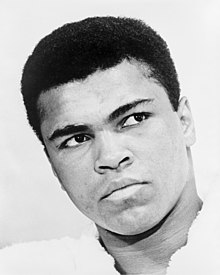
Ali in 1967 |
| Statistics |
| Nickname(s) |
The Greatest
The People's Champion
The Louisville Lip |
| Rated at |
Heavyweight |
| Height |
6 ft 3 in (191 cm)[1] |
| Reach |
78 in (198 cm) |
| Nationality |
American |
| Born |
Cassius Marcellus Clay, Jr.
January 17, 1942
Louisville, Kentucky, U.S. |
| Died |
June 3, 2016 (aged 74)
Phoenix, Arizona, U.S. |
| Stance |
Orthodox |
| Boxing record |
| Total fights |
61 |
| Wins |
56 |
| Wins by KO |
37 |
| Losses |
5 |
| Website |
muhammadali.com |
|
|
Muhammad Ali (;[2] born Cassius Marcellus Clay, Jr., January 17, 1942 – June 3, 2016[3]) was an American professional boxer, generally considered the greatestheavyweight in the history of the sport. Early in his career, Ali was known for being an inspiring, controversial and polarizing figure both inside and outside the boxing ring.[4][5] He is one of the most recognized sports figures of the past 100 years, crowned "Sportsman of the Century" by Sports Illustrated and "Sports Personality of the Century" by the BBC.[6][7]He also wrote several best-selling books about his career, including The Greatest: My Own Story and The Soul of a Butterfly.
Ali, originally known as Cassius Clay, began training at 12 years old and at the age of 22 won the world heavyweight championship in 1964 from Sonny Liston in a stunning upset. Shortly after that bout, Ali joined the Nation of Islam and changed his name. He converted toSunni Islam in 1975, and 30 years later began adhering to Sufism.
In 1967, three years after winning the heavyweight title, Ali refused to be conscriptedinto the U.S. military, citing his religious beliefs and opposition to American involvement in theVietnam War. He was eventually arrested and found guilty on draft evasion charges and stripped of his boxing title. He did not fight again for nearly four years—losing a time of peak performance in an athlete's career. Ali's appeal worked its way up to the U.S. Supreme Court where, in 1971, his conviction was overturned. Ali's actions as a conscientious objector to the war made him an icon for thelarger counterculture generation.[8][9]
Ali remains the only three-time lineal world heavyweight champion; he won the title in 1964, 1974, and 1978. Between February 25, 1964 and September 19, 1964 Muhammad Ali reigned as the undisputed heavyweight boxing champion.
Nicknamed "The Greatest", Ali was involved in several historic boxing matches.[10] Notable among these were the first Liston fight, three with rival Joe Frazier, and "The Rumble in the Jungle" with George Foreman, in which he regained titles he had been stripped of seven years earlier.
At a time when most fighters let their managers do the talking, Ali, inspired by professional wrestler "Gorgeous" George Wagner, thrived in—and indeed craved—the spotlight, where he was often provocative and outlandish.[11][12][13] He controlled most press conferences and interviews, and spoke freely about issues unrelated to boxing.[14][15] Ali transformed the role and image of the African American athlete in America by his embrace of racial pride and his willingness to antagonize the white establishment in doing so.[16][17][18] In the words of writer Joyce Carol Oates, he was one of the few athletes in any sport to "define the terms of his public reputation".[19]
Early life and amateur career
Cassius Marcellus Clay Jr. was born on January 17, 1942, in Louisville, Kentucky.[20] The older of two boys, he was named for his father, Cassius Marcellus Clay Sr., who himself was named in honor of the 19th century abolitionist and politician of the same name. He had a sister and four brothers, including Nathaniel Clay.[21][22] Clay's paternal grandparents were John Clay and Sallie Anne Clay; Clay's sister Eva quoted that Sallie was a native of Madagascar.[23] His father painted billboards and signs,[20] and his mother, Odessa O'Grady Clay, was a household domestic. Although Cassius Sr. was a Methodist, he allowed Odessa to bring up both Cassius and his younger brother Rudolph "Rudy" Clay(later renamed Rahman Ali) as Baptists.[24] He was a descendant of pre-Civil War era American slaves in the American South, and was predominantly of African-American descent, with Irish and English heritage.[25][26][27]
He was first directed toward boxing by Louisville police officer and boxing coach Joe E. Martin,[28] who encountered the 12-year-old fuming over a thief taking his bicycle. He told the officer he was going to "whup" the thief. The officer told him he better learn how to box first.[29] For the last four years of Clay's amateur career he was trained by boxing cutman Chuck Bodak.[30]
Clay made his amateur boxing debut in 1954,[31] and he won six Kentucky Golden Gloves titles, two national Golden Gloves titles, an Amateur Athletic Union National Title, and the Light Heavyweight gold medal in the 1960 Summer Olympics in Rome.[32]Clay's amateur record was 100 wins with five losses. Ali claimed in his 1975 autobiography that shortly after his return from the Rome Olympics he threw his gold medal into the Ohio River after he and a friend were refused service at a "whites-only" restaurant and fought with a white gang. The story has since been disputed and several of Ali's friends, includingBundini Brown and photographer Howard Bingham, have denied it. Brown told Sports Illustrated writer Mark Kram, "Honkies sure bought into that one!" Thomas Hauser's biography of Ali stated that Ali was refused service at the diner but that he lost his medal a year after he won it.[33] Ali received a replacement medal at a basketball intermission during the 1996 Olympics in Atlanta, where he lit the torch to start the games.
Professional boxing
Early career
Clay made his professional debut on October 29, 1960, winning a six-round decision overTunney Hunsaker. From then until the end of 1963, Clay amassed a record of 19–0 with 15 wins by knockout. He defeated boxers including Tony Esperti, Jim Robinson, Donnie Fleeman, Alonzo Johnson, George Logan, Willi Besmanoff, Lamar Clark, Doug Jones andHenry Cooper. Clay also beat his former trainer and veteran boxer Archie Moore in a 1962 match.
These early fights were not without trials. Clay was knocked down both by Sonny Banksand Cooper. In the Cooper fight, Clay was floored by a left hook at the end of round four and was saved by the bell. The fight with Doug Jones on March 13, 1963, was Clay's toughest fight during this stretch. The number-two and -three heavyweight contenders respectively, Clay and Jones fought on Jones' home turf at New York's Madison Square Garden. Jones staggered Clay the first round, and the unanimous decision for Clay was greeted by boos and a rain of debris thrown onto the ring (watching on closed-circuit TV, heavyweight champ Sonny Liston quipped that if he fought Clay he might get locked up for murder). The fight was later named "Fight of the Year".
In each of these fights, Clay vocally belittled his opponents and vaunted his abilities. Jones was "an ugly little man" and Cooper was a "bum". He was embarrassed to get in the ring with Alex Miteff. Madison Square Garden was "too small for me".[34] Clay's behavior provoked the ire of many boxing fans.[35]
After Clay left Moore's camp in 1960, partially due to Clay's refusing to do chores such as dish-washing and sweeping, he hired Angelo Dundee, whom he had met in February 1957 during Ali's amateur career,[36] to be his trainer. Around this time, Clay sought longtime idolSugar Ray Robinson to be his manager, but was rebuffed.[37]
Heavyweight champion
By late 1963, Clay had become the top contender for Sonny Liston's title. The fight was set for February 25, 1964, in Miami. Liston was an intimidating personality, a dominating fighter with a criminal past and ties to the mob. Based on Clay's uninspired performance against Jones and Cooper in his previous two fights, and Liston's destruction of former heavyweight champion Floyd Patterson in two first-round knock outs, Clay was a 7–1 underdog. Despite this, Clay taunted Liston during the pre-fight buildup, dubbing him "the big ugly bear". "Liston even smells like a bear," Clay said. "After I beat him I'm going to donate him to the zoo."[38] Clay turned the pre-fight weigh-in into a circus, shouting at Liston that "someone is going to die at ringside tonight". Clay's pulse rate was measured at 120, more than double his normal 54.[39] Many of those in attendance thought Clay's behavior stemmed from fear, and some commentators wondered if he would show up for the bout.
The outcome of the fight was a major upset. At the opening bell, Liston rushed at Clay, seemingly angry and looking for a quick knockout. But Clay's superior speed and mobility enabled him to elude Liston, making the champion miss and look awkward. At the end of the first round Clay opened up his attack and hit Liston repeatedly with jabs. Liston fought better in round two, but at the beginning of the third round Clay hit Liston with a combination that buckled his knees and opened a cut under his left eye. This was the first time Liston had ever been cut. At the end of round four, as Clay returned to his corner, he began experiencing blinding pain in his eyes and asked his trainer Angelo Dundee to cut off his gloves. Dundee refused. It has been speculated that the problem was due to ointment used to seal Liston's cuts, perhaps deliberately applied by his corner to his gloves.[39](Though unconfirmed, Bert Sugar claimed that two of Liston's opponents also complained about their eyes "burning".[40][41])
Despite Liston's attempts to knock out a blinded Clay, Clay was able to survive the fifth round until sweat and tears rinsed the irritation from his eyes. In the sixth, Clay dominated, hitting Liston repeatedly. Liston did not answer the bell for the seventh round, and Clay was declared the winner by TKO. Liston stated that the reason he quit was an injured shoulder. Following the win, a triumphant Clay rushed to the edge of the ring and, pointing to the ringside press, shouted: "Eat your words!" He added, "I am the greatest! I shook up the world. I'm the prettiest thing that ever lived."[42]
In winning this fight, Clay became at age 22 the youngest boxer to take the title from a reigning heavyweight champion, though Floyd Patterson was the youngest to win the heavyweight championship at 21, during an elimination bout following Rocky Marciano's retirement. Mike Tyson broke both records in 1986 when he defeated Trevor Berbick to win the heavyweight title at age 20.
Soon after the Liston fight, Clay changed his name to Muhammad Ali upon converting to Islam and affiliating with the Nation of Islam. Ali then faced a rematch with Liston scheduled for May 1965 in Lewiston, Maine. It had been scheduled for Boston the previous November, but was postponed for six months due to Ali's emergency surgery for a hernia three days before.[43] The fight was controversial. Midway through the first round, Liston was knocked down by a difficult-to-see blow the press dubbed a "phantom punch". Ali refused to retreat to a neutral corner, and referee Jersey Joe Walcott did not begin the count. Liston rose after he had been down about 20 seconds, and the fight momentarily continued. But a few seconds later Walcott stopped the match, declaring Ali the winner by knockout. The entire fight lasted less than two minutes.[44]
It has since been speculated that Liston dropped to the ground purposely. Proposed motivations include threats on his life from the Nation of Islam, that he had bet against himself and that he "took a dive" to pay off debts. Slow-motion replays show that Liston was jarred by a chopping right from Ali, although it is unclear whether the blow was a genuine knock-out punch.[45]
Ali defended his title against former heavyweight champion Floyd Patterson on November 22, 1965. Before the match, Ali mocked Patterson, who was widely known to call him by his former name Cassius Clay, as an "Uncle Tom", calling him "The Rabbit". Although Ali clearly had the better of Patterson, who appeared injured during the fight, the match lasted 12 rounds before being called on a technical knockout. Patterson later said he had strained his sacroiliac. Ali was criticized in the sports media for appearing to have toyed with Patterson during the fight.[46]
Ali and then-WBA heavyweight champion boxer Ernie Terrell had agreed to meet for a bout in Chicago on March 29, 1966 (the WBA, one of two boxing associations, had stripped Ali of his title following his joining the Nation of Islam). But in February Ali was reclassified by the Louisville draft board as 1-A from 1-Y, and he indicated that he would refuse to serve, commenting to the press, "I ain't got nothing against no Viet Cong; no Viet Cong never called me nigger."[47] Amidst the media and public outcry over Ali's stance, the Illinois Athletic Commission refused to sanction the fight, citing technicalities.[48]
Instead, Ali traveled to Canada and Europe and won championship bouts against George Chuvalo, Henry Cooper, Brian London and Karl Mildenberger.
Ali returned to the United States to fight Cleveland Williams in the Houston Astrodome on November 14, 1966. The bout drew a then-indoor world record crowd of 35,460 people. Williams had once been considered among the hardest punchers in the heavyweight division, but in 1964 he had been shot at point-blank range by a Texas policeman, resulting in the loss of one kidney and 10 feet (3.0 m) of his small intestine. Ali dominated Williams, winning a third-round technical knockout in what some consider the finest performance of his career.
Ali fought Terrell in Houston on February 6, 1967. Terrell was billed as Ali's toughest opponent since Liston—unbeaten in five years and having defeated many of the boxers Ali had faced. Terrell was big, strong and had a three-inch reach advantage over Ali. During the lead up to the bout, Terrell repeatedly called Ali "Clay", much to Ali's annoyance (Ali called Cassius Clay his "slave name"). The two almost came to blows over the name issue in a pre-fight interview with Howard Cosell. Ali seemed intent on humiliating Terrell. "I want to torture him," he said. "A clean knockout is too good for him."[49] The fight was close until the seventh round when Ali bloodied Terrell and almost knocked him out. In the eighth round, Ali taunted Terrell, hitting him with jabs and shouting between punches, "What's my name, Uncle Tom... what's my name?" Ali won a unanimous 15-round decision. Terrell claimed that early in the fight Ali deliberately thumbed him in the eye — forcing Terrell to fight half-blind — and then, in a clinch, rubbed the wounded eye against the ropes. Because of Ali's apparent intent to prolong the fight to inflict maximum punishment, critics described the bout as "one of the ugliest boxing fights". Tex Maule later wrote: "It was a wonderful demonstration of boxing skill and a barbarous display of cruelty." Ali denied the accusations of cruelty but, for Ali's critics, the fight provided more evidence of his arrogance.
After Ali's title defense against Zora Folley on March 22, he was stripped of his title due to his refusal to be drafted to army service.[20] His boxing license was also suspended by the state of New York. He was convicted of draft evasion on June 20 and sentenced to five years in prison and a $10,000 fine. He paid a bond and remained free while the verdict was being appealed.
Exile and comeback
Ali refused to be inducted into the armed forces, stating publicly, "No Vietcong ever called me nigger". He was systematically denied a boxing license in every state and stripped of his passport. As a result, he did not fight from March 1967 to October 1970—from ages 25 to almost 29—as his case worked its way through the appeal process. In 1971, the U.S. Supreme Court overturned his conviction in a unanimous 8-0 ruling (Thurgood Marshallabstained from the case).
During this time of inactivity, as opposition to the Vietnam War began to grow and Ali's stance gained sympathy, he spoke at colleges across the nation, criticizing the Vietnam War and advocating African American pride and racial justice.
On August 12, 1970, with his case still in appeal, Ali was granted a license to box by the City of Atlanta Athletic Commission, thanks to State Senator Leroy R. Johnson.[50] Ali's first return bout was against Jerry Quarry on October 26, resulting in a win after three rounds after Quarry was cut.
A month earlier, a victory in federal court forced the New York State Boxing Commission to reinstate Ali's license.[51] He fought Oscar Bonavena at Madison Square Garden in December, an uninspired performance that ended in a dramatic TKO of Bonavena in the 15th round. The win left Ali as a top contender against heavyweight champion Joe Frazier.
Ali and Frazier's first fight, held at the Garden on March 8, 1971, was nicknamed the "Fight of the Century", due to the tremendous excitement surrounding a bout between two undefeated fighters, each with a legitimate claim as heavyweight champions. Veteran boxing writer John Condon called it "the greatest event I've ever worked on in my life". The bout was broadcast to 35 foreign countries; promoters granted 760 press passes.[33]
Adding to the atmosphere were the considerable pre-fight theatrics and name calling. Ali portrayed Frazier as a "dumb tool of the white establishment". "Frazier is too ugly to be champ," Ali said. "Frazier is too dumb to be champ." Ali also frequently called Frazier anUncle Tom. Dave Wolf, who worked in Frazier's camp, recalled that, "Ali was saying 'the only people rooting for Joe Frazier are white people in suits, Alabama sheriffs, and members of the Ku Klux Klan. I'm fighting for the little man in the ghetto.' Joe was sitting there, smashing his fist into the palm of his hand, saying, 'What the fuck does he know about the ghetto?'"[33]
Ali began training at a farm near Reading, Pennsylvania in 1971 and finding the country setting to his liking, Muhammad Ali then sought to develop a real training camp in the countryside. Twenty minutes from Reading, (one hour from Philadelphia and a two-hour drive from New York City), Ali found a five-acre site on a Pennsylvania country road in the village of Deer Lake. (On a map, the location can more easily be found by looking for "Orwigsburg".)[52] On this site, Ali carved out what was to become his training camp, the camp where he lived and trained for all the many fights he had from 1972 on to the end of his career in the 1980s. The camp still stands today and is a bed and breakfast.[53]
The Monday night fight lived up to its billing. In a preview of their two other fights, a crouching, bobbing and weaving Frazier constantly pressured Ali, getting hit regularly by Ali jabs and combinations, but relentlessly attacking and scoring repeatedly, especially to Ali's body. The fight was even in the early rounds, but Ali was taking more punishment than ever in his career. On several occasions in the early rounds he played to the crowd and shook his head "no" after he was hit. In the later rounds—in what was the first appearance of the "rope-a-dope strategy"—Ali leaned against the ropes and absorbed punishment from Frazier, hoping to tire him. In the 11th round, Frazier connected with a left hook that wobbled Ali, but because it appeared that Ali might be clowning as he staggered backwards across the ring, Frazier hesitated to press his advantage, fearing an Ali counter-attack. In the final round, Frazier knocked Ali down with a vicious left hook, which referee Arthur Mercante said was as hard as a man can be hit. Ali was back on his feet in three seconds.[33] Nevertheless, Ali lost by unanimous decision, his first professional defeat.
Ali's characterizations of Frazier during the lead-up to the fight cemented a personal animosity toward Ali by Frazier that lasted until Frazier's death.[33] Frazier and his camp always considered Ali's words cruel and unfair, far beyond what was necessary to sell tickets. Shortly after the bout, in the studios of ABC's Wide World of Sports during a nationally televised interview with the two boxers, Frazier rose from his chair and wrestled Ali to the floor after Ali called him ignorant.
In the same year basketball star Wilt Chamberlain challenged Ali, and a fight was scheduled for July 26. Although the seven foot two inch tall Chamberlain had formidable physical advantages over Ali, weighing 60 pounds more and able to reach 14 inches further, Ali was able to intimidate Chamberlain into calling off the bout. This happened during a shared press conference with Chamberlain in which Ali repeatedly responded to reporters with the traditional lumberjack warning, "Timber," and said, "The tree will fall!" With these statements of confidence, Ali was able to unsettle his taller opponent into calling off the bout.[54]
After the loss to Frazier, Ali fought Jerry Quarry, had a second bout with Floyd Patterson and faced Bob Foster in 1972, winning a total of six fights that year. In 1973, Ken Nortonbroke Ali's jaw while giving him the second loss of his career. After initially seeking retirement, Ali won a controversial decision against Norton in their second bout, leading to a rematch at Madison Square Garden on January 28, 1974, with Joe Frazier—who had recently lost his title to George Foreman.
Ali was strong in the early rounds of the fight, and staggered Frazier in the second round (referee Tony Perez mistakenly thought he heard the bell ending the round and stepped between the two fighters as Ali was pressing his attack, giving Frazier time to recover). However, Frazier came on in the middle rounds, snapping Ali's head in round seven and driving him to the ropes at the end of round eight. The last four rounds saw round-to-round shifts in momentum between the two fighters. Throughout most of the bout, however, Ali was able to circle away from Frazier's dangerous left hook and to tie Frazier up when he was cornered—the latter a tactic that Frazier's camp complained of bitterly. Judges awarded Ali a unanimous decision.
Heavyweight champion (second tenure)
The defeat of Frazier set the stage for a title fight against heavyweight champion George Foreman in Kinshasa, Zaire, on October 30, 1974—a bout nicknamed "The Rumble in the Jungle". Foreman was considered one of the hardest punchers in heavyweight history. In assessing the fight, analysts pointed out that Joe Frazier and Ken Norton—who had given Ali four tough battles and won two of them—had been both devastated by Foreman in second round knockouts. Ali was 32 years old, and had clearly lost speed and reflexes since his twenties. Contrary to his later persona, Foreman was at the time a brooding and intimidating presence. Almost no one associated with the sport, not even Ali's long-time supporter Howard Cosell, gave the former champion a chance of winning.
As usual, Ali was confident and colorful before the fight. He told interviewer David Frost, "If you think the world was surprised when Nixon resigned, wait 'til I whup Foreman's behind!"[55] He told the press, "I've done something new for this fight. I done wrestled with an alligator, I done tussled with a whale; handcuffed lightning, thrown thunder in jail; only last week, I murdered a rock, injured a stone, hospitalized a brick; I'm so mean I make medicine sick."[56] Ali was wildly popular in Zaire, with crowds chanting "Ali, bomaye" ("Ali, kill him") wherever he went.
Ali opened the fight moving and scoring with right crosses to Foreman's head. Then, beginning in the second round—and to the consternation of his corner—Ali retreated to the ropes and invited Foreman to hit him while covering up, clinching and counter-punching—all while verbally taunting Foreman. ("Is that all you got, George? They told me you could hit.") The move, which would later become known as the "Rope-A-Dope", so violated conventional boxing wisdom—letting one of the hardest hitters in boxing strike at will—that at ringside writer George Plimpton thought the fight had to be fixed.[33] Foreman, increasingly angered, threw punches that were deflected and did not land squarely. Midway through the fight, as Foreman began tiring, Ali countered more frequently and effectively with punches and flurries, which electrified the pro-Ali crowd. In the eighth round, Ali dropped an exhausted Foreman with a combination at center ring; Foreman failed to make the count. Against the odds, and amidst pandemonium in the ring, Ali had regained the title by knockout.
In reflecting on the fight, George Foreman later said: "I'll admit it. Muhammad outthought me and outfought me."[33]
Ali's next opponents included Chuck Wepner, Ron Lyle, and Joe Bugner. Wepner, a journeyman known as "The Bayonne Bleeder", stunned Ali with a knockdown in the ninth round; Ali would later say he tripped on Wepner's foot. It was a bout that would inspire Sylvester Stallone to create the acclaimed film, Rocky.
Ali then agreed to a third match with Joe Frazier in Manila. The bout, known as the "Thrilla in Manila", was held on October 1, 1975[20] in temperatures approaching 100 °F (38 °C). In the first rounds, Ali was aggressive, moving and exchanging blows with Frazier. However, Ali soon appeared to tire and adopted the "rope-a-dope" strategy, frequently resorting to clinches. During this part of the bout Ali did some effective counter-punching, but for the most part absorbed punishment from a relentlessly attacking Frazier. In the 12th round, Frazier began to tire, and Ali scored several sharp blows that closed Frazier's left eye and opened a cut over his right eye. With Frazier's vision now diminished, Ali dominated the 13th and 14th rounds, at times conducting what boxing historian Mike Silver called "target practice" on Frazier's head. The fight was stopped when Frazier's trainer, Eddie Futch, refused to allow Frazier to answer the bell for the 15th and final round, despite Frazier's protests. Frazier's eyes were both swollen shut. Ali, in his corner, winner by TKO, slumped on his stool, clearly spent.
An ailing Ali said afterwards that the fight "was the closest thing to dying that I know", and, when later asked if he had viewed the fight on videotape, reportedly said, "Why would I want to go back and see Hell?" After the fight he cited Frazier as "the greatest fighter of all times next to me".
Decline
Following the Manila bout, Ali fought Jean-Pierre Coopman, Jimmy Young, and Richard Dunn, winning the last by knockout. Later in 1976, he participated in an exhibition bout in Tokyo against Japanese professional wrestler and martial artist Antonio Inoki (Muhammad Ali vs. Antonio Inoki).[57] Though the fight was a publicity stunt, Inoki's kicks caused bruises, two blood clots and an infection in Ali's legs.[57] The fight was ultimately declared a draw.[57] He fought Ken Norton for the third time at Yankee Stadium in September 1976, where Ali won by a heavily contested decision, which was loudly booed by the audience. He reacted to the fallout of this by announcing a brief retirement to practice his faith in Islam, having converted to Sunni Islam after falling out with the Nation of Islam the previous year.[58]
After winning against Alfredo Evangelista in May 1977, Ali struggled in his next fight againstEarnie Shavers that September, who pummeled him a few times with punches to the head. Ali won the fight by another unanimous decision, but the bout caused his longtime doctorFerdie Pacheco to quit after he was rebuffed for telling Ali he should retire. Pacheco was quoted as saying, "the New York State Athletic Commission gave me a report that showed Ali's kidneys were falling apart. I wrote to Angelo Dundee, Ali's trainer, his wife and Ali himself. I got nothing back in response. That's when I decided enough is enough."[33]
Following this win, on July 27, 1979, Ali announced his retirement from boxing. His retirement was short-lived, however; Ali announced his comeback to face Larry Holmes for the WBC belt in an attempt to win the heavyweight championship an unprecedented fourth time. The fight was largely motivated by Ali's need for money. Boxing writer Richie Giachetti said, "Larry didn't want to fight Ali. He knew Ali had nothing left; he knew it would be a horror."
It was around this time that Ali started struggling with vocal stutters and trembling hands.[59]The Nevada Athletic Commission (NAC) ordered that he undergo a complete physical in Las Vegas before being allowed to fight again. Ali chose instead to check into the Mayo Clinic, who declared him fit to fight. Their opinion was accepted by the NAC on July 31, 1980, paving the way for Ali's return to the ring.[60]
The fight took place on October 2, 1980, in Las Vegas, with Holmes easily dominating Ali, who was weakened from thyroid medication he had taken to lose weight. Giachetti called the fight "awful... the worst sports event I ever had to cover". Actor Sylvester Stallone at ringside said it was like watching an autopsy on a man who is still alive.[33] Ali's trainer Angelo Dundee finally stopped the fight in the eleventh round, the only fight Ali lost by knockout. The Holmes fight is said to have contributed to Ali's Parkinson's syndrome.[61]Despite pleas to definitively retire, Ali fought one last time on December 11, 1981 in Nassauagainst Trevor Berbick, losing a ten-round decision.
Later years and death
Ali was diagnosed with Parkinson's syndrome in 1984, a disease that commonly results from head trauma from activities such as boxing.[62][63][64] Ali still remained active during this time, however, later participating as a guest referee at WrestleMania I.[65][66]

President
Reagan "punching" Muhammad Ali in the oval office, 1983
Around 1987, the California Bicentennial Foundation for the U.S. Constitution selected Ali to personify the vitality of the U.S. Constitution and Bill of Rights. Ali rode on a float at the following year's Tournament of Roses Parade, launching the U.S. Constitution's 200th birthday commemoration. He published an oral history, Muhammad Ali: His Life and Times by Thomas Hauser, in 1991. That same year Ali traveled to Iraq during the Gulf War and met with Saddam Hussein in an attempt to negotiate the release of American hostages.[67] In 1996, he had the honor of lighting the flame at the 1996 Summer Olympics inAtlanta, Georgia. Ali's bout with Parkinson's led to a gradual decline in Ali's health though he was still active into the early years of the millennium, even promoting his own biopic, Ali, in 2001. Ali also contributed an on-camera segment to the America: A Tribute to Heroesbenefit concert.
In 1998, Ali appeared at the MCG in Australia where the 1998 AFL Grand Final took place between Adelaide against North Melbourne where he did a lap of honour during the pre-match entertainment. He also met Carlton Football Club legend Alex Jesaulenko.
On November 17, 2002, Muhammad Ali went to Afghanistan as the "U.N. Messenger of Peace".[68] He was in Kabul for a three-day goodwill mission as a special guest of the UN.[69]
On September 1, 2009, Ali visited Ennis, County Clare, Ireland, the home of his great-grandfather, Abe Grady, who emigrated to the U.S. in the 1860s, eventually settling in Kentucky.[70] A crowd of 10,000 turned out for a civic reception, where Ali was made the first Honorary Freeman of Ennis.[71]
On July 27, 2012, Ali was a titular bearer of the Olympic Flagduring the opening ceremonies of the 2012 Summer Olympics in London. He was helped to his feet by his wife Lonnie to stand before the flag due to his Parkinson's rendering him unable to carry it into the stadium.[72]
In February 2013 Ali's brother, Rahman Ali, said Muhammad could no longer speak and could be dead within days.[73] Ali's daughter, May May Ali, responded to the rumors, stating that she had talked to him on the phone the morning of February 3 and he was fine.[74]
On December 20, 2014, Ali was hospitalized for a mild case of pneumonia.[75] Ali was once again hospitalized on January 15, 2015, for a urinary tract infection after being found unresponsive at a guest house in Scottsdale, Arizona.[76][77] He was released the next day.[78]
Ali was hospitalized again on June 2, 2016 with a respiratory condition. His condition was initially described as "fair".[79] The following day, Ali's condition worsened, and he was placed on life support.[80][81] His condition did not improve, and late on June 3, it was announced that Ali had died at the age of 74.[82][83][84]
Personal life
Marriages and children
Ali was married four times and had seven daughters and two sons. Ali met his first wife,cocktail waitress Sonji Roi, approximately one month before they married on August 14, 1964. Roi's objections to certain Muslim customs in regard to dress for women contributed to the breakup of their marriage. They divorced on January 10, 1966.
On August 17, 1967, Ali married Belinda Boyd. After the wedding, she, like Ali, converted to Islam. She changed her name to Khalilah Ali, though she was still called Belinda by old friends and family. They had four children: Maryum (born 1968), twins Jamillah and Rasheda (born 1970), and Muhammad Ali, Jr. (born 1972).[86] Maryum has a career as an author and rapper.[87]
In 1975, Ali began an affair with Veronica Porsche, an actress and model. By the summer of 1977, Ali's second marriage was over and he had married Veronica.[citation needed] At the time of their marriage, they had a baby girl, Hana, and Veronica was pregnant with their second child. Their second daughter, Laila Ali, was born in December 1977. By 1986, Ali and Veronica were divorced.[citation needed]
Laila later became a boxer in 1999,[88] despite her father's earlier comments against female boxing in 1978: "Women are not made to be hit in the breast, and face like that... the body's not made to be punched right here [patting his chest]. Get hit in the breast... hard... and all that."[89] As of 2014, Laila is undefeated in the super middleweight category, with 24 wins, no losses, and no draws.[90]
On November 19, 1986, Ali married Yolanda ("Lonnie") Williams. They had been friends since 1964 in Louisville. They have one son, Asaad Amin, whom they adopted when Amin was five months old.[86][91][92][93][94]
Ali was a resident of Cherry Hill, New Jersey in the early 1970s.[95] Ali had two other daughters, Miya and Khaliah, from extramarital relationships.[86][96]
Ali most recently lived in Scottsdale, Arizona, with Lonnie.[97] In January 2007 it was reported that they had put their home in Berrien Springs, Michigan, up for sale and had purchased a home in eastern Jefferson County, Kentucky, for $1,875,000.[98] Lonnie converted to Islam from Catholicism in her late twenties.[99]
Religious beliefs
Affiliation with Nation of Islam
Ali said that he first heard of the Nation of Islam (NOI) when he was fighting in the Golden Gloves tournament in Chicago in 1959, and attended his first NOI meeting in 1961. He continued to attend meetings, although keeping his involvement hidden from the public. In 1962, Clay met Malcolm X, who soon became his spiritual and political mentor, and by the time of the first Liston fight NOI members, including Malcolm X, were visible in his entourage. This led to a story in The Miami Herald just before the fight disclosing that Clay had joined the Nation, which nearly caused the bout to be canceled.
In fact, Clay was initially refused entry to the Nation of Islam (often called the Black Muslims at the time) due to his boxing career.[100] However, after he won the championship from Liston in 1964, the Nation of Islam was more receptive and agreed to recruit him as a member.[100]Shortly afterwards, Elijah Muhammad recorded a statement that Clay would be renamed Muhammad (one who is worthy of praise) Ali (fourth rightly guided caliph).
Only a few journalists (most notably Howard Cosell) accepted the new name at that time. Ali later announced: "Cassius Clay is my slave name."[101] Ali's friendship with Malcolm X ended as Malcolm split with the NOI a couple of weeks after Ali joined, and Ali remained with the Nation.[100][102] Ali later said that turning his back on Malcolm was one of the mistakes he regretted most in his life.[103]
Aligning himself with the Nation of Islam, its leader Elijah Muhammad, and a narrative that labeled the white race as the perpetrator of genocide against African Americans made Ali a target of public condemnation. The NOI was widely viewed by whites and even some African Americans as a black separatist "hate religion" with a propensity toward violence; Ali had few qualms about using his influential voice to speak NOI doctrine.[18] In a press conference articulating his opposition to the Vietnam War, Ali stated, "my enemy is the white people, not the Vietcong".[18] In relation to integration, he said: "We who follow the teachings of Elijah Muhammad don't want to be forced to integrate. Integration is wrong. We don't want to live with the white man; that's all."[104] And in relation to inter-racial marriage: "No intelligent black man or black woman in his or her right black mind wants white boys and white girls coming to their homes to marry their black sons and daughters."[104] Indeed, Ali's religious beliefs at the time included the notion that the white man was "the devil" and that white people were not "righteous".
Writer Jerry Izenberg once noted that, "the Nation became Ali's family and Elijah Muhammad became his father. But there is an irony to the fact that while the Nation branded white people as devils, Ali had more white colleagues than most African American people did at that time in America, and continued to have them throughout his career."[33]
Conversion to Sunni Islam
Ali converted from the Nation of Islam sect to mainstream Sunni Islam in 1975. In a 2004 autobiography, written with daughter Hana Yasmeen Ali, Muhammad Ali attributes his conversion to the shift toward Islam made by Warith Deen Muhammad after he gained control of the Nation of Islam upon the death of Elijah Muhammad in 1975. Later in his life, he embraced the spiritual teachings of Universal Sufism founder Inayat Khan.[105]
Vietnam War and resistance to the draft
Ali registered for the draft on his eighteenth birthday and was listed as 1-A in 1962.[106] In 1964, he was reclassified as 1-Y (fit for service only in times of national emergency) after two mental tests found his IQ was 78[107] (16th percentile), well below the armed force's 30th-percentile threshold.[106] (He was quoted as saying, "I said I was the greatest, not the smartest!")[106][107] By early 1966, the army lowered its standards to permit soldiers above the 15th percentile and Ali was again classified as 1-A.[20][106][107] This classification meant he was now eligible for the draft and induction into the United States Army during a time when the U.S. was involved in the Vietnam War.
When notified of this status, Ali declared that he would refuse to serve in the Army and publicly considered himself a conscientious objector.[20] Ali stated: "War is against the teachings of the Holy Qur'an. I'm not trying to dodge the draft. We are not supposed to take part in no wars unless declared by Allah or The Messenger. We don't take part in Christian wars or wars of any unbelievers." More succinctly and famously he said, "I ain't got no quarrel with them Viet Cong—no Viet Cong ever called me nigger." The statement articulated, for many people, a reason to oppose the war.[108][109]
Appearing for his scheduled induction into the U.S. Armed Forces on April 28, 1967 in Houston, Ali refused three times to step forward at the call of his name. An officer warned him he was committing a felony punishable by five years in prison and a fine of $10,000. Once more, Ali refused to budge when his name was called. As a result, he was arrested. On the same day the New York State Athletic Commission suspended his boxing license and stripped him of his title. Other boxing commissions followed suit. Ali would not be able to obtain a license to box in any state for over three years.[110]
At the trial on June 20, 1967, after only 21 minutes of deliberation, the jury found Ali guilty.[20] After a Court of Appeals upheld the conviction, the case went to the U.S. Supreme Court.
In the years between the appellate court decision and the Supreme Court verdict, Ali remained free. As public opinion began turning against the war and the Civil Rights movement continued to gather momentum, Ali became a popular speaker at colleges and universities across the country, rare if not unprecedented for a boxer. At Howard University, for example, he gave his popular "Black Is Best" speech to 4,000 cheering students and community intellectuals, after he was invited to speak by sociology professor Nathan Hareon behalf of the Black Power Committee, a student protest group.[111][112]
On June 28, 1971, the Supreme Court in Clay v. United States overturned Ali's conviction by a unanimous 8-0 decision (Justice Thurgood Marshall did not participate).[113] The decision was not based on, nor did it address, the merits of Ali's claims per se; rather, the Court held that since the Appeal Board gave no reason for the denial of a conscientious objector exemption to Ali, and that it was therefore impossible to determine which of the three basic tests for conscientious objector status offered in the Justice Department's brief that the Appeals Board relied on, Ali's conviction must be reversed.[114]
Impact of Ali's stance
Ali's example inspired countless black Americans and others. The New York Timescolumnist William Rhoden wrote, "Ali's actions changed my standard of what constituted an athlete's greatness. Possessing a killer jump shot or the ability to stop on a dime was no longer enough. What were you doing for the liberation of your people? What were you doing to help your country live up to the covenant of its founding principles?"[9]
Recalling Ali's anti-war position, Kareem Abdul-Jabbar said: "I remember the teachers at my high school didn't like Ali because he was so anti-establishment and he kind of thumbed his nose at authority and got away with it. The fact that he was proud to be a Black man and that he had so much talent ... made some people think that he was dangerous. But for those very reasons I enjoyed him."[115]
Ali inspired Martin Luther King, Jr., who had been reluctant to address the Vietnam War for fear of alienating the Johnson Administration and its support of the civil rights agenda. Now, King began to voice his own opposition to the war for the first time.[116]
In speaking of the cost on Ali's career of his refusal to be drafted, his trainer Angelo Dundee said, "One thing must be taken into account when talking about Ali: He was robbed of his best years, his prime years."[117]
Ali's resistance to the draft was covered in the 2013 documentary The Trials of Muhammad Ali. (See In the media and popular culture below.)
NSA monitoring of Ali's communications
In a secret operation code-named "Minaret", the National Security Agency (NSA) monitored the communications of leading Americans, including Ali, Senators Frank Church andHoward Baker, Dr. Martin Luther King, prominent U.S. journalists, and others who criticized the U.S. war in Vietnam.[118] A review by NSA of the NSA's Minaret program concluded that Minaret was "disreputable if not outright illegal."[118]
Boxing style
Ali had a highly unorthodox boxing style for a heavyweight, epitomized by his catchphrase "float like a butterfly, sting like a bee". Never an overpowering puncher, Ali relied early in his career on his superior hand speed, superb reflexes and constant movement, dancing and circling opponents for most of the fight, holding his hands low and lashing out with a quick, cutting left jab that he threw from unpredictable angles. His footwork was so strong that it was extremely difficult for opponents to cut down the ring and corner Ali against the ropes.
One of Ali's greatest tricks was to make opponents overcommit by pulling straight backward from punches. Disciplined, world-class boxers chased Ali and threw themselves off balance attempting to hit him because he seemed to be an open target, only missing and leaving themselves exposed to Ali's counter punches, usually a chopping right.[119] Slow motion replays show that this was precisely the way Sonny Liston was hit and apparently knocked out by Ali in their second fight.[120] Ali often flaunted his movement and dancing with the "Ali Shuffle", a sort of center-ring jig.[121] Ali's early style was so unusual that he was initially discounted because he reminded boxing writers of a lightweight, and it was assumed he would be vulnerable to big hitters like Sonny Liston.
Using a synchronizer, Jimmy Jacobs, who co-managed Mike Tyson, measured young Ali's punching speed versus Sugar Ray Robinson, a welter/middleweight, often considered the best pound-for-pound fighter in history. Ali was 25% faster than Robinson, even though Ali was 45–50 pounds heavier.[122] Ali's punches produced approximately 1,000 pounds of force.[123] "No matter what his opponents heard about him, they didn't realize how fast he was until they got in the ring with him", Jacobs said.[124] The effect of Ali's punches was cumulative. Charlie Powell, who fought Ali early in Ali's career and was knocked out in the third round, said: "When he first hit me I said to myself, 'I can take two of these to get one in myself.' But in a little while I found myself getting dizzier and dizzier every time he hit me. He throws punches so easily that you don't realize how much they hurt you until it's too late."[34]
Commenting on fighting the young Ali, George Chuvalo said: "He was just so damn fast. When he was young, he moved his legs and hands at the same time. He threw his punches when he was in motion. He'd be out of punching range, and as he moved into range he'd already begun to throw the punch. So if you waited until he got into range to punch back, he beat you every time."[33]
Floyd Patterson said, "It's very hard to hit a moving target, and (Ali) moved all the time, with such grace, three minutes of every round for fifteen rounds. He never stopped. It was extraordinary."[33]
Darrell Foster, who trained Will Smith for the movie Ali, said: "Ali's signature punches were the left jab and the overhand right. But there were at least six different ways Ali used to jab. One was a jab that Ali called the 'snake lick', like cobra striking that comes from the floor almost, really low down. Then there was Ali's rapid-fire jab—three to five jabs in succession rapidly fired at his opponents' eyes to create a blur in his face so he wouldn't be able to see the right hand coming behind it."[125]
In the opinion of many, Ali became a different fighter after the 3½-year layoff. Ferdie Pacheco, Ali's corner physician, noted that he had lost his ability to move and dance as before.[33] This forced Ali to become more stationary and exchange punches more frequently, exposing him to more punishment while indirectly revealing his tremendous ability to take a punch. This physical change led in part to the "rope-a-dope" strategy, where Ali would lie back on the ropes, cover up to protect himself and conserve energy, and tempt opponents to punch themselves out. Ali often taunted opponents in the process and lashed back with sudden, unexpected combinations. The strategy was dramatically successful in the George Foreman fight, but less so in the first Joe Frazier bout when it was introduced.
Of his later career, Arthur Mercante said: "Ali knew all the tricks. He was the best fighter I ever saw in terms of clinching. Not only did he use it to rest, but he was big and strong and knew how to lean on opponents and push and shove and pull to tire them out. Ali was so smart. Most guys are just in there fighting, but Ali had a sense of everything that was happening, almost as though he was sitting at ringside analyzing the fight while he fought it."[33]
"Talking trash"
Ali regularly taunted and baited his opponents—including Liston, Frazier, and Foreman—before the fight and often during the bout itself. Ali's pre-fight theatrics were almost always highly entertaining, and his words were sometimes cutting, and were largely designed to promote the fight. His antics often targeted a particular psychological trigger or vulnerability in his opponent that would provoke a reaction and cause the opponent to lose focus. He said Frazier was "too dumb to be champion", that he would whip Liston "like his Daddy did", that Terrell was an "Uncle Tom" and that Patterson was a "rabbit". In speaking of how Ali stoked Liston's anger and overconfidence before their first fight, one writer commented that "the most brilliant fight strategy in boxing history was devised by a teenager who had graduated 376 in a class of 391".[122]
Ali typically portrayed himself as the "people's champion" and his opponent as a tool of the (white) establishment (despite the fact that his entourage often had more white faces than his opponents'). During the early part of Ali's career, he built a reputation for predicting rounds in which he would finish opponents, often vowing to crawl across the ring or to leave the country if he lost the bout.[20] Ali admitted he adopted the latter practice from "Gorgeous" George Wagner, a popular professional wrestling champion in the Los Angeles area who drew thousands of fans to his matches as "the man you love to hate".[20]
ESPN columnist Ralph Wiley called Ali "The King of Trash Talk".[126] In 2013, The Guardian said Ali exemplified boxing's "golden age of trash talking".[127] The Bleacher Report called Clay's description of Sonny Liston smelling like a bear and his vow to donate him to a zoo after he beat him the greatest trash talk line in sports history.[128]
Legacy
Muhammad Ali defeated every top heavyweight in his era, which has been called the golden age of heavyweight boxing. Ali was named "Fighter of the Year" by Ring Magazine more times than any other fighter, and was involved in more Ring Magazine "Fight of the Year" bouts than any other fighter. He was an inductee into theInternational Boxing Hall of Fame and held wins over seven other Hall of Fame inductees. He was one of only three boxers to be named "Sportsman of the Year" by Sports Illustrated.
In 1978, three years before Ali's permanent retirement, theBoard of Aldermen in his hometown of Louisville, Kentucky, voted 6–5 to rename Walnut Street to Muhammad Ali Boulevard. This was controversial at the time, as within a week 12 of the 70 street signs were stolen. Earlier that year, a committee of the Jefferson County Public Schools considered renaming Central High School in his honor, but the motion failed to pass. At any rate, in time, Muhammad Ali Boulevard—and Ali himself—came to be well accepted in his hometown.[129] In 1993, theAssociated Press reported that Ali was tied with Babe Ruth as the most recognized athlete, out of over 800 dead or alive athletes, in America. The study found that over 97% of Americans over 12 years of age identified both Ali and Ruth.[130]
He was the recipient of the 1997 Arthur Ashe Courage Award. Two years later, in 1999, theBBC produced a special version of its annual BBC Sports Personality of the Year Award ceremony, and Ali was voted their Sports Personality of the Century,[131] receiving more votes than the other four contenders combined. On September 13, 1999, Ali was named "Kentucky Athlete of the Century" by the Kentucky Athletic Hall of Fame in ceremonies at the Galt House East.[132] On January 8, 2005, Muhammad Ali was presented with thePresidential Citizens Medal by President George W. Bush. Later that November, he received the Presidential Medal of Freedom at a White House ceremony.[133][134] and the "Otto Hahn Peace Medal in Gold" of the UN Association of Germany (DGVN) in Berlin for his work with the U.S. civil rights movement and the United Nations (December 17, 2005).
On November 19, 2005 (Ali's 19th wedding anniversary), the $60 million non-profit Muhammad Ali Center opened indowntown Louisville. In addition to displaying his boxing memorabilia, the center focuses on core themes of peace,social responsibility, respect, and personal growth. On June 5, 2007, he received an honorary doctorate of humanities at Princeton University's 260th graduation ceremony.[135]
Ali Mall, located in Araneta Center, Quezon City, Philippines, is named after him. Construction of the mall, the first of its kind in the Philippines, began shortly after Ali's victory on a boxing match with Joe Frazier in nearby Araneta Coliseum in 1975. The mall opened in 1976 with Ali personally gracing its opening.[136]
Ranking in heavyweight history
Ali is generally considered one of the greatest heavyweights of all time by boxing commentators and historians. Ring Magazine, a prominent boxing magazine, named him number 1 in a 1998 ranking of greatest heavyweights from all eras.[137]
Ali was named the second greatest fighter in boxing history by ESPN.com behind only welterweight and middleweight great Sugar Ray Robinson.[138] In December 2007, ESPN listed Ali second in its choice of the greatest heavyweights of all time, behind Joe Louis.[139]
The Associated Press voted Ali the No. 1 heavyweight of the 20th century in 1999.[140]
In the media and popular culture
As a world champion boxer and social activist, Ali has been the subject of numerous books, films and other creative works.
Ali has appeared on the cover of Sports Illustrated on 37 different occasions, second only to Michael Jordan.[141]
Ali had a cameo role in the 1962 film version of Requiem for a Heavyweight, and during his exile, he starred in the short-lived Broadway musical, Buck White (1969).
In 1963, Ali released an album of spoken word on Columbia Records titled I Am the Greatest, and in 1964, he recorded the song "Stand by Me".[142][143]
Ali appeared in the documentary film Black Rodeo (1972) riding both a horse and a bull. His autobiography The Greatest: My Own Story, written with Richard Durham, was published in 1975.[144] In 1977 the book was adapted into a film called The Greatest, in which Ali played himself and Ernest Borgnine playedAngelo Dundee.
The film Freedom Road, made in 1978, features Muhammad Ali in a rare acting role as Gideon Jackson, an ex-slave in 1870s Virginia who gets elected to the U.S. Senate in Washington, D.C., and battles other former slaves and white sharecroppers to keep the land they have tended all their lives. On the set ofFreedom Road Ali met Canadian singer-songwriter Michel, and subsequently helped create Michel's album entitled The First Flight of the Gizzelda Dragon. and the hour-long television show With Love From Muhammad Ali.
Ali was the subject of This Is Your Life in 1978 when he was surprised by Eamonn Andrews.[145]
Ali was featured in Superman vs. Muhammad Ali, a 1978 DC Comics comic book pitting the champ against Superman, a fictional superhero.
In 1979, Ali guest-starred as himself in an episode of the NBC sitcom Diff'rent Strokes.
The Muhammad Ali Effect, named after Ali, is a term that came into use in psychology in the 1980s, as he stated in his autobiography The Greatest: My Own Story: "I only said I was the greatest, not the smartest."[144] According to this effect, when people are asked to rate their intelligence and moral behavior in comparison to others, people will rate themselves as more moral, but not more intelligent than others.[146][147]
When We Were Kings, a 1996 documentary about the Rumble in the Jungle, won anAcademy Award,[148] and the 2001 biopic Ali garnered an Oscar nomination for Will Smith's portrayal of the lead role.[149] The latter film was directed by Michael Mann, with mixed reviews, the positives given to Smith's portrayal of Ali. Prior to making the film, Smith rejected the role until Ali requested that he accept it. Smith said the first thing Ali told him was: "Man you're almost pretty enough to play me."[150]
In 2002, for his contributions to the entertainment industry, Ali was honored with a star on the Hollywood Walk of Fame at 6801 Hollywood Boulevard.[151] His star is the only one to be mounted on a vertical surface, out of deference to his request that his name not be walked upon.[152][153]
The Trials of Muhammad Ali, a documentary directed by Bill Siegel that focuses on Ali's refusal of the draft during the Vietnam War, opened in Manhattan on August 23, 2013.[154][155] A made-for-TV movie called Muhammad Ali's Greatest Fight, also in 2013, dramatized the same aspect of Ali's life.
In 2015, Ali released his memoir The Greatest: My Own Story, which chronicles the battles he faced in and out of the ring. It was edited by Nobel Prize-winning novelist Toni Morrison.
https://en.wikipedia.org/wiki/Muhammad_Ali



