| Kirk Douglas |

Douglas in 1969 |
| Born |
Issur Danielovitch
December 9, 1916 (age 100)
Amsterdam, New York, U.S. |
| Other names |
Izzy Demsky |
| Occupation |
Actor, producer, director, author |
| Years active |
1946–2008 |
| Political party |
Democratic |
| Spouse(s) |
Diana Douglas (m. 1943;div. 1951)
Anne Buydens (m. 1954) |
| Children |
Michael (b. 1944)
Joel (b. 1947)
Peter (b. 1955)
Eric (1958–2004) |
| Signature |
 |
Kirk Douglas (born Issur Danielovitch; December 9, 1916) is an American actor, producer, director, and author. He is one of the last survivors of the industry's Golden Age. After an impoverished childhood with immigrant parents and six sisters, he had his film debut in The Strange Love of Martha Ivers(1946) with Barbara Stanwyck. Douglas soon developed into a leading box-office star throughout the 1950s and 1960s, known for serious dramas, including westerns and war movies. During a sixty-year acting career, he has appeared in over 90 movies, and in 1960 helped end the Hollywood Blacklist.
Douglas became an international star through positive reception for his leading role as an unscrupulous boxing hero in Champion(1949), which brought him his first nomination for the Academy Award for Best Actor. Other early films include Young Man with a Horn(1950), playing opposite Lauren Bacall andDoris Day; Ace in the Hole opposite Jan Sterling (1951); and Detective Story (1951). He received a second Oscar nomination for his dramatic role in The Bad and the Beautiful(1952), opposite Lana Turner, and his third nomination for portraying Vincent van Gogh inLust for Life (1956).
In 1955, he established Bryna Productions, which began producing films as varied asPaths of Glory (1957) and Spartacus (1960). In those two films, he starred and collaborated with then relatively unknown director, Stanley Kubrick. Douglas helped break theHollywood blacklist by having Dalton Trumbo write Spartacus with an official on-screen credit, although Trumbo's family claims he overstated his role. He produced and starred inLonely Are the Brave (1962), considered a cult classic, and Seven Days in May (1964), opposite Burt Lancaster, with whom he made seven films. In 1963, he starred in the Broadway play One Flew Over the Cuckoo's Nest, a story he purchased, which he later gave to his son Michael Douglas, who turned it into an Oscar-winning film.
As an actor and philanthropist, Douglas has received three Academy Award nominations, an Oscar for Lifetime Achievement, and the Presidential Medal of Freedom. As an author, he has written ten novels and memoirs. Currently, he is No. 17 on the American Film Institute's list of the greatest male screen legends of classic Hollywood cinema, and the highest-ranked living person on the list. After barely surviving a helicopter crash in 1991 and then suffering a stroke in 1996, he has focused on renewing his spiritual and religious life. He lives with his second wife of more than 60 years, Anne, a producer. He turned 100on December 9, 2016.[1]
Early life and education[edit]
Douglas was born Issur Danielovitch in Amsterdam, New York, the son of Bryna "Bertha" (née Sanglel; 1884–1958) and Herschel "Harry" Danielovitch (c. 1884–1950; citations regarding his exact year of birth differ).[2][3][4] His parents were Jewish immigrants fromChavusy, Mogilev Region, in the Russian Empire (present-day Belarus),[5] and the family spoke Yiddish at home.[6][7][8]
His father's brother, who emigrated earlier, used the surname Demsky, which Douglas' family adopted in the United States.[9]:2 Douglas grew up as Izzy Demsky and legally changed his name to Kirk Douglas before entering the United States Navy during World War II.[10][a]
In his 1988 autobiography, The Ragman's Son, Douglas notes the hardships that he, along with six sisters and his parents, endured during their early years in Amsterdam, New York:
My father, who had been a horse trader in Russia, got himself a horse and a small wagon, and became a ragman, buying old rags, pieces of metal, and junk for pennies, nickels, and dimes. ... Even on Eagle Street, in the poorest section of town, where all the families were struggling, the ragman was on the lowest rung on the ladder. And I was the ragman's son.[2]
ouglas-graduation.jpg">
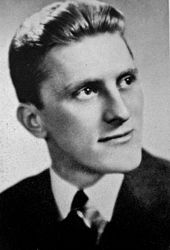
Growing up, Douglas sold snacks to mill workers to earn enough to buy milk and bread to help his family. Later, he delivered newspapers and during his youth worked at more than forty different jobs before getting a job acting.[11] He found living in a family with six sisters to be stifling: "I was dying to get out. In a sense, it lit a fire under me."[12] In high school, after acting in plays, he then knew he wanted to become a professional actor.[12] Unable to afford tuition, Douglas talked his way into the Dean's office at St. Lawrence University and showed him a list of his high school honors. He received a loan which he paid back by working part-time as a gardener and a janitor. He was a standout on the wrestling team, and wrestled one summer in a carnival to make money.[13]
Douglas' acting talents were noticed at the American Academy of Dramatic Arts in New York City, which gave him a special scholarship. One of his classmates was Betty Joan Perske (later to become better known as Lauren Bacall), who would play an important role in launching his film career.[14] Another classmate, and a friend of Bacall, was aspiring actress Diana Dill, who would later become Douglas's first wife. Bacall wrote that she "had a wild crush on Kirk,"[15] and they dated casually.
During their time together, she learned he had no money, and that he once spent the night in jail since he had no place to sleep. She once gave him her uncle's old coat to keep warm: "I thought he must be frozen in the winter ... He was thrilled and grateful." Sometimes, just to see him, she would drag a friend or her mother to the restaurant where he worked as a busboy and waiter. He told her his dream was to some day bring his family to New York to see him on stage. During that period she fantasized about some day sharing her personal and stage life with Douglas, but would later be disappointed: "Kirk did not really pursue me. He was friendly and sweet—enjoyed my company—but I was clearly too young for him", the eight years younger Bacall later wrote.[15]
Early career[edit]
Douglas first wanted to be an actor after he recited the poem The Red Robin of Springwhile in kindergarten and received applause.[16] He enlisted in the United States Navy in 1941, shortly after the United States entered World War II, where he served as a communications officer in anti-submarine warfare. He was medically discharged for war injuries in 1944.[citation needed] He married Diana Dill on November 2, 1943. They had two sons, Michael in 1944 and Joel in 1947, before they divorced in 1951.[17][18]
After the war, Douglas returned to New York City and found work in radio, theater andcommercials. In his radio work, he acted in a number of network soap operas, and sees those experiences as being especially valuable, as skill in using one's voice is important for aspiring actors, and regrets that the same avenues are no longer open to them.[14] His stage break occurred when he took over the role played by Richard Widmark in Kiss and Tell (1943), which then led to other offers.[14]
Douglas had planned to remain a stage actor, until his friend, Lauren Bacall, helped him get his first film role by recommending him to director Hal Wallis, who was looking for a new male talent.[19] Wallis's film, The Strange Love of Martha Ivers (1946), with Barbara Stanwyck, became Douglas's debut screen appearance. He played a young, insecure man, stung with jealousy, whose life was dominated by a ruthless older woman, and he hid his feelings with alcohol. It would be the last time that Douglas portrayed a weakling in a film role.[20][21] Reviewers of the film noted that Douglas already projected qualities of a "natural film actor," with the similarity of this role with later ones explained by biographer Tony Thomas:
His style and his personality came across on the screen, something that does not always happen, even with the finest actors. Douglas had, and has, a distinctly individual manner. He radiates a certain inexplicable quality, and it is this, as much as talent, that accounts for his success in films.[22]
https://en.wikipedia.org/wiki/Kirk_Douglas



