Coordinates:  20°40′19.02″N 103°17′2.76″W
Per
Spanish naming customs individuals mentioned in this article have two surnames. To distinguish between church leaders with the same paternal surname (i.e.
Joaquín), both their first name and their paternal surname are used when mentioned.
| Church of the Living God, Pillar and Ground of the Truth, The Light of the World |
|---|
| Iglesia del Dios Vivo, Columna y Apoyo de la Verdad, La Luz del Mundo |
 Flagship Temple of La Luz del Mundo Church |
| Classification | Restorationist
(Christian primitivism) |
|---|
| Orientation | Charismatic |
|---|
| Theology | Nontrinitarian |
|---|
| Structure | Hierarchical |
|---|
| Leader | Naasón Joaquín García[3] |
|---|
| Region | 58 countries[4] as of August 2018 |
|---|
| Headquarters | Guadalajara, Jalisco, Mexico |
|---|
| Founder | Aarón (born Eusebio) Joaquín González |
|---|
| Origin | 6 April 1926[5][6]
Monterrey, Nuevo León, Mexico |
|---|
| Branched from | Early Apostolic Faith movement in Mexico; tracing shared roots with the Iglesia Apostólica de la Fe en Cristo Jesús and the Iglesia Evangélica Cristiana Espiritual |
|---|
| Separations | Iglesia del Dios Vivo, Columna y Apoyo de la Verdad, El Buen Pastor (The Good Shepherd) |
|---|
| Congregations | 2,869[4] as of August 2013 |
|---|
| Members | Between 1 and 5 million. SeeStatistics |
|---|
| Other name(s) | Spanish: La Luz del Mundo; LLDM; LDM; Iglesia La Luz del Mundo; ILLMEnglish: La Luz del Mundo Church; Church of the Living God, Pillar and Ground of the Truth, The Light of the World; The Light of the World Church |
|---|
| Official website | www.bereainternacional.com |
|---|
| Local Spanish pronunciation: [i´ɣlesja ðel djoz ´biβo, ko´lumna j a´poʝo ðe la βeɾ´ðað, la luz del ´mundo] |
The Iglesia del Dios Vivo, Columna y Apoyo de la Verdad, La Luz del Mundo, (English:Church of the Living God, Pillar and Ground of the Truth, The Light of the World)—or simplyLa Luz del Mundo (LLDM)—is a Nontrinitarian Christian denomination with international headquarters in Guadalajara, Jalisco, Mexico. La Luz del Mundo practices a form ofrestorationist theology centered on three leaders: Aarón—born Eusebio—Joaquín González (1896–1964), Samuel Joaquín Flores (1937–2014), and Naasón Joaquín García (born 1969). These three men are regarded by LLDM as modern day Apostles of Jesus Christ and Servants of God.
La Luz del Mundo had its beginnings in 1926 just as Mexico plunged into a violent strugglebetween the anti-clerical government and Catholic rebels. The conflict centered in the west-central states like Jalisco, where Aarón Joaquín focused his missionary efforts. Given the environment of the time, the Church remained a small missionary endeavor until 1934, when it built its first temple. Thereafter LLDM continued to grow and expand, interrupted only by an internal schism in 1942. Joaquín was succeeded by his son Samuel upon his death, who was in turn succeeded by his son Naasón upon his death. The Church is now present in more than 50 countries and has between 1 and 5 million adherents worldwide.
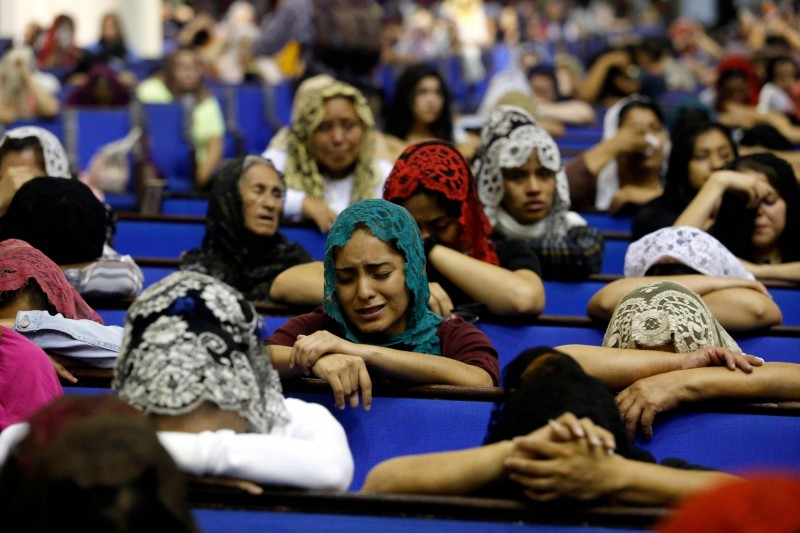
The Church describes itself as the restoration of primitive Christianity. It does not use crossesor religious images in its worship services. Female members follow a dress code that includes long skirts and use head coverings during services. Although the Church does not allow women to hold leadership positions in its religious hierarchy, women do hold leadership positions in church public relations and in the various church-operated civil organizations.
LLDM leaders have faced accusations of sexual abuse.[7] In June 2019, church leader Naasón Joaquín García was arrested at Los Angeles International Airport and charged with sex crimesby the California Department of Justice.[8]
The full name of the Church is Iglesia del Dios Vivo, Columna y Apoyo de la Verdad, La Luz del Mundo ("Church of the Living God, Pillar and Ground of The Truth, The Light of the World") which is derived from two passages in the Bible, Matthew 5:14 and 1 Timothy 3:15.
History[edit]
Historical background[edit]
Eusebio Joaquín González was born on August 14, 1896 in Colotlán, Jalisco, Mexico. At a young age, he joined the Constitutional Army during the Mexican Revolution.[11] While he was on leave in 1920, he met Elisa Flores, whom he later married. While stationed in the state ofCoahuila in 1926, he came into contact with Saulo and Silas, two ascetic preachers from the Iglesia Cristiana Espiritual. Their teachings forbade their followers to keep good hygiene and wear regular clothes. After being baptized by the two itinerant preachers, Joaquín resignedfrom the army, and along with his wife became domestic workers to the two preachers.
During the 1920s, Mexico underwent a period of instability under the administration of Plutarco Elías Calles, who was seeking to limit the influence of the Catholic Church to modernize and centralize the state within the religious sphere of Mexican society. To protest Calles's policies, the Catholic Church suspended all religious services, bringing about an uprising in Mexico. This uprising, or Cristero War, lasted from 1926 to 1929 and reemerged in the 1930s. On April 6, 1926, Joaquín had a vision in which God changed his name from Eusebio to Aarón and told him to leave Monterrey, where he and his wife served Saulo and Silas. On his journey, Aarón Joaquín preached near the entrances of Catholic churches—often facing religious persecution—until he arrived at Guadalajara on December 12, 1926. The Cristero Wars impacted both Catholic and non-Catholic congregations and preachers, especially evangelical movements. Small movements were attacked by the government and the Cristeros, resulting in a hostile environment for Aarón Joaquín's work.
Ministry of Aarón Joaquín González (1926–1964)[edit]
Early years[edit]
Working as a shoe vendor, Aarón Joaquín formed a group of ten worshipers who met at his wife's apartment. He began constructing the Church's hierarchy by instituting the first two deaconesses, Elisa Flores and Francisca Cuevas. Later he charged the first minister to oversee fourteen congregations in Ameca, Jalisco. During these early years (late 1920s), Aarón Joaquín traveled to the states ofMichoacán, Nayarit, and Sinaloa to preach. In 1931, the first Santa Cena (Holy Supper) was held to commemorate the crucifixion of Jesus. The Church met in rural areas, fearing complaints from Catholic neighbors. Urbanization contributed migrants from the countryside who added a significant number of members to the Church.
In 1934, a temple was built in Sector Libertad of Guadalajara's urban zone and members were encouraged to buy homes in the same neighborhood, thereby establishing a community. The temple was registered as Iglesia Cristiana Espiritual (Spiritual Christian Church) but Aarón Joaquín claimed to have received God's word in the dedication of the temple, saying that it was "light of the world" and that they were theIglesia del Dios Vivo, Columna y Apoyo de la Verdad (Church of the Living God, Pillar and Ground of the Truth). The Church used the latter name to identify itself. In 1939, it moved to a new meeting place at 12 de Octubre street in San Antonio in southeast Guadalajara, forming its second small community which was populated mainly by its members. This community was an attempt to escape the hostile environment, not to create an egalitarian society.
In 1938, Aarón Joaquín returned to Monterrey to preach to his former associates. There he learned that he had been baptized using theTrinitarian formula and not in the name of Jesus Christ as he preached. His re-baptism in the name of Christ by his collaborator Lino Figueroa marked Aarón Joaquín's separation from the rest of the Pentecostal community.
Schism of 1942[edit]
1942, in its most significant schism, at least 250 members left La Luz del Mundo. Tensions began to build after Aarón Joaquín's birthday, when the congregation gave him gifts of flowers and sang hymns. This celebration generated a heated debate that culminated with thedefection of several church members, including some pastors. Anthropologist Renée de la Torre described this schism as a power struggle in which Aarón Joaquín was accused of having enriched himself at the expense of the faithful. Church dissidents took to local newspaper El Occidental to accuse members of LLDM of committing immoralities with young women. Some of the accusations were aimed to close down a temple that the Church used with government permission. Members of La Luz del Mundo attribute this episode to the envy and ambition of the dissidents, who formed their own group called El Buen Pastor (The Good Shepherd) under the leadership of José María González, with doctrines and practices similar to those of LLDM. The leader is considered a prophet of God. As of 2010, El Buen Pastor Church has a membership of 17,700 in Mexico.[30]
Among those who defected to El Buen Pastor was Lino Figueroa, the pastor who had re-baptized Aarón Joaquín in 1938. Aarón Joaquín had a vision in July 1943 where the baptism by Figueroa was invalidated and he was ordered to re-baptize himself invoking Jesus' name. The whole congregation was re-baptized as well, as now Aarón Joaquín was the source of baptismal legitimacy and authenticity. With all those who had challenged him gone, Aarón Joaquín was able to consolidate leadership of the La Luz del Mundo.
Hermosa Provincia[edit]
With the growth of La Luz del Mundo in the city, issues of safety developed in the 12 de Octubre street meeting place in the late 1940s and early 1950s. In 1952, Aarón Joaquín purchased a plot of land outside the city and called it Hermosa Provincia (Beautiful Province), with the intent of forming a small community made up exclusively by members of LLDM. The land was then sold at reduced prices to church members. The community included most necessities; services provided in Hermosa Provincia included health, education, and other urban services, which were provided in full after six years partly with help that the Church received from municipal and non-municipal authorities.This dependency upon outside assistance to obtain public services ended by 1959 when residents formed the Association of Colonists of Hermosa Provincia, which was used to directly petition the government. Hermosa Provincia received official recognition from the city for being the only neighborhood that had eliminated illiteracy by the early 1970s. The neighborhood became a standard model for the Church, which has replicated it in many cities in Mexico and other countries. Aarón Joaquín started missionary efforts in Central America and by the early 1960s, LLDM had 64 congregations and 35 missions. By 1964, after his death, the Church had between 20,000 and 30,000 members spread through five countries, including Mexico.
Ministry of Samuel Joaquín Flores (1964–2014)[edit]
Samuel Joaquín Flores was born on February 14, 1937, the youngest of eight siblings. He became the leader of La Luz del Mundo by the age of 27 after the death of his father. He continued his father's desire for international expansion by traveling outside of Mexico extensively. He first visited LLDM members in Michoacán in August 1964 and later that year he went to Los Angeles on a missionary trip. By 1970, the Church had expanded to Costa Rica, Colombia, and Guatemala. Its first small temple in Hermosa Provincia was demolished and replaced by a larger one in 1967. With Samuel Joaquín's work, LLDM became integrated into Guadalajara and the Church replicated the model of Hermosa Provincia in many cities in Mexico and abroad. By 1972, there were approximately 72,000 members of the Church, which increased to 1.5 million by 1986 and to 4 million by 1993. Anthropologist Patricia Fortuny says that LLDM's growth can be attributed to several factors, including its social benefits, which "improves the living conditions of believers." Samuel Joaquín oversaw the construction of schools, hospitals and other social services produced by the La Luz del Mundo. The Church also expanded to countries including the UK, the Netherlands,Switzerland, Ethiopia and Israel between 1990 and 2010. By the end of Samuel Joaquín’s ministry, La Luz del Mundo was present in fifty countries. After fifty years at the head of LLDM, Samuel Joaquín died in his home on December 8, 2014.[46]
Ministry of Naasón Joaquín García (2014–present)[edit]
On December 14, 2014, Naasón Joaquín García, the fifth out of the eight Joaquín children, became the leader of La Luz del Mundo upon the death of his father.[47] Naasón Joaquín was born on May 7, 1969 in Guadalajara. He previously served as a church minister for 22 years, during which time he launched Berea Internacional, the church's media and publishing arm. Under his leadership the church has expanded to four additional countries. [48][49][50]
Beliefs and practices[edit]
Worship[edit]
During La Luz del Mundo's religious services, male and female members are separated during worship; from the preacher's perspective, women sit on the left side of the temple and men on the right [52] The Church does not use musical instruments during its services. There is no dancing or clapping, and women cover their heads with a veil during services.[55] Hymns are sung a cappella;[56] Despite this, members listen to instrumental music and some compose their own music. When singing, all congregants sing at the same time to maintain uniformity during their meetings. LLDM believes that worship should be done "spiritually" and only to God, and thus temples are devoid ofimages, saints, crosses, and anything that might be considered idolatry.[58] The places of worship have plain walls and wide, clear windows.[56]
The Church holds three daily prayer meetings during the week, with two meetings on Sundays and one regular consecration. On Sunday mornings, congregants meet at the temple for Sunday school, which begins with prayers and hymns. After that, the preacher—usually a minister—presides over a talk during which he reads from the Bible and presents the material to be covered throughout the week. During the talk, it is common for members of either sex to read a cited verse from the Bible. At the end of the talk, more hymns and prayers are recited and voluntary donations are given. Sunday evening services begin with hymns and prayers, after which members of the congregation of both sexes recite from the Bible or sing hymns. A shorter talk is held with the aim of deepening the Sunday school's talk.
LLDM holds three scheduled prayer meetings each day. The first daily prayer meeting is at 5:00 a.m. and usually lasts one hour. The service includes a talk that is meant to recordar (remember) the material covered in Sunday school. The 9:00 a.m. prayer was originally started by Aarón Joaquín's wife, Elisa Flores. A female church member presides over the prayer meeting, which includes a talk. The evening prayer has the same structure as the 5:00 a.m. meeting. In each prayer meeting members are expected to be prepared with their Bibles, hymn books and notebooks and to be consecrated.
Members of La Luz del Mundo believe that the Bible is the only source of Christian doctrine. It is used as the main source of ministers' and lay persons' talks during prayer meetings. Through organizational arrangements, such as Sunday school, church authorities attempt to maintain uniformity of teachings and beliefs throughout all congregations. The Bible is the only historical reference used by LLDM during religious services. Members can find cited Bible verses quickly, regardless of their level of education. It is also seen as the only and "sufficient rules of faith for salvation."[63]
Restorationism[edit]
La Luz del Mundo teaches that there was no salvation on Earth between the death of the last Apostle (Apostle John) around 96 AD and the calling of Aarón Joaquín in 1926. Members believe that the Church itself was founded by Jesus Christ approximately two thousand years ago and that after the deaths of the Apostles, the church became corrupt and was lost.[6] LLDM claims that through Aarón Joaquín, it is the restoration of the primitive Christian church that was lost during the formation of the Catholic Church. After those times passed, the beginning of Aarón Joaquín's ministry is seen as the restoration of the original Christian Church. Salvation can be attained in the Church by following the Bible-based teachings of their leader.
Calling of the Servants of God[edit]
La Luz del Mundo believes its apostles are directly chosen and sent by God to "preach the will of God and Salvation".[66] It believes that Aarón Joaquín was called by God to restore the primitive Christian Church. Aarón Joaquín was succeeded by his son Samuel upon his death in 1964; the latter was succeeded by his son Naasón upon his death in 2014. Although Church leadership has remained in the Joaquín family since its funding, LLDM maintains that succession of power is by divine calling, not by kinship.[67] LLDM teaches that it is the only true Christian churchfounded by Jesus Christ because it is led by Naasón Joaquín, whom it considers the only true servant of God and Apostle of Christ in this era.[6] Members believe that this Apostolic Authority allows them to find peace, feel close to God and attain meaning in their lives from the hopes of joining with Christ to reign with him for eternity.[68]
Christology[edit]
La Luz del Mundo rejects the doctrine of the Trinity as a later addition to Christian theology.[69] It believes in a "one and universal" God, and in Jesus Christ who is the "Son of God and Savior of the world", rather than part of a trinity.[58][70] God is worshiped "by essence", whereas Christ is worshiped "by commandment."[71] Moreover, by worshiping Christ they are also worshiping God through him according to their teachings.[72]The Church also preaches baptism in the name of Christ for forgiveness of sins, and baptism with the Holy Spirit as confirmation from God for entrance into heaven.[70]
Role of women[edit]
Female congregants of La Luz del Mundo are discouraged from wearing jewelry, makeup, and short hair. They are taught to dress modestly, which means wearing long dresses and skirts. These restrictions do not apply to recreational activities, such as swimming.[74] Women wear a head covering during religious meetings. According to an interview of one adherent, women in LLDM are considered equal to men in social spheres and have equal capacities for obtaining higher education, social careers, and other goals that may interest them. However, they are not allowed to become ministers or serve in major leadership roles within the Church. The women are taught to submit to their husbands. Aarón Joaquín established the 9 a.m. prayer after hearing about one of his followers who was being abused by her Catholic husband. This prayer became one led by women. These prayers are seen as a religious activity equal to all other activities, and provide space for empowerment in which women can express themselves and develop a status within the congregation's membership. Anthropologist Fortuny said, concerning the 9 a.m. prayer, that, "I infer from this that, if the membership considers this as [a] female [gathering], they would be giving authority to women in the religious or ecclesiastical framework of the ritual, and this then [would] put [them] on a plane of equality or [in] absence of subordination to men." She said that women of the Church may be playing with their subordinate roles in LLDM to acquire certain benefits.
Church women personalize their attire, according to Fortuny. Rebozos are worn by indigenous members and specially designed veils by other female members. Fortuny says that, "... wearing long skirts does not negate the meaning of being a woman and, although it underlines the difference between men and women, [LLDM's female members] say that it does not make them feel like inferior human beings". Fortuny says women describe their attire as part of obeying biblical commands found in 1 Timothy 2:9, and 1 Corinthians 11:15 for long hair. Female members say the Church's dress code makes them feel they are honoring God and that it is part of their "essence".
Fortuny also states that dress codes are a sign of a patriarchal organization because men are only forbidden from growing their hair long or wearing shorts in public. Women, at times, can be more autonomous than those in the general population in Mexico. Fortuny says that the growing trend of educated women having husbands in supporting roles is also seen within LLDM both in the Guadalajara and Houston, Texascongregations. Many young female members said they want to undergo post-secondary education, and some told Fortuny they were degree students. Both young men and women are equally encouraged to enter post-compulsory education. Fathers who are members of LLDM are more likely than their mothers to direct their daughters towards attending university.
La Luz del Mundo does not practice ordination of women. According to Fortuny, women can become missionaries or evangelizers; the lowest tier of the Church's hierarchy. She states that "the rank of deaconess is not a position which common women could aspire to". Dormady states that the first two deaconesses were Elisa Flores and Francisca Cuevas. Wives of important members of the Church usually get the rank of deaconess, according to Dormady.[89]
Women are active and play key roles in organizing activities and administering them in the Church. Female office holders are always head of groups of women and not groups of men. A deaconess can help pastors and deacons, but cannot herself administer the sacrament. All members of the ministerial hierarchy are paid for their services as part of the tithe by the congregational members.
At the turn of the century, La Luz del Mundo began promoting women to public relations positions that were previously held by men only.[91] As of December 2014, two women (and three men) serve as legal representatives of the church in Northern Mexico.[92]  ublic relations positions that have been held by women include spokesperson, director of social communication, and assistant director of international affairs.[93][94]Within church operated civil organizations women also occupy executive positions such as director of La Luz del Mundo Family Services, a violence prevention and intervention center in Milwaukee;[96] Director of Social Work and Psychology within the Ministry of Social Welfare;[97]director of the Samuel Joaquín Flores Foundation; president of Recab de México A.C.;[98] and director of the Association of Students and Professionals in the U.S.[99]
Other beliefs and practices[edit]
La Luz del Mundo teaches moral and civil principles such as community service and that science is a gift from God.[70] Members of LLDM do not celebrate Christmas or Holy Week. The most important yearly rituals are the Holy Supper (Santa Cena in Spanish or "Santa Convocation"), held yearly on August 14, and the anniversary of Naasón Joaquín's birth is held on May 7 at its international headquarters in Guadalajara.
Organization[edit]
Ecclesiastical organization[edit]
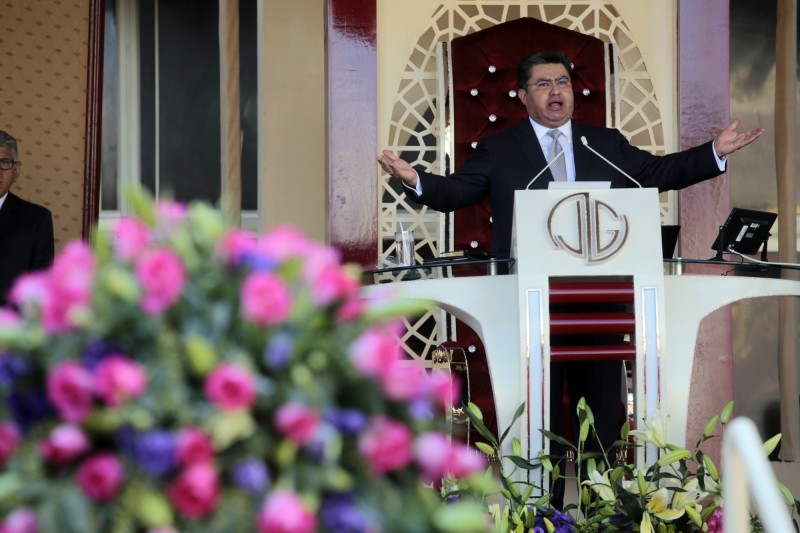
The organization of La Luz del Mundo is hierarchical. The head of the church, Naasón Joaquín, refers to himself as the "Apostle and Servant of God" and the organizational authority as General Director of the Church. Below him in rank are the pastors, who are expected to develop one or more of the qualities as doctor, prophet, and evangelist. All pastors are evangelists and are expected to undertake missionary tasks. As doctors, pastors explain the word of God and as prophets they interpret it. Below them are the deacons, who administer the sacraments to the congregational members. Below the deacons are the encargados (managers or overseers), who have responsibility for the moral conduct and well-being of certain groups within the congregation. Overseers grant permits to members who wish to leave their congregations for vacations or to take jobs outside of the church district. At the lowest echelon of the hierarchy are the obreros (laborers), who mainly assist their higher-ups with missionary work.[102]
Territorial organization[edit]
A church, or group, that is unable to fully provide for the religious needs of its members is called a mission. Missions are dependent on a congregation which is administered by a minister. A group of several congregations with their missions form a district. The Church in each nation is divided into multiple districts. In Mexico, several districts form together into five jurisdictions that act as legal entities.[103]
Notable Temples[edit]
La Luz del Mundo uses the architecture of its temples to express its faith through symbolism and to attract potential converts.[104][105][106]Among the Church's buildings are a replica of a Mayan pyramid in Honduras, a mock Taj Mahal in Chiapas, and a Greco-Roman-inspired temple in Texas. Its flagship temple is located in its headquarters in Hermosa Provincia. Two smaller replicas of this temple are being built inAnchorage, Alaska and in Chile to symbolize "the northern and southern-most reach of the Church's missionary efforts."[105]
Hermosa Provincia Temple[edit]
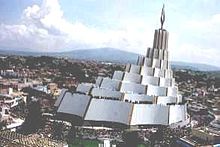
Flagship temple in Guadalajara
The flagship temple in Guadalajara is pyramidal and has an innovative structure. The project began in 1983, when the Church's former temple, built to accommodate 8,000 people, was deemed insufficient to accommodate the growing number membership who attended various annual celebrations.[107] Construction began on July 3, 1983, when Samuel Joaquín laid the cornerstone, and lasted until August 1, 1992.[108] The temple was completed largely by members of the Church. It is a notable architectural feature in Guadalajara in a working-class district on the outskirts of the city.
Dozens of institutions, architects, and engineers were invited to submit proposals for a new temple. The pyramidal design submitted by local architect Leopoldo Fernández Font was selected from the final shortlist of four proposals.[107] Fernandez was later awarded an honorary degree for this and other structures.[109] The temple was built to accommodate 12,000 worshipers and is used for annual ceremonies.
The building's design represents the infinite power and existence of God. It consists of seven levels over a base menorah, each of which symbolize steps toward the human spirit's perfection.[107] In February 1991, a laser beacon was installed to commemorate the 449-year anniversary of the founding of Guadalajara.[110] On July 1999, the pinnacle of the temple was replaced by Aaron's rod, a twenty-ton bronze sculpture by artist Jorge de la Peña. The installation of the 23-metre (75 ft) long structure required a special crane.[111][112]
Houston Texas Temple[edit]
uzDelMundoHoustonTX.jpg" class="image" style="text-decoration: none; color: rgb(11, 0, 128); background: none;">
uzDelMundoHoustonTX.jpg" class="internal" title="Enlarge" style="text-decoration: none; color: rgb(11, 0, 128); display: block; text-indent: 15px; white-space: nowrap; overflow: hidden; width: 15px; height: 11px; -webkit-user-select: none; background: linear-gradient(transparent, transparent), url("data:image/svg+xml,%3Csvg xmlns=%22http://www.w3.org/2000/svg%22 width=%2215%22 height=%2211%22 viewBox=%220 0 11 15%22%3E %3Cg id=%22magnify-clip%22 fill=%22%23fff%22 stroke=%22%23000%22%3E %3Cpath id=%22bigbox%22 d=%22M1.509 1.865h10.99v7.919H1.509z%22/%3E %3Cpath id=%22smallbox%22 d=%22M-1.499 6.868h5.943v4.904h-5.943z%22/%3E %3C/g%3E %3C/svg%3E");">
The Houston Texas Temple
The main temple in Houston, Texas, was inspired by Greco-Roman architecture. It is the largest temple constructed by La Luz del Mundo in the United States as of 2011. The temple's pillars resemble the Parthenon. The front of the building is decorated with carved scenes from the Bible and three panes of stained glass also depict biblical scenes. The temple can hold 4,500 people. The interior has marble floors, glass chandeliers, and wood paneling.
The structure is worth US$18 million and consists of the temple, classrooms, offices, and a parsonage. There is a sitting area with fourteen free-standing columns in a circle next to the temple.[114] Each column represents each of the Apostles at the time of construction—including Aarón and Samuel Joaquín. On top of the temple under Aaron's rod—the Church's symbol which represents God's power to bring spiritual life to believers—is a large, golden dome.[114] The symbol is also a reference to the Church's founder.[114]
Construction of the temple began in 2000 and was finished in 2005. Most of the construction was done by Church volunteers, who provided funding and a skilled workforce.[114] The structure was designed by LLDM members and the design was revised by architects to ensure compliance with building codes.[114] The decorations and ornaments were also designed and installed by Church members.[114] The temple serves as a central congregation for southeastern Texas.
Membership Statistics[edit]
LDM_distribution_in_Mexico.svg" class="image" style="text-decoration: none; color: rgb(11, 0, 128); background: none;">
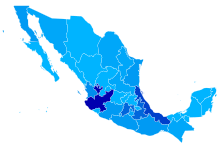
LDM_distribution_in_Mexico.svg" class="internal" title="Enlarge" style="text-decoration: none; color: rgb(11, 0, 128); display: block; text-indent: 15px; white-space: nowrap; overflow: hidden; width: 15px; height: 11px; -webkit-user-select: none; background: linear-gradient(transparent, transparent), url("data:image/svg+xml,%3Csvg xmlns=%22http://www.w3.org/2000/svg%22 width=%2215%22 height=%2211%22 viewBox=%220 0 11 15%22%3E %3Cg id=%22magnify-clip%22 fill=%22%23fff%22 stroke=%22%23000%22%3E %3Cpath id=%22bigbox%22 d=%22M1.509 1.865h10.99v7.919H1.509z%22/%3E %3Cpath id=%22smallbox%22 d=%22M-1.499 6.868h5.943v4.904h-5.943z%22/%3E %3C/g%3E %3C/svg%3E");">
Demographics of La Luz del Mundo Church according to the 2010
INEGI Census.
There are no definitive statistics for the total membership of La Luz del Mundo. It has reported having over five million members worldwide in 2000, with 1.5 million in Mexico. The Church does not appear in the 1990Mexican census or any census prior to that.[116]
The 2000 Mexican census reported about 70,000 members five years or older nationwide, and the 2010 census reported 188,326 members of any age.[119] The Church of Jesus Christ of Latter-day Saints, whose numbers also differ significantly from those of the census—1,234,545 compared to the census figure of 314,932—said ambiguity in the census questionnaire was the source of the disparity.[120] The World Christian Encyclopedia reports 430,000 adherents in Mexico in 2000 and 488,000 in Mexico in 2010.[121] Based on the number of congregations and the average number of members per congregation, anthropologist Hugo G. Nutini estimated in 2000 that the Church had a total membership of around 1,125,000 adherents worldwide, with more than two-thirds of those in Mexico. In 2008, Fortuny and Williams reported a membership of 7,000,000.[122] Anthropologist Ávila Meléndez says that the membership numbers reported by LLDM are plausible given the great interest it has generated among "religious authorities" and the following it receives in Mexico.
In El Salvador, as of 2009, there are an estimated 70,000 members of La Luz del Mundo, which had 140 congregations with a minister and 160 other congregations with between 13 and 80 members.[123] As of 2008, there were around 60,000 members of LLDM in the United States.
Controversies and Criticism[edit]
La Luz del Mundo has been the subject of several controversies, including the potential for mass suicide, and sexual abuse accusations.
False claims of potential mass suicide[edit]
Following the Heaven's Gate mass suicide on March 26, 1997, Mexican journalists looked for religious group at home that could stage similar acts.[125] The following day, on TV Azteca's evening newscast Hechos, Jorge Erdely Graham of the obscure anti-cult group Instituto Cristiano de Mexico (Christian Institute of Mexico) pointed to La Luz del Mundo as a group with the potential to commit mass suicide.[125]Erdely's claims were based on an anonymous interview with three Church members conducted two years earlier by the California-based anti-cult group Centro de Investigaciones Religiosas (Religious Research Center). LLDM denied the claims, arguing that the answers of three individuals could not be used to make generalizations about an entire community. The claims were debunked by various religious scholars, including Gordon Melton and David Bromley, who characterized the accusations as "fraudulent reports by ideological enemies."Anthropologist Elio Masferrer Kan criticized the methodology employed in the interview, noting that the interviewer cornered the subjects to obtain the desired response.
Sexual abuse accusations[edit]
On May 18, 1997–a day after Samuel Joaquín's 35th wedding anniversary[128]–a handful of women claimed on the Mexican network Televisathat they had been sexually abused by Samuel Joaquín approximately twenty years earlier. In a third report on August 17, shortly after the church's most significant holiday, former member Moisés Padilla Íñiguez also accused Samuel Joaquín of sexually abusing him when he was a teenager.[130] These accusations were spearheaded by Erdely's anti-cult group, which demanded that La Luz del Mundo be stripped of its legal recognition as a religious organization.[133] Four people later filed formal complaints with the state prosecutor, but the statute of limitations for the alleged crimes had passed.[125] The sexual abuse accusations against Samuel Joaquín followed similar accusations against influential, Mexican-born Catholic priest Marcial Maciel, leader and founder of the Legion of Christ, in the Hartford Courant on February 23, 1997.[134] Only Mexico City newspaper La Jornada and small Mexico City television station Canal 40 reported on the Maciel sex abuse scandal in Mexico where most of his victims were from and where he enjoyed the support of the Mexican elite.[135] In contrast to the accusations against Samuel Joaquín which received extensive media coverage,[136] the accusations against Maciel were quickly shut down, the journalists who reported on them lost their jobs, and Canal 40 was bankrupted following an advertiser boycott.[137][138] The accusations against Maciel would be taken seriously years later when he was removed from public ministry in 2006 and his crimes denounced by the Vatican in 2010.[139]
The issue came back to life in February 1998 when, two days before Samuel Joaquín's birthday, Padilla reported being kidnapped and stabbed by two gunmen.[125][140][141] adilla received 57 shallow slashes from a dagger which, although they did not put his life in immediate danger,[140] could have resulted in death from blood loss.[125] adilla blamed Samuel Joaquín for the stabbing and for an earlier attack in which he was allegedly beaten by men who warned him against criticizing the Church leader.[125] An LLDM spokesman denied that the Church or Samuel Joaquín had any involvement in the attack and suggested that Padilla may have orchestrated it in a desperate attempt to authenticate his previous charges against the organization.[125][141]
Judicial authorities investigating the charges said the alleged victims were not being fully cooperative, whereas former LLDM members expressed suspicion of the Mexican legal system, arguing that it favored the Church.[125] Ten years later a spokesman for the state prosecutor said the criminal complaints were unsuccessful because, in addition to the statute of limitations, the accusations were incomplete.[142]
When asked whether she believed the sexual abuse accusations to be true, Fortuny stated that, "I am sure these allegations are true" and described Samuel Joaquín as a megalomaniac.[143] Sociologist Roberto Blancarte called the controversy a "persecution" fueled by "obscure interests."[144] Sociologist Bernardo Barranco described it as a dirty war that was well exploited by the media.[145][146] Anthropologist Carlos Garma Navarro criticized that the accusations were first brought before the media, and thought it was very likely that the accusations were an attempt to give the church a bad image.[147][148]
On June 4, 2019, California Attorney General Xavier Becerra's office released a statement announcing the arrest of La Luz del Mundo leader Naasón Joaquín García in connection with alleged human trafficking, production of child pornography, forcible rape of a minor, and otherfelonies. The California Department of Justice alleges that Garcia and his co-defendants committed twenty-six felonies between 2015 and 2018.[149] LLDM denied the accusations.[150]
Wealth inequality[edit]
Church leaders have been criticized for accumulating wealth while the majority of LLDM members belong to the lower economic classes.[151]The Joaquín family owns a lavish private zoo-themed ranch called Silver Wolf Ranch in Seguin, Texas, valued at $3 million as of 2008, and includes horses and a collection of restored vintage cars.[152] Lifelong Church member and lawyer, Maria Elena Castillo, states that the ranch is divided into two parts, a federally registered nonprofit zoo and wildlife rescue refuge, and a private zoo-themed family retreat. The nonprofit part is funded by donations from Church members in Texas, while the private part is funded by family earnings from businesses such as a travel agency in Guadalajara per a church spokesperson.[153]
Discrimination[edit]
Opposition to new temple in California[edit]
In 1995, La Luz del Mundo acquired a vacant nursery building in a commercial zone in Ontario, California. The Church planned to use it for religious activities and was assured that it could as long as building requirements were met. The city then passed a law requiring all new religious organizations to obtain a conditional use permit to operate a church in the commercial zone.[154] In 1998, LLDM petitioned for such a permit, but concerned residents objected to its plans.[142] María de Lourdes Argüelles, professor at Claremont Graduate University and board member of the Instituto Cristiano de México,[155] led the opposition against LLDM, which she called a "destructive sect".[125] She said she had seen children and teenagers working overnight on the site under precarious conditions.
Ontario officials met with objecting residents and began researching the Church, checking with cities where LLDM had temples, but found no problems.[125] After considering zoning questions and citing traffic, parking and disruption of economic plans for that area, the city denied the permit to the Church. LLDM then sued the city for denying it use of its own building for services and for allegedly violating its civil rights. The case was settled out of court in 2004, and LLDM was allowed to build the temple.[142] The city agreed to pay about US$150,000 in cash and fee credits to the Church.[154] The case was not taken to court because city officials and attorneys concluded the city would most likely lose the case and spend more money than the settlement.[154]
Denominational discrimination[edit]
According to Fortuny, members of LLDM, along with members of other Protestant denominations, are treated as "second class citizens".She says the church is called a "sect" in an offensive manner in Mexico. Rodolfo Morán Quiroz, a sociologist, said that the discrimination started by the Catholic Church, which in the past caused LLDM to establish its community in Hermosa Provincia, continues in Mexico.[159]Church founder Aarón Joaquín was beaten by Cristeros and was jailed by the government for preaching in the open air.[160]
In 1995, as thousands of members of the church traveled to the Holy Supper celebration in Guadalajara, several members of a neighboring community supported by Cardinal Juan Sandoval Íñiguez protested the use of schools to provide temporary shelters for the LLDM pilgrims. The protesters said that after the ceremony the schools were left in disarray; however church authorities presented photographic evidence to newspapers to refute these claims.[161]
According to Church spokesperson Armando Maya Castro, many students who are members of LLDM have been discriminated against and punished for refusing to partake in celebrations and customs concerning the Day of the Dead at school.[162] In one case reported by a Mexican newspaper, La Gaceta, a female member of LLDM was pushed by a fellow bus passenger, who then crossed herself because the member was wearing a long skirt.[163] In July 25, 2008, a public official sealed the entrance to an LLDM temple in Puerto Vallarta, trapping the congregation inside, until other officials removed the seals. This incident occurred because of complaints from individuals who did not like the presence of the Church in the area. Reporter Rodolfo Chávez Calderón stated that LLDM was in compliance with local laws.[164]
Many female Church members have faced discrimination and verbal abuse on buses, in schools, and in hospitals.[165] LLDM members who were patients in a Mexican hospital were denied access to their ministers in 2011. The hospital required permission from Catholic clergy so that LLDM ministers could visit patients.[166]
LLDM ministers reported that the site of a newly constructed temple in Silao was subject to harassment, vandalism, and physical threats because of religious intolerance, which caused them to request increased police protection.[167][168] In February 2012, seventy ministers of LLDM from different nations appeared before Mexican authorities in Guadalajara to denounce the lack of police protection for the church's residents in the city after a series of attacks left several members hospitalized.[169]