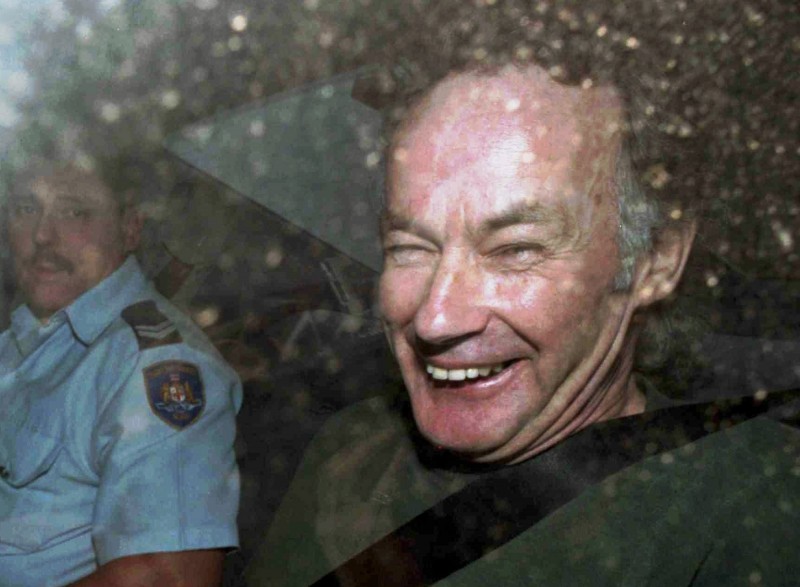
The backpacker murders were a spate of serial killings that took place in New South Wales, Australia, between 1989 and 1993, committed by Ivan Milat. The bodies of seven missing young people aged 19 to 22 were discovered partially buried in the Belanglo State Forest, 15 kilometres (9.3 mi) south-west of the New South Wales town of Berrima. Five of the victims were foreign backpackers (three German, two British) and two were Australian travellers from Melbourne. Milat was convicted of the murders on 27 July 1996 and was sentenced to seven consecutive life sentences, as well as 18 years without parole. He died in prison on 27 October 2019.
Murders[edit]
Background[edit]
Up until the mid-1990s, hitchhiking in Australia was viewed as an adventurous and inexpensive, if not completely safe, means of travel.[1] Encouraged by articles in travel publications such as Lonely Planet, backpackers on limited budgets sought ways to travel cheaply, such as purchasing used cars or using buses.[2] However, unsolved Australian missing-person cases such as that of Trudie Adams (1978), Tony Jones (1982), Naoko Onda (1987)[3] and Anna Rosa Liva (1991)[4] led to those who still hitchhiked to begin to travel in pairs for safety.
By the time of the first Belanglo State Forest discoveries, several other backpackers had also disappeared. One case involved a young Victorian couple from Frankston, Deborah Everist (19) and James Gibson (19), who had been missing since leaving Sydney for ConFest, near Albury, on 30 December 1989.[5] Another related to Simone Schmidl (21), from Germany, who had been missing since leaving Sydney for Melbourne on 20 January 1991.[5] Similarly, a German couple, Gabor Neugebauer (21) and Anja Habschied (20), had disappeared after leaving a Kings Cross hostel for Mildura on 26 December 1991. Another involved missing British backpackers Caroline Clarke (21) and Joanne Walters (22), who were last seen in Kings Cross on 18 April 1992.[6]
First and second victims[edit]

A sign at the entrance to the Belanglo State Forest
On 19 September 1992, two runners discovered a concealed corpse while orienteering in Belanglo.[7] The following morning, police discovered a second body 30 metres (98 ft) from the first.[8]  olice quickly confirmed, via dental records, that the bodies were those of Clarke and Walters.[5] Walters had been stabbed 14 times; four times in the chest, once in the neck, and nine times in the back which would have paralysed her.[5] Clarke had been shot 10 times in the head at the burial site, and police believe she had been used as target practice.[5][9] After a thorough search of the forest, investigators ruled out the possibility of further discoveries within Belanglo State Forest.[10]
Third and fourth victims[edit]
In October 1993, a local man searching for firewood discovered bones in a particularly remote section of the forest.[11] He returned with police to the scene where two bodies were quickly discovered and later identified as Gibson and Everist. Gibson's skeleton, found in a foetal position, showed eight stab wounds.[5] A large knife had cut through his upper spine causing paralysis, and stab wounds to his back and chest would have punctured his heart and lungs. Everist had been savagely beaten; her skull was fractured in two places, her jaw was broken and there were knife marks on her forehead. She had been stabbed once in the back.[12] The presence of Gibson's body in Belanglo puzzled investigators as his camera had previously been discovered on 31 December 1989, and his backpack later on 13 March 1990, by the side of the road at Galston Gorge, in the northern Sydney suburbs, over 120 kilometres (75 mi) to the north.[6][5]
Fifth, sixth and seventh victims[edit]
On 1 November 1993, a skeleton was found in a clearing along a fire trail in the forest during a police sweep.[13] It was later identified as that of Schmidl,[6] and bore at least eight stab wounds: two had severed her spine and others would have punctured her heart and lungs.[14] Clothing found at the scene was not Schmidl's, but matched that of another missing backpacker, Habschied.[5] The bodies of Habschied and Neugebauer were then found on a nearby fire trail, on 4 November 1993, in shallow graves 50 metres (160 ft) apart.[12] Habschied had been decapitated, and despite an extensive search, her skull was never found.[14][15] Neugebauer had been shot in the head six times.[14][16]
There was evidence that some of the victims did not die instantly from their injuries.[17]
Search for the serial killer[edit]
In response to the finds, on 14 October 1993, Task Force Air, containing more than 20 detectives and analysts, was set up by the NSW Police.[18] On 5 November 1993, the NSW government increased the reward in relation to the Belanglo serial killings to $500,000.[18] ublic warnings were also given, particularly aimed at international backpackers, to avoid hitchhiking along the Hume Highway.[5] After developing their profile of the killer, the police faced an enormous volume of data from numerous sources.[19] Investigators applied link analysis technology to Roads and Traffic Authority vehicle records, gym memberships, gun licensing, and internal police records. As a result, the list of suspects was progressively narrowed to a short list of 230, then to an even shorter list of 32.[20]
There were similar aspects to all the murders.[21] Each of the bodies had been dumped in remote bush-land and covered by a pyramid of sticks and ferns.[21][22] Forensic study determined that each had suffered multiple stab wounds to the torso, and many showed signs of sexual assault. The killer, probably a local with a 4WD,[18] had evidently restrained and spent considerable time with the victims both during and after the murders, as campsites were discovered close to the location of each body. Matching .22 bullets, shell casings, and cartridge boxes from two weapons also linked the crime scenes.[18] Speculation arose that the crimes were the work of several killers,[23][24] given that most of the victims had been attacked while as pairs, had been killed in different ways, and buried separately.
On 13 November 1993, police received a call from Paul Onions (24) in the U.K. On 25 January 1990, Onions had been backpacking in Australia and, while hitchhiking from Liverpool station towards Mildura, had accepted a ride south out of Casula from a man known only as "Bill".[25][16] South of the town of Mittagong, and less than 1 km from Belanglo State Forest, Bill stopped and pulled out a revolver and some ropes stating it was a robbery, at which point Onions managed to flee while Bill pursued and shot at him.[26][27] Onions flagged down Joanne Berry, a passing motorist, and together they sped off and described the assailant and his vehicle to the Bowral police.[28] On 13 April 1994, detectives re-found the note regarding Onions' call and sought the original report from Bowral police, but it was missing. Fortunately, a constable had recorded details in her notebook. Onions' statement was corroborated by Berry, who had also contacted the investigation team, along with the girlfriend of a man who worked with Ivan Milat, who thought he should be questioned over the case.[29]
Ivan Milat[edit]
Background[edit]
Ivan Robert Marko Milat (27 December 1944 – 27 October 2019)[30] was the son of a Croatian emigrant, Stjepan Marko "Steven" Milat (1902–1983), and an Australian, Margaret Elizabeth Piddleston (1920–2001), who married when she was 16.[31][32][33] Milat was the fifth-born of their 14 children.[34] Many of the 10 Milat boys were well known to local police, and Milat displayed antisocial behaviour at a young age, leading to a stint in a residential school at age 13.[35] By 17, he was in a juvenile detention centre for theft, and at 19, was involved in a shop break in.[35] In 1964, he was sentenced to 18 months for a break and enter, and a month after release, he was arrested for driving a stolen car and was sentenced to 2 years hard labour.[35] In September 1967, aged 23, he was sentenced to 3 years for theft.[35] In April 1971, he was charged with the abduction of two 18 year-old hitchhikers and the rape of one of them.[36] While awaiting trial, he was involved in a string of robberies with some of his brothers, before faking his suicide and fleeing to New Zealand for a year.[35] He was rearrested in 1974, but the robbery and kidnap cases against him failed at trial with the help of the Milat's family lawyer, John Marsden. Taking on a job as a truck driver in 1975, he met a 16-year-old girl who was then pregnant by his cousin, whom he married in 1983.[35] She left him in 1987 due to domestic violence and they divorced in October 1989.[35] By the time of the first crimes, Milat had worked on and off for 20 years for the Roads & Traffic Authority all over the state.[35]
Arrest and trial[edit]
On 26 February 1994, police surveillance of the Milat house at Cinnabar Street, Eagle Vale commenced.[35] olice learnt that Milat had recently sold his silver Nissan Patrol four-wheel drive shortly after the discovery of the bodies of Clarke and Walters.[37] olice also confirmed that Milat had not been working on any of the days of the attacks[35][38] and acquaintances also told police about Milat's obsession with weapons.[7][39] Milat's brother, Bill, who often had his identity used by his brother for work or vehicle registrations, was questioned by investigators.[35] When the connection between the Belanglo murders and Onions' experience was made, Onions flew to Australia to help with the investigation.[40] On 5 May 1994, Onions positively identified Milat as the man who had picked him up and attempted to assault him.[11]
Milat was arrested at his home on 22 May 1994 on robbery and weapon charges related to the Onions attack after 50 police officers surrounded the premises, including heavily armed officers from the Tactical Operations Unit.[13][38] The search of Milat's home revealed various weapons, including a .22-calibre Anschütz Model 1441/42 rifle and parts of a .22 calibre Ruger 10/22 rifle that matched the type used in the murders, a Browning pistol, and a Bowie knife.[41] Also uncovered was foreign currency, clothing, a tent, sleeping bags, camping equipment and cameras belonging to several of his victims.[41][42] Homes belonging to his mother and five of his brothers were also searched at the same time by over 300 police,[43] uncovering a total of 24 weapons, 250 kg of ammunition, and several more items belonging to the victims.[41]
Milat appeared in court on 23 May, but he did not enter a plea.[14] On 31 May, Milat was also charged with the seven backpacker murders.[41] On 28 June, Milat sacked his defence lawyer, Marsden, and sought legal aid to pay for his defence.[41] Meanwhile, brothers Richard and Walter were tried in relation to weapons, drugs and stolen items found on their properties.[41] A committal hearing for Milat regarding the murders began on 24 October and lasted until 12 December, during which over 200 witnesses appeared.[41] Based on the evidence, at the beginning of February 1995, Milat was remanded in custody until June that same year.
On 26 March 1996, the trial opened at the NSW Supreme Court and was prosecuted by Mark Tedeschi.[44] His defence argued that, in spite of the evidence, there was no non-circumstantial proof Milat was guilty and attempted to shift the blame to other members of his family, particularly Richard.[44] 145 witnesses took the stand, including members of the Milat family who endeavoured to provide alibis, and, on 18 June, Milat himself.[45] On 27 July 1996, after 18 weeks of testimony, a jury found Milat guilty of the murders.[13][46] He was given a life sentence on each count without the possibility of parole. He was also convicted of the attempted murder, false imprisonment and robbery of Onions, for which he received six years' jail each.[16]
Incarceration and appeals[edit]
On his first day, when arriving at Maitland Gaol, Milat was beaten by another inmate.[47] Almost a year later, on 16 May 1997, he made an escape attempt alongside convicted drug dealer and former Sydney councillor George Savvas.[48] The plan failed and Savvas was found hanged in his cell the next day, and Milat was transferred to the maximum-security super prison in Goulburn, New South Wales.[49]
In November 1997, Milat appealed against his convictions due to a breach of his common law right to legal representation, as established in Dietrich v The Queen. However, the NSW Court of Criminal Appeal dismissed the appeal.[21] In 2004, Milat filed an application with the High Court that he be allowed special leave to appeal on new grounds. The application for leave was ultimately dismissed, affirming the Court of Criminal Appeal's decision to disallow his initial appeal.[50][51] On 27 October 2005, in the NSW Supreme Court[52] Milat's final avenue of appeal was refused.[53] In 2006, two other application attempts were rejected as well, as was one in November 2011.[45]
In 2006, a toaster and TV given to Milat in his cell caused a public outcry.[54][45] On 26 January 2009, Milat cut off his little finger with a plastic knife, with the intention of mailing it to the High Court to force an appeal.[55] He was taken to Goulburn Hospital under high security; however, on 27 January 2009 Milat was returned to prison after doctors decided surgery was not possible.[56] Milat had previously self-harmed in 2001, when he swallowed razor blades, staples and other metal objects.[55] In May 2011, Milat went on a 9-day hunger strike, losing 25 kilograms in an unsuccessful attempt to be given a PlayStation.[57]
Health and death[edit]
In May 2019, Milat was transferred to Prince of Wales Hospital, Randwick, and was subsequently diagnosed with terminal oesophageal cancer.[58] Following his treatment he was transferred to Long Bay Correctional Centre to continue his custodial sentences.[59]
On 9 August 2019, a terminally ill Milat was moved to a secure treatment unit located in the Prince of Wales Hospital following the loss of 20 kilograms in previous weeks; Milat was also exhibiting a high temperature. His status, however, was reported as not life threatening.[60]
Milat died at 4:07 a.m. on 27 October 2019 while being treated at Long Bay Jail’s hospital wing. He was 74 years old.[61][62]
Other developments[edit]
Police maintain that Milat may have been involved in more attacks or murders than the seven for which he was convicted.[45] Based on MO similarities, examples include Keren Rowland (20, disappeared 26 February 1971, found in the Fairbairn Pine Plantation in May 1971), Peter Letcher (18, missing November 1987, found in the Jenolan State Forest in 1988), and Dianne Pennacchio (29, disappeared 6 September 1991, found in the Tallaganda State Forest in November 1991).[45][63] Further, given the possibility of an accomplice,[64] the murder cases were kept open.[45] On 18 July 2005, Milat's former lawyer, Marsden, made a deathbed statement in which he claimed that Milat had been assisted by his sister, Shirley Soire (1946–2003), in the killings of the two British backpackers.[34][65]
In 2001, Milat, was ordered to give evidence at an inquest into the disappearances in the Newcastle area of three other female backpackers (Leanne Goodall, 20, disappeared 30 December 1978; Robyn Hickie, 18, disappeared 7 April 1979; Amanda Robinson, 14, disappeared 21 April 1979).[45][66] A related cold case is that of Gordana Kotevski (16) who disappeared in 1994.[67] Although Milat was working in the area at the time of the crimes, no case has been brought against him due to a lack of evidence.[68] Similar inquiries were launched in 2003, in relation to the disappearance of two nurses and again in 2005, relating to the disappearance of hitchhiker Annette Briffa, but no charges were laid.[69][70]
In 2010, in a media interview, Onions, described how he accepted, but did not use, a $200,000 reward granted for his part in the conviction of Milat.[45][71][72][73]
In 2012, Milat's great-nephew Matthew Milat and his friend Cohen Klein (both aged 19 at the time of their sentencing) were sentenced to 43 years and 32 years in prison, respectively, for murdering David Auchterlonie on his 17th birthday with an axe at the Belanglo State Forest in November 2010. Matthew Milat struck Auchterlonie with the double-headed axe as Klein audio-recorded the attack with a mobile phone.[74][75]
In May 2015, Milat's brother Boris Milat told Steve Aperen, a former homicide detective who serves as a consultant with the Los Angeles Police Department and the U.S. Federal Bureau of Investigation, that Milat was responsible for another shooting: that of taxi cab driver Neville Knight, in 1962 after Milat admitted to the crime. After conducting polygraph tests with Boris Milat and Allan Dillon, the man convicted of Knight's shooting, Aperen is convinced that both men are telling the truth and that Milat did in fact shoot Knight.[76]
In popular culture[edit]
On 8 November 2004, Milat gave a televised interview on Australian Story, in which he denied that any of his family had been implicated in the seven murders.[77] The 2005 Australian film Wolf Creek is based on the backpacker murders of two British females.[78][79] A sequel, Wolf Creek 2, based on backpacker murders of two Germans, was released in 2013. A miniseries on the Seven Network, Catching Milat, screened in 2015 and focused on the members of "Task Force Air" who tracked Milat.[80] A book by Milat's nephew, Alistair Shipsey, The Milat Letters (ISBN 1785547844) was released in 2016;[81][82] In December 2018, Australian author Amanda Howard was authoring a book, based on her correspondence with Milat, of his crimes.[83] In March 2019, Casefile True Crime Podcast began airing a five-part series on the crimes.[5]
https://en.wikipedia.org/wiki/Backpacker_murders