From Wikipedia, the free encyclopedia
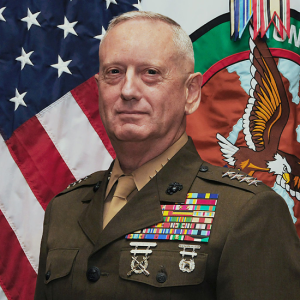
James N. Mattis (born September 8, 1950) is a retired United States Marine Corps generalwho last served as the 11th commander ofUnited States Central Command from August 11, 2010 to March 22, 2013.
Mattis is known for implementing the COINstrategy. Before President Obama appointed him to replace General Petraeus on August 11, 2010, he previously commanded United States Joint Forces Command from November 9, 2007 to August 2010 and served concurrently as NATO's Supreme Allied Commander Transformation from November 9, 2007 to September 8, 2009. Prior to that, he commanded I Marine Expeditionary Force,United States Marine Forces Central Command, and 1st Marine Division during theIraq War.[3]
On December 1, 2016, President-elect Donald Trump announced that Mattis would be nominated to serve as United States Secretary of Defense in the coming administration.[4]
Early life and education
Mattis was born on September 8, 1950 inPullman, Washington.[5] His mother's name is Lucille (Proulx) Mattis.[6] He was raised inRichland, Washington and graduated fromColumbia High School in 1968.[7]
Military career
He initially enlisted in the United States Marine Corps in 1969.[8] He later earned a Bachelor of Arts degree in history from Central Washington University[9] and was commissioned a second lieutenant through theReserve Officers' Training Corps on January 1, 1972.[10] During his service years, Mattis was considered to be an intellectual among the upper ranks, with his personal library numbering more than 7,000 volumes. Major General Robert H. Scales, Retired, Ph.D., described him as "... one of the most urbane and polished men I have known." Reinforcing this intellectual persona was the fact he carried his own personal copy of the Meditationsof Marcus Aurelius throughout his deployments.[11]
As a lieutenant, Mattis served as a rifle and weapons platoon commander in the 3rd Marine Division. As a captain, he was assigned as the Naval Academy Preparatory School's Battalion Officer (composed of Enlisted Midshipman Candidates and its Company Officers and Enlisted Staff), commanded Rifle and Weapons Companies in the 1st Marine Regiment, then Recruiting Station Portland, Oregon, as a major.
Persian Gulf War
Upon promotion to the rank of lieutenant colonel, Mattis commanded 1st Battalion, 7th Marines, which was one of Task Force Ripper's assault battalions during the Persian Gulf War.
Afghanistan War
As a colonel, Mattis commanded the 7th Marine Regiment. He led the 1st Marine Expeditionary Brigade as its commanding officer upon promotion to brigadier general.
During the initial planning for the War in Afghanistan, Mattis led Task Force 58 in operations in the southern part of the country, becoming the first Marine Corps officer to ever command a Naval Task Force in combat.[10]
While serving in Afghanistan as a brigadier general, he was known as an officer who engaged his men with "real leadership". A young Marine officer named Nathaniel Fick cited an example of that leadership when he witnessed Mattis in a fighting hole talking with a sergeant and a lance corporal: "No one would have questioned Mattis if he'd slept eight hours each night in a private room, to be woken each morning by an aide who ironed his uniforms and heated his MREs. But there he was, in the middle of a freezing night, out on the lines with his Marines."[12]
Iraq War
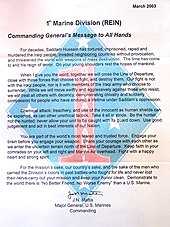
Letter written by Mattis on the eve of the
2003 invasion of Iraq, addressed to members of the 1st Marine Division.
As a major general, Mattis commanded the 1st Marine Divisionduring the 2003 invasion of Iraq and subsequent stability operations during the Iraq War.[13]
Mattis played key roles in combat operations in Fallujah, including negotiation with the insurgent command inside the city during Operation Vigilant Resolve in April 2004, as well as participation in planning of the subsequent Operation Phantom Fury in November. In May 2004, Mattis ordered the 3 a.m. bombing of a suspected enemy safe house near the Syrian border, which later came to be known as the Mukaradeeb wedding party massacre, and which resulted in the locally-reported deaths of 42 civilian men, women and children who were attending a wedding celebration. Mattis stated that it had taken him 30 seconds to deliberate on bombing the location.[14]
Following a U.S. Department of Defense survey that showed only 55% of American soldiers and 40% of U.S. Marines would report a colleague for abusing civilians, Mattis told U.S. Marines in May 2007 that "Whenever you show anger or disgust toward civilians, it's a victory for al-Qaeda and other insurgents." Reflecting an understanding of the need for restraint in war as key to defeating an insurgency, he added that "Every time you wave at an Iraqi civilian, al-Qaeda rolls over in its grave."[15]
Mattis popularized the 1st Marine Division's motto "no better friend, no worse enemy", a paraphrase of the famous self-made epitaph for the Roman dictator Lucius Cornelius Sulla,[16] in his open letter to all men within the division for their return to Iraq. This phrase later became widely publicized during the investigation into the conduct of Lieutenant Ilario Pantano, a platoon commander serving under Mattis.[17][18][19][20][21][22]
As his division prepared to ship out, Mattis called in experts in Arab culture to lead cultural sensitivity classes. He constantly toured the battlefield to tell stories of Marines who were able to show discretion and cultural sensitivity in moments of high pressure.[23] He encouraged his men to grow mustaches to look more like the people they were working with.[23]
He also was noted for a willingness to remove senior leaders under his command at a time when the U.S. military seemed unable or unwilling to relieve under-performing or incompetent officers. During the division's push to Baghdad, Mattis relieved Colonel Joe D. Dowdy, regimental commander of Regimental Combat Team-1, and it was such a rare occurrence in the modern military that it made the front page of newspapers. Despite this, Mattis declined to comment on the matter publicly other than to say that the practice of officer relief remains alive, or at least "We are doing it in the Marines."[12] Later interviews of Dowdy's officers and men revealed that "the colonel was doomed partly by an age-old wartime tension: Men versus mission—in which he favored his men" while Mattis insisted on execution of the mission to seize Baghdad swiftly.[24]
Combat Development Command
After being promoted to lieutenant general, Mattis took command of Marine Corps Combat Development Command. On February 1, 2005, speaking ad libitum at a forum in San Diego, he said "You go into Afghanistan, you got guys who slap women around for five years because they didn't wear a veil. You know, guys like that ain't got no manhood left anyway. So it's a hell of a lot of fun to shoot them. Actually, it's a lot of fun to fight. You know, it's a hell of a hoot. It's fun to shoot some people. I'll be right upfront with you, I like brawling." Mattis's remarks sparked controversy and General Michael Hagee, Commandant of the Marine Corps, issued a statement suggesting that Mattis should have chosen his words more carefully, but would not be disciplined.[25]
U.S. Joint Forces Command

Mattis testifies before the Committee on Armed Services during his confirmation hearing for appointment to Commander.
The Pentagon announced on May 31, 2006 that Lieutenant General Mattis was chosen to take command of I Marine Expeditionary Force, based out of Marine Corps Base Camp Pendleton.[26] On September 11, 2007, Secretary of DefenseRobert Gates announced that President George W. Bush had nominated Mattis for appointment to the rank of general to command U.S. Joint Forces Command in Norfolk, Virginia. NATO agreed to appoint Mattis as Supreme Allied Commander Transformation. On September 28, 2007, the United States Senate confirmed Mattis's nomination, and he relinquished command of I MEF on November 5, 2007 to Lieutenant GeneralSamuel Helland.
Mattis was promoted to four-star general and took control of JFCOM/SACT on November 9, 2007. He transferred the job of SACT to French General Stéphane Abrial on September 9, 2009, but continued in command of JFCOM.[27]
U.S. Central Command
In early 2010, Mattis was reported to be on the list of U.S. Marine generals being considered for selection to replace James T. Conway as the Commandant of the U.S. Marine Corps.[28] In July, he was recommended by Defense Secretary Robert Gates for nomination to replace David Petraeus as commander of United States Central Command,[5][29] and formally nominated by President Barack Obama on July 21.[30]
His confirmation by the Senate Armed Services Committee marked the first time Marines had held billets as commander and deputy commander of a Unified Combatant Command.[31] He took command at a ceremony at MacDill Air Force Base on August 11.[32][33][34]
As head of Central Command, Mattis oversaw the wars in Iraq and Afghanistan and was responsible for a region that includes Syria, Iran, Yemen.[35] The Obama administration did not place much trust in Mattis, because he was perceived to be too eager for a military confrontation with Iran.[36]
He retired from the Marine Corps on May 22, 2013.
Civilian career
Since retirement from the military, Mattis has worked for FWA Consultants and also serves as a Member of the General Dynamics Board of Directors.[37] In August 2013, he became an Annenberg Distinguished Visiting Fellow at the Hoover Institution[38] and has since been named as their Davies Family Distinguished Visiting Fellow.[39]
In mid-2012, a Department of Defense official evaluating Theranos's blood-testing technology for military initiated a formal inquiry with the Food and Drug Administrationabout the company's intent to distribute its tests without FDA clearance. In August 2012, via email, Elizabeth Holmes, the CEO of Theranos asked Mattis, who had expressed interest in testing Theranos's technology in combat areas, to help. Within hours, Mattis forwarded his email exchange with Holmes to military officials, asking "how do we overcome this new obstacle."[40] Since 2013, Mattis has been a board member of Theranos, a controversialSilicon Valley biotech company with criticized corporate governance practices.[41] In a July 2013 letter from the Department of Defense approving his possible employment by Theranos, Mattis was given permission with conditions. He was cautioned to do so only if he did not represent Theranos with regards to the blood testing device and its potential acquisition by the Departments of the Navy or Defense.[40] According to the Wall Street Journal, Theranos is under criminal investigation.[42]
In December 2015, Mattis joined the advisory board[43] of Spirit of America - a 501c3 nonprofit organization that provides assistance to support the safety and success of American troops and the local people they seek to help.
He is co-editor of the book, Warriors & Citizens: American Views of Our Military, published in August 2016.[44]
Secretary of Defense
On November 20, 2016, President-elect Donald Trump said that he was considering Mattis for United States Secretary of Defense. Trump met with Mattis for a little over one hour inBedminster, New Jersey.[45] He later stated on Twitter, "General James "Mad Dog" Mattis, who is being considered for Secretary of Defense, was very impressive yesterday. A true General's General!"[46]
On December 1, 2016, it was announced at a rally in Cincinnati that Mattis would be nominated for Secretary of Defense by President-elect Donald Trump.[47] As Mattis retired from the military in 2013, his nomination will require a waiver of the National Security Act of 1947, which requires a seven-year wait period before retired military personnel can assume the role of Secretary of Defense.[48] Mattis would be the second Secretary of Defense to receive such a waiver, following George Marshall.[48]
Political views
Israeli-Palestinian peace process
efense.gov_photo_essay_111214-D-VO565-001.jpg">

efense.gov_photo_essay_111214-D-VO565-001.jpg">
Mattis talks to General
Martin Dempsey on board a C-17 while flying to Baghdad, December 15, 2011.
Mattis supports a two-state solution model for Israel-Palestinian peace. He says the current situation in Israel is “unsustainable” and argues that the settlements harm prospects for peace and could theoretically lead to an apartheid-like situation in the West Bank.[49] In particular, he believes the lack of a two-state solution is upsetting to the Arab allies of America, which weakens US esteem amongst its Arab allies. Mattis strongly supports John Kerryon the Middle East peace process, praising Kerry for being "wisely focused like a laser-beam" towards a two-state solution.[50]
Iran and Arab allies
Mattis believes that Iran is the principal threat to the stability of the Middle East, ahead of Al-Qaeda and ISIS. Mattis says: "I consider ISIS nothing more than an excuse for Iran to continue its mischief. Iran is not an enemy of ISIS. They have a lot to gain from the turmoil in the region that ISIS creates." On the Iran nuclear deal, although he sees it as a poor agreement, he believes there is now no way to tear it up, saying: "We are just going to have to recognize that we have an imperfect arms control agreement. Second, that what we achieved is a nuclear pause, not a nuclear halt".[51] Mattis argues that the nuclear inspections may fail to prevent Iran from seeking to develop nuclear weapons, but that "[i]f nothing else at least we will have better targeting data if it comes to a fight in the future."[51]Additionally, he criticizes President Barack Obama for being naive about Iranian intentions and Congress for being “pretty much absent” on last year’s nuclear deal.[52] Mattis' views on Iran were speculated to have been the reason he was fired by President Obama.[53]
Mattis praises the friendship of regional US allies such as Jordan and the United Arab Emirates.[54] He has criticized Barack Obama and Donald Trump for their view of seeing allies as 'free-loading', saying: "For a sitting U.S. president to see our allies as freeloaders is nuts."[54] He has cited the importance of the United Arab Emirates and Jordan as countries that wanted to help, for example, in filling in the gaps in Afghanistan.[55] He has criticized current defense strategy as giving “the perception we’re pulling back” from US allies.[55] He stresses the need for the US to bolster its ties with allied intelligence agencies, particularly the intelligence agencies of Jordan, Egypt and Saudi Arabia.[56] In 2012, Mattis argued for providing weapons to Syrian rebels, as a way to fight back against Iranian proxies in Syria.[57]
Russia
Speaking at a conference sponsored by The Heritage Foundation in Washington in 2015 Mattis stated that he believed that Russian President Vladimir Putin's intent is "to break NATO apart."[58] Mattis has also spoken out against (what he believed to be) Russia’s expansionist or bellicose policies in Syria, Ukraine and the Baltic states.[59] Mattis also believes that Donald Trump’s conciliatory statements toward Russia are ill informed.[59]
Personal life
efense.gov_photo_essay_100428-N-0696M-076.jpg">

efense.gov_photo_essay_100428-N-0696M-076.jpg">
Mattis receiving the Distinguished Military Leadership Award from
Michael Mullen at the annual Atlantic Council Awards Gala in Washington, D.C.
Mattis is a graduate of the U.S. Marine Corps Amphibious Warfare School, U.S. Marine Corps Command and Staff College, and the National War College. Mattis is also noted for his intellectualism and interest in the study of military history and world history,[13][23] with a personal library that once included over 7,000 volumes,[1] and a penchant for publishing required reading lists for Marines under his command.[60][61] Mattis is a life-long bachelor,[62] who has never been married and has no children.[1] He is nicknamed "The Warrior Monk" because of his bachelor life, and the fact he devoted his life to studying and fighting war.[63] He is known for the intellectual rigor he puts on his Marines and his belief in risk-management, and in the need for troops under his command to read widely about the cultural norms and history of the area they are sent to, as he himself does. Before deploying to Iraq, Mattis ensured his troops were given courses on Arab culture and cultural sensitivity classes.[23]
Military awards
Mattis's decorations, awards, and badges include:
Civilian awards
Mattis's civilian awards include:
In popular culture
- Mattis's quote "Be polite, be professional, but have a plan to kill everybody you meet." was paid homage in the Meet the Sniper video for Team Fortress 2. The quote became "Be polite, be efficient, have a plan to kill everyone you meet."
https://en.wikipedia.org/wiki/James_Mattis
作者 Niall Ferguson 是著名歷史學者,目前為哈佛大學教授、牛津大學耶穌學院資深研究員、史丹福大學胡佛研究所資深研究員。他的著作包括《帝國:大英世界秩序興衰以及給世界強權的啟示》、《金錢與權力》、《貨幣崛起:金融資本如何改變世界歷史及其未來之路》、《文明:決定人類走向的六大殺手級 Apps》、《西方文明的四個黑盒子》等。
《大西洋》雜誌記者薩琳娜‧齊托寫道:「媒體把川普的話當真,卻不把他當一回事。選民把川普當一回事,卻不把他的話當真。」大概是對 2016 美國大選最好的觀察,值得列入所有的佳言錄裡面。
麥提斯本人說過很多值得收錄成冊的名言佳句。我喜歡他打招呼的方式:「別惹我們。因為如果你這麼做的話,倖存者未來一萬年都會繼續書寫我們今天在這裡所做的事。」或者:「我和平而來,我沒帶任何武器,但我含淚請求你:如果你亂搞,我就把你們全部殺死。」麥提斯不但說到,他會做到。他是 2003 年美軍入侵伊拉克第一海軍陸戰隊的總指揮,他的優異表現為他贏得了實戰大師的名聲。在往巴格達推進的過程中,他因為一位上校的推進速度太慢而解除了他的職務。他在 2007 年與裴卓斯(David Petraeus)將軍合著《反叛亂野戰手冊》(Counterinsurgency Field Manual),也是在伊拉克獲致成功的「大增兵」(surge)策略守則。由於他鍾愛戰鬥,以致於海軍陸戰隊的勇士們給他取了一個又敬又愛暱名:「瘋狗」(Mad Dog)。
我必須向讀者承認,麥提斯跟我都是史丹福大學胡佛研究所的研究員。我很欣賞他,把他當好友。他本人既不瘋狂也不會亂咬人,而是說話輕柔,博學多聞的人。麥提斯不但是令敵人喪膽的戰士,也是思考周慮的策略專家,更是一位類似羅馬皇帝奧里略(Marcus Aurelius)的士兵—學者,後者的《沈思錄》是他帶到伊拉克與阿富汗戰場上閱讀的經典。
所以他現在被川普延攬,理應很受肯定。但是,想得美——美國的媒體受到川普勝選的羞辱,開始想辦法抹黑他,說他的過度期很混亂。好巧不巧,麥提斯的化名之一就是「混亂」(Chaos),這形容他讓敵營產生的狀態。川普目前的組閣名單,並不是在重演《誰是接班人》,而是延攬「多才多藝」的各部門首長。
確實,麥提斯不是個傳統的選擇,這是杜魯門在 1950 年任命馬歇爾將軍以來,第一位入主五角大廈的軍人,其他的國防部長都是平民——反映出美國長期以來執著於「武人必須由文官節制」的信念。川普決定忽視此一傳統,提交要求國會通過豁免將軍退休七年之規定,麥提斯才能出任國防部長一職(譯註:麥提斯於 2013 年退役,尚未滿七年,依美國國家安全法,需要國會同意豁免退役七年的限制)。文官一片震怒。但我認為這是川普當選三週以來最好的決定。
其他的人選也相當不錯。財政部長一職,川普提名史蒂芬‧紐卿(Steven Mnuchin),他在金融界很成功。結果,美國媒體又是一片哀號,抱怨「高盛重入政府」。然而紐卿在十四年前就離開高盛銀行,轉業後做的其他事情都很成功,包括製作電影《阿凡達》、挽救破產的房貸銀行印地麥克、以及川普的選戰等等。交通部長趙小蘭也是個聰明的選擇。
國務卿人選很重要,川普審慎評估當然沒錯。前總統候選人羅姆尼(Mitt Romney)在選戰過程中批評川普,過去又批評俄國,大概無法達成川普的外交目標——跟普丁總統作成一個「絕好的交易」(do a ‘great deal’)。裴卓斯將軍是有名的軍事策略家,但他的洩密事件才過了沒多久,況且再聘任一個將軍可能會讓川普政府看起來像軍事政府。紐約前市長朱里安尼是忠誠的支持者,但參議員鮑伯‧寇爾克(Bob Corker)大概是安全的選擇。
然而麥提斯可能是最重要的人事布局。當然,常常見諸報端搶頭條的是國務卿。但是誠如小布希任內國防部長倫斯斐(Donald Rumsfeld)已經證明,管五角大廈的人不但資源很多,而且可以輕易地把軍事力量化為政治力量。麥提斯的任命有利川普。以下就是我的原因。
作為總統,川普能夠修復美國失靈的外交政策。他跟普丁做成好的交易,不但可以結束敍利亞內戰,解決烏克蘭東部並不太冷的戰爭。如果他跟中國作成好交易,不但會解決美國製造業流失的問題,也可以處理亞太地區容易擦槍走火的議題——北朝鮮、南海、台灣。
要達成上述目標,不只需要季辛吉式的外交手腕,也需要可信的武力作為後援——因為沒有軍事作後盾,美國的盟友與敵人只會佔生意人川普的便宜,就像他們佔法律系教授歐巴馬的便宜一樣。而麥提斯可以在此發揮他的長才。
第二,麥提斯對伊朗是鷹派。有人說就是因為他願意考慮對伊朗動武,才導致歐巴馬把他從美國中央司令部開除,雖然如此,他也無悔。他今年四月在演講時才說:「德黑蘭政權是影響中東和平穩定的最大威脅。」
即使如此,他並不贊成撕毀歐巴馬跟伊朗簽定的限核協定。麥提斯會忠告川普保留協定,只在伊朗違反協定時,才進行軍事反擊。他也認為應該對伊朗的傀儡如真主黨採取更強硬的行動。
最後,麥提斯對於中國亦有想法。他在參議院軍事委員會上作證時曾經表示:「雖然(我們)必須在太平洋與中國維持正面關係,但也必須建立制衡的系統,以避免中國繼續在南海與其他地方遂行霸凌行動。」
羅斯福總統的原則是「溫言在口,大棒在手」。在歐巴馬任內,美國講話大聲,卻只拿著一根下垂的枝條。這一切都要改變了。麥提斯溫言在口,不像川普。他手上拿的棒子確實很尖。他講的話我們都必須認真看待。






.png)


