Former Cuban President Fidel Castro has died at age 90
Sven Creutzmann | Mambo Photo | Getty Images
Fidel Castro observes the May Day parade at the Revolution Square in Havana, Cuba May 1, 1998.
Former President Fidel Castro, who led a rebel army to improbable victory in Cuba, embraced Soviet-style communism and defied the power of 10 U.S. presidents during his half century rule, has died at age 90.
With a shaking voice, his younger brother, Raul Castro, announced on state television that his brother died at 10:29 p.m. on Friday night.
Castro's reign over the island-nation 90 miles from Florida was marked by the U.S.-backed Bay of Pigs invasion in 1961 and the Cuban Missile Crisis a year later that brought the world to the brink of nuclear war. The bearded revolutionary, who survived a crippling U.S. trade embargo as well as dozens, possibly hundreds, of assassination plots, died eight years after ill health forced him to formally hand power over to Raul.
Castro overcame imprisonment at the hands of dictator Fulgencio Batista, exile in Mexico and a disastrous start to his rebellion before triumphantly riding into Havana in January 1959 to become, at age 32, the youngest leader in Latin America. For decades, he served as an inspiration and source of support to revolutionaries from Latin America to Africa.
1953年7月26日,卡斯楚領導發動反對弗爾亨西奧·巴蒂斯塔·薩爾迪瓦右翼獨裁政權的武裝起義,攻打蒙卡達兵營,失敗後被捕,在法庭上發表了著名的自我辯護詞《歷史將宣判我無罪》(La historia me absolverá)。1955年,古巴總統巴蒂斯塔宣布國內大赦後,他流亡美國、墨西哥,在墨西哥期間創建「七·二六運動」。卡斯楚1956年回到古巴,在馬埃斯特臘山區創建起義軍和根據地。
This articleis abouta person who has recently died. Some information, such as the circumstances of the person's death and surrounding events, may change as more facts become known. Initial news reports may beunreliable. Thelast updatesto this articlemay not reflectthe most current information.
Born inBiránas the son of a wealthy farmer, Castro adoptedleftistanti-imperialistpolitics while studying law at theUniversity of Havana. After participating in rebellions againstright-winggovernments in the Dominican Republic and Colombia, he planned the overthrow of Cuban PresidentFulgencio Batista, launching a failed attack on theMoncada Barracksin 1953. After a year's imprisonment, he traveled to Mexico where he formed a revolutionary group, the26th of July Movement, with his brotherRaúl CastroandChe Guevara. Returning to Cuba, Castro took a key role in theCuban Revolutionby leading the Movement in aguerrilla waragainst Batista's forces from theSierra Maestra. After Batista's overthrow in 1959, Castro assumed military and political power as Cuba's Prime Minister. The United States was alarmed by Castro's friendly relations with theSoviet Union, and unsuccessfully attempted to remove him byassassination,economic blockade, and counter-revolution, including theBay of Pigs invasionof 1961. Countering these threats, Castro formed an alliance with the Soviets and allowed them to place nuclear weapons on the island, sparking theCuban Missile Crisis—a defining incident of theCold War—in 1962.
Castro was a controversial and divisive world figure. He was decorated withvarious international awards, and his supporters laud him as a champion of socialism, anti-imperialism, andhumanitarianism, whose revolutionary regime secured Cuba's independence fromAmerican imperialism. Conversely, critics view him as atotalitariandictatorwhose administration oversawmultiple human-rights abuses, anexodus of more than one million Cubans, and the impoverishment of the country's economy. Through his actions and his writings, he significantly influenced the politics of various individuals and groups across the world.
美國一直不滿卡斯楚的共產政權。1961年4月17日,美國中情局特工與不滿卡斯楚政權的古巴流亡者武裝突擊登陸古巴西南岸豬玀灣(Bay of Pigs),希望一舉拉下卡斯楚,結果3天內大敗全滅。在憂慮美國侵略下,卡斯楚積極向蘇聯爭取部署可搭載核彈的中程彈道飛彈。1962年10月美軍偵察機拍攝到在古巴部署的彈道飛彈,美國發動海空封鎖,與運飛彈前往古巴的蘇聯船艦爆發衝突,差點引發第三次世界大戰。最後在美國甘迺迪總統與蘇聯領導人赫魯雪夫秘密磋商下才解除危機。

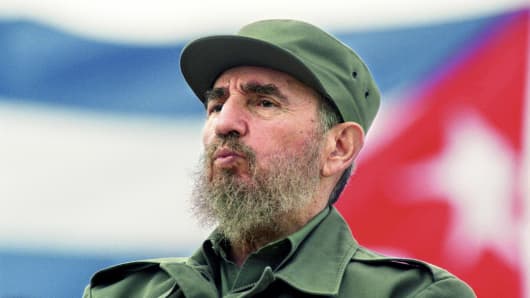


 圖片附件: 卡斯楚.JPG (2016-11-27 09:50, 70.72 KB) / 下載次數 613


