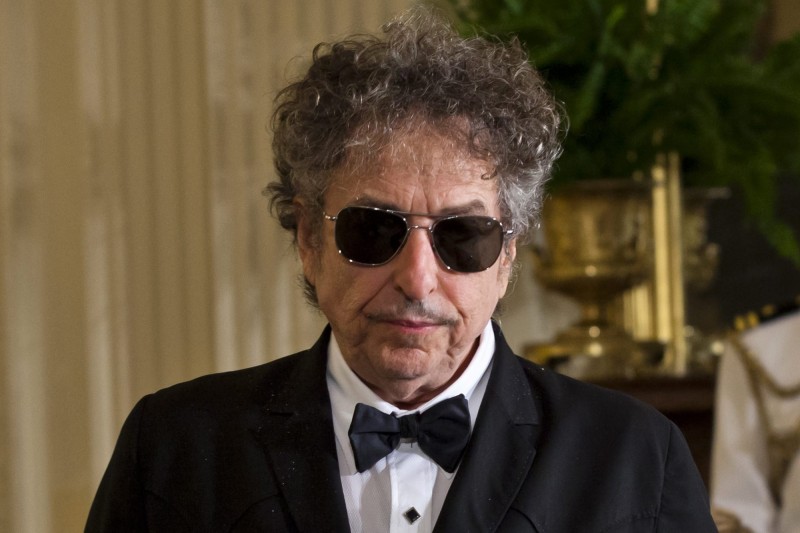
巴布·狄倫(英語:Bob Dylan,1941年5月24日-),原名勞勃·艾倫·齊默曼(Robert Allen Zimmerman),美國唱作人、藝術家和作家。從1961年發布首張專輯至今,狄倫在流行音樂界和文化界起到的影響已超過50年。他的大多數著名作品都來自1960年代的反抗民謠,也被廣泛認為是當時美國新興的反叛文化的代言人,儘管他否認了這一點。他的部分早期作品成為了當時美國民權反戰運動的聖歌,例如《答案在風中飄》(Blowin' in the Wind)和《時代在變》(The Times They Are a-Changing)。1960年代中期狄倫開始從原先的抗議民謠風格轉型,並在1965年發行單曲《像一塊滾石》(Like a Rolling Stone),也從此改變了流行音樂的傳統分類。在一些搖滾音樂人的幫助下,狄倫60年代中期的一些作品登上了《告示牌》榜單冠軍,但同時也受到了來自民權運動者的指責和批評。
在1961年的一次從明尼阿波利斯到芝加哥的途中,狄倫改變主意,前往紐約,去探望自己的音樂偶像、當時已患亨廷頓氏舞蹈癥的伍迪·格思里,並在其面前演出。在一些紐約格林威治村的小俱樂部中的演出中,他逐漸脫穎而出,獲得了以Robert Shelton為首的樂評人的好評,並為哥倫比亞唱片公司的傳奇星探約翰·哈蒙德所注意,於當年10月與該公司簽訂了第一份唱片合約,為期五年,並於1962年推出了名為《巴布·狄倫》的處女專輯。這張專輯裡,只有《Song To Woody》與《Talking New York》是狄倫自己的創作,其餘都是他在格林威治村民謠圈子裡向其他歌手學來的歌曲。
他於1963年發行第二張專輯《自由馳騁的巴布·狄倫》(The Freewheelin' Bob Dylan),專輯中十三首歌都是狄倫自己的創作,並因其受到伍迪·格思里而影響,以演唱抗議歌曲而出名,他這個時期最有代表性的歌曲之一,即《答案在風中飄》(Blowing in The Wind),在其後的反戰和民權運動中被反覆傳唱,而很多人也是透過在電影《阿甘正傳》中瓊·貝茲對這首歌的翻唱而認識狄倫。
狄倫許多早期的歌曲,都是因為別人的翻唱才廣為人知,例如被人們稱為民謠女皇的瓊·貝茲與彼得、保羅和瑪麗(eter, Paul and Mary" href="https://en.wikipedia.org/wiki/Peter,_Paul_and_Mary">Peter, Paul and Mary),不僅翻唱過狄倫的歌曲,更是狄倫的重要支持者和朋友。瓊·貝茲與狄倫彼此相知相惜,遂產生一段秘密戀情,兩人開始交往。
自1963年起,瓊·貝茲邀請狄倫與她一起巡迴演出;1963年8月28日,兩人曾於著名的「進軍華盛頓」這場大規模的民權運動遊行中,演唱《Only A Pawn In Their Game》與《Keep Your Eyes On The Prize》這兩首歌曲[3]。正是在這次大遊行中,馬丁·路德·金發表了他著名的《我有一個夢》的演講。在這個過程中,狄倫逐漸成為人們心目中民權運動的代言人,但是他本人卻對此開始反感起來。1963年底,在甘迺迪總統被刺殺不久之後,他前往接受國家緊急民權委員會的一個頒獎儀式,他帶著酒氣,質疑了委員會的作用。在此之後,他逐漸遠離民權運動和抗議歌曲。
他曾經於1963年和1964年,兩次在新港民謠音樂節(Newport Folk Festival)上演出。六零年代的民謠音樂界,對於搖滾樂的出現與盛行普遍感到不滿,狄倫卻在1965年7月25日,於當年的民謠音樂節中,第一次在舞台表演中使用電吉他,在觀眾的掌聲和噓聲中,他僅僅演唱了三首「插了電(Plugged)」的歌曲,隨即被憤怒的聽眾趕下台,這被認為是其從民謠轉向搖滾樂的轉折點。關於為什麼狄倫要在1965年的表演中使用電吉他,從而讓許多他原來的民謠聽眾認為他是一個叛徒,一直有著多種不同的解釋。但是,這次表演也被認為是民謠歷史上的一個重要時刻,因為它代表著即使是對狄倫這樣的繼承傳統的音樂家來說,民謠再也無法再滿足狄倫的需求了。
1965年狄倫發行了自己的第一張搖滾專輯《重訪六十一號公路》(Highway 61 Revisited),其中的一曲《像一塊滾石》(Like a Rolling Stone)迅速登上美國排行榜第二名、英國排行榜第四名,後來並被Rolling Stone雜誌列為史上最偉大的歌曲。在專輯出版之後,狄倫開始在美國國內巡演,在這個過程中,仍然有歌迷要求他放棄搖滾樂,改回到民謠的原聲吉他中。
進入90年代,狄倫出版唱片的速度開始變得緩慢,其中在1992年的As I Been to You、和1993年的World Gone Wrong中,他重新拾起早期的民謠,翻唱許多並不廣為人知的歌曲。1992年10月16日,在麥迪遜花園廣場,舉辦了一場紀念狄倫踏入歌壇三十年的演唱會,其中包括尼爾·楊(Neil Young)、埃裡克·克萊普頓(Eric Clapton)、前披頭四吉他手喬治·哈里森(George Harrison)等人均到場表演[5]。1995年,狄倫在MTV音樂台錄製不插電演唱會;1997年初,由於突然心臟病發作,當年的歐洲巡迴被迫取消,但他很快就康復出院,甚至還於當年9月27日,在教宗若望保祿二世面前表演[6]。1997年9月30日,狄倫發行了由Daniel Lanois製作的Time out of Mind,距離他上一張原創專輯Oh Mercy有八年之久。
2001年9月11日,狄倫發行Love and Theft;2004年10月,他出版了名為Chronicles, Vol. 1,的自傳,作為計畫中三部分的自傳的第一部,記述了他的童年生活、在紐約奮鬥的經過、中年陷入創作低潮的心情…等。推出之後,該書停留紐約時報書籍非小說類排行榜長達19周。該書中文簡體版已由江蘇人民出版社和鳳凰出版傳媒集團共同出版,譯名為《像一塊滾石》;繁體中文版亦已由大塊文化出版股份有限公司出版,譯名為《搖滾記》。
Bob Dylan(/ˈdɪlən/; bornRobert Allen Zimmerman, May 24, 1941) is an American songwriter, singer, artist, and writer. He has been influential in popular music and culture for more than five decades. Much of his most celebrated work dates from the 1960s when his songs chronicled social unrest, although Dylan repudiated suggestions from journalists that he was a spokesman for his generation. Nevertheless, early songs such as "Blowin' in the Wind" and "The Times They Are a-Changin'" became anthems for the Americancivil rightsandanti-warmovements. Leaving behind his initial base in theAmerican folk music revival, his six-minute single "Like a Rolling Stone", recorded in 1965, enlarged the range of popular music. Dylan's mid-1960s recordings, backed by rock musicians, reached the top end of theUnited States music chartsbut were critcized by others in the folk movement for using electic instruments.
Dylan's lyrics incorporate a wide range of political, social, philosophical, and literary influences. They defied existing pop music conventions and appealed to the burgeoningcounterculture. Initially inspired by the performances ofLittle Richardand the songwriting ofWoody Guthrie,Robert Johnson, andHank Williams, Dylan has amplified and personalized musicalgenres. His recording career, spanning more than 50 years, has explored the traditions in American song—fromfolk,blues, andcountrytogospel,rock and roll, androckabillytoEnglish,Scottish, andIrish folk music, embracing evenjazzand theGreat American Songbook. Dylan performs with guitar, keyboards, and harmonica. Backed by a changing lineup of musicians, he has toured steadily since the late 1980s on what has been dubbed theNever Ending Tour. His accomplishments as a recording artist and performer have been central to his career, but songwriting is considered his greatest contribution.
Bob Dylan was born Robert Allen Zimmerman (Hebrewnameשבתאי זיסל בן אברהם[Shabtai Zisl ben Avraham])[3][4]in St Mary's Hospital on May 24, 1941, inDuluth, Minnesota,[5][6]and raised inHibbing, Minnesota, on theMesabi Rangewest ofLake Superior. He has a younger brother, David. Dylan's paternal grandparents, Zigman and Anna Zimmerman, emigrated fromOdessa, in theRussian Empire(now Ukraine), to the United States following the anti-Semiticpogroms of 1905.[7]His maternal grandparents, Ben and Florence Stone, wereLithuanian Jewswho arrived in the United States in 1902.[7]In his autobiography,Chronicles: Volume One, Dylan wrote that his paternal grandmother's maiden name was Kirghiz and her family originated fromKağızmandistrict ofKars Provincein northeastern Turkey.[8]
Dylan's parents, Abram Zimmerman and Beatrice "Beatty" Stone, were part of a small, close-knit Jewish community. They lived in Duluth until Robert was six, when his father hadpolioand the family returned to his mother's hometown, Hibbing, where they lived for the rest of Robert's childhood. In his early years he listened to the radio—first tobluesandcountry stationsfromShreveport, Louisianaand later, when he was a teenager, to rock and roll.[9]He formed several bands while attendingHibbing High School. In the Golden Chords, he performedcoversof songs byLittle Richard[10]andElvis Presley.[11]Their performance ofDanny & the Juniors' "Rock and Roll Is Here to Stay" at their high school talent show was so loud that the principal cut the microphone.[12]In 1959, his high school yearbook carried the caption "Robert Zimmerman: to join 'Little Richard'."[10][13]The same year, as Elston Gunnn [sic], he performed two dates withBobby Vee, playing piano and clapping.[14][15][16]
The thing about rock'n'roll is that for me anyway it wasn't enough... There were great catch-phrases and driving pulse rhythms... but the songs weren't serious or didn't reflect life in a realistic way. I knew that when I got into folk music, it was more of a serious type of thing. The songs are filled with more despair, more sadness, more triumph, more faith in the supernatural, much deeper feelings.[17]
He began to perform at the Ten O'Clock Scholar, a coffeehouse a few blocks from campus, and became involved in theDinkytownfolk musiccircuit.[18][19]
During his Dinkytown days, Zimmerman began introducing himself as "Bob Dylan".[20][a 1]In his memoir, Dylan acknowledged that he had been influenced by the poetry ofDylan Thomas.[21]Explaining his change of name in a 2004 interview, Dylan remarked, "You're born, you know, the wrong names, wrong parents. I mean, that happens. You call yourself what you want to call yourself. This is the land of the free."[22]
1960s
Relocation to New York and record deal
In May 1960, Dylan dropped out of college at the end of his first year. In January 1961, he traveled to New York City, to perform there and visit his musical idolWoody Guthrie,[23]who was seriously ill withHuntington's diseaseinGreystone Park Psychiatric Hospital.[24]Guthrie had been a revelation to Dylan and influenced his early performances. Describing Guthrie's impact, he wrote: "The songs themselves had the infinite sweep of humanity in them... [He] was the true voice of the American spirit. I said to myself I was going to be Guthrie's greatest disciple."[25]As well as visiting Guthrie in hospital, Dylan befriended Guthrie's acolyteRamblin' Jack Elliott. Much of Guthrie's repertoire was channeled through Elliott, and Dylan paid tribute to Elliott inChronicles: Volume One.[26]
From February 1961, Dylan played at clubs aroundGreenwich Village. He befriended and picked up material from folk singers there, includingDave Van Ronk,Fred Neil,Odetta, theNew Lost City Ramblers, and Irish musiciansthe Clancy Brothers and Tommy Makem.[27]In September, Dylan gained public recognition whenRobert Sheltonwrote a review inThe New York Timesof a show atGerde's Folk City.[28]The same month Dylan played harmonica on folk singerCarolyn Hester's third album, which brought his talents to the attention of the album's producer,John Hammond.[29]Hammond signed Dylan toColumbia Recordsin October. The performances on his first Columbia album—Bob Dylan—in March 1962,[30]consisted of familiar folk, blues andgospelwith two original compositions. The album sold only 5,000 in its first year, just enough to break even.[31]Within Columbia Records, some referred to the singer as "Hammond's Folly"[32]and suggested dropping his contract, but Hammond defended Dylan and was supported byJohnny Cash.[31]In March 1962, Dylan contributed harmonica and back-up vocals to the albumThree Kings and the Queen, accompanyingVictoria SpiveyandBig Joe Williamson a recording forSpivey Records.[33]While working for Columbia, Dylan recorded under the pseudonym Blind Boy Grunt,[34]forBroadside, a folk magazine and record label.[35]Dylan used the pseudonym Bob Landy to record as a piano player onThe Blues Project, a 1964 anthology album byElektra Records.[34]As Tedham Porterhouse, Dylan played harmonica onRamblin' Jack Elliott's1964 album,Jack Elliott.[34]
"Blowin' in the Wind" was, according to critic Andy Gill, "the song with which Dylan's name is most inextricably linked, and safeguarded his reputation as acivil libertarianthrough any number of changes in style and attitude".[36]
Dylan made two important career moves in August 1962: he legally changed his name to Robert Dylan,[37]and he signed a management contract withAlbert Grossman.[38](In June 1961, Dylan had signed an agreement with Roy Silver. In 1962, Grossman paid Silver $10,000 to become sole manager.)[39]Grossman remained Dylan's manager until 1970, and was notable for his sometimes confrontational personality and for protective loyalty.[40]Dylan said, "He was kind of like aColonel Tom Parkerfigure ... you could smell him coming."[19]Tensions between Grossman andJohn Hammondled to Hammond's being replaced as producer of Dylan's second album by the young African-American jazz producer,Tom Wilson.[41]
Dylan made his first trip to the United Kingdom from December 1962 to January 1963.[42]He had been invited by TV directorPhilip Savilleto appear in a drama,Madhouse on Castle Street, which Saville was directing forBBC Television.[43]At the end of the play, Dylan performed "Blowin' in the Wind", one of its first public performances.[43]The film recording ofMadhouse on Castle Streetwasdestroyedby the BBC in 1968.[43]While in London, Dylan performed at London folk clubs, includingthe Troubadour,Les Cousins, andBunjies.[42]He also learned material from UK performers, includingMartin Carthy.[43]
By the time of Dylan's second album,The Freewheelin' Bob Dylan, in May 1963, he had begun to make his name as a singer and a songwriter. Many songs on this album were labeledprotest songs, inspired partly by Guthrie and influenced byPete Seeger's passion for topical songs.[44]"Oxford Town", for example, was an account ofJames Meredith's ordeal as the first black student to risk enrollment at theUniversity of Mississippi.[45]
The first song on theFreewheelin'album, "Blowin' in the Wind", partly derived its melody from the traditionalslavesong, "No More Auction Block",[46]while its lyrics questioned the social and political status quo. The song was widely recorded by other artists and became a hit forPeter, Paul and Mary.[47]AnotherFreewheelin'song, "A Hard Rain's a-Gonna Fall" was based on the folk ballad "Lord Randall". With veiled references to an impending apocalypse, the song gained more resonance when theCuban Missile Crisisdeveloped a few weeks after Dylan began performing it.[48][a 2]Like "Blowin' in the Wind", "A Hard Rain's a-Gonna Fall" marked a new direction in songwriting, blending astream-of-consciousness,imagistlyrical attack with traditional folk form.[49]
Dylan's topical songs enhanced his early reputation, and he came to be seen as more than just a songwriter.Janet Maslinwrote ofFreewheelin': "These were the songs that established [Dylan] as the voice of his generation—someone who implicitly understood how concerned young Americans felt aboutnuclear disarmamentand the growing movement forcivil rights: his mixture of moral authority and nonconformity was perhaps the most timely of his attributes."[50][a 3]Freewheelin'also included love songs and surreal talking blues. Humor was an important part of Dylan's persona,[51]and the range of material on the album impressed listeners, includingThe Beatles.George Harrisonsaid of the album, "We just played it, just wore it out. The content of the song lyrics and just the attitude—it was incredibly original and wonderful."[52]
The rough edge of Dylan's singing was unsettling to some but an attraction to others.Joyce Carol Oateswrote: "When we first heard this raw, very young, and seemingly untrained voice, frankly nasal, as if sandpaper could sing, the effect was dramatic and electrifying."[53]Many early songs reached the public through more palatable versions by other performers, such asJoan Baez, who became Dylan's advocate as well as his lover.[54]Baez was influential in bringing Dylan to prominence by recording several of his early songs and inviting him on stage during her concerts.[55]
"Mixed-Up Confusion", recorded during theFreewheelin'sessions with a backing band, was released as a single and then quickly withdrawn. In contrast to the mostly solo acoustic performances on the album, the single showed a willingness to experiment with arockabillysound.Cameron Crowedescribed it as "a fascinating look at a folk artist with his mind wandering towardsElvis PresleyandSun Records."[57]
Protest andAnother Side
In May 1963, Dylan's political profile rose when he walked out ofThe Ed Sullivan Show. During rehearsals, Dylan had been told byCBStelevision's head of program practices that "Talkin' John Birch Paranoid Blues" was potentially libelous to theJohn Birch Society. Rather than comply with censorship, Dylan refused to appear.[58]
Dylan said of "The Times They Are a-Changin'": "This was definitely a song with a purpose. I wanted to write a big song, some kind of theme song, with short concise verses that piled up on each other in a hypnotic way. The civil rights movement and the folk music movement were pretty close and allied together at that time."[17]
By this time, Dylan and Baez were prominent in thecivil rights movement, singing together at theMarch on Washingtonon August 28, 1963.[59]Dylan's third album,The Times They Are a-Changin', reflected a more politicized and cynical Dylan.[60]The songs often took as their subject matter contemporary stories, with "Only A Pawn In Their Game" addressing the murder of civil rights workerMedgar Evers; and theBrechtian"The Lonesome Death of Hattie Carroll" the death of black hotel barmaid Hattie Carroll, at the hands of young white socialite William Zantzinger.[61]On a more general theme, "Ballad of Hollis Brown" and "North Country Blues" addressed despair engendered by the breakdown of farming and mining communities. This political material was accompanied by two personal love songs, "Boots of Spanish Leather" and "One Too Many Mornings".[62]
By the end of 1963, Dylan felt both manipulated and constrained by the folk and protest movements.[63]Accepting the "Tom PaineAward" from theNational Emergency Civil Liberties Committeeshortly after the assassination ofJohn F. Kennedy, an intoxicated Dylan questioned the role of the committee, characterized the members as old and balding, and claimed to see something of himself and of every man in Kennedy's assassin,Lee Harvey Oswald.[64]
BobbyDylan, as the college yearbook lists him:St. Lawrence University, upstate New York, November 1963
Another Side of Bob Dylan, recorded on a single evening in June 1964,[65]had a lighter mood. The humorous Dylan reemerged on "I Shall Be Free No. 10" and "Motorpsycho Nightmare". "Spanish Harlem Incident" and "To Ramona" are passionate love songs, while "Black Crow Blues" and "I Don't Believe You (She Acts Like We Never Have Met)" suggest the rock and roll soon to dominate Dylan's music. "It Ain't Me Babe", on the surface a song about spurned love, has been described as a rejection of the role of political spokesman thrust upon him.[66]His newest direction was signaled by two lengthy songs: theimpressionistic"Chimes of Freedom", which setssocial commentaryagainst a metaphorical landscape in a style characterized byAllen Ginsbergas "chains of flashing images,"[67]and "My Back Pages", which attacks the simplistic and arch seriousness of his own earlier topical songs and seems to predict the backlash he was about to encounter from his former champions as he took a new direction.[68]
In the latter half of 1964 and 1965, Dylan moved from folk songwriter tofolk-rockpop-music star. His jeans and work shirts were replaced by aCarnaby Streetwardrobe, sunglasses day or night, and pointed "Beatle boots". A London reporter wrote: "Hair that would set the teeth of a comb on edge. A loud shirt that would dim the neon lights ofLeicester Square. He looks like an undernourishedcockatoo."[69]Dylan began to spar with interviewers. Appearing on theLes Cranetelevision show and asked about a movie he planned, he told Crane it would be a cowboy horror movie. Asked if he played the cowboy, Dylan replied, "No, I play my mother."[70]
Bob Dylan making an impromptu guest appearance withthe ByrdsatCiro'snightclub, March 26, 1965
Dylan's late March 1965 albumBringing It All Back Homewas another leap,[71]featuring his first recordings with electric instruments. The first single, "Subterranean Homesick Blues", owed much toChuck Berry's "Too Much Monkey Business";[72]its free association lyrics described as harkening back to the energy ofbeat poetryand as a forerunner ofrapandhip-hop.[73]The song was provided with an early video, which openedD. A. Pennebaker'scinéma véritépresentation of Dylan's 1965 tour of Great Britain,Dont Look Back.[74]Instead of miming, Dylan illustrated the lyrics by throwing cue cards containing key words from the song on the ground. Pennebaker said the sequence was Dylan's idea, and it has been imitated in music videos and advertisements.[75]
The second side ofBringing It All Back Homecontained four long songs on which Dylan accompanied himself on acoustic guitar and harmonica.[76]"Mr. Tambourine Man" became one of his best known songs when The Byrds recorded an electric version that reached number one in the US and UK .[77][78]"It's All Over Now, Baby Blue" and "It's Alright Ma (I'm Only Bleeding)" were two of Dylan's most important compositions.[76][79]
In 1965, heading theNewport Folk Festival, Dylan performed his first electric set since high school with apickup groupmostly from thePaul Butterfield Blues Band, featuringMike Bloomfield(guitar),Sam Lay(drums) and Jerome Arnold (bass), plusAl Kooper(organ) andBarry Goldberg(piano).[80]Dylan had appeared at Newport in 1963 and 1964, but in 1965 met with cheering and booing and left the stage after three songs. One version has it that the boos were from folk fans whom Dylan had alienated by appearing, unexpectedly, with an electric guitar.Murray Lerner, who filmed the performance, said: "I absolutely think that they were booing Dylan going electric."[81]An alternative account claims audience members were upset by poor sound and a short set. This account is supported by Kooper and one of the directors of the festival, who reports his recording proves the only boos were in reaction to the MC's announcement that there was only enough time for a short set.[82][83]
Nevertheless, Dylan's performance provoked a hostile response from the folk music establishment.[84][85]In the September issue ofSing Out!,Ewan MacCollwrote: "Our traditional songs and ballads are the creations of extraordinarily talented artists working inside disciplines formulated over time ...'But what of Bobby Dylan?' scream the outraged teenagers ... Only a completely non-critical audience, nourished on the watery pap of pop music, could have fallen for such tenth-rate drivel."[86]On July 29, four days after Newport, Dylan was back in the studio in New York, recording "Positively 4th Street". The lyrics contained images of vengeance and paranoia,[87]and it has been interpreted as Dylan's put-down of former friends from the folk community—friends he had known in clubs alongWest 4th Street.[88]
Dylan's 1965 hit single, which appeared on the albumHighway 61 Revisited. In 2004, it was chosen as the greatest song of all time byRolling Stonemagazine.[89]
In July 1965, the single "Like a Rolling Stone" peaked at two in the U.S. and at four in the UK charts. At over six minutes, the song altered what a pop single could convey.Bruce Springsteen, in his speech for Dylan's inauguration into theRock and Roll Hall of Fame, said that on first hearing the single, "that snare shot sounded like somebody'd kicked open the door to your mind".[90]In 2004 and in 2011,Rolling Stonelisted it as number one of "The 500 Greatest Songs of All Time".[89][91]The song opened Dylan's next album,Highway 61 Revisited, named after the road that led from Dylan's Minnesota to the musical hotbed ofNew Orleans.[92]The songs were in the same vein as the hit single, flavored byMike Bloomfield's blues guitar andAl Kooper's organ riffs. "Desolation Row", backed by acoustic guitar and understated bass,[93]offers the sole exception, with Dylan alluding to figures in Western culture in a song described by Andy Gill as "an 11-minute epic of entropy, which takes the form of aFellini-esqueparade of grotesques and oddities featuring a huge cast of celebrated characters, some historical (Einstein,Nero), some biblical (Noah, Cain and Abel), some fictional (Ophelia, Romeo, Cinderella), some literary (T.S. EliotandEzra Pound), and some who fit into none of the above categories, notably Dr. Filth and his dubious nurse."[94]
In support of the album, Dylan was booked for two U.S. concerts with Al Kooper andHarvey Brooksfrom his studio crew andRobbie RobertsonandLevon Helm, former members ofRonnie Hawkins's backing bandthe Hawks.[95]On August 28 at Forest Hills Tennis Stadium, the group was heckled by an audience still annoyed by Dylan's electric sound. The band's reception on September 3 at theHollywood Bowlwas more favorable.[96]
From September 24, 1965, in Austin, Texas, Dylan toured the U.S. and Canada for six months, backed by the five musicians from the Hawks who became known asthe Band.[97]While Dylan and the Hawks met increasingly receptive audiences, their studio efforts floundered. ProducerBob Johnstonpersuaded Dylan to record inNashvillein February 1966, and surrounded him with top-notch session men. At Dylan's insistence, Robertson and Kooper came from New York City to play on the sessions.[98]The Nashville sessions produced the double albumBlonde on Blonde(1966), featuring what Dylan called "that thin wild mercury sound".[99]Kooper described it as "taking two cultures and smashing them together with a huge explosion": the musical world of Nashville and the world of the "quintessential New York hipster" Bob Dylan.[100]
On November 22, 1965, Dylan secretly married 25-year-old former modelSara Lownds.[101]Some of Dylan's friends, including Ramblin' Jack Elliott, say that, immediately after the event, Dylan denied he was married.[101]JournalistNora Ephronmade the news public in theNew York Postin February 1966 with the headline "Hush! Bob Dylan is wed."[102]
Dylan toured Australia and Europe in April and May 1966. Each show was split in two. Dylan performed solo during the first half, accompanying himself onacoustic guitarand harmonica. In the second, backed bythe Hawks, he played electrically amplified music. This contrast provoked many fans, who jeered andslow handclapped.[103]The tour culminated in a raucous confrontation between Dylan and his audience at the ManchesterFree Trade Hallin England on May 17, 1966.[104]A recording of this concert was released in 1998:The Bootleg Series Vol. 4: Bob Dylan Live 1966. At the climax of the evening, a member of the audience, angered by Dylan's electric backing, shouted: "Judas!" to which Dylan responded, "I don't believe you ... You're a liar!" Dylan turned to his band and said, "Play it fucking loud!"[105]as they launched into the final song of the night—"Like a Rolling Stone".
During his 1966 tour, Dylan was described as exhausted and acting "as if on a death trip".[106]D. A. Pennebaker, the film maker accompanying the tour, described Dylan as "taking a lot of amphetamine and who-knows-what-else."[107]In a 1969 interview withJann Wenner, Dylan said, "I was on the road for almost five years. It wore me down. I was on drugs, a lot of things ... just to keep going, you know?"[108]In 2011,BBC Radio 4reported that, in an interview that Robert Shelton taped in 1966, Dylan said he had kicked heroin in New York City: "I got very, very strung out for a while ... I had about a $25-a-day habit and I kicked it."[109]Some journalists questioned the validity of this confession, pointing out that Dylan had "been telling journalists wild lies about his past since the earliest days of his career."[110][111]
Motorcycle accident and reclusion
After his tour, Dylan returned to New York, but the pressures increased.ABC Televisionhad paid an advance for a TV show.[112]His publisher,Macmillan, was demanding a manuscript of the poem/novelTarantula.ManagerAlbert Grossmanhad scheduled a concert tour for the latter part of the year.
On July 29, 1966, Dylan crashed his 500ccTriumph Tiger 100motorcycle near his home inWoodstock, New Yorkand was thrown to the ground. Though the extent of his injuries was never disclosed, Dylan said that he broke severalvertebraein his neck.[113]Mystery still surrounds the circumstances of the accident since no ambulance was called to the scene and Dylan was not hospitalized.[113][114]Dylan's biographers have written that the crash offered Dylan the chance to escape the pressures around him.[113][115]Dylan confirmed this interpretation in his autobiography: "I had been in a motorcycle accident and I'd been hurt, but I recovered. Truth was that I wanted to get out of the rat race."[116]Dylan withdrew from public and, apart from a few appearances, did not tour again for almost eight years.[117]
Once Dylan was well enough to resume creative work, he began to editD. A. Pennebaker's film of his 1966 tour. A rough cut was shown to ABC Television and rejected as incomprehensible to a mainstream audience.[118]The film was subsequently titledEat the Documenton bootleg copies, and it has been screened at a handful of film festivals.[119][120]In 1967 he began recording with the Hawks at his home and in the basement of the Hawks' nearby house, "Big Pink".[121]These songs, initially demos for other artists to record, provided hits forJulie Driscollandthe Brian Auger Trinity("This Wheel's on Fire"),The Byrds("You Ain't Goin' Nowhere", "Nothing Was Delivered"), andManfred Mann("Mighty Quinn"). Columbia released selections in 1975 asThe Basement Tapes. Over the years, more songs recorded by Dylan and his band in 1967 appeared onbootleg recordings, culminating in a five-CD set titledThe Genuine Basement Tapes, containing107 songs and alternative takes.[122]In the coming months, the Hawks recorded the albumMusic from Big Pinkusing songs they worked on in their basement in Woodstock, and renamed themselvesthe Band,[123]beginning a long recording and performing career of their own.
In October and November 1967, Dylan returned toNashville.[124]Back in the studio after 19 months, he was accompanied byCharlie McCoyon bass,[124]Kenny Buttreyon drums,[124]andPete Drakeon steel guitar.[124]The result wasJohn Wesley Harding, a contemplative record of shorter songs, set in a landscape that drew on theAmerican Westand the Bible. The sparse structure and instrumentation, with lyrics that took theJudeo-Christiantradition seriously, departed from Dylan's own work and from the psychedelic fervor of the 1960s.[125]It included "All Along the Watchtower", with lyrics derived from theBook of Isaiah(21:5–9). The song was later recorded byJimi Hendrix, whose version Dylan acknowledged as definitive.[17]Woody Guthrie died on October 3, 1967, and Dylan made his first live appearance in twenty months at a Guthrie memorial concert held atCarnegie Hallon January 20, 1968, where he was backed by the Band.[126]
ay Lady Lay.ogg" href="https://en.wikipedia.org/wiki/Fileay_Lady_Lay.ogg">"Lay Lady Lay"
Dylan's next release,Nashville Skyline(1969), was mainstream country featuring Nashville musicians, a mellow-voiced Dylan, a duet withJohnny Cash, and the hit single "Lay Lady Lay".[128]Varietywrote, "Dylan is definitely doing something that can be called singing. Somehow he has managed to add an octave to his range."[129]Dylan and Cash also recorded a series of duets, but only their recording of Dylan's "Girl from the North Country" was used on the album.
In May 1969, Dylan appeared on the first episode of Johnny Cash's television show, duetting with Cash on "Girl from the North Country", "I Threw It All Away", and "Living the Blues". Dylan next traveled to England to top the bill at theIsle of Wightfestival on August 31, 1969, after rejecting overtures to appear at theWoodstock Festivalcloser to his home.[130]
1970s
In the early 1970s, critics charged that Dylan's output was varied and unpredictable.Rolling StonewriterGreil Marcusasked "What is this shit?" on first listening toSelf Portrait, released in June 1970.[131][132]Self Portrait, a double LP including few original songs, was poorly received.[133]In October 1970, Dylan releasedNew Morning, considered a return to form.[134]This album included "Day of the Locusts", a song in which Dylan gave an account of receiving an honorary degree fromPrinceton Universityon June 9, 1970.[135]In November 1968, Dylan had co-written "I'd Have You Anytime" withGeorge Harrison;[136]Harrison recorded "I'd Have You Anytime" and Dylan's "If Not for You" for his 1970 solo triple albumAll Things Must Pass. Dylan's surprise appearance at Harrison's 1971Concert for Bangladeshattracted media coverage, reflecting that Dylan's live appearances had become rare.[137]
Dylan began 1973 by signing with a new label,David Geffen'sAsylum Records, when his contract with Columbia Records expired. On his next album,Planet Waves, he used the Band as backing group, while rehearsing for a tour. The album included two versions of "Forever Young", which became one of his most popular songs.[144]As one critic described it, the song projected "something hymnal and heartfelt that spoke of the father in Dylan",[145]and Dylan himself commented: "I wrote it thinking about one of my boys and not wanting to be too sentimental."[17]
Columbia Records simultaneously releasedDylan, a collection of studio outtakes (almost exclusively covers), widely interpreted as a churlish response to Dylan's signing with a rival record label.[146]In January 1974, Dylan returned to touring after seven years; backed by the Band, he embarked on aNorth American tourof 40 concerts. A live double album,Before the Flood, was on Asylum Records. Soon, according toClive Davis, Columbia Records sent word they "will spare nothing to bring Dylan back into the fold".[147]Dylan had second thoughts about Asylum, miffed that while there had been millions of unfulfilled ticket requests for the 1974 tour, Geffen had sold only 700,000 copies ofPlanet Waves.[147]Dylan returned to Columbia Records, which reissued his two Asylum albums.
Dylan said of the opening song fromBlood on the Tracks: "I was trying to deal with the concept of time, and the way the characters change from the first person to the third person, and you're never sure if the first person is talking or the third person. But as you look at the whole thing it really doesn't matter."[17]
After the tour, Dylan and his wife became estranged. He filled a small red notebook with songs about relationships and ruptures, and recorded an album entitledBlood on the Tracksin September 1974.[148]Dylan delayed the release and re-recorded half the songs atSound 80Studios inMinneapoliswith production assistance from his brother, David Zimmerman.[149]
Released in early 1975,Blood on the Tracksreceived mixed reviews. In theNME,Nick Kentdescribed "the accompaniments [as] often so trashy they sound like mere practice takes."[150]InRolling Stone,Jon Landauwrote that "the record has been made with typical shoddiness."[150]Over the years critics came to see it as one of Dylan's greatest achievements. InSalon.com, Bill Wyman wrote: "Blood on the Tracksis his only flawless album and his best produced; the songs, each of them, are constructed in disciplined fashion. It is his kindest album and most dismayed, and seems in hindsight to have achieved a sublime balance between the logorrhea-plagued excesses of his mid-1960s output and the self-consciously simple compositions of his post-accident years."[151]NovelistRick Moodycalled it "the truest, most honest account of a love affair from tip to stern ever put down on magnetic tape."[152]
In the middle of that year, Dylan wrote a ballad championing boxerRubin "Hurricane" Carter, imprisoned for a triple murder inPaterson, New Jersey, in 1966. After visiting Carter in jail, Dylan wrote "Hurricane", presenting the case for Carter's innocence. Despite its length—over eight minutes—the song was released as a single, peaking at 33 on the U.S.Billboard chart, and performed at every 1975 date of Dylan's next tour, theRolling Thunder Revue.[a 4][153]The tour featured about one hundred performers and supporters from the Greenwich Village folk scene, includingT-Bone Burnett, Ramblin' Jack Elliott,Joni Mitchell,[154][155]David Mansfield,Roger McGuinn,Mick Ronson, Joan Baez, andScarlet Rivera, whom Dylan discovered walking down the street, her violin case on her back.[156]Allen Ginsbergaccompanied the troupe, staging scenes for the film Dylan was shooting.Sam Shepardwas hired to write the screenplay, but ended up accompanying the tour as informal chronicler.[157]
Running through late 1975 and again through early 1976, the tour encompassed the release of the albumDesire, with many of Dylan's new songs featuring atravelogue-like narrative style, showing the influence of his new collaborator, playwrightJacques Levy.[158][159]The 1976 half of the tour was documented by a TV concert special,Hard Rain, and the LPHard Rain; no concert album from the better-received and better-known opening half of the tour was released until 2002'sLive 1975.[160]
Dylan performing in the Feyenoord Football Club Stadium, Rotterdam, June 23, 1978
The 1975 tour with the Revue provided the backdrop to Dylan's nearly four-hour filmRenaldo and Clara, a sprawling narrative mixed with concert footage and reminiscences. Released in 1978, the movie received poor, sometimes scathing, reviews.[161][162]Later in that year, a two-hour edit, dominated by the concert performances, was more widely released.[163]
In 1978, Dylan embarked on ayear-long world tour, performing 114 shows in Japan, the Far East, Europe and the US, to a total audience of two million. Dylan assembled an eight piece band and three backing singers. Concerts in Tokyo in February and March were released as the live double album,Bob Dylan At Budokan.[166]Reviews were mixed.Robert Christgauawarded the album a C+ rating, giving the album a derisory review,[167]whileJanet Maslindefended it inRolling Stone, writing: "These latest live versions of his old songs have the effect of liberating Bob Dylan from the originals."[168]When Dylan brought the tour to the U.S. in September 1978, the press described the look and sound as a 'Las Vegas Tour'.[169]The 1978 tour grossed more than $20 million, and Dylan told theLos Angeles Timesthat he had debts because "I had a couple of bad years. I put a lot of money into the movie, built a big house ... and it costs a lot to get divorced in California."[166]
In April and May 1978, Dylan took the same band and vocalists into Rundown Studios inSanta Monica, California, to record an album of new material:Street-Legal.[170]It was described by Michael Gray as, "afterBlood On The Tracks, arguably Dylan's best record of the 1970s: a crucial album documenting a crucial period in Dylan's own life".[171]However, it had poor sound and mixing (attributed to Dylan's studio practices), muddying the instrumental detail until a remastered CD release in 1999 restored some of the songs' strengths.[172]
Dylan took five months off at the beginning of 1979 to attend Bible school.[17]His subsequent albumSlow Train Comingreached No. 3 on the U.S.Billboard200chart and included thisGrammy-winning song.
In the late 1970s, Dylan became aborn again Christian[173][174][175]and released two albums ofcontemporary gospel music.Slow Train Coming(1979) featured the guitar accompaniment ofMark Knopfler(ofDire Straits) and was produced by veteranR&BproducerJerry Wexler. Wexler said that Dylan had tried to evangelize him during the recording. He replied: "Bob, you're dealing with a 62-year-old Jewish atheist. Let's just make an album."[176]Dylan won theGrammy Award for Best Male Rock Vocal Performancefor the song "Gotta Serve Somebody". His second Christian-themed album,Saved(1980), received mixed reviews, described by Michael Gray as "the nearest thing to a follow-up album Dylan has ever made,Slow Train Coming IIand inferior"[177]When touring in late 1979 and early 1980, Dylan would not play his older, secular works, and he delivered declarations of his faith from the stage, such as:
Years ago they ... said I was a prophet. I used to say, "No I'm not a prophet" they say "Yes you are, you're a prophet." I said, "No it's not me." They used to say "You sure are a prophet." They used to convince me I was a prophet. Now I come out and say Jesus Christ is the answer. They say, "Bob Dylan's no prophet." They just can't handle it.[178]
Dylan's Christianity was unpopular with some fans and musicians.[179]Shortly beforehis murder,John Lennonrecorded "Serve Yourself" in response to Dylan's "Gotta Serve Somebody".[180]By 1981,Stephen Holdenwrote in theNew York Timesthat "neither age (he's now 40) nor his much-publicized conversion to born-again Christianity has altered his essentially iconoclastic temperament."[181]
1980s
Dylan in Toronto April 18, 1980
In late 1980, Dylan briefly played concerts billed as "A Musical Retrospective", restoring popular 1960s songs to the repertoire.Shot of Love, recorded early the next year, featured his first secular compositions in more than two years, mixed with Christian songs. "Every Grain of Sand" reminded some ofWilliam Blake's verses.[182]
In the 1980s, reception of Dylan's recordings varied, from the well-regardedInfidelsin 1983 to the pannedDown in the Groovein 1988. Michael Gray condemned Dylan's 1980s albums for carelessness in the studio and for failing to release his best songs.[183]As an example of the latter, theInfidelsrecording sessions, which again employed Knopfler on lead guitar and also as the album's producer, resulted in several notable songs that Dylan left off the album. Best regarded of these were "Blind Willie McTell", a tribute to thedead blues musicianand an evocation ofAfrican American history,[184]"Foot of Pride" and "Lord Protect My Child". These three songs were released onThe Bootleg Series Volumes 1–3 (Rare & Unreleased) 1961–1991.[185]
Between July 1984 and March 1985, Dylan recordedEmpire Burlesque.[186]Arthur Baker, who had remixed hits forBruce SpringsteenandCyndi Lauper, was asked to engineer and mix the album. Baker said he felt he was hired to make Dylan's album sound "a little bit more contemporary".[186]
Dylan sang onUSA for Africa's famine relief single "We Are the World". On July 13, 1985, he appeared at the climax at theLive Aidconcert atJFK Stadium, Philadelphia. Backed byKeith RichardsandRonnie Wood, he performed a ragged version of "Hollis Brown", his ballad of rural poverty, and then said to the worldwide audience exceeding one billion people: "I hope that some of the money ... maybe they can just take a little bit of it, maybe ... one or two million, maybe ... and use it to pay the mortgages on some of the farms and, the farmers here, owe to the banks."[187]His remarks were widely criticized as inappropriate, but they did inspireWillie Nelsonto organize a series of events,Farm Aid, to benefit debt-ridden American farmers.[188]
In April 1986, Dylan made a foray intorap musicwhen he added vocals to the opening verse of "Street Rock", featured onKurtis Blow's albumKingdom Blow.[189]Dylan's next studio album,Knocked Out Loaded, in July 1986 contained three covers (by LittleJunior Parker,Kris Kristoffersonand the gospel hymn "Precious Memories"), plus three collaborations with (Tom Petty,Sam ShepardandCarole Bayer Sager), and two solo compositions by Dylan. One reviewer commented that "the record follows too many detours to be consistently compelling, and some of those detours wind down roads that are indisputably dead ends. By 1986, such uneven records weren't entirely unexpected by Dylan, but that didn't make them any less frustrating."[190]It was the first Dylan album sinceFreewheelin'(1963) to fail to make the Top 50.[191]Since then, some critics have called the 11-minute epic that Dylan co-wrote with Sam Shepard, "Brownsville Girl", a work of genius.[192]
In 1986 and 1987, Dylan toured withTom Petty and the Heartbreakers, sharing vocals with Petty on several songs each night. Dylan also toured with theGrateful Deadin 1987, resulting in a live albumDylan & The Dead. This received negative reviews:Allmusicsaid, "Quite possibly the worst album by either Bob Dylan or the Grateful Dead."[193]Dylan then initiated what came to be called theNever Ending Touron June 7, 1988, performing with a back-up band featuring guitaristG. E. Smith. Dylan continued to tour with a small, evolving band for the next 20 years.[194]
In 1987, Dylan starred inRichard Marquand's movieHearts of Fire, in which he played Billy Parker, a washed-up rock star turned chicken farmer whose teenage lover, (Fiona), leaves him for a jaded English synth-pop sensation played byRupert Everett.[195]Dylan also contributed two original songs to the soundtrack—"Night After Night", and "I Had a Dream About You, Baby", as well as a cover ofJohn Hiatt's "The Usual". The film was a critical and commercial flop.[196]Dylan was inducted into theRock and Roll Hall of Famein January 1988, with Bruce Springsteen's introduction declaring, "Bob freed your mind the way Elvis freed your body. He showed us that just because music was innately physical did not mean that it was anti-intellectual.[197]
The albumDown in the Groovein May 1988 sold even more unsuccessfully than his previous studio album.[198]Michael Gray wrote: "The very title undercuts any idea that inspired work may lie within. Here was a further devaluing of the notion of a new Bob Dylan album as something significant."[199]The critical and commercial disappointment of that album was swiftly followed by the success of theTraveling Wilburys. Dylan co-founded the band withGeorge Harrison,Jeff Lynne,Roy Orbison, andTom Petty, and in late 1988 their multi-platinumTraveling Wilburys Vol. 1reached three on the US album chart,[198]featuring songs that were described as Dylan's most accessible compositions in years.[200]Despite Orbison's death in December 1988, the remaining four recorded a second album in May 1990 with the titleTraveling Wilburys Vol. 3.[201]
Dylan finished the decade on a critical high note withOh Mercyproduced byDaniel Lanois. Michael Gray wrote that the album was: "Attentively written, vocally distinctive, musically warm, and uncompromisingly professional, this cohesive whole is the nearest thing to a great Bob Dylan album in the 1980s."[199][202]The track "Most of the Time", a lost love composition, was later prominently featured in the filmHigh Fidelity, while "What Was It You Wanted?" has been interpreted both as a catechism and a wry comment on the expectations of critics and fans.[203]The religious imagery of "Ring Them Bells" struck some critics as a re-affirmation of faith.[204]
作者: 馬龍 時間: 2016-10-14 08:01
1990s
Dylan's 1990s began withUnder the Red Sky(1990), an about-face from the seriousOh Mercy. The album contained several apparently simple songs, including "Under the Red Sky" and "Wiggle Wiggle". The album was dedicated to "Gabby Goo Goo", a nickname for the daughter of Dylan andCarolyn Dennis, Desiree Gabrielle Dennis-Dylan, who was four.[205]Sidemenon the album included George Harrison,SlashfromGuns N' Roses,David Crosby,Bruce Hornsby,Stevie Ray Vaughan, andElton John. Despite the line-up, the record received bad reviews and sold poorly.[206]
In 1991, Dylan received aGrammy Lifetime Achievement Awardfrom American actorJack Nicholson.[207]The event coincided with the start of theGulf WaragainstSaddam Hussein, and Dylan performed "Masters of War". Dylan then made a short speech, saying "My daddy once said to me, he said, 'Son, it is possible for you to become so defiled in this world that your own mother and father will abandon you. If that happens, God will believe in your ability to mend your own ways.'"[208]This sentiment was subsequently revealed to be a quote from 19th-century German Jewish intellectual, RabbiSamson Raphael Hirsch.[209]
Over the next few years Dylan returned to his roots with two albums covering folk and blues numbers:Good as I Been to You(1992) andWorld Gone Wrong(1993), featuring interpretations and acoustic guitar work. Many critics and fans commented on the quiet beauty of the song "Lone Pilgrim",[210]written by a 19th-century teacher. In November 1994 Dylan recorded two live shows forMTV Unplugged. He said his wish to perform traditional songs was overruled bySonyexecutives who insisted on hits.[211]The album from it,MTV Unplugged, included "John Brown", an unreleased 1962 song of how enthusiasm for war ends in mutilation and disillusionment.[212]
Dylan performs during the 1996 Lida Festival inStockholm
With a collection of songs reportedly written while snowed-in on his Minnesota ranch,[214]Dylan booked recording time withDaniel Lanoisat Miami'sCriteria Studiosin January 1997. The subsequent recording sessions were, by some accounts, fraught with musical tension.[215]Before the album's release Dylan was hospitalized with a life-threatening heart infection,pericarditis, brought on byhistoplasmosis. His scheduled European tour was cancelled, but Dylan made a speedy recovery and left the hospital saying, "I really thought I'd be seeingElvissoon."[216]He was back on the road by mid-year, and performed beforePope John Paul IIat the World Eucharistic Conference inBologna, Italy. The Pope treated the audience of 200,000 people to a homily based on Dylan's lyric "Blowin' in the Wind".[217]
In September Dylan released the new Lanois-produced album,Time Out of Mind. With its bitter assessment of love and morbid ruminations, Dylan's first collection of original songs in seven years was highly acclaimed. One critic wrote: "the songs themselves are uniformly powerful, adding up to Dylan's best overall collection in years."[218]This collection of complex songs won him his first solo "Album of the Year"Grammy Award.[219]
In December 1997, U.S. PresidentBill Clintonpresented Dylan with aKennedy CenterHonor in the East Room of theWhite House, paying this tribute: "He probably had more impact on people of my generation than any other creative artist. His voice and lyrics haven't always been easy on the ear, but throughout his career Bob Dylan has never aimed to please. He's disturbed the peace and discomforted the powerful."[220]
In 1999, Dylan embarked on a North American tour withPaul Simon, where each alternated as headline act with a "middle" section where they performed together, starting on the first of June and ending September 18. The collaboration was generally well-received, with just one critic, Seth Rogovoy, from theBerkshire Eagle, questioning the collaboration.[221]
Dylan'sOscar-winning song was featured in the movieWonder Boys. The line "sapphire-tinted skies" echoes the verse ofShelley[222]while "forty miles of bad road" echoesDuane Eddy'shit single.
Dylan commenced the new millennium by winning thePolar Music Prizein May 2000 and his firstOscar; his song "Things Have Changed", written for the filmWonder Boys, won anAcademy Awardin March 2001.[223]The Oscar, by some reports a facsimile, tours with him, presiding over shows perched atop an amplifier.[224]
"Love and Theft"was released on September 11, 2001. Recorded with his touring band, Dylan produced the album himself under the pseudonym Jack Frost.[225]The album was critically well received and earned nominations for several Grammy awards.[226]Critics noted that Dylan was widening his musical palette to includerockabilly, Western swing, jazz, and even lounge ballads.[227]"Love and Theft"generated controversy whenThe Wall Street Journalpointed out similarities between the album's lyrics and Japanese author Junichi Saga's bookConfessions of a Yakuza.[228][229]
In October 2004, Dylan published the first part of his autobiography,Chronicles: Volume One. Confounding expectations,[235]Dylan devoted three chapters to his first year in New York City in 1961–1962, virtually ignoring the mid-1960s when his fame was at its height. He also devoted chapters to the albumsNew Morning(1970) andOh Mercy(1989). The book reached number two onThe New York Times'Hardcover Non-Fiction best seller list in December 2004 and was nominated for aNational Book Award.[236]
Dylan earned yet another distinction in a 2007 study of US legal opinions and briefs that found his lyrics were quoted by judges and lawyers more than those of any other songwriter, 186 times versus 74 bythe Beatles, who were second. Among those quoting Dylan wereUS Supreme CourtChief Justice John Robertsand JusticeAntonin Scalia, both conservatives. The most widely cited lines included "you don't need a weatherman to know which way the wind blows" from "Subterranean Homesick Blues" and "when you ain't got nothing, you got nothing to lose" from "Like a Rolling Stone".[242][243]
Modern Times
May 3, 2006, was the premiere of Dylan's radio presenting career, hosting a weekly radio program,Theme Time Radio Hour, forXM Satellite Radio, with song selections revolving around a chosen theme.[244][245]Dylan played classic and obscure records from the 1930s to the present day, including contemporary artists as diverse asBlur,Prince,L.L. Cool Jandthe Streets. The show was praised by fans and critics as "great radio," as Dylan told stories and made eclectic references with his sardonic humor, while achieving a thematic beauty with his musical choices.[246][247]In April 2009, Dylan broadcast the 100th show in his radio series; the theme was "Goodbye" and the final record played was Woody Guthrie's "So Long, It's Been Good to Know Yuh". This has led to speculation that Dylan's radio series may have ended.[248]
ylan2_Spectrum.jpg">
ylan2_Spectrum.jpg">
Dylan, the Spectrum, 2007
On August 29, 2006, Dylan released hisModern Timesalbum. Despite some coarsening of Dylan's voice (a critic forThe Guardiancharacterised his singing on the album as "a catarrhal death rattle"[249]) most reviewers praised the album, and many described it as the final installment of a successful trilogy, embracingTime Out of Mindand"Love and Theft".[250]Modern Timesentered the U.S. charts at number one, making it Dylan's first album to reach that position since 1976'sDesire.[251]The New York Timespublished an article exploring similarities between some of Dylan's lyrics inModern Timesand the work of theCivil WarpoetHenry Timrod.[252]
Bob Dylan performs at Air Canada Centre, Toronto, November 7, 2006
On October 1, 2007, Columbia Records released the triple CD retrospective albumDylan, anthologising his entire career under theDylan 07logo.[261]As part of this campaign,Mark Ronsonproduced a re-mix of Dylan's 1966 tune "Most Likely You Go Your Way and I'll Go Mine", which was released as a maxi-single. This was the first time Dylan had sanctioned a re-mix of one of his classic recordings.[262]
The sophistication of theDylan 07marketing campaign was a reminder that Dylan's commercial profile had risen considerably since the 1990s. This first became evident in 2004, when Dylan appeared in a TV advertisement forVictoria's Secretlingerie.[263]Three years later, in October 2007, he participated in a multi-media campaign for the 2008Cadillac Escalade.[264][265]Then, in 2009, he gave the highest profile endorsement of his career, appearing with rapperwill.i.amin aPepsiad that debuted during the telecast ofSuper Bowl XLIII.[266]The ad, broadcast to a record audience of 98 million viewers, opened with Dylan singing the first verse of "Forever Young" followed by will.i.am doing ahip hopversion of the song's third and final verse.[267]
In October 2008, Columbia releasedThe Bootleg Series Vol. 8 – Tell Tale Signsas both a two-CD set and a three-CD version with a 150-page hardcover book. The set contains live performances and outtakes from selected studio albums fromOh MercytoModern Times, as well as soundtrack contributions and collaborations withDavid BrombergandRalph Stanley.[268]The pricing of the album—the two-CD set went on sale for $18.99 and the three-CD version for $129.99—led to complaints about "rip-off packaging" from some fans and commentators.[269][270]The release was widely acclaimed by critics.[271]The abundance of alternative takes and unreleased material suggested to one reviewer that this volume of old outtakes "feels like a new Bob Dylan record, not only for the astonishing freshness of the material, but also for the incredible sound quality and organic feeling of everything here."[272]
Together Through LifeandChristmas in the Heart
Bob Dylan released his albumTogether Through Lifeon April 28, 2009. In a conversation with music journalist Bill Flanagan, published on Dylan's website, Dylan explained that the genesis of the record was when French film directorOlivier Dahanasked him to supply a song for his newroad movie,My Own Love Song; initially only intending to record a single track, "Life Is Hard," "the record sort of took its own direction".[273]Nine of the ten songs on the album are credited as co-written by Bob Dylan andRobert Hunter.[274]
The album received largely favorable reviews,[275]although several critics described it as a minor addition to Dylan's canon of work. Andy Gill wrote inThe Independentthat the record "features Dylan in fairly relaxed, spontaneous mood, content to grab such grooves and sentiments as flit momentarily across his radar. So while it may not contain too many landmark tracks, it's one of the most naturally enjoyable albums you'll hear all year."[276]
In its first week of release, the album reached number one in theBillboard200chart in the U.S.,[277]making Bob Dylan (67 years of age) the oldest artist to ever debut at number one on that chart.[277]It also reached number one on theUK album chart, 39 years after Dylan's previous UK album chart topperNew Morning. This meant that Dylan currently holds the record for the longest gap between solo number one albums in the UK chart.[278]
The album received generally favorable reviews.[281]The New Yorkercommented that Dylan had welded a pre-rock musical sound to "some of his croakiest vocals in a while", and speculated that Dylan's intentions might be ironic: "Dylan has a long and highly publicized history with Christianity; to claim there's not a wink in the childish optimism of 'Here Comes Santa Claus' or 'Winter Wonderland' is to ignore a half-century of biting satire."[282]InUSA Today,Edna Gundersenpointed out that Dylan was "revisiting yuletide styles popularized byNat King Cole,Mel Tormé, and theRay Conniff Singers." Gundersen concluded that Dylan "couldn't sound more sentimental or sincere".[283]
In an interview published inThe Big Issue, journalist Bill Flanagan asked Dylan why he had performed the songs in a straightforward style, and Dylan responded: "There wasn't any other way to play it. These songs are part of my life, just like folk songs. You have to play them straight too."[284]
On October 18, 2010, Dylan released Volume 9 of his Bootleg Series,The Witmark Demos. This comprised 47demo recordingsof songs taped between 1962 and 1964 for Dylan's earliest music publishers: Leeds Music in 1962, andWitmark Musicfrom 1962 to 1964. One reviewer described the set as "a hearty glimpse of young Bob Dylan changing the music business, and the world, one note at a time."[285]The critical aggregator website Metacritic awarded the album a Metascore of 86, indicating "universal acclaim".[286]In the same week,Sony LegacyreleasedBob Dylan: The Original Mono Recordings, a box set that for the first time presented Dylan's eight earliest albums, fromBob Dylan(1962) toJohn Wesley Harding(1967), in their original mono mix in the CD format. The CDs were housed in miniature facsimiles of the original album covers, replete with original liner notes. The set was accompanied by a booklet featuring an essay by music criticGreil Marcus.[287][288]
On April 12, 2011,Legacy RecordingsreleasedBob Dylan in Concert – Brandeis University 1963, taped atBrandeis Universityon May 10, 1963, two weeks prior to the release ofThe Freewheelin' Bob Dylan. The tape was discovered in the archive of music writerRalph J. Gleason, and the recording carries liner notes byMichael Gray, who writes the recording captures Dylan "from way back whenKennedywas President andthe Beatleshadn't yet reached America. It reveals him not at any Big Moment but giving a performance like his folk club sets of the period... This is the last live performance we have of Bob Dylan before he becomes a star."[289]
The extent to which his work was studied at an academic level was demonstrated on Dylan's 70th birthday on May 24, 2011, when three universities organized symposia on his work. TheUniversity of Mainz,[290]theUniversity of Vienna,[291]and theUniversity of Bristol[292]invited literary critics and cultural historians to give papers on aspects of Dylan's work. Other events, including tribute bands, discussions and simple singalongs, took place around the world, as reported inThe Guardian: "From Moscow to Madrid, Norway to Northampton and Malaysia to his home state of Minnesota, self-confessed 'Bobcats' will gather today to celebrate the 70th birthday of a giant of popular music."[293]
On May 29, 2012, U.S. PresidentBarack Obamaawarded Dylan aPresidential Medal of Freedomin the White House. At the ceremony, Obama praised Dylan's voice for its "unique gravelly power that redefined not just what music sounded like but the message it carried and how it made people feel".[296]
On September 11, 2012, Dylan released his 35th studio album,Tempest.[297]The album features a tribute toJohn Lennon, "Roll On John", and the title track is a 14 minute song about thesinking of the Titanic.[298]ReviewingTempestforRolling Stone, Will Hermes gave the album five out of five stars, writing: "Lyrically, Dylan is at the top of his game, joking around, dropping wordplay and allegories that evade pat readings and quoting other folks' words like a freestyle rapper on fire." Hermes calledTempest"one of [Dylan's] weirdest albums ever", and opined, "It may also be the single darkest record in Dylan's catalog."[299]The critical aggregator websiteMetacriticawarded the album a score of 83 out of 100, indicating "universal acclaim".[300]
On August 27, 2013, Columbia Records released Volume 10 of Dylan's Bootleg Series,Another Self Portrait (1969–1971).[301]The album contained 35 previously unreleased tracks, including alternate takes and demos from Dylan's 1969–1971 recording sessions during the making of theSelf PortraitandNew Morningalbums. The box set also included a live recording of Dylan's performance with the Band at theIsle of Wight Festival in 1969.Another Self Portraitreceived favorable reviews, earning a score of 81 on the critical aggregator, Metacritic, indicating "universal acclaim".[302]AllMusiccritic Thom Jurek wrote, "For fans, this is more than a curiosity, it's an indispensable addition to the catalog."[303]
On November 4, 2013, Columbia Records releasedBob Dylan: Complete Album Collection: Vol. One, a boxed set containing all 35 of Dylan's studio albums, six albums of live recordings, and a collection, entitledSidetracks, of singles, songs from films and non-album material.[304]The box includes new album-by-album liner notes written byClinton Heylinwith an introduction by Bill Flanagan. On the same date, Columbia released a compilation,The Very Best of Bob Dylan, which is available in both single CD and double CD formats.[305]To publicize the 35 album box set, an innovative video of the song "Like a Rolling Stone" was released on Dylan's website. The interactive video, created by directorVania Heymann, allowed viewers to switch between 16 simulated TV channels, all featuring characters who are lip-synching the lyrics of the 48-year-old song.[306][307]
On February 2, 2014, Dylan appeared in a commercial for theChrysler 200car which was screened during the2014 Super BowlAmerican football game. At the end of the commercial, Dylan says: "So let Germany brew your beer, let Switzerland make your watch, let Asia assemble your phone. We will build your car." Dylan's Super Bowl commercial generated controversy andop-edpieces discussing theprotectionistimplications of his words, and whether the singer had "sold out" to corporate interests.[308][309][310][311][312]
In 2013 and 2014, auction house sales demonstrated the high cultural value attached to Dylan's mid-1960s work, and the record prices that collectors were willing to pay for artefacts from this period. In December 2013, theFender Stratocasterwhich Dylan had played at the1965 Newport Folk Festivalfetched $965,000, the second highest price paid for a guitar.[313][314]In June 2014, Dylan's hand-written lyrics of "Like a Rolling Stone", his 1965 hit single, fetched $2 million dollars at auction, a record for a popular music manuscript.[315][316]
On October 28, 2014,Simon & Schusterpublished a massive 960 page, thirteen and a half pound edition of Dylan's lyrics,Lyrics: Since 1962. The book was edited by literary criticChristopher Ricks, Julie Nemrow and Lisa Nemrow, to offer variant versions of Dylan's songs, sourced from out-takes and live performances. A limited edition of 50 books, signed by Dylan, was priced at $5,000. "It’s the biggest, most expensive book we’ve ever published, as far as I know," said Jonathan Karp, Simon & Schuster’s president and publisher.[317][318]
On February 3, 2015, Dylan releasedShadows in the Night, featuring ten songs written between 1923 and 1963,[321][322]which have been described as part of theGreat American Songbook.[323]All the songs on the album were recorded byFrank Sinatrabut both critics and Dylan himself cautioned against seeing the record as a collection of "Sinatra covers".[321][324]Dylan explained, "I don't see myself as covering these songs in any way. They've been covered enough. Buried, as a matter a fact. What me and my band are basically doing is uncovering them. Lifting them out of the grave and bringing them into the light of day."[325]In an interview, Dylan said he had been thinking about making this record since hearingWillie Nelson's 1978 albumStardust.[326]
Shadows In the Nightreceived favorable reviews, scoring 82 on the critical aggregator Metacritic, which indicates "universal acclaim".[327]Critics praised the restrained instrumental backings and Dylan's singing, saying that the material had elicited his best vocal performances in recent years.[323][328]Bill Prince inGQcommented: "A performer who's had to hear his influence in virtually every white pop recording made since he debuted his ownself-titled albumback in 1962 imagines himself into the songs of his pre-rock'n'roll early youth."[324]InThe Independent, Andy Gill wrote that the recordings "have a lingering, languid charm, which... help to liberate the material from the rusting manacles of big-band and cabaret mannerisms."[329]The album debuted at number one in theUK albums chartin its first week of release.[330]
On October 5, 2015,IBMlaunched a marketing campaign for itsWatsoncomputer system which featured Dylan. Dylan is seen conversing with the computer which says it has read all his lyrics and reports: "My analysis shows that your major themes are that time passes and love fades." Dylan replies: "That sounds about right."[331]
On November 6, 2015, Sony Music releasedThe Bootleg Series Vol. 12: The Cutting Edge 1965–1966. This work consists of previously unreleased material from the three albums Dylan recorded Between January 1965 and March 1966:Bringing It All Back Home,Highway 61 RevisitedandBlonde on Blonde. The records have been released in three formats: a 2-CD "Best Of" version, a 6-CD "Deluxe edition", and an 18-CD "Collector's Edition" in a limited edition of 5,000 units. On Dylan's website the "Collector's Edition" was described as containing "every single note recorded by Bob Dylan in the studio in 1965/1966".[332][333]The critical aggregator websiteMetacriticawardedCutting Edgea score of 99, indicating universal acclaim.[334]The Best of the Cutting Edgeentered theBillboardTop Rock Albums chart at number one on November 18, based on its first-week sales.[335]
On March 2, 2016, it was announced that Dylan had sold an extensive archive of about 6,000 items to theGeorge Kaiser Family Foundationand theUniversity of Tulsa. It was reported that the sale price was "an estimated $15 million to $20 million", and the archive comprises notebooks, drafts of Dylan lyrics, recordings, and correspondence.[336]Filmed material in the collection includes 30 hours of outtakes from the 1965 tour documentaryDont Look Back, 30 hours of footage shot on Dylan's legendary1966 electric tour, and 50 hours shot on the 1975Rolling Thunder Revue. The archive will be housed at Helmerich Center for American Research, a facility at theGilcrease Museum.[337]
On May 20, 2016, Dylan released his 37th studio album,Fallen Angels, which was described as "a direct continuation of the work of 'uncovering' the Great Songbook that he began on last year’sShadows In the Night."[338]The album contained twelve songs by classic songwriters such asHarold Arlen,Sammy CahnandJohnny Mercer, eleven of which had been recorded by Sinatra.[338]Jim Farber wrote inEntertainment Weekly: "Tellingly, [Dylan] delivers these songs of love lost and cherished not with a burning passion but with the wistfulness of experience. They’re memory songs now, intoned with a present sense of commitment. Released just four days ahead of his 75th birthday, they couldn’t be more age-appropriate."[339]The album received a score of 79 on critical aggregator website Metacritic, denoting "generally favorable reviews".[340]
In September 2016,Legacy Recordingsannounced a 36-CD set,Bob Dylan: The 1966 Live Recordings, including every known recording of Bob Dylan’s 1966 concert tour, will be released on November 11. Legacy Recordings president Adam Block said: "While doing the archival research forThe Cutting Edge 1965-1966, last year's box set of Dylan's mid-'60s studio sessions, we were continually struck by how great his 1966 live recordings really are."[341]The recordings commence with the concert in Sydney, Australia, on April 13, 1966, and end with theRoyal Albert Hallconcert in London on May 27. The liner notes for the set are byClinton Heylin, author of the book,Judas!: From Forest Hills to the Free Trade Hall: A Historical View of Dylan’s Big Boo, a study of the 1966 tour.[342]
Bob Dylan performing at Finsbury Park, London, June 18, 2011
The Never Ending Tour commenced on June 7, 1988,[343]and Dylan has played roughly 100 dates a year for the entirety of the 1990s and 2000s—a heavier schedule than most performers who started out in the 1960s.[344]By May 2013, Dylan and his band had played more than 2,500 shows,[345][346]anchored by long-time bassistTony Garnier, drummer George Recile, multi-instrumentalist Donnie Herron, and guitaristCharlie Sexton.[347]To the dismay of some of his audience,[348]Dylan's performances remain unpredictable as he alters his arrangements and changes his vocal approach night after night.[349]Critical opinion about Dylan's shows remains divided. Critics such asRichard Williamsand Andy Gill have argued that Dylan has found a successful way to present his rich legacy of material.[350][351]Others have criticized his live performances for mangling and spitting out "the greatest lyrics ever written so that they are effectively unrecognisable", and giving so little to the audience that "it is difficult to understand what he is doing on stage at all."[352]
Dylan's performances inChinain April 2011 generated controversy. Some criticised him for not making any explicit comment on the political situation in China, and for, allegedly, allowing the Chinese authorities to censor his set list.[353][354]Others defended Dylan's performances, arguing that such criticism represented a misunderstanding of Dylan's art, and that no evidence for the censorship of Dylan's set list existed.[355][356]In response to these allegations, Dylan posted a statement on his website: "As far as censorship goes, the Chinese government had asked for the names of the songs that I would be playing. There's no logical answer to that, so we sent them the set lists from the previous 3 months. If there were any songs, verses or lines censored, nobody ever told me about it and we played all the songs that we intended to play."[357]
Dylan commenced a tour of Japan in Tokyo on April 4, 2016, which concluded in Yokohama on April 28. Dylan announced a tour of the US starting in Woodinville WA on June 4, 2016, and finishing in Gilford NH on July 17.[358]Dylan has also announced his participation in a so-called "Mega-Fest" titledDesert Trip, in California on October 7, when he will perform at the same event as the Rolling Stones, Neil Young, Paul McCartney, the Who and Roger Waters.[359]
Visual artist
The cover of Dylan's albumSelf Portrait(1970) is a reproduction of a painting of a face by Dylan.[360]Another of his paintings is reproduced on the cover of the 1974 albumPlanet Waves. In 1994Random HousepublishedDrawn Blank, a book of Dylan's drawings.[361]In 2007, the first public exhibition of Dylan's paintings,The Drawn Blank Series, opened at the Kunstsammlungen inChemnitz, Germany;[362]it showcased more than 200 watercolors andgouachesmade from the original drawings. The exhibition coincided with the publication ofBob Dylan: The Drawn Blank Series, which includes 170 reproductions from the series.[362][363]From September 2010 until April 2011, theNational Gallery of Denmarkexhibited 40 large-scale acrylic paintings by Dylan,The Brazil Series.[364]
In July 2011, a leading contemporary art gallery,Gagosian Gallery, announced their representation of Dylan's paintings.[365]An exhibition of Dylan's art,The Asia Series, opened at the Gagosian Madison Avenue Gallery on September 20, displaying Dylan's paintings of scenes in China and the Far East.[366]The New York Timesreported that "some fans and Dylanologists have raised questions about whether some of these paintings are based on the singer's own experiences and observations, or on photographs that are widely available and were not taken by Mr. Dylan."The Timespointed to close resemblances between Dylan's paintings and historic photos of Japan and China, and photos taken byDmitri KesselandHenri Cartier-Bresson.[367]TheMagnum photo agencyconfirmed that Dylan had licensed the reproduction rights of these photographs.[368]
Dylan's second show at the Gagosian Gallery,Revisionist Art, opened in November 2012. The show consisted of thirty paintings, transforming and satirizing popular magazines, includingPlayboyandBabytalk.[369][370]In February 2013, Dylan exhibited theNew Orleans Seriesof paintings at thePalazzo Realein Milan.[371]In August 2013, Britain'sNational Portrait Galleryin London hosted Dylan's first major UK exhibition,Face Value, featuring twelve pastel portraits.[372]
In November 2013, the Halcyon Gallery, in London, exhibited seven wrought iron gates created by Dylan (the exhibition was entitledMood Swings). In a statement released by the gallery, Dylan said, "I've been around iron all my life ever since I was a kid. I was born and raised in iron ore country, where you could breathe it and smell it every day. Gates appeal to me because of the negative space they allow. They can be closed but at the same time they allow the seasons and breezes to enter and flow. They can shut you out or shut you in. And in some ways there is no difference."[373][374]
Since 1994, Dylan has published six books of paintings and drawings.[375]
據悉,13日宣布獎項當晚,狄倫正在美國拉斯維加斯舉行演唱會,隔日則在加州印第奧(Indio)參與「沙漠之旅」搖滾音樂節,但兩次都沒發表任何意見。然而,在14日音樂節上,狄倫特別以《Why Try to Change Me Now》(為何現在試圖改變我)一曲謝幕,外界紛紛猜測,這可能是狄倫對該獎的真實心聲。 這兩則新聞呈現絕對的反差,一方重視諾貝爾獎,對諾貝爾獎若飢若渴、求之不得,千方百計,甚至無所不用其極要獲得;另一方卻視諾貝爾獎如無物,甚至於抱怨擾亂其生活。平實地說,現今世人大都屬於前一類,後一類極為稀有,也就是說世人多重名重利、求名求利。巴布狄倫實在異於常人。另一位異於常人的數學家是位「隱居的」俄羅斯拓樸學家,名叫葛里格利佩利曼(Grigori Perelman)。他因證明了過去100年來,無數的數學家都沒能夠證明的「龐加萊猜想」(法國數學家龐加萊在1904年提出的命題),獲得數學界最高獎項「菲爾茲獎」(Fields Medal)。但佩利曼拒絕領獎,他也拒絕位於麻州劍橋市的克雷數學研究所頒發的100萬美元獎金。 佩利曼接受媒體採訪時,說:「我不認為我所說的東西能引起公眾的絲毫興趣。我知道很多人愛自我宣傳,那祝他們好運,但我不認為這是正確的事情。」他不是說說而已,佩利曼在2002年就在網路上公開發表自己的研究成果而不怕被剽竊。他的證明就在3篇論文上,他的同事花了近4年的時間,才解開那3篇論文、68頁說明的意涵。而同樣的問題,克雷數學研究所網站上刊登了另外3篇論文網址,那些數學證明共有992頁。佩利曼大方的說:「任何人對我的解題方法感興趣,都可以在那裡找到,讓他們去讀吧!我把所有計算法都發表出來了。這就是我能提供給公眾的東西。」





 INKS">格式手冊規範。


 Bob Dylan 終打破兩周沉默,在電話確認接受諾貝爾文學獎。(美聯社)