rotection_policy#semi" title="This article is semi-protected until December 23, 2023 at 12:36 UTC, to promote compliance with the policy on biographies of living persons" style="text-decoration-line: none; color: rgb(51, 102, 204); background: none;">
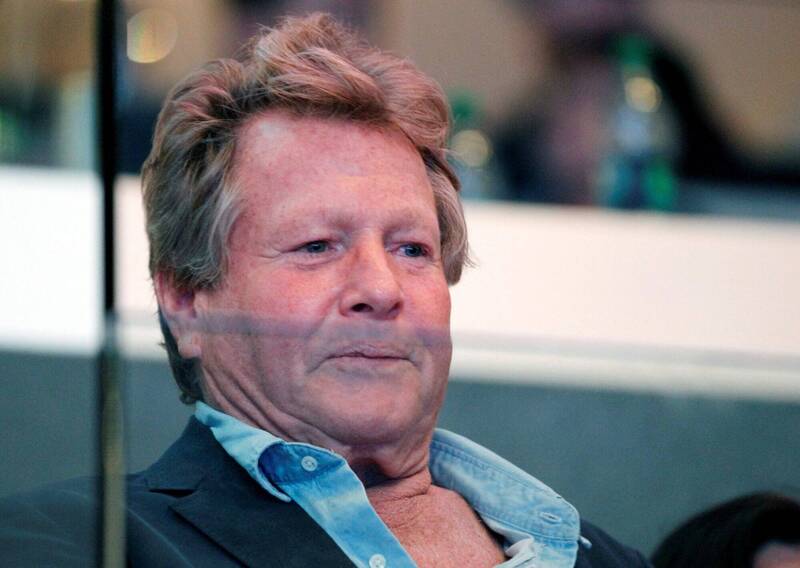
Ryan O'Neal[a] (April 20, 1941 – December 8, 2023) was an American actor. Born in Los Angeles, he trained as an amateur boxer before beginning a career in acting in 1960.
O'Neal was born in Los Angeles on April 20, 1941, the eldest son of actress Patricia Ruth Olga (née O'Callaghan; 1907–2003) and novelist and screenwriter Charles O'Neal.[a][13] His father was of Irish and English descent, while his mother was of paternal Irish and maternal Ashkenazi Jewish ancestry.[13][14] His brother, Kevin, was an actor and screenwriter.[3]
O'Neal attended University High School in Los Angeles, and trained there to become a Golden Gloves boxer. During the late 1950s, his father had a job writing on a television series called Citizen Soldier, and moved the family to Munich, where O'Neal attended Munich American High School.[15]
In 1964 he was cast as Rodney Harrington in the prime time serial drama Peyton Place. O'Neal said he got the role because "the studio was looking for a young Doug McClure".[21] The series was a big success, making national names of its cast including O'Neal. Several were offered movie roles, including Mia Farrow, Rosemary's Baby (1968), and Barbara Parkins, Valley of the Dolls (1967), and O'Neal was keen to do films.[22] During the series' run O'Neal appeared in a pilot for a proposed series, European Eye (1968).[23] He was also signed to ABC for a recording contract.[24] O'Neal's first lead in a feature came with The Big Bounce (1969),[25] based on an Elmore Leonard novel.[26] In 1969, he appeared in a TV version of Under the Yum Yum Tree (1963).[27]
1970–1980: Film stardom
In 1970, O'Neal played an Olympic athlete in The Games. The film had been co-written by Erich Segal, who recommended O'Neal for the lead in the romantic drama Love Story (1970), based on Segal's novel and script. A number of actors had turned down the role including Beau Bridges and Jon Voight before it was offered to O'Neal. His fee was $25,000; he said he had an offer that paid five times as much to appear in a Jerry Lewis film, but O'Neal knew that Love Story was the better prospect and selected that instead.[28]Paramount Pictures studio head, Robert Evans, who was married to the film's female lead, Ali MacGraw, said they tested 14 other actors but no one compared to O'Neal; he said the part was "a Cary Grant role – a handsome leading man with lots of emotion."[29] "I hope the young people like it", O'Neal said before the film came out. "I don't want to go back to TV. I don't want to go back to those NAB conventions."[28]Love Story turned out to be a box office phenomenon, making O'Neal a star and earning him nominations for the Academy Award for Best Actor and the Golden Globe Award for Best Actor – Motion Picture Drama, although O'Neal was bitter that he was never given a percentage of the profits, unlike co-star Ali MacGraw.[30][31]
O'Neal in Finland, 1970
In between the film's production and release, O'Neal appeared in a TV movie written by Eric Ambler, Love Hate Love (1971), which received good ratings. He also made a Western, Wild Rovers (1971) with William Holden for director Blake Edwards. Wild Rovers, badly cut by MGM, was considerably less popular than Love Story. O'Neal was going to make another film for MGM, Deadly Honeymoon (1974), from a novel by Lawrence Block.[32] However, O'Neal pulled out. Peter Bogdanovich later said MGM head Jim Aubrey was "cruel" to O'Neal.[33]
O'Neal spent over a year making Barry Lyndon (1975) for Kubrick. The resulting film was considered a commercial disappointment and had a mixed critical reception; it won O'Neal a Harvard Lampoon Award for the Worst Actor of 1975. Reflecting in 1985, O'Neal said the film was "all right but he [Kubrick] completely changed the picture during the year he spent editing it".[30] The film's reputation has risen in recent years but O'Neal said his career never recovered from the film's reception.[37]
O'Neal had been originally meant to star in Bogdanovich's flop musical At Long Last Love but was replaced by Burt Reynolds. However he made the screwball comedy Nickelodeon (1976) with Reynolds, Bogdanovich, and Tatum O'Neal, for a fee of $750,000. The film flopped at the box office. O'Neal followed this with a small role in the all-star war film A Bridge Too Far (1977), playing General James Gavin. O'Neal's performance as a hardened general was much criticised, although O'Neal was only a year older than Gavin at the time of the events in the film. "Can I help it if I photograph like I'm 16 and they gave me a helmet that was too big for my head?" he later said. "At least I did my own parachute jump."[38] The film performed poorly at the U.S. box office but did well in Europe.[citation needed]
O'Neal initially turned down a reported $3 million to star in Oliver's Story (1978), a sequel to Love Story.[31] Instead he appeared in the car-chase film The Driver (1978), directed by Walter Hill, who had written The Thief Who Came to Dinner. This was a box office disappointment in the U.S. but, like A Bridge Too Far, did better overseas. Hill later said he "was so pleased with Ryan in the movie and I was very disappointed that people didn't particularly give him any credit for what he did. To me, he's the best he's ever been. I cannot imagine another actor."[39] O'Neal was meant to follow this with The Champ (1979), directed by Franco Zeffirelli, but decided to pull out after Zeffirelli refused to cast O'Neal's son Griffin opposite him.[31] Instead he agreed to make Oliver's Story after all once the script was rewritten.[31] However the film was a flop at the box office.[40]
"What I have to do now, seriously, is win a few hearts as an actor", he said in 1978. "The way Cary Grant did. I know I've got a lot of winning to do. But I'm young enough. I'll get there..."[31] Around this time, O'Neal was meant to star in The Bodyguard, from a Lawrence Kasdan script, opposite Diana Ross for director John Boorman. However the film fell over when Ross pulled out, and it would not be made until 1992, with Kevin Costner in O'Neal's old role.[41] There was some talk he would appear in a film from Michelangelo Antonioni, Suffer or Die,[42] but this did not happen.
O'Neal instead played a boxer in a comedy, The Main Event, reuniting him with Streisand. He received a fee of $1 million plus a percentage of the profits. The Main Event was a sizeable hit at the box office. Also in 1979, he produced a documentary, The Contender, about a boxer he managed.[43]
A 1980 profile of O'Neal described him:
Unlike most stars of the post-Hoffman era he is very handsome, especially when moustached: he has blond curly hair and a toothpaste smile: he seems to lead an interesting life. What is on screen is, er, less interesting, but still agreeable. Maybe he would really come on if he had the apprenticeship of the stars of the 30s: for he is, to underline the point, a throwback to that era. There are no nervous tics, solemnity is at bag; his is an easy, genial presence, and thank heaven for it![44]
1981–1987: Career fluctuations
O'Neal was looking next to act in the lead role in the film version of The Thorn Birds to be directed by Arthur Hiller, but the book ended up being adapted as a miniseries.[45] Instead O'Neal made a British-financed thriller, Green Ice (1981), for the most money he had ever received up front.[30] The movie had a troublesome production (the original director quit during filming) and flopped at the box office. He had a cameo in Circle of Two, a film his daughter made with Richard Burton. O'Neal said Burton told him during filming he was "five years away from winning acceptance as a serious actor" ... [and that] .. "On the other hand, my agent, Sue Mengers says I'm right on the threshold. Split the difference, that's two and a half years. One good picture, that's all I need..."[46]
However, in the early 1980s he focused on comedies. He received $2 million for the lead in So Fine.[47] This was followed by Partners (1982), a farce written by Francis Veber in which O'Neal played a straight cop who goes undercover as one half of a gay couple. He then played a film director loosely based on Peter Bogdanovich in Irreconcilable Differences (1984); he received no upfront fee but got a percentage of the profits.[48] It was a minor box office success. A 1984 profile called him "the Billy Martin of Hollywood, whether it's his love affair with Farrah Fawcett... his precocious actor daughter Tatum or fisticuffs with his son Griffin. He just can't seem to stay out of the news." O'Neal said he felt more like Rocky Marciano, "wondering why guys are always picking fights with me. If I'm in a good picture, they'll like me. If I'm not they'll hate me. Hey I'm mad too when I don't make good pictures."[49]
O'Neal said too many of the roles he had played were "off the beaten path for me".[30] In particular he regretted doing The Thief Who Came to Dinner, A Bridge Too Far, The Driver, So Fine, Partners, and Green Ice. He blamed this in part on having to pay alimony and child support. He also said agent Sue Mengers encouraged him to constantly work.[30] "If I could get a good director to choose me for a picture, I was okay", he said. "But they stopped calling me in the mid-70s... I made a whole bunch of pictures that didn't make any money and people lost interest in me... Directors take me reluctantly. I feel I'm lucky to be here in the first place and they know it too. I'm a glamour boy, a Hollywood product. I have a TV background and they can point to the silly movies I've made."[30] In 1985, O'Neal tried something different, playing a L.A. Herald Examiner sportswriter and sports columnist who also gambles far too much in Fever Pitch (1985),[50] the final movie for director Richard Brooks.[51] Even less conventional was Tough Guys Don't Dance (1987) for director Norman Mailer.[25] Both movies flopped at the box office, and received poor reviews.[51][52]
He's sweet as sugar, and he's volatile. He's got some of that Irish stuff in him, and he can blow up a bit. One day he was doing a scene, and I said, "Bring it down a little bit," and Ryan said, "I quit! You can't say 'Bring it down' to me that loud!" I said, "If you quit, I'm going to break your nose." He started to cry. He's sort of a big baby at times, but he's a good guy, and he's very talented. He's had a strange career, but he was a monster star.[37]
O'Neal was a recurring character on Fox's Bones from seasons 2 to 12, with his final episode airing in February 2017.[53] In 2011, Ryan and Tatum attempted to restore their broken father/daughter relationship after 25 years. Their reunion and reconciliation process was captured in the Oprah Winfrey Network series Ryan and Tatum: The O'Neals, which O'Neal produced. It ran only nine episodes, and he later said that it left their relationship in a worse state than before.[4] O'Neal could be seen in Slumber Party Slaughter (2012) and Knight of Cups (2015) in a small role.[7][9]
In 2016, O'Neal reunited with Love Story co-star Ali MacGraw in a staging of A. R. Gurney's play Love Letters.[54] In February 2021, O'Neal and MacGraw were honored with stars on the Hollywood Walk of Fame, nearly 50 years after the release of Love Story.[55]
Personal life
Relationships
O'Neal married his first wife, actress Joanna Moore, in 1963. They had two children before separating in 1966. Moore eventually lost custody of their children to O'Neal as a result of her alcoholism and drug addiction.[37]
His second marriage was to actress and his Peyton Place co-star Leigh Taylor-Young, with whom he had a son. They remained friends after divorcing in 1973.[37][56] "I could speak to parts of Ryan like temper and volatility and reactivity, but I deeply know his goodness", Taylor-Young said.[37][56]
O'Neal was in a relationship with actress Farrah Fawcett from 1979 to 1997. The relationship was tumultuous due to his infidelity and volatile behavior. Fawcett ended the relationship after she discovered O'Neal in bed with actress Leslie Stefanson.[37] O'Neal and Fawcett reunited in 2001 and were together until her death in 2009.[37]
For several years, O'Neal was estranged from his three elder children. "I'm a hopeless father. I don't know why. I don't think I was supposed to be a father. Just look around at my work—they're either in jail or they should be", he told Vanity Fair.[37] In her autobiography, A Paper Life, Tatum wrote that she had suffered physical and emotional abuse as a result of her father's drug abuse.[37] Griffin O'Neal also suggested their family's problems stemmed from Ryan. "My father gave me cocaine when I was 11 and insisted I take it", he said.[37] Griffin added, "He was a very abusive, narcissisticpsychopath. He gets so mad he can't control anything he's doing."[37]
In 2007, O'Neal was arrested for shooting at Griffin, which he claimed was in self-defense; the charges were dropped.[61] O'Neal refused to allow Griffin to attend Fawcett's funeral in 2009.[62] He infamously hit on Tatum at Fawcett's funeral, not recognizing her as his daughter.[63][64]
In 2011, Tatum published a book with her father and appeared with him on the TV show Ryan and Tatum: the O'Neals. In August of that year, O'Neal, Tatum, and Patrick attended Redmond's court appearance on firearms and drug charges.[65]
Redmond has struggled with drug addiction for most of his adult life. In 2008, O'Neal and Redmond were arrested for drug possession in their Malibu home.[66] In 2015, Redmond's probation was revoked and he was sentenced to three years in the California Department of Corrections and Rehabilitation.[67] In 2018, Redmond was arrested and charged with attempted murder, robbery, assault and drug possession after he allegedly tried to rob a convenience store in Santa Monica. In an interview from jail he blamed his struggles on his parents.[67]
Health and death
In 2001, O'Neal was diagnosed with chronic myelogenous leukemia (CML).[68] After struggling with leukemia, O'Neal was frequently seen at Fawcett's side when she was battling cancer. He told People magazine, "It's a love story. I just don't know how to play this one. I won't know this world without her. Cancer is an insidious enemy."[69] In April 2012, O'Neal stated he had been diagnosed with stage 4 prostate cancer.[70] He later stated it was stage 2.[71]