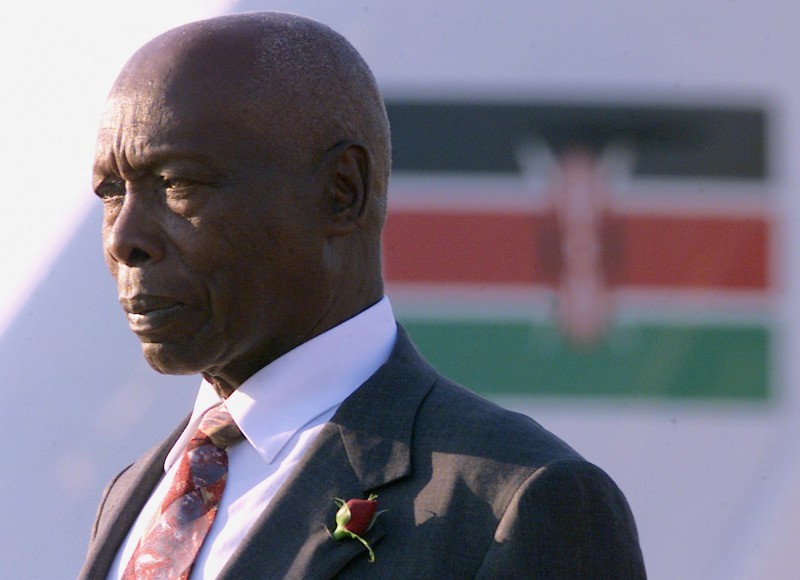
Daniel Toroitich arap Moi ( ronunciation_respelling_key" title="Help ronunciation respelling key" style="text-decoration-line: none; color: rgb(11, 0, 128); background: none;">MOH-ee; 2 September 1924 – 4 February 2020)[4] was a Kenyan politician who was the second and longest-serving President of Kenya from 1978 to 2002. He served as the third Vice President of Kenya from 1967 to 1978, and succeeded President Jomo Kenyatta following the latter's death. Initially popular both domestically and with Western countries, who saw his regime as countering against communist influences from Ethiopia and Tanzania, Moi's popularity fell around 1990 as the economy stagnated and the Cold War ended. Following popular agitation and external pressures, he was forced to allow multiparty elections in 1991; he then led his party, KANU, to victory in the disputed 1992 and 1997 elections.[5] Constitutionally barred from seeking a third term, Moi chose Uhuru Kenyatta as his successor, but Kenyatta was defeated by Mwai Kibaki in the 2002 election and Kibaki replaced Moi as president.
Born into the Tugen sub-group of the Kalenjin people in the Kenyan Rift Valley, Moi studied as a boy at the Africa Inland Mission school before training as a teacher, working in that profession until 1955. He then entered politics and was elected a member of the Legislative Council for Rift Valley. As independence approached, Moi joined the Kenyan delegation which travelled to London for the Lancaster House Conferences, where the country's first post-independence constitution was drafted. In 1960 he founded the Kenya African Democratic Union (KADU) as a rival party to Jomo Kenyatta's Kenya African National Union (KANU). Following independence in 1963 Kenyatta, who became Prime Minsiter and later President of the new nation, convinced Moi to merge the two parties. Kenyatta appointed Moi to his government in 1964 and then promoted him to Vice-President in 1967. Despite opposition from a Kikuyu elite known as the Kiambu Mafia, Kenyatta groomed Moi as his successor, and he took over as president when Kenyatta died in 1978.
Human rights organisations such as Amnesty International, as well as a special investigation by the United Nations, accused Moi of human rights abuses during his presidency. Inquiries held after the end of his presidency found evidence that Moi and his sons had engaged in corruption, including the 1990s Goldenberg scandal. Moi died at the age of 95 in February 2020.[6]
Early life and entry into politics[edit]
Moi was born Toroitich arap (son of) Moi in the Rift Valley village of Kuriengwo, which is now in the Sacho division of Baringo County,[7] Moi’s father, Kimoi arap Chebii, died in 1928. Moi was only four then and little is known about his mother, Kabon. What is known is that his elder brother, Tuitoek, became his guardian and that he was one of the herdsboys from Sacho location recommended to join the new Africa Inland Mission (AIM) School at Kabartonjo in 1934 before it was shifted to Kapsabet.[8] He was from the Tugen sub-group of the Kalenjin people.[9]
At the African Mission School at Kabartonjo, Moi became a Christian and adopted the name Daniel.[7] Moi attended Kapsabet Teacher Training College, after its relocation from Kabartonjo, from 1945 to 1947. He later attended Kagumo Teacher’s College.[8] and taught classes at Tambacha Teacher's Training College. Later he became the headmaster of a school in the Keiyo District. He worked as a teacher from 1946 until 1955.[8]
In 1955 Moi entered politics when he was elected Member of the Legislative Council for Rift Valley. He was the chosen replacement of Dr. John ole Tameno, the former representative who had had to quit due to heavy drinking and suspected connections to the freedom movement.[10] In 1957 Moi was re-elected Member of the Legislative Council for Rift Valley. Moi was part of the Kenyan delegation at the Lancaster House Conferences in London, which drafted the country's first post-independence constitution, and in 1961 became Minister of Education in the pre-independence government.[11]
In 1960 he founded the Kenya African Democratic Union (KADU) with Ronald Ngala to challenge the Kenya African National Union (KANU) led by Jomo Kenyatta. KADU pressed for a federal constitution, while KANU was in favour of centralism. The advantage lay with the numerically stronger KANU, and the first post-independence constitution emphasised national unity, with no provisions of a federal nature.[12]
Vice-Presidency[edit]
After Kenya gained independence on 12 December 1963, Kenyatta convinced Moi that KADU and KANU should be merged to complete the process of decolonisation. Accordingly, KADU dissolved and joined KANU in 1964. The only real challenge to KANU's dominance came from the Kenya People's Union, starting in 1966. That party was banned in 1969, and from that point onward Kenya was a de facto one-party state dominated by the Kĩkũyũ-Luo alliance. However, with an eye on the fertile lands of the Rift Valley populated by members of Moi's Kalenjin tribe, Kenyatta secured their support by first promoting Moi to Minister for Home Affairs in 1964, and then to Vice-President in 1967. As a member of a minority tribe Moi was also an acceptable compromise for the major tribes. Moi was elected to the Kenyan parliament in 1963 from Baringo North. From 1966 until his retirement in 2002 he served as the Baringo Central MP.[13]
However, Moi faced opposition from the Kikuyu elite known as the Kiambu Mafia, who would have preferred one of their own to be eligible for the presidency. This resulted in an attempt by the constitutional drafting group to change the constitution to prevent the vice-president automatically assuming power in the event of the president's death.[14] But many senior Kikuyu politicians, including Mwai Kibaki and Charles Njonjo, as well as Kenyatta himself, opposed such a change to the order of succession, fearing it might lead to dangerous political instability if Kenyatta died, given his advanced age and perennial illnesses. Thus Moi's position was safeguarded.[15]
Presidency[edit]

Presidential Standard of Daniel Toroitich arap Moi
When Jomo Kenyatta died on 22 August 1978, Moi became acting president. Per the Constitution, a special presidential election for the balance of Kenyatta's term was to be held on 8 November, 90 days later. That never happened as the Cabinet held a Special Cabinet meeting without Moi and decided that no one else was interested and went around the country campaigning for him to be declared elected unopposed. He was therefore sworn in as the second President of Kenya on 14 October 1978.[16][17]
In the beginning, Moi was popular, with widespread support all over the country. He toured the country and came into contact with the people everywhere, which was in great contrast to Kenyatta's imperial style of governing behind closed doors. However, political realities dictated that he would continue to be beholden to the Kenyatta system which he had inherited intact, including the nearly dictatorial powers vested in the presidency. Despite his popularity, Moi was still too weak to consolidate his power. From the beginning, anticommunism was an important theme of Moi's government; speaking on the new President's behalf, Vice-President Mwai Kibaki bluntly stated, "There is no room for communists in Kenya."[18]
On 1 August 1982, lower-level Air Force personnel, led by Senior Private Grade-I Hezekiah Ochuka and backed by university students, attempted a coup d'état to oust Moi. The putsch was quickly suppressed by military and police forces commanded by Chief of General Staff Mahamoud Mohamed.[19] There may have been two or even three independent groups attempting to seize power at the same time, for differing reasons, but the most serious was led by prominent Kikuyu politicians and members of the police and armed forces.[20]
Moi took the opportunity to dismiss political opponents and consolidate his power. He reduced the influence of Kenyatta's men in the cabinet through a long running judicial enquiry that resulted in the identification of key Kenyatta men as traitors. Moi pardoned them but not before establishing their traitor status in the public view. The main conspirators in the coup, including Ochuka were sentenced to death, marking the last judicial executions in Kenya.[21] He appointed supporters to key roles and changed the constitution to formally make KANU the only legally permitted party in the country. However, as mentioned above, Kenya had been a de facto one-party state since 1969. Kenya's academics and other intelligentsia did not accept this and the universities and colleges became the origin of movements that sought to introduce democratic reforms. However, Kenyan secret police infiltrated these groups and many members moved into exile. Marxism could no longer be taught at Kenyan universities. Underground movements, e.g. Mwakenya and Pambana, were born.[22]
Moi's regime now faced the end of the Cold War, and an economy stagnating under rising oil prices and falling prices for agricultural commodities. At the same time the West no longer dealt with Kenya as it had in the past, when it was viewed as a strategic regional outpost against communist influences from Ethiopia and Tanzania. At that time Kenya had received much foreign aid, and the country was accepted as well governed with Moi as a legitimate leader and firmly in charge. Western allies deliberately overlooked the increasing degree of political repression, including the use of torture at the infamous Nyayo House torture chambers. Some of the evidence of these torture cells was eventually to be exposed in 2003 after Mwai Kibaki became President.[23]
However, a new thinking emerged among Western policymakers after the end of the Cold War, and as Moi increasingly was viewed as a despot. Foreign aid was withheld pending compliance with economic and political reforms. One of the key conditions imposed on his regime, especially by the United States through fiery ambassador Smith Hempstone, was the restoration of a multi-party system. Despite his own lack of enthusiasm for the multiparty system, Moi managed to win over his party who were pro-single party. Moi announced his intention to repeal Section 2(A) of the constitution, allowing multipartyism, at a KANU conference in Kasarani in December 1991. Despite fierce debate and opposition from many delegates, the conference eventually passed the motion unanimously.[24]
Moi won elections in 1992 and 1997, which were marred by political violence on both sides. Moi skilfully exploited Kenya's mix of ethnic tensions in these contests, gaining a plurality in both elections through a mix of picking up votes across the country while his opponents' support was more concentrated, attracting votes a wide of smaller tribes as well as the Luhya, and taking advantage of fears of Kikuyu domination amongst the non-Kikuyu majority.[25] In the absence of an effective and organised opposition, Moi had no difficulty in winning. Although it is also suspected that electoral fraud may have occurred, the key to his victory in both elections was a divided opposition. In 1992 he polled 36.3% of the votes, and in 1997 he received 40.4% but both were comfortable victories because the other votes was split between the opposition, which failed to field a unity opposition candidate.[25]
Criticism and corruption allegations[edit]
In 1999 the findings of NGOs like Amnesty International and a special investigation by the United Nations were published which indicated that human rights abuses were prevalent in Kenya under the Moi regime.[26][27]
Reporting on corruption and human rights abuses by British reporter Mary Anne Fitzgerald from 1987–88 resulted in her being vilified by the government and finally deported.[28] Moi was implicated in the 1990s Goldenberg scandal and subsequent cover-ups, where the Kenyan government subsidised exports of gold far in excess of the foreign currency earnings of exporters. In this case, the gold was smuggled from Congo, as Kenya has negligible gold reserves. The Goldenberg scandal cost Kenya the equivalent of more than 10% of the country's annual GDP.[29]
Half-hearted inquiries that began at the request of foreign aid donors never amounted to anything substantial during Moi's presidency.[30][31] Although it appears that the peaceful transfer of power to Mwai Kibaki may have involved an understanding that Moi would not stand trial for offences committed during his presidency, foreign aid donors reiterated their requests, and Kibaki reopened the inquiry. As the inquiry has progressed, Moi, his two sons, Philip and Gideon (now a Senator), and his daughter, June, as well as a host of high-ranking Kenyans, have been implicated. In testimony delivered in late July 2003, Treasury Permanent Secretary Joseph Magari recounted that, in 1991, Moi ordered him to pay Ksh34.5 million ($460,000) to Goldenberg, contrary to the laws then in force.[32]
In October 2006, Moi was found by the International Centre for Settlement of Investment Disputes to have taken a bribe from a Pakistani businessman, to award a monopoly of duty-free shops at the country's international airports in Mombasa and Nairobi. The businessman, Ali Nasir, claimed to have paid Moi US$2 million in cash to obtain government approval for the World Duty Free Limited investment in Kenya.[33]
On 31 August 2007, WikiLeaks published a secret report that laid bare a web of shell companies, secret trusts and frontmen that his entourage had used to funnel hundreds of millions of pounds into nearly 30 countries.[34][35]
Retirement[edit]
Moi was constitutionally barred from running in the 2002 presidential elections. Some of his supporters floated the idea of amending the constitution to allow him to run for a third term, but Moi preferred to retire, choosing Uhuru Kenyatta, the son of Kenya's first President, as his successor.[36] However, Mwai Kibaki was elected President by a two to one majority over Kenyatta, which was confirmed on 29 December 2002. Kibaki was then wheelchair bound, having narrowly escaped death in a road traffic accident on the campaign trail. Moi handed over power in a poorly organised ceremony that had one of the largest crowds ever seen in Nairobi in attendance. The crowd was openly hostile to Moi.[37]
After leaving office in December 2002, Moi lived in retirement, largely shunned by the political establishment. However, he still retained some popularity with the masses, and his presence never failed to gather a crowd. He spoke out against a proposal for a new constitution in 2005; according to Moi, the document was contrary to the aspirations of the Kenyan people. After the proposal was defeated in a November 2005 constitutional referendum, President Kibaki called President Moi to arrange for a meeting to discuss the way forward.
On 25 July 2007, Kibaki appointed Moi as special peace envoy to Sudan, referring to Moi's "vast experience and knowledge of African affairs" and "his stature as an elder statesman". In his capacity as peace envoy, Moi's primary task was to help secure peace in southern Sudan, where an agreement, signed in early 2005, was being implemented. At the time, the Kenyan press speculated that Moi and Kibaki were planning an alliance ahead of the December 2007 election.[38] On 28 August 2007, Moi announced his support for Kibaki's re-election and said that he would campaign for Kibaki. He sharply criticised the two opposition Orange Democratic Movement factions, arguing that they were tribal in nature.[39][40]
Moi owned the Kiptagich Tea Factory, established in 1979, which has been involved in controversy. In 2009 the factory was under threat of being closed down by the government during the Mau Forest evictions.[41]
Personal life[edit]
Moi was married to Lena Moi (née Helena Bomett) from 1950 until their separation in 1974, before his presidency. Lena’s parents, the Paul Bomett family, were pioneer Christians in Eldama Ravine. They respected Moi, the young, tall, handsome and well-mannered orphan boy.[8]
It was at the Bometts that Moi sought shelter during school holidays, unable to return home, 160 kilometres away, like the older boys.[8] He would also stay at the home of the Christian family of Isaiah Chesire, the father of Kanu’s nominated MP Zipporah Kittony, and former Eldoret North MP Reuben Chesire.[8]
In 1950, after leaving Kagumo Teacher’s College, Moi, who had been dating Lena, married her in a church wedding officiated by Erik Barnett, the son of Albert Barnett (after whom Kabarnet Town is named) at the AIC mission in Eldama Ravine after he paid two heifers, one ox, and four sheep to the Bomett family. Moi’s long-time friend, Francis Cherogony, was the best man. With the marriage, Lena abandoned her career as a teacher and immersed herself into bringing up her family, settling down with Moi at Tambach Government School, where his first two children, Jennifer and Jonathan Kipkemboi, were born in 1952 and 1953 respectively.[8]
Daniel arap Moi had eight children, five sons and three daughters. Among the children are Gideon Moi (Senator Kanu gets new lease of life after poll victory, Baringo County), the late Jonathan Toroitich (a former rally driver, died 2019) and Philip Moi (a retired army officer).[42][43] His older and only brother William Tuitoek died in 1995.[44] He was a lifelong member of the Africa Inland Mission Church, following his enrollment at the church's school in 1934.[9]
Moi was the founder and patron of major schools in Kenya which include Moi Educational Centre, Kabarak High School and Sunshine Secondary Schools, and Sacho Primary and Secondary, among others.[45]
In August 2017, Moi was diagnosed with dementia.[46] In October 2019, he was hospitalized under critical condition at The Nairobi Hospital due to complications of pleural effusion.[47] He was discharged in November 2019, only to be hospitalized again days later for knee surgery.[48]
Moi died at The Nairobi Hospital on the early morning of 4 February 2020 at the age of 95 in the presence of family.[49][50]