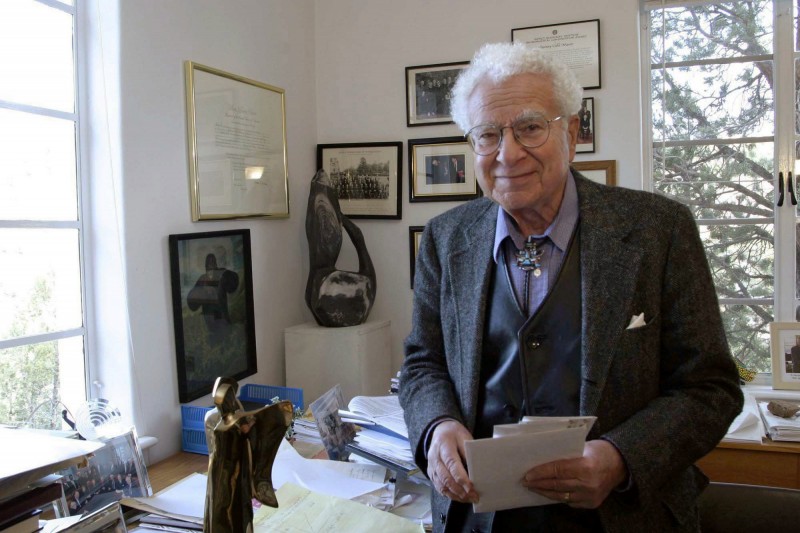
Murray Gell-Mann (; September 15, 1929 – May 24, 2019)[5] was an Americanphysicist who received the 1969 Nobel Prize in Physics for his work on the theory of elementary particles. He was the Robert Andrews Millikan  rofessor of Theoretical Physics Emeritus at theCalifornia Institute of Technology, a distinguished fellow and co-founder of the Santa Fe Institute, a professor of physics at the University of New Mexico, and the Presidential Professor of Physics and Medicine at the University of Southern California.[6]
Gell-Mann spent several periods at CERN, a nuclear research facility in Switzerland, among others as a John Simon Guggenheim Memorial Foundation fellow in 1972.[7][8]
Early life and education[edit]
Gell-Mann was born in lower Manhattan into a family of Jewish immigrants from the Austro-Hungarian Empire, specifically from Chernivtsi (historical name: Czernowitz) in present-dayUkraine.[9][10] His parents were Pauline (née Reichstein) and Arthur Isidore Gell-Mann, who taughtEnglish as a second language (ESL).[11]
Propelled by an intense boyhood curiosity and love for nature and mathematics, he graduatedvaledictorian from the Columbia Grammar & Preparatory School aged 14 and subsequently entered Yale College as a member of Jonathan Edwards College.[5][12] At Yale, he participated in the William Lowell Putnam Mathematical Competition and was on the team representing Yale University (along with Murray Gerstenhaber and Henry O. Pollak) that won the second prize in 1947.[13] Gell-Mann earned a bachelor's degree in physics from Yale in 1948 and a PhD in physics from Massachusetts Institute of Technology (MIT) in 1951.[14] His supervisor at MIT was Victor Weisskopf.[3][15]
He was a postdoctoral fellow at the Institute for Advanced Study in 1951,[5] and a visiting research professor at the University of Illinois at Urbana–Champaign from 1952 to 1953.[16] He was a visiting associate professor at Columbia University and an associate professor at the University of Chicago in 1954–1955 before moving to the California Institute of Technology, where he taught from 1955 until he retired in 1993.[17]
Nuclear physics[edit]
In 1958, Gell-Mann in collaboration with Richard Feynman, in parallel with the independent team ofE. C. George Sudarshan and Robert Marshak, discovered the chiral structures of the weak interaction of physics and developed the V-A theory (vector minus axial vector theory).[18] This work followed the experimental discovery of the violation of parity by Chien-Shiung Wu, as suggested by Chen-Ning Yang and Tsung-Dao Lee, theoretically.[19]
Gell-Mann's work in the 1950s involved recently discovered cosmic ray particles that came to be called kaons and hyperons. Classifying these particles led him to propose that a quantum numbercalled strangeness would be conserved by the strong and the electromagnetic interactions, but not by the weak interactions.[20] (Kazuhiko Nishijima arrived at this idea independently, calling the quantity  -charge after the eta meson.[21][22]) Another of Gell-Mann's ideas is the Gell-Mann–Okubo formula, which was, initially, a formula based on empirical results, but was later explained by his quark model.[citation needed] Gell-Mann and Abraham Pais were involved in explaining the puzzling aspect of the neutral kaon mixing.[23]
Murray Gell-Mann’s fortunate encounter with mathematician Richard Earl Block at Caltech, in the fall of 1960, ‘enlightened’ him to introduce a novel classification scheme, in 1961, for hadrons, elementary particles that participate in the strong interaction.[24] [25] Similar scheme had been independently proposed by Yuval Ne'eman; now explained by the quark model.[26] Gell-Mann referred to the scheme as the eightfold way, because of the octets of particles in the classification (the term is a reference to the Eightfold Path of Buddhism).[5][14]
Gell-Mann, along with Maurice Lévy, developed the sigma model of pions, which describes low-energy pion interactions.[27]
In 1964, Gell-Mann and, independently, George Zweig went on to postulate the existence of quarks, particles of which the hadrons of this scheme are composed. The name was coined by Gell-Mann and is a reference to the novel Finnegans Wake, by James Joyce ("Three quarks for Muster Mark!" book 2, episode 4). Zweig had referred to the particles as "aces",[28] but Gell-Mann's name caught on. Quarks, antiquarks, and gluons were soon established as the underlying elementary objects in the study of the structure of hadrons. He was awarded a Nobel Prize in Physics in 1969 for his contributions and discoveries concerning the classification of elementary particles and their interactions.[29]
In the 1960s, he introduced current algebra as a method of systematically exploiting symmetries to extract predictions from quark models, in the absence of reliable dynamical theory. This method led to model-independent sum rules confirmed by experiment and provided starting points underpinning the development of the Standard Model (SM), the widely accepted theory of elementary particles.[30][31]
In 1972 he and Harald Fritzsch introduced the conserved quantum number "color charge", and later, together with Heinrich Leutwyler, they coined the term quantum chromodynamics (QCD) as the gauge theory of the strong interaction.[32] The quark model is a part of QCD, and it has been robust enough to accommodate in a natural fashion the discovery of new "flavors" of quarks, which superseded the eightfold way scheme.[citation needed]
Gell-Mann was responsible, together with Pierre Ramond and Richard Slansky,[33] and independently of Peter Minkowski, Rabindra Mohapatra, Goran Senjanović, Sheldon Lee Glashow, and Tsutomu Yanagida, for the seesaw theory of neutrino masses, that produces masses at the large scale in any theory with a right-handed neutrino. He is also known to have played a role in keeping string theory alive through the 1970s and early 1980s, supporting that line of research at a time when it was a topic of niche interest.[34][35]
Complexity science and popular writing[edit]
At the time of his death, he was the Robert Andrews Millikan Professor of Theoretical Physics Emeritus at California Institute of Technology as well as a University Professor in the Physics and Astronomy Department of the University of New Mexico in Albuquerque, New Mexico, and the Presidential Professor of Physics and Medicine at the University of Southern California.[36] He was a member of the editorial board of theEncyclopædia Britannica. In 1984 Gell-Mann co-founded the Santa Fe Institute—a non-profit theoretical research institute in Santa Fe, New Mexico—to study complex systems and disseminate the notion of a separate interdisciplinary study of complexity theory.[37][38]

Murray Gell-Mann in Nice, 2012
He wrote a popular science book about physics and complexity science, The Quark and the Jaguar: Adventures in the Simple and the Complex (1994).[39] The title of the book is taken from a line of a poem byArthur Sze: "The world of the quark has everything to do with a jaguar circling in the night".[40]
The author George Johnson has written a biography of Gell-Mann, Strange Beauty: Murray Gell-Mann, and the Revolution in 20th-Century Physics (1999), which was shortlisted for the Royal Society Book Prize.[41]Gell-Mann himself criticized Strange Beauty for some inaccuracies, with one interviewer reporting him wincing at the mention of it.[42] hysicist and Nobel laureate Philip Anderson, in his chapter on Gell-Mann from a 2011 book,[43] said that Johnson's biography is a "must-read". Sheldon Lee Glashow, another Nobel laureate, also gave Strange Beauty a generally positive review while noting some inaccuracies,[44] and physicist and science historian Silvan S. Schweber noted that Johnson did not go into depth about Gell-Mann's work with military-industrial organizations like theInstitute for Defense Analyses.[45] Johnson said that Gell-Mann was a perfectionist and that The Quark and the Jaguar was consequently submitted late and incomplete.[43][46]
In 2012 he and his companion Mary McFadden published the book Mary McFadden: A Lifetime of Design, Collecting, and Adventure.[47]
Quantum foundations[edit]
Gell-Mann was a proponent of the consistent histories approach to understanding quantum mechanics, which he advocated in papers withJames Hartle.[35][48]
Personal life[edit]
Gell-Mann married J. Margaret Dow (d. 1981) in 1955; they had a daughter and a son. Margaret died in 1981, and in 1992 he married Marcia Southwick, with whom he had a stepson.[5]
Gell-Mann's interests outside of physics included archaeology, birdwatching and linguistics.[49][50] Along with S. A. Starostin, he established theEvolution of Human Languages project[51] at the Santa Fe Institute. As a humanist and an agnostic, Gell-Mann was a Humanist Laureate in theInternational Academy of Humanism.[52][53] Together with author Michael Crichton, he was responsible for defining the theoretical psychological phenomenon called the Gell-Mann amnesia effect.[54] He endorsed Barack Obama for the United States presidency in October 2008.[55]
Gell-Mann died on May 24, 2019, at his home in Santa Fe, New Mexico.[5][56]
Awards and honors[edit]
Gell-Mann won numerous awards and honours including the following:
Universities that gave Gell-Mann honorary doctorates include Cambridge, Columbia, the University of Chicago, Oxford and Yale.[49]





![[icon]](https://zh.wikipedia.org/wiki/File:Wiki_letter_w_cropped.svg)


.jpg)