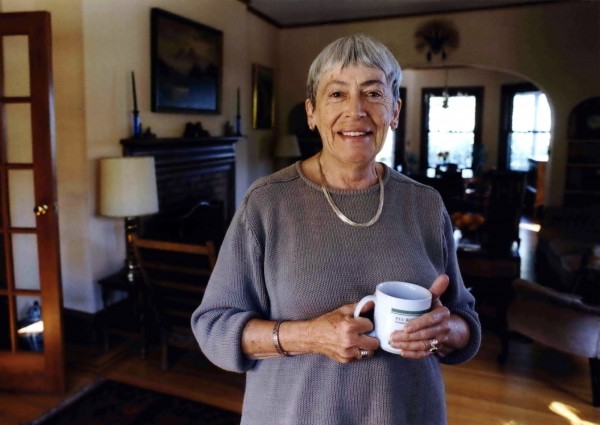
Ursula Kroeber Le Guin(US: ;[1] née Kroeber; October 21, 1929 – January 22, 2018) was an American novelist. Working mainly in the genres offantasy and science fiction, she also authored children's books, short stories, poetry, and essays. Her writing was first published in the 1960s and often depicted futuristic or imaginary alternative worlds in politics, the natural environment, gender, religion, sexuality, and ethnography. In 2016, The New York Times described her as "America's greatest living science fiction writer",[2] although she said that she would prefer to be known as an "American novelist".[3]
She influenced Booker Prize winners and other writers, such as Salman Rushdie and David Mitchell, and notable science fiction and fantasy writers including Neil Gaiman and Iain Banks.[4]She won the Hugo Award, Nebula Award, Locus Award, and World Fantasy Award, each more than once.[4][5] In 2014, she was awarded the National Book Foundation Medal for Distinguished Contribution to American Letters.[6] In 2003, she was made a Grandmaster of Science Fiction, one of a few women writers to take the top honor in the genre.[7]
Birth and family[edit]
Ursula Kroeber was the daughter of anthropologist Alfred Louis Kroeber of the University of California, Berkeley, and writer Theodora Kracaw.[8]
Childhood and education[edit]
Ursula and her three older brothers, Clifton, Theodore, and Karl Kroeber,[9] were encouraged to read and were exposed to their parents' dynamic friend group, which included Native Americans and Robert Oppenheimer, who was later to become in part a model for her hero in The Dispossessed.[8]:2 Le Guin stated that, in retrospect, she was grateful for the ease and happiness of her upbringing.[8] The encouraging environment fostered Le Guin's interest in literature; her first fantasy story was written at age 9, her first science fiction story submitted for publication in the magazine Astounding Science Fiction at age 11.[8] The family spent the academic year in Berkeley, retreating in the summers to "Kishamish" in Napa Valley, "an old, tumble-down ranch ... [and] a gathering place for scientists, writers, students, and California Indians. Even though I didn't pay much attention, I heard a lot of interesting, grown-up conversation."[10] She was interested in biology and poetry, but found math difficult.[11]
Le Guin attended Berkeley High School. She received her B.A. (Phi Beta Kappa) in Renaissance French and Italian literature from Radcliffe College in 1951, and M.A. in French and Italian literature from Columbia University in 1952. Soon after, Le Guin began her Ph.D. work and won a Fulbright grant to continue her studies in France from 1953 to 1954.[8]
Marriage and family[edit]
In 1953, while traveling to France aboard the Queen Mary, Le Guin met her future husband, historian Charles Le Guin.[12] They married later that year in Paris. After marrying, Le Guin chose not to continue her doctoral studies of the poet Jean Lemaire de Belges.[11]
The couple returned to the United States so that he could pursue his Ph.D. at Emory University.[13] During this time, she worked as a secretary and taught French at the university level. Their first child, Elisabeth (1957), was born in Moscow, Idaho, where Charles taught. In 1958 the Le Guins moved to Portland, Oregon,[14] where their daughter Caroline (1959) was born, and where they lived thereafter.[15] Charles is Emeritus Professor of History at Portland State University.[16] During this time, she continued to make time for writing in addition to maintaining her family life. In 1964, her third child, Theodore, was born.[8]
Le Guin died on January 22, 2018, at her home in Portland, Oregon; her son stated that she had been in poor health for several months. Her New York Times obituary called her "the immensely popular author who brought literary depth and a tough-minded feminist sensibility to science fiction and fantasy with books like The Left Hand of Darkness and the Earthsea series".[17]
Writing career[edit]
Le Guin became interested in literature quite early. At age 11, she submitted her first story to the magazine Astounding Science Fiction. It was rejected.[18] She continued writing but did not attempt to publish for ten years.[citation needed]
From 1951 to 1961 she wrote five novels, which publishers rejected, because they seemed inaccessible.[11] She also wrote poetry during this time, including Wild Angels (1975).[11]
Her earliest writings, some of which she adapted in Orsinian Tales and Malafrena, were non-fantastic stories set in the imaginary country of Orsinia. Searching for a way to express her interests, she returned to her early interest in science fiction; in the early 1960s her work began to be published regularly. One Orsinian Tale was published in the Summer 1961 issue of The Western Humanities Review and three of her stories appeared in 1962 and 1963 numbers ofFantastic Stories of Imagination, a monthly edited by Cele Goldsmith. Goldsmith also editedAmazing Stories, which ran two of Le Guin's stories in 1964, including the first "Hainish" story.[5][19]
In 1964 the short story "The Word of Unbinding" was published. This was the first of theEarthsea fantasy series, which includes six books and eight short stories. The three linkedyoung adult novels beginning with A Wizard of Earthsea (1968), The Tombs of Atuan (1970), and The Farthest Shore (1972), sometimes referred to as The Earthsea Trilogy, in later years would be joined by the books Tehanu, Tales from Earthsea and The Other Wind.
Le Guin received wide recognition for her novel The Left Hand of Darkness, which won theHugo and Nebula awards in 1970. Her subsequent novel The Dispossessed made her the first person to win both the Hugo and Nebula Awards for Best Novel twice for the same two books.[20]
In later years, Le Guin worked in film and audio. She contributed to The Lathe of Heaven, a 1979 PBS film based on her novel of the same name. In 1985 she collaborated with avant-garde composer David Bedfordon the libretto of Rigel 9, a space opera. In May 1983 she delivered a well-received commencement address entitled "A Left-Handed Commencement Address" atMills College, Oakland, California. "A Left-Handed Commencement Address" is included in her nonfiction collection Dancing at the Edge of the World.[21]
In 1984, Le Guin was part of a group along with Ken Kesey, Brian Booth, and William Stafford that founded the Oregon Institute of Literary Arts, which is now known as Literary Arts in Portland.[22]
In December 2009, Le Guin resigned from the Authors Guild in protest over its endorsement ofGoogle Books, Google's book digitization project. "You decided to deal with the devil", she wrote in her resignation letter. "There are principles involved, above all the whole concept of copyright; and these you have seen fit to abandon to a corporation, on their terms, without a struggle."[23][24] (See Authors Guild, Inc. v. Google, Inc..)
Influences[edit]
Le Guin was influenced by fantasy writers, including J. R. R. Tolkien, by science fiction writers, including Philip K. Dick (who was in her high school class, though they did not know each other),[25][26][27] by central figures of Western literature such as Leo Tolstoy, Virgil and theBrontë sisters, by feminist writers such as Virginia Woolf, by children's literature such as Alice in Wonderland, The Wind in the Willows, The Jungle Book, by Norse mythology, and by books from the Eastern tradition such as the Tao Te Ching.[4][28][29][30][31]
When asked about her influences, she replied:
Once I learned to read, I read everything. I read all the famous fantasies – Alice in Wonderland, and Wind in the Willows, and Kipling. I adored Kipling's Jungle Book. And then when I got older I found Lord Dunsany. He opened up a whole new world – the world of pure fantasy. And ... Worm Ouroboros. Again, pure fantasy. Very, very fattening. And then my brother and I blundered into science fiction when I was 11 or 12. Early Asimov, things like that. But that didn't have too much effect on me. It wasn't until I came back to science fiction and discovered Sturgeon – but particularly Cordwainer Smith. ... I read the story "Alpha Ralpha Boulevard", and it just made me go, "Wow! This stuff is so beautiful, and so strange, and I want to do something like that."[32]
In the mid-1950s, she read J. R. R. Tolkien's The Lord of the Rings, which had an enormous impact on her. But rather than making her want to follow in Tolkien's footsteps, it simply showed her what was possible with the fantasy genre.[33]
Le Guin exploits the creative flexibility of the science fiction and fantasy genres to undertake thorough explorations of dimensions of both social and psychological identity and of broader cultural and social structures. In doing so, she draws on sociology, anthropology, andpsychology, leading some critics to categorize her work as soft science fiction.[34] She objected to this classification of her writing, arguing the term is divisive and implies a narrow view of what constitutes valid science fiction.[18] Underlying ideas of anarchism and environmentalism also make repeated appearances throughout Le Guin's work.[citation needed]
In 2014 Le Guin said about the appeal of contemplating possible futures in science fiction:
anything at all can be said to happen [in the future] without fear of contradiction from a native. The future is a safe, sterile laboratory for trying out ideas in, a means of thinking about reality, a method.[35]
Sociology, anthropology and psychology[edit]
Being so thoroughly informed by social science perspectives on identity and society, Le Guin treats race and gender quite deliberately. The majority of her main characters are people of color, a choice made to reflect the non-white majority of humans, and one to which she attributes the frequent lack of character illustrations on her book covers.[36] Her writing often makes use of alien (i.e., human but non-Terran) cultures to examine structural characteristics of human culture and society and their impact on the individual.
This prominent theme of cultural interaction is most likely rooted in the fact that Le Guin grew up in a household of anthropologists where she was surrounded by the remarkable case of Ishi – a Native American acclaimed in his time as the "last wild Indian" – and his interaction with the white man's world. Le Guin's father was director of the University of California Museum of Anthropology, where Ishi was studied and worked as a research assistant. Her mother wrote the bestseller Ishi in Two Worlds. Similar elements are echoed through many of Le Guin's stories – from Planet of Exile and City of Illusions to The Word for World Is Forest and The Dispossessed.[36]
Le Guin's writing notably employs the ordinary actions and transactions of everyday life, clarifying how these daily activities embed individuals in a context of relation to the physical world and to one another. For example, the engagement of the main characters with the everyday business of looking after animals, tending gardens and doing domestic chores is central to the novel Tehanu. Themes of Jungian psychology also are prominent in her writing.[37]
Take for example Le Guin's Hainish Cycle, a series of novels encompassing a loose collection of societies, of various related human species, that exist largely in isolation from one another, providing the setting for her explorations of intercultural encounter. The Left Hand of Darkness,The Dispossessed and The Telling all consider the consequences of contact between different worlds and cultures. Unlike those in much mainstream science fiction, Hainish Cycle civilization does not possess reliable human faster-than-light travel, but does have technology for instantaneous communication. The social and cultural impact of the arrival of Ekumen envoys (known as "mobiles") on remote planets, and the culture shock that the envoys experience, constitute major themes of The Left Hand of Darkness. Le Guin's concept has been borrowed explicitly by several other well-known authors, to the extent of using the name of the communication device (the "ansible").[38] The Left Hand of Darkness is particularly noted for the way she explores social, cultural, and personal consequences of sexual identity through a novel involving a human's encounter with an intermittently androgynous race.[39]
Environmentalism[edit]
Elizabeth McDowell states in her 1992 master's thesis that Le Guin "identif[ies] the present dominant socio-political American system as problematic and destructive to the health and life of the natural world, humanity, and their interrelations".[40] This idea recurs in several of Le Guin's works, most notably The Left Hand of Darkness (1969), The Word for World Is Forest (1972),The Dispossessed (1974), The Eye of the Heron (1978), Always Coming Home (1985), and "Buffalo Gals, Won't You Come Out Tonight" (1987). All of these works center around ideas regarding socio-political organization and value-system experiments in both utopias anddystopias.[41] As McDowell explains, "Although many of Le Guin's works are exercises in the fantastic imagination, they are equally exercises of the political imagination."[41]
In addition to her fiction, Le Guin's book Out Here: Poems and Images from Steens MountainCountry, a collaboration with artist Roger Dorband, is a clear environmental testament to the natural beauty of that area of Eastern Oregon.[citation needed]
Anarchism and Taoism[edit]
Le Guin's feelings towards anarchism were closely tied to her Taoist beliefs and both ideas appear in her work. "Taoism and Anarchism fit together in some very interesting ways and I've been a Taoist ever since I learned what it was."[42] She participated in numerous peace marches and although she did not call herself an anarchist, since she did not live the lifestyle, she did feel that "Democracy is good but it isn't the only way to achieve justice and a fair share."[43] Le Guin said: "The Dispossessed is an Anarchist utopian novel. Its ideas come from the Pacifist Anarchist tradition – Kropotkin etc. So did some of the ideas of the so-called counterculture of the sixties and seventies."[44] She also said that anarchism "is a necessary ideal at the very least. It is an ideal without which we couldn't go on. If you are asking me is anarchism at this point a practical movement, well, then you get in the question of where you try to do it and who's living on your boundary?"[45]
Le Guin has been credited with helping to popularize anarchism as her work "rescues anarchism from the cultural ghetto to which it has been consigned [and] introduces the anarchist vision...into the mainstream of intellectual discourse". Indeed her works were influential in developing a new anarchist way of thinking; a postmodern way that is more adaptable and looks at/addresses a broader range of concerns.[46]
Adaptations of her work[edit]
Few of Le Guin's major works have been adapted for film or television. Her 1971 novel The Lathe of Heaven has been adapted twice: The first adaptation was made in 1979 by WNET Channel 13 in New York, with her own participation, and the second adaptation was made in 2002 by the A&E Network. In a 2008 interview, she said she considers the 1979 adaptation as "the only good adaptation to film" of her work to date.[18]
In the early 1980s animator and director Hayao Miyazaki asked permission to create an animated adaptation of Earthsea. However, Le Guin, who was unfamiliar with his work and anime in general, turned down the offer. Years later, after seeing My Neighbor Totoro, she reconsidered her refusal, believing that if anyone should be allowed to direct an Earthsea film, it should be Hayao Miyazaki.[47] The third and fourth Earthsea books were used as the basis of the 2006 animated film Tales from Earthsea (ゲド戦記 Gedo Senki). The film, however, was directed by Miyazaki's son, Gorō, rather than Hayao Miyazaki himself, which disappointed Le Guin. While she was positive about the aesthetic of the film, writing that "much of it was beautiful",[47] she took great issue with its re-imagining of the moral sense of the books and greater focus on physical violence. "[E]vil has been comfortably externalized in a villain", Le Guin writes, "the wizard Kumo/Cob, who can simply be killed, thus solving all problems. In modern fantasy (literary or governmental), killing people is the usual solution to the so-called war between good and evil. My books are not conceived in terms of such a war, and offer no simple answers to simplistic questions."[47]
In 1987, the CBC Radio anthology program Vanishing Point adapted The Dispossessed into a series of six 30-minute episodes,[48] and at an unspecified date The Word for World Is Forest as a series of three 30-minute episodes.[49]
In 1995, Chicago's Lifeline Theatre presented its adaptation of The Left Hand of Darkness. Reviewer Jack Helbig at the Chicago Reader wrote that the "adaptation is intelligent and well crafted but ultimately unsatisfying", in large measure because it is extremely difficult to compress a complex 300-page novel into a two-hour stage presentation.[50]
In 2004 the Sci Fi Channel adapted the first two books of the Earthsea trilogy as the miniseriesLegend of Earthsea. Le Guin was highly critical of the adaptation, calling it a "far cry from the Earthsea I envisioned", objecting both to the use of white actors for her red, brown, or black-skinned characters, and to the way she was "cut out of the process".[51]
Her novella, Paradises Lost, published in The Birthday of the World: and Other Stories, was adapted into an opera by the American composer Stephen Andrew Taylor and Canadian librettist Marcia Johnson. The opera premiered April 26, 2012 at the Krannert Center for the Performing Arts on the campus of the University of Illinois.[52]
In 2013, the Portland Playhouse and Hand2Mouth Theatre produced a stage adaptation of The Left Hand of Darkness, directed and adapted by Jonathan Walters, with text adapted by John Schmor. The play opened May 2, 2013, and ran until June 16, 2013, in Portland, Oregon.[53]
In early 2017 Le Guin's award winning novel The Left Hand of Darkness was picked up by Critical Content, a production company formerly known as Relativity Television, to be produced as a television limited series. Le Guin was to serve as a consulting producer on the project.[54]
Lifetime and career awards[edit]
In April 2000 the U.S. Library of Congress made Le Guin a Living Legend in the "Writers and Artists" category for her significant contributions to America's cultural heritage.[55] In 2002 she won a PEN/Malamud Award for "excellence in a body of short fiction".[56] In 2004 she received two American Library Association honors for her lasting contributions: for young adult literature, the annual Margaret Edwards Award; for children's literature, selection to deliver the annual May Hill Arbuthnot Lecture.[57][58] The annual Edwards Award recognizes one writer and a particular body of work; the 2004 panel cited six works published from 1968 to 1990: A Wizard of Earthsea, The Tombs of Atuan, The Farthest Shore, and Tehanu (the first four Earthsea books),The Left Hand of Darkness and The Beginning Place. The panel said that Le Guin "has inspired four generations of young adults to read beautifully constructed language, visit fantasy worlds that inform them about their own lives, and think about their ideas that are neither easy nor inconsequential".[57]
At its 2009 convention, the Freedom From Religion Foundation awarded the Emperor Has No Clothes Award to Le Guin.[59] The FFRF describes the award as "celebrating 'plain speaking' on the shortcomings of religion by public figures".[60][a]
In 2014, Le Guin was awarded the Medal for Distinguished Contribution to American Letters by the National Book Foundation, a lifetime achievement award.[63][64] Her acceptance speech, which criticized Amazon as a "profiteer" and praised her fellow authors of fantasy and science fiction, was widely considered the highlight of the ceremony.[65]
Recognizing her stature in the speculative fiction genre, Le Guin was the Professional Guest of Honor at the 1975 World Science Fiction Convention in Melbourne, Australia. That year she was also named the sixth Gandalf Award Grand Master of fantasy.[5] The Science Fiction Research Association (SFRA) gave her its Pilgrim Award in 1989 for her "lifetime contributions to SF and fantasy scholarship".[5] At the 1995 World Fantasy Convention she won the World Fantasy Award for Life Achievement, a judged recognition of outstanding service to the fantasy field.[5][66]The Science Fiction and Fantasy Hall of Fame inducted her in 2001, its sixth class of two deceased and two living writers.[67] The Science Fiction and Fantasy Writers of America made her its 20th Grand Master in 2003.[68] In 2010, Le Guin was awarded the Lyman Tower SargentDistinguished Scholar Award by the North American Society for Utopian Studies.[69]
Her speech "A Left-Handed Commencement Address", given in 1983 at Mills College, is listed as No. 82 in American Rhetoric's Top 100 Speeches of the 20th Century (listed by rank).[21][70]
Awards for specific titles[edit]
Le Guin won dozens of annual "year's best" literary awards. For novels alone she won fiveLocus, four Nebula, two Hugo, and one World Fantasy Award. (The Dispossessed won the Locus, Nebula, and Hugo.) She also won those four awards in short fiction categories, although she turned down a Nebula award for her novelette The Diary of the Rose in protest at the Science Fiction Writers of America's treatment of Stanisław Lem.[5][71] Her nineteen Locus Awards, voted by magazine subscribers, are more than any other writer has received.[72] Her third Earthsea novel, The Farthest Shore, won the 1973 National Book Award for Young People's Literature,[73] and she was a finalist for ten Mythopoeic Awards, nine in Fantasy and one for Scholarship.[74] Unlocking the Air and Other Stories was one of three finalists for the 1997 Pulitzer Prize for Fiction.[75] She won the 2017 Hugo Award for Best Related Work for a collection of essays entitled Words Are My Matter: Writings About Life and Books, 2000–2016.[76]
Selected works[edit]
Ursula K. Le Guin has written fiction and nonfiction works for audiences including children, adults, and scholars. Her most notable works are listed here.
- Earthsea fantasy series[77]
- Hainish science fiction series[19]
- Miscellaneous
- The Lathe of Heaven, 1971 (Locus SF Award)[86]
- The Wind's Twelve Quarters, 1975
- Orsinian Tales, 1976
- The Eye of the Heron, 1978 (first published in the anthology Millennial Women)
- The Beginning Place, 1980 (also published as Threshold, 1986)
- The Compass Rose, 1982
- Always Coming Home, 1985
- Searoad: Chronicles of Klatsand, 1991
- Annals of the Western Shore, 2004–2007 (Powers, the third volume, won the Nebula Award for Best Novel)
- Lavinia, 2008 (Locus Fantasy Award)[87]
Documentary[edit]
Film-maker Arwen Curry began production on a documentary about Le Guin in 2009, filming "dozens" of hours of interviews with the author as well as many other writers and artists who have been inspired by her. Curry launched a successful crowdfunding campaign to finish the documentary in early 2016 after winning a grant from the National Endowment for the Humanities.[88][89]
See also[edit]
- Jump up^ In the northwestern U.S., the Pacific Northwest Booksellers Association gave Le Guin a Lifetime Achievement Award in 2001.[61] The Washington Center for the Book recognized her distinguished body of work with the Maxine Cushing Gray Fellowship for Writers on October 18, 2006.[62]
https://en.wikipedia.org/wiki/Ursula_K._Le_Guin